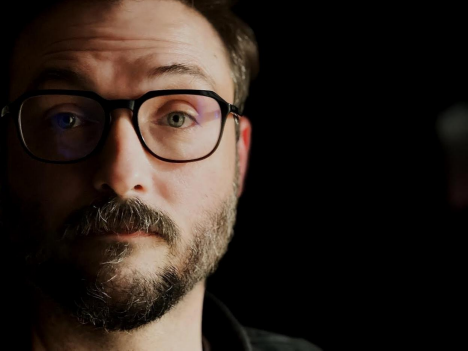
Interview with Patrick Joseph Caoile, Author of Tales from Manila Ave.

Cover of the book Tales from Manila Ave. The cover image shows a colorful line of people holding hands in a line, with some other abstract images.

Patrick Joseph Caoile spoke with Sundress intern Penny Wei about his latest short story collection Tales from Manila Ave., where they discussed the importance of food, play as a way to navigate migration and displacement, and living on Manila Ave. and places like it.

Penny Wei: What does it mean to belong to a place like Manila Ave, where generational history and familial warmth live alongside eviction and social class divides?

Patrick Joseph Caoile: There’s a line from one of the Nightmare on Elm Street movies that Freddy Krueger says, “Every town has an Elm Street!”, which seems to hold true. I even make a reference to this in one of my stories. In the case of Elm Street, the idea that a place is inescapable sounds like a prison. But that’s not all what a sense of place can be. For me, it’s comforting that you can find a Manila Ave. in places like Queens or Jersey City. When I lived in Lafayette, Louisiana, there was one there, too. Of course, not every Manila Ave. will have the equivalent of a strong Filipino community. Still, the name implicitly gestures towards the Philippines, and with it so many associations. With its global history as a gateway between the East and the West, the capital city of Manila is an avenue in and of itself. Manila is a metropolis of culture and commerce, but also of extreme class divide between squatters and shopping malls. In cities in the US, gentrification continues to displace those who can no longer afford to live in neighborhoods where their families have flourished for years prior. And yet, people continue to eat, dance, celebrate, mourn, and tell stories. This is how I envision Manila Ave.: a container of all these contradictions—a push and a pull, a home away from home.

PW: In several stories, food serves an important role. How do you see food operating as a bridge between cultures, identities, and memories?

PJC: I find importance not just in food, but in the making of it. When I think of Filipino food, I think of how laborious it is to make. In “Along Came a Stray” the siblings decide to roll lumpia for their Christmas dinner, just as they did when they were younger. They try to hold on to a tradition that they learned from their parents. Lumpia is a very tactile dish, a lot of chopping, mixing, wrapping. And after it’s fried and cooled, you pick one up with your fingers, dip it into some sweet chili sauce, and enjoy it. But it’s worth it. Not just the taste, but the experience. A recipe is a story, right? Beginning, middle, end. So, when I write food into a story, I find it intuitive to bring characters, backstory, and theme together. “Sinigang” definitely synthesizes those goals for me, too.

Even something as simple as coffee speaks to the wider implications of food. Coffee beans need to grow in a specific climate, be cultivated, be farmed, and be harvested. It takes a lot of labor to produce a cup of coffee. There’s also its history as a product of colonization. Alongside its dispersion is a story of displacement. On the other hand, as a beverage of leisure, you’ll find people connecting over coffee—business meetings, dates, catching up with friends, revolutions. Writers, like me, can’t write a single word without it. A lot of stories have been told over coffee. In “Kapé,” I sought to write towards these implications.

Also, I just like to eat and cook. Every writer needs sustenance. I’m a product of a childhood that was shaped by shows on PBS like Yan Can Cook and America’s Test Kitchen and Food Network, where people, food, and stories coexisted. Now, I love The Bear. I wanted to be a chef when I grew up. Maybe I still do.

PW: Catholicism, superstition, and faith run through these stories in different ways. What role does religion play in shaping the Filipino immigrant experience?

PJC: Just as food brings people together, so does religion. It’s all part of custom, like the house blessing in “A State of Grace,” the wedding in “Tong, Tong, Tong,” and the funeral in “A Balikbayan Affair.” These occasions bring together titos, titas, cousins, cousins of cousins, and anyone else who might have entered the celebrants’ lives in some way, big or small. Even the idea of being blessed by an elder, the mano po that is mentioned in “Tales from Manila Ave.,” is tied up in Catholicism. But as much as these customs celebrate grace, there are also aspects of Filipino faith that have a darker edge. Pagpag, for example, is the practice of making a tertiary stop between the site of a funeral and going back home; this way, any lingering or unsettled ghosts won’t follow. I don’t explicitly reference pagpag in “A Balikbayan Affair,” but that’s part of the reason why the family is at a truck stop saloon after the funeral. There are some stories in this collection in which I dip a toe into horror or the Gothic, and I’m definitely going to explore ways to lean into these in the future. In fact, the title Tales from Manila Ave. echoes the title of Nick Joaquin’s Tales of the Tropical Gothic, which is no accident.

PW: Some of your stories sit at the edge of childhood. How do you see childhood as a lens for reckoning with larger forces of war, dictatorship, and displacement?

PJC: I think a lot about a quote from James Baldwin, “The children are always ours, every single one of them, all over the globe; and I am beginning to suspect that whoever is incapable of recognizing this may be incapable of morality.” This has been on my mind for the past few years because of the war and genocide in Palestine, as well as the immigration raids here in the US. Whether it’s a family’s displacement from the land, or their displacement from each other, children are a witness through all of it, and so are we. Baldwin adds, “What we see in the children is what they have seen in us—or, more accurately perhaps, what they see in us.”

When I wrote these stories, I tried to center children as witnesses in some way: as communal narrators memorializing a storyteller, as sisters adjusting to an American suburb, as children trying to prevent their parents’ divorce. But even when stories take a more adult perspective, the children are always in sight, such as the widowed mother looking at her sons in the final scene of “A Balikbayan Affair,” or the first-generation Filipino American protagonists of the last two stories who are now ushering in the next generation. I think it’s important, as a worldview, to consider what it means to be a child living in an empire, where the political is always personal. Of course, Star Wars comes to mind, Avatar: The Last Airbender, too. But Scout Finch from To Kill A Mockingbird was certainly an influence in my writing, specifically as a child witnessing the changes around her, which are simultaneously political and personal.

I immigrated to the US when I was four years old. A lot of the logistics and paperwork happened behind closed doors where my parents carried the weight and anxiety of it all. I know that isn’t the same for every immigrant family. Some children need to translate for their parents, for example. But in these stories, I sought to fill in the gaps of the Filipino American immigrant story. I imagined the space between the world of children and the world of adults full of conflict, tension, and misunderstandings but also of love, hope, and connection. Children often don’t get a say in things. If they did, what would they tell us?

PW: Animals appear throughout the book. What does it mean for the nonhuman to accompany the immigrant story?

PJC: There are definitely a lot of cats in this book, prominently in “The House at the End of Maplewood Drive” and “Along Came a Stray.” In my family, we weren’t allowed to have pets growing up, except for the occasional fish or small turtle in a small tank. We had guinea pigs once, but didn’t bring them along when we moved from California to New Jersey. Only recently, just this past July, did I get my own cat, Clark Kafka “Cafecito” Kent. So, part of working cats into my stories is admittedly wish fulfillment. Usually, in that mythical notion of the American Dream, there’s a dog accompanying the mom, dad, son, and daughter. Dogs are “man’s best friend.” On the other hand, cats get a bad rep, tied up with witches and bad luck superstitions. But cats are so full of personality and also so full of care: the way a mama cat will pick up one kitten after the other to bring them to a safe place, the way she bathes them and gives them attention. The idea of bonded pairs and belonging to a litter—there’s a lot of familial connotations, like the struggle of staying together as a family. We can learn a lot from cats. Just ask T. S. Eliot and Andrew Lloyd Webber.

PW: In “Everything Must Stay” objects refuse to be discarded, even as they choke the living space. How do we measure the value of a life, or the significance/impact of a migration, with the things we keep?

PJC: The store in “Everything Must Stay” is a sari-sari, which means “miscellaneous” or “variety.” I think that meaning captures the immigrant experience in many ways. Immigrants carry a lot of baggage, literal and metaphorical. Sometimes space is limited, so what we choose to take with us must hold some kind of significance in comparison to other things. One example is the Santo Niño statue that Grace and her mother bring to their new apartment in “A State of Grace.” A toothbrush or laundry detergent—those simpler things can easily be found in a sari-sari store. At the same time, things can take on a new or second life. In the tradition of sending a balikbayan box to family in the Philippines, secondhand clothes or shelf-stable foods like canned Vienna sausages or chocolates become totems of our connection back to the motherland, back to the people we still hold dear despite the geographical distance. Objects are gifts, objects are resources. In “Everything Must Stay,” the sari-sari not only holds snacks and beauty products, but also holds the Filipino community together, and ultimately keeps the family at its center together.

PW: Childhood games—rice kites, Halloween nights, street songs—recur throughout the collection. What does it mean to return to play as a way of surviving displacement? How does childhood in general serve as a lens for exploring war?

PJC: I remember when I was just entering the first grade, when my family had just moved to New Jersey, I made friends with classmates by coming up with some really weird lore about our school. We gathered around someone’s desk, claiming that we had each seen a weird, glowing green light outside the school at night. As if we all went out of our homes, one by one, when everyone was asleep. We confirmed each other’s accounts, even drawing out a map of the school and labeling the tree where the green light was spotted. We probably could’ve passed a lie detector test; we were so convinced of ourselves. But of course, none of it was real (or was it?). I don’t know if anyone else from that class remembers, but that memory has stuck with me. As the new kid in the class, I felt welcomed by my classmates.

Play is unifying in that way—play as creative instead of competitive. Like I mentioned before, seeing the world through the eyes of children is ingrained in my approach to storytelling. Writing is play. We pretend as our characters and imagine what their lives must be like, and our task is to convince everyone else that they are true. The power of storytelling is that it centers on people, not statistics. It cuts through paperwork, bureaucracy, technicalities—that stuff of the adult world. Some might consider that escapism. At least for me, writing embraces the truth of our world. Or like how Kuya Jem does in “Tales from Manila Ave.,” it bends the truth towards magic.

PW: Several of the stories highlight women as laborers—nannies, nurses, domestic workers. Can you speak to the tension between Filipino women sustaining homes across two countries while rarely being recognized in either?

PJC: The Philippines has matriarchal roots. Despite the patriarchal structures introduced by colonization and imperialism, those roots still bloom. For example, there have been two women who’ve held office as president of the Philippines. Even through Catholicism, women seem to be the center of local religious life, leading community prayers and the rosary. They are also great storytellers in their own right; tsismis is indeed a craft. In this way, I think Filipino women might be most attuned to what it means to be Filipino. To sustain that across two countries is no easy task. It takes a lot of labor, in more ways than one. Many become Overseas Filipino Workers (OFWs) in the healthcare and hospitality industries, and others as domestic workers. Many are teachers, too, like my own mother, who is a special education teacher. In all these fields and professions, there’s a necessary and intuitive sense of care. Mia Alvar captures a lot of these sentiments in her stories from In the Country, and I am so very grateful for her kind words of support for my book. Like in her stories, I similarly sought to capture the tension between Filipino women’s professional and personal lives.

PW: How does Tales from Manila Ave. as a whole explore survival across borders and generations?

PJC: I don’t think I ever considered the theme of survival in my book. But surely it’s there. I recently came across the story “Target Island” by Mariah Rigg, and in an interview with The Common, she considers how “the short story is just like a really long obituary.” When talking about Rigg’s story with my fiction students, which is about a man’s long and harrowing life intertwined with the island of Kahoʻolawe, we noted how obituaries usually end with a list of living family members, the “survived by.” In some ways, I think it’s helpful to think of short stories as obituaries.

The dedication of Tales from Manila Ave. certainly presents this book as one: to my family and relatives “in this world and the next.” In 2023 I had lost my paternal grandmother, and in the following year, 2024, I lost my maternal grandmother. We grew up mostly away from them, but whenever my siblings and I visited them in the Philippines, they were always so happy and proud of us. The last time we had seen them in person was in 2019. Their passing was a bit of a realization that my connection to the motherland was fading. Grief is always built into the immigrant story in that way. The characters in my stories get to that realization, too. I can list all the ways my characters mourn and grieve, but I would practically be listing every one of them in my stories. They grieve their parents, spouses, and siblings. They grieve a life of what-could-have-been if they had never left the Philippines at all. They are the “survived by” who have to figure out how to live with what’s left of their loved ones: customs, traditions, faith, memories, secrets, recipes, and ultimately themselves.

Tales from Manila Ave. is available now from Sundress Publications!


Photo of Patrick Joseph Caoile, author of Tales from Manila Ave.

Patrick Joseph Caoile was born in the Philippines and grew up in northern New Jersey. His work is featured in storySouth, Porter House Review, Bright Flash Literary Review, the anthology Growing Up Filipino 3, and elsewhere. He has received support from Roots.Wounds.Words and Martha’s Vineyard Institute of Creative Writing. He holds a BA in English from Saint Peter’s University, MA in English from Seton Hall University, and PhD in English with a creative writing concentration from the University of Louisiana at Lafayette. He is a visiting assistant professor of literature and creative writing at Hamilton College.

Penny Wei is from Shanghai and Massachusetts. She has been recognized by the Longfellow House, Cafe Muse, and Just Poetry, amongst others. Her works are up or forthcoming on Eunoia Review, Inflectionist Review, Dialogist, Aloka, and elsewhere.

Sundress Editorial Intern Penny Wei

Interview with Donna Vorreyer, Author of Unrivered

The cover art for "Unrivered," featuring a drawn image of a faceless woman with white hair wearing a bodice of several colors and textures, including midnight blue, white, teal, and red. She appears to have feather-like objects coming from both hands.

Ahead of the 2025 release of her fourth poetry collection, Unrivered, Donna Vorreyer spoke with Sundress Publications editorial intern Lizzy DiGrande. Here, they discussed the beauty that grows from grief and resilience, the complexities of fertility in humans and nature, and how we learn to live inside bodies and lives that are always shifting.

Lizzy DiGrande: The title “Unrivered ” appears in various forms throughout the collection, such as in “Blood Line,” where you write, “I wanted there to be a rivering, a signal.” Can you talk about what “rivering” means and how you feel it encapsulates this poetry collection?

Donna Vorreyer: There is a reason civilizations were built around rivers. Fresh water for drinking, for cooking, for planting, for animals. Food sources. Transportation. So when a landscape is “unrivered,” through drought or sprawl or natural disaster, everything around it also becomes lost. I started to think about the idea of droughts in a lifetime, how we are drained of certain things that have defined us.

For me, it started with early menopause. My body literally stopped flowing, and the thing that I had been taught made me a woman was gone. And of course, I’m aging and all the fun physical things that come with it, so vitality and youth are ebbing. Then in 2018, I lost both of my parents, to whom I was very close. That loss led to a lot of questioning of the faith I had been raised in. Then lockdown came. Then I retired from teaching, the only job I had ever known as an adult for 36 years. With that retirement also came the loss of relationships I had thought were friendships, but were merely relationships of proximity and convenience.  So when I was reaching for a concept, a word that would encompass the feeling of losing the most grounding elements of identity, “unrivered” seemed correct.  In the poem you mentioned, “rivering” is a direct reference to menstruation/menopause, but the idea of being unrivered hopefully resonates in multiple ways as a reference to loss in general, to what is drained from you as you age. And so, how does one reroute the waters? Come up with new ways to see the self and the world? You “salvage a self, unrivered.” 

LD: Religious imagery is a strong, recurring theme in this collection, as evident in the mentions of transubstantiation, stigmata, apostasy, and even snakes. How has your own relationship with Christianity or Catholicism shaped the way these themes appear in your work?

DV: My relationship with faith changed while caring for and then losing my parents during lockdown, which happened shortly after. I struggled (and still do) with how to reconcile the faith I was raised in with the harsh realities of grief and isolation and global loss. I still find solace in and seek out places where I feel the pull of the spiritual—sometimes in expected places, like churches, and sometimes in unexpected ones, like viewing a bank of clouds or watching the movement of light on water. When the concept of self is wavering or uncertain, the desire to connect or reconnect with something larger than the self becomes very strong. A desire for connection with the divine, however one defines it, can be a grounding force.

LD: In “Coppering,” you highlight Dorothy Hood’s 1977 painting Copper Signal as the inspiration behind this ekphrastic poem. How did you build on this piece of visual art to bring a deeper meaning to it? How is the poem interacting with Copper Signal, and what are you hoping your poem adds to the conversation?

DV: I first saw this painting in San Antonio while attending AWP. The painting is mostly rust/red with a split or chasm of those colors that leads to a jagged brilliant blue that then fades into a deep midnight in the bottom left corner. One of the phrases I wrote in my notebook in the museum that day was “blood-rock/blue-vein,” and the poem builds from a description of the abstract landscape in the painting to a reference to the menopausal body, still “thick with life and howling.” Copper is often associated with blood—the color, smell, and taste—and it seemed like a natural progression as I drafted the poem. There is also a deep rift in the painting, something divisive that separates one side of the canvas from the other. To me, that seemed like a clear image of a breakage, a major change. I don’t know if it adds anything to the conversation about Hood’s painting. I only know how it felt to me in that moment.

LD: In your acknowledgements, you mention how Waterfall Glen Forest Preserve in DuPage County, Illinois, almost plays a character in many of these pieces. How has this place worked to ground your poems and shape the collection?

DV: I love being outdoors (though not sleeping there—I’ll hike all day, but I want a bed and walls at night). We are lucky to have a 2500-acre forest preserve about a mile from our home, and it is the place where we most frequently walk (and, during the pandemic, the only place we went outside the house). After spending hours and hours there, I continue to make discoveries (like a small waterfall whose force varies with the weather or a gully that looks like the perfect place for someone to die in a Decemberists song). I also continue to be delighted by its small pleasures—a family of deer running across the trail, the mosses that grow on the rocks, the thunderous frogsong in the spring. A forest is also the perfect place to observe a constant state of change and cycles, a type of reinvention that mirrors the changes and cycles of aging in the book.

LD: In “I Contest My Body’s First Eviction Notice,” you break words across lines, even starting a new line with a singular letter from the previous word. How does intentional fragmentation work to reflect this poem’s subject matter?

DV: I remember that I wanted those fragmented lines to be able to be read in two ways, for the reader to think, “Wait a minute, I thought it was this, but it’s this.” The mid-word line breaks move the meanings from broad to more specific. The stairs are a subtle swell, but then, oops, they cause swelling. The damage can refer to the body as a whole, but the addition of the d on the next line allows it to be a specific part that is damaged. There is a sort of disorientation when the body starts to refuse tasks that used to be easy or starts to exhibit new and troubling symptoms. I wanted to try and mimic that confusion with the structure of the poem. And I do love a poem that resists being read aloud, that wants to be seen on the page.

LD: There is tension between the idea that one’s imagination remains fertile, but the physical body is barren. How has this juxtaposition shaped your own sense of identity? What do you hope readers take away from this concept and its relation to womanhood and resilience?

DV: I think that tension is true for anyone, regardless of gender. Everyone has a body, and every body ages, though aging as a female brings different expectations from the world, particularly regarding appearance and worth. And the imagination can be both a refuge and a very unwelcome generator of maybes that can make reality seem even more difficult. So I think that specific word as it relates to the book, to being unrivered, is more related to losing a sense of usefulness, a sense of purpose, a sense of value as a person in the world, and imagination is key to seeing new versions of a self that has changed. I would hope that readers see themselves somewhere in these poems and know that they are not alone in their self-criticism and their raging against time, but also not alone in their turn toward what is beautiful, toward desire and joy.

LD: The concept of “dropping breadcrumbs” is scattered throughout the collection. What does that image mean to you, and why do you think it recurs?

DV: That image appears three times because it is the last/first line in the heroic sonnet crown that anchors the collection. Thus, it is an ending line in one sonnet, a beginning line in another, and then an internal line in the final sonnet that finishes the crown. The image of dropping breadcrumbs, of course, comes from Hansel and Gretel leaving a trail to follow back home. In reality, dropping breadcrumbs in a forest wouldn’t work as birds, insects, and animals would make them quickly disappear. So dropping breadcrumbs became, in the crown, once a mundane image of cooking dinner and twice a metaphor for a flawed tether to past mistakes, a false belief that one can go back and somehow change what has already happened.

LD: There are so many strikingly vivid images in this collection, such as a student carrying a lemon in his pocket, and “the intricate lace edges of kale mapping an unknown coast.” Are these images derived from observation, imagination, or a mix of both?

DV: I think it’s always a mix of both. I taught middle school for thirty years, and the lemon in the pocket was a real thing. (You don’t want to know what other things were kept in some pockets, trust me.) But the placing of it in that poem came from a flash of that memory out of nowhere, a way to connect a past experience with a certain state of mind I was trying to convey in the poem. All writers are observers, but just writing a pure description or narration of an image or event is not a poem. Observation and extrapolation combine to make the most memorable images, I find.

LD: Different sections of this collection touch on topics ranging from grieving the loss of parents, menopause, body dysmorphia, and more. Is there a significance to the order of these sections, perhaps to suggest growth in the writer?

DV: When I ordered the collection, I knew I would be splitting up the sonnets in the crown, so I first chose poems that seemed to connect to each individual sonnet in some way. (A reader may see repeated themes or diction or images, for example.) But the arc of the collection as a whole moves from grief, confusion, and fear to acceptance and rediscovery. This is not to imply that confusion and grief and fear end, but more to recognize that they have become a part of learning how to continue to grow and find joy. The heroic crown as a form is both propulsive and recursive, moving forward by throwing back to a line from the previous sonnet, and then bringing back all of the first lines at the end. Life is the same way. It is always moving forward, even while it is looking back.

Pre-order your copy of Unrivered today


Donna Vorreyer is the author of four full-length poetry collections: Unrivered (2025), To Everything There Is (2020), Every Love Story is an Apocalypse Story (2016), and A House of Many Windows (2013), all from Sundress Publications. Her poems have been nominated for multiple Pushcart and Best of the Net Awards. Donna has also published seven chapbooks, including The Girl (2017, Porkbelly Press). She currently lives and creates in the western suburbs of Chicago, runs the online reading series A Hundred Pitchers of Honey, and is the co-editor/co-founder of the online journal Asterales: A Journal of Arts & Letters.

White woman smiles at camera in selfie format. She has brown hair and is wearing a blue denim dress.

Elizabeth “Lizzy” DiGrande is a graduate student in Emerson College’s Publishing and Writing program, where she also serves as a Transformational Leaders Fellow and Writing Assistant for the Emerson Grad Life Blog. She is on the board of the Women’s National Book Association, Boston chapter, and is passionate about amplifying women’s voices in publishing. Originally from New Jersey, she now resides in Boston and can often be found perusing the city’s public libraries or exploring new restaurants. She hopes to build a career as both a food writer and literary agent championing female-identifying authors.

We Call Upon the Author to Explain—Luke Sutherland

We Call Upon the Author to Explain

Book cover of Distance Sequence by Luke Sutherland

Following the release of his debut nonfiction chapbook, Distance Sequence, Luke Sutherland spoke with Sundress intern Aylli Cortez about his creative process and influences. In this book, the narrator unearths his past to dwell on the persistence of trans love across physical and temporal barriers. Through hybrid forms and innovative craft decisions, Luke’s prose offers raw and earnest reflections on intimacy, ecology, the body, and the task of remembering.

Distance Sequence won the 2023 OutWrite Chapbook Contest and was published by Neon Hemlock Press in 2024.

Aylli Cortez: While distance becomes a barrier in the literal world, the narrator returns to their partner B through nonlinear vignettes. What made you decide to move back and forth in time rather than stick to a chronological sequence of events?

Luke Sutherland: Traditional chronology never comes to me easily. I find it generally not up to the task of translating memories in any real way. One of the push-and-pull struggles of memoir is contending with the fact that you’re narrativizing your life. Making a story of our personal experiences is a very human impulse; almost everyone does it, whether they write it down or not. There’s a fiction to this, and when we turn that self-narrative outward, letting others share in it, it can be very uncomfortable for both reader and writer. Non-linearity is a way of poking at the necessary artifice of memoir, while also an attempt to depict memory in the slippery way we actually experience it. 

AC: One of my favorite sections in the book takes us to Olympic National Park, where the narrator and B share intimate moments in nature. As the narrator detailed their lush environment and tender exchanges with B, my attention was drawn to their sense of awareness—what they observe around them, and how they ponder their visibility as a transgender man. Where does the book take place, and what about this setting spurs you to reflect on the body? How does nature shape your writing?

LS: The book spans the east and west coast, but the meat of it happens in the Olympic peninsula. All of my work plays with ecology. I’m always trying to get at the social construction of the ‘natural,’ both ecologically and morally. It’s a violent construction; we see this in everything from Zionist ecofascism (trying to make the “empty” desert bloom) to the criminalization of transition. Attempting to label certain expressions of human life as unnatural is deeply fascistic. On a practical level, the park is in Distance Sequence because that is where the events took place, but the decision to make it so central was strategic. 

AC: Themes of queer love and longing crystallize in the narrator’s relationship with B. I noticed their interactions didn’t end when B moved away, and the narrator’s feelings didn’t fade when other loves entered the picture. This portrayal of “dykelove” and “transsexual love” as a generous rather than finite resource was so refreshing to me, and I liked how it emphasized community. Would you be willing to share your influences? I’d be curious to learn about the people and/or art that informed your notions of love.

LS: I love your phrasing of love as a generous resource. The most important lessons I’ve learned have come from my friends and lovers, especially other transsexuals, and especially disabled kinksters, who know radical care better than most. To that end: the documentary BloodSisters and Davey Davis’ newsletter are both indispensable. Southern Comfort and By Hook or By Crook also come to mind. Gerardo Sámano Córdova’s Monstrillio is one of the best novels about love, period. And it’s impossible for me to talk about my influences without mentioning The Faggots and Their Friends Between Revolutions.

AC: There are several parts where the narrator describes having a visceral reaction upon recalling painful events. When it came to narrating these moments, how did you manage your proximity to the text? The book also includes pictures of what appear to be journal entries. When did you start writing about these events?

LS: I started writing the book almost immediately after the events took place. I’ve never been one to keep a diary or document my life in a straightforward way. When I got home from seeing B, though, I couldn’t stop writing about it. The incessantness is what tipped me off to the fact that I was writing a book, not a private diary. I had recently seen Minari and read an interview with Lee Isaac Chung about how the arc of the film revealed itself when he made a list of eighty memories of his childhood—really granular, sensorial stuff. I thought: can I do that? Get down eighty moments in as much detail as possible? That’s how it started. 

The most painful memories in Distance are ones my body has held onto without the permission of my consciousness. The game then, so to speak, was to try to remember something on purpose, to bleed on purpose, rather than allowing whatever alchemic equation that usually dissolves some experiences and preserves others to take over. 

AC: The book is divided into twelve sections, each one focusing on a single or series of memories. Three sections share a recurring title: Memorywork. How did the “work” of writing these sections differ from the rest of the book?

LS: The ‘Memorywork’ triptych is me speaking directly to B. There is so much art about falling in love, and yet it is easy to forget what a difficult thing it can be. It is ecstatic, but pleasure and ecstasy aren’t always synonyms. Explaining your life to a new lover is in a way an act of dialogic memoir. The ‘work’ of memorywork isn’t labor in the capitalist sense, but it is effortful. I wrote the triptych the way I wished I could tell it to B but which distance prevented me from doing. Thinking of it that way, they are probably the most intimate chapters in the book, where the writer/reader veil is stretched thinnest.

AC: I’m drawn to the images that are scattered throughout the book: handwritten notes, travel photos, maps of hiking trails, illustrations of flora… I love how they surround and “hug” the prose, positioning the text among visual mementos. What urged you to include these in the book? What was the thought process behind their arrangement?

LS: It just made sense to me! Similar to non-linearity being true to the actual experience of remembering, including images made the text feel fuller. All relationships create ephemera, a mutual archive of sorts, but much of the relationship in the book played out through ephemera; it wasn’t incidental flotsam, but a driving force. Sharing it directly captured an intimacy that my text alone couldn’t. It’s also playful. What is an image, after all? When you’re looking at a scan of a handwritten note, is that image, or is that text? The two categories eventually start collapsing. 

AC: The fluidity of your prose, your playfulness with form, was really immersive for me as a reader. Did these formal choices come naturally to you or were they the outcome of revisions? Do they stretch or sit comfortably with your practice of writing creative nonfiction?

LS: I always like fucking with form, but for this project in particular, that was the case from the beginning. I’m agnostic of genre, and the idea that creative nonfiction should ‘sit’ on the page in a certain way strikes me as very boring. Prose writers do themselves a disservice when they don’t consider the options that verse and experimental text rendering offers them. Why are we so stiff with our lines? A paragraph can be such a dull container. 

So, this wasn’t a stretch for me, but the formal influence of Camelia Berry Grass’ Hall of Waters can’t be overstated. That book changed my writing, and Camelia is one of the most interesting essayists there is. 

AC: Is this sequence finished? Do you envision your next project/s as extensions of this book, or as conversant with it?

LS: I’ve made a concerted effort to not think about whether the sequence of the book is over. When I started to feel myself dissociate from the present moment with B—thinking things like, how can I write about this later, what’s the thematic thread here?—that was my sign to back off. We have to actually experience the present if we have any hope of writing about it authentically later. 

Most of my time lately has been focused on a novel about a trans punk band who start to experience bodily mutations. The novel and Distance Sequence are connected in that I am perennially interested in unconventional narrative structure, the mutability of bodies, trans intimacy, and the illusion of a distinct natural world. But it also feels like a bit of a relief to get back to full-throated fiction—finally I can stop thinking about myself for a while.

Distance Sequence is available from Neon Hemlock Press


Luke Sutherland

Luke Sutherland is a writer, librarian, and publisher on Piscataway lands, so-called Washington D.C. His debut chapbook Distance Sequence won the 2023 OutWrite Chapbook Contest and was published by Neon Hemlock Press. He was a finalist for the Larry Neal Writers’ Award, the Black Warrior Review Flash Contest, and the SmokeLong Quarterly Award for Flash Fiction. He is an interviews editor at smoke + mold and co-founder of the DC-area trans small press Lilac Peril. You can find him online as @lukejsuth. Photo credit to Farrah Skeiky.

Aylli Cortez

Aylli Cortez is a transmasc Filipino poet and creative writing graduate of Ateneo de Manila University, where he received a DALISAYAN Award in the Arts for Poetry in 2024. His debut chapbook Unabandon was a winner of the Gacha Press Chapbook Contest and will be published in 2025. His work has appeared in VERDANT Journal, en*gendered lit, Bullshit Lit, and HAD, among others. Based in Metro Manila, he is currently a poetry reader for ANMLY and a member of the Ateneo Press Review Crew. Find him online @1159cowboy or visit his website.

Interview with Sarah Fawn Montgomery, Author of Nerve

Following the release of her craft chapbook, Nerve: Unlearning Workshop Ableism to Develop Your Disabled Writing Practice, Sarah Fawn Montgomery spoke with Sundress intern Aylli Cortez about recognizing alternatives to traditional creative writing instruction. With incisive clarity, Sarah presents a multitude of possibilities for accessible spaces and work that empowers rather than depletes.

Nerve is part of Sundress Publications’s 2025 Craft Chaps Series.

Aylli Cortez: From discussing the need to unlearn ableist workshop advice, you then provide alternative ways for readers to develop their practice, design their space, and discover forms that truly work for them. What made you decide to organize the book into these sections?

Sarah Fawn Montgomery: I began with unlearning ableist advice because so many disabled, chronically ill, and neurodivergent writers are encouraged to believe they are somehow failing because they struggle with the writing instruction they have received. Because so many of us are quick to blame ourselves due to internalized ableism, it’s important to dismantle ableist education, pointing out the ways that this kind of instruction not only hinders our work, but hurts our brains and bodies. 

I wanted to point out ways traditional writing workshops are at odds with the disabled experience, as well as common microaggressions disabled writers encounter as advice, because this is the starting ground for many who have endured abuse in the workshop and are looking for ways to remake their practice entirely. This starting point then allowed me to discuss other important and often overlooked aspects of being a disabled writer. Offering ways to design disabled writing spaces, discover disabled forms and structures, and develop strategies for the practical business of being a writer was essential because many disabled writers operate entirely differently than our abled colleagues, yet this is never discussed in writing workshops or common craft advice.

AC: Not only is this book dedicated to crip kin, it also demonstrates what it means to be crip kin—to, as an author, write with your disabled readers and their varied experiences or symptoms in mind. What were your goals while writing for this audience?

SFM: So often disability is ignored or presented as a burden to accommodate. Most craft books and writing workshops assume a universality of experience, as if every writer utilizes creativity using the same methods, education a one-size-fits-all experience. I’m someone who spent many years in traditional writing workshops, pursuing an MFA then a PhD, and eventually achieving tenure as a creative writing professor. While I was able to write using the conventional methods I was taught, they never seemed authentic to my creativity, and, as I write about in Nerve, they came at great physical and mental costs.

This is a shared experience for many disabled writers, so I wanted to center our experiences in this book, framing them not as deficits, but as abundant sources of inspiration and innovation. This is a book that explores the disabled experience but does not suggest that this experience is universal. Instead, I try to provide many ways of writing the disabled, chronically ill, and neurodivergent experience, recognizing that what works for one writer may not work for another, and may not even work for the same writer as their bodies and minds shift with symptoms, abilities, and time. Instead, this is a book about modeling disabled perspectives, offering a variety of ways of being and writing in the world, and encouraging writers to listen to their bodies and minds rather than conventional wisdom. Disabled writers are incredibly innovative—we have to be to survive in an ableist world!—and so I wanted this book to center this innovation so that we might learn to trust our intuition and find the ways that foster our success rather than trying to force myself to follow ableist methods do not actually serve us. 

AC: The book’s generative prompts are direct and specific, inviting readers to write from their own lives and resist non-inclusive expectations. Why did you place these prompts at the end of the book?

SFM: Disabled writers experience radical shifts in our abilities on a day-to-day, sometimes moment-to-moment basis, so it was important to structure this book in a way that responded to this reality. Some writers may have the ability to engage with craft advice, while others may be looking for quick prompts to get them started. By sectioning them out this way, disabled writers can reflect on their abilities in the moment and quickly locate what will best serve them.

Similarly, not every writer engages with writing exercises the same way. For example, as an autistic writer, I have always struggled with direct prompts. I prefer a larger list of possibilities to choose from rather than a direct exercise, which can feel prescriptive, and often renders me unable to write. That’s why I model so many possibilities in the book, offering writers many different ways to do something so that they can choose what works for them and hopefully feel unencumbered by the performance of an exercise, as well as providing a list of generative prompts for writers who prefer direct exercises. Many of these prompts come directly from the advice in the book but are worded in a way that is more specific and offer readers and writers a clear task, while still providing the freedom and flexibility to make it their own.

AC: A recurring tip that resonated with me was the act of reframing rest and reflection as integral parts of the writing process, especially as one’s body and sense of time shift. Could you tell us more about the intention behind these themes of replenishment and regulation as opposed to healing?

SFM: Writing and publishing seem to constantly reinforce productivity, but this is exhausting for anyone for whom writing is not a full-time job, let alone disabled people, who are busy instead with the task of living. Capitalistic hustle culture maintains that products are more important than people, and craft books are no exception, focusing on the writing rather than the writer. But we can’t write well if we don’t live well, so I wanted to reframe rest and reflection as part of the writing process because these are essential for writers yet largely absent from conversations around craft.

In addition, it was important for me to write about replenishment and regulation rather than recovery, because for many of us, recovery simply isn’t an option. I can’t recover from my various disabilities, and while I would certainly like to be in less chronic pain, I would not choose to recover from my neurodivergence even if I could. My disabilities and my neurodivergence are essential parts of my being, essential ways that I process the world, essential components of my creative abilities. Rest and reflection are important strategies that allow us to exist in our bodies and brains in ways that can sustain us. We spend enough time and energy trying to live in an ableist world, so by considering replenishment and regulation as necessary to both disabled and writing life, we can start to consider writing as an act of agency rather than capitalistic production. Narrative is an act of empowerment, but we can’t be empowered if we are hurting. Rest and reflection are essential because we deserve to exist in our bodies and brains in ways that respond to pain and encourage pleasure. 

AC: In response to academic and publishing settings that enforce formal constraints on an already constrained group, what formal choices did you have the most fun with while putting this book together?

SFM: As someone who has spent many years in academic and publishing settings, I took a lot of pleasure in dismantling many of the constraints I was taught and have been required to follow throughout my career. First, the length of this book is a direct pushback against the argument that a longer work is inherently more valuable than a shorter one, that hybridity or chapbooks do not hold as much intellectual weight as full-length books. I wanted the length of this book to surprise readers and ask them to reconsider their beliefs about what constitutes a good craft book, what counts as good craft advice, and who gets to decide.

Similarly, this book puts the reader firmly in the role of expert. Most craft books situate the author and various writers included throughout the text as the experts readers must follow if they want to succeed, but disabled people are experts of our experiences, and so we should be taking advice from our own bodies and brains rather than forcing ourselves to follow the ableist advice of others, no matter their résumés. This book is full of reminders to unlearn various ableist advice you may have learned in school in favor of your own intuition and innovation.

Nerve is available to download for free from Sundress Publications


Sarah Fawn Montgomery in a forest.

Sarah Fawn Montgomery is the author of Nerve: Unlearning Workshop Ableism to Develop Your Disabled Writing Practice. She is also the author of Halfway from Home, Quite Mad: An American Pharma Memoir, and three poetry chapbooks. Abbreviate, a short collection of flash nonfiction, is forthcoming. She is an Associate Professor at Bridgewater State University.

Aylli Cortez is a transmasc Filipino poet and creative writing graduate of Ateneo de Manila University, where he received a DALISAYAN Award in the Arts for Poetry in 2024. His debut chapbook Unabandon was a winner of the Gacha Press Chapbook Contest and will be published in 2025. His work has appeared in VERDANT Journal, en*gendered lit, Bullshit Lit, and HAD, among others. Based in Metro Manila, he is currently a poetry reader for ANMLY and a member of the Ateneo Press Review Crew. Find him online @1159cowboy or visit his website.

Interview with Mahreen Sohail, Author of An Expansive Place

Following the release of her craft chapbook, An Expansive Place, Mahreen Sohail spoke with Sundress intern Aylli Cortez about how her daily preoccupations morph into creative ones. By questioning the dilemma to “stay or stray” from motifs in her work, Mahreen dwells on the process of expanding an idea organically—turning writing roadblocks into pools of generative reflection.

Through personal anecdotes, close readings, and provocative prompts, this book invites writers to embrace new chapters in their lives and approach long-budding interests from multiple angles. Here, Mahreen shows us that placing oneself on the page can bring relief rather than restriction.

An Expansive Place is part of Sundress Publications’s 2025 Craft Chaps Series.

Aylli Cortez: At the beginning of the book, you mentioned a rejection that drew your attention to “what feels like the one story [you’re] grappling with”—the subject of women as daughters first. Would you mind sharing the significance of this subject in your writing?

Mahreen Sohail: I’m drawn to this topic because it’s an entry point to many other relationships and modes of being – daughters as carers of parents, as siblings, as women who hold the family together, who learn from their mothers, or who want to be the opposite of their mothers. I’m also interested in the place daughters hold in the family they’re born into because how they function in that family and in that relationship continues to influence them in the future and how and who they form ties with. In general, I want to understand how women accomplish the act of moving away, growing up and away from the family they grew up in. Many women in Pakistan move from their parent’s house to their in-laws house. They go, almost overnight, from being daughters to daughters-in-law. Isn’t that crazy? It’s always interesting to me that women can do this apparently so seamlessly, but I think there is a level of sacrifice of the self involved. So, you can explore the topic of daughters from different angles, and these angles always reveal something new about women and their agency in society. 

AC: In citing Amy Hempel’s two types of narrative pressure, you opened the conversation to the need to hide vis-a-vis the need to tell. How did this mantra shape or echo across your process of assembling this book?

MS: I don’t really think about the types of narrative pressure when I’m generating a draft, that only comes later during the revision process. So much of the original draft depends on instinct and just feeling your way through a narrative. But once I could see the shape of the craft chapbook, I saw that its arc could include my pregnancy, the postpartum period, my concerns about my writing and how these orbited Ernaux’s work. I thought about that in the revision process, how what I was saying in the chapbook about myself could be underscored but what I had learned from Ernaux. And of course you can’t say all of the things, all at once. So much of my time postpartum was about parsing through what I was experiencing slowly and I wanted the essay to read that way too. And a lot of the credit also goes to Sohini Basak who edited the chapbook, and is just such an amazing, astute reader. She did a great job asking the right questions, telling me what needed to be expanded, or what could be cut. 

AC: Place is a recurring preoccupation. Some locations seem to come with weight (e.g., the country you resided in while writing Pakistani characters) while others relieve weight (e.g., the pool you swam in postpartum). As you navigated pregnancy and giving birth, how did your perception of moving to a more expansive place in your writing change? Was “getting there” a heavy concern that remained throughout?

MS: What a great question. I think the answer to this changes depending on the stage of my life. When I wrote this essay, I had just given birth a few months ago, and I think I felt like I was in a sort of a limbo. The pool, and swimming in general, helped me come back to my body and remember what my body used to be capable of pre-baby. I was concerned back then about ‘coming back to myself,’ returning to who I used to be (in body and in mind) and maybe subconsciously I thought of myself as a place. Now I have a toddler who I love more and more everyday, and I’m realising that there’s no returning to who I used to be. The version of me that existed pre-baby has changed, and as a result my writing has changed. Place doesn’t feel like a heavy concern anymore, which is maybe why it doesn’t feel so restrictive anymore. In caring less, I may have moved to a more expansive place? I don’t know. 

AC: The book includes excerpts from two of Annie Ernaux’s works, which you mentioned reading methodically. In articulating your craft concerns, what made it necessary to include your close reading/s of her books?

MS: I read her start to finish and in order while I was pregnant. It felt transformative for my mind, during a time when my body was going through a transformation too. I talk a little bit about this in the essay, but I think Ernaux helped me see that I could have a baby, and continue to be an artist. I’m always amazed to read an artist and a writer’s body of work because it shows me that the arc of a writer’s vision can be long and short at the same time. They can care about the same thing over the course of their life and yet write books that are so wonderfully different. The Years and A Woman’s Story are very different books but are also both about women, about motherhood, and daughterhood, and culture and the family you come from. I thought my experience of reading her would stand well next to that current moment of my life as a writer, a soon-to-mother, and then a mother. 

AC: Each anecdote is followed by a writing prompt that reflects on the experience of being rejected, of running into impediments that stall writing. What do these prompts encourage readers to discover?

MS: I hope the prompts will encourage writers to pause and think about their process. What makes them slow down? What is a hang-up that is actually an interest in disguise? What are the things they are interested in and do these appear regularly in their writing? How can they examine these in different ways? The last prompt is my favorite. I love swimming because it doesn’t allow you to do anything but be present for your body. You can’t listen to music, you can’t talk, you can’t podcast anything. I am never as fully present as I am when I’m in the water, and I think being fully present for at least some part of the day is a prerequisite to being an artist. Lynne Steger Strong has this wonderful newsletter where she talks about how “Attention, is not something you do, but something in which you participate.” Swimming helps me do that. It helps me be attentive to just myself and my surroundings (the pool). I hope these prompts help readers become more attuned to themselves, and the topics that make their writing theirs. 

An Expansive Place is available to download for free from Sundress Publications


Mahreen Sohail has an MFA from Sarah Lawrence College where she studied as a Fulbright scholar. Her work has appeared in Guernica, Granta, Pushcart Prize Anthology (XLII), A Public Space, and elsewhere. She was previously a Charles Pick Fellow at the University of East Anglia in Norwich (UK), and is a recipient of fellowships from MacDowell, Yaddo and Hedgebrook. Her first collection of short stories is forthcoming from A Public Space.

Aylli Cortez is a transmasc Filipino poet and creative writing graduate of Ateneo de Manila University, where he received a DALISAYAN Award in the Arts for Poetry in 2024. His debut chapbook Unabandon was a winner of the Gacha Press Chapbook Contest and will be published in 2025. His work has appeared in VERDANT Journal, en*gendered lit, Bullshit Lit, and HAD, among others. Based in Metro Manila, he is currently a poetry reader for ANMLY and a member of the Ateneo Press Review Crew. Find him online @1159cowboy or visit his website.

We Call Upon the Author to Explain—Holly M. Wendt

Heading North by Holly M. Wendt contains sharp, seductive prose and a rare perspective. Viktor Myrnikor, one of the novel’s two narrators, is a young and talented Russian hockey player who keeps his sexuality a secret. Readers become intimate with Viktor’s mind, a place hidden from so many, resulting in magnified tenderness and awareness.   

In this interview, Wendt provides invaluable advice on research, novel structure, dialogue, revision, and debuting. 

A picture of the cover of the book Heading North by Holly M Wendt. A stylized illustration of a bridge is depicted with a backdrop of dark and light blue.

 Marah Hoffman: Because I know the depth and breadth of your passion for sports writing, I know you could have written a gripping story about almost any sport. I am curious, why hockey?

Holly M. Wendt: From the start, this was always a hockey story. The novel’s inciting circumstances—the real-life Lokomotiv Yaroslavl plane crash in 2011 and the foundation of the You Can Play Project, aimed at ending homophobia in sports, in 2012—are inextricable from the hockey world. And, as of both the beginning of the writing process in 2012 and this moment in 2024, there are no former or current gay players who are out in the NHL. (There is an out minor league hockey player in the Nashville Predators’ system, so I’m hopeful that fact will change, soon.) Both the writing process of Heading North and the plot of it are in conversation with these circumstances, which is to say in conversation with the world of professional ice hockey. 

MH: Heading North traverses multiple years, lives, states, and countries. If you don’t mind divulging, how long did you work on this novel containing so many lifetimes? How did you stay connected to the world of the story?

HW: The functional timeline of the book and its events really only spans a few years—roughly 2009 to 2012—but my writing of it has taken eleven years, from the first words to the final pass of copy edits. And though I did put it away at various times in those years—to let the manuscript rest before each of its major revisions, to work on other things, to finally stop tinkering when I submitted it to Braddock Avenue Books—but each time I returned to it, returning felt right and good, just as urgent as before. That was especially true at the last opportunity I had to make substantive edits before publication, which was also the moment I worried most about. But the heart of my connection with this novel is my own inherent investment in both sports and queer representation in them, which is an ongoing conversation. It all remains relevant.

MH: In Heading North, the sounds of the Golden Gate Bridge at night and skates on fresh ice, the sensation of blood gushing from the nose–all come alive. Readers are expertly placed in the body of Viktor, a professional hockey player. They are also well-situated in place. I must ask: what was your research process like? 

HW: I’m essentially incapable of liking something a little bit, so novel research is always carte blanche to give in to that obsessive quality, and it’s a process that I love. In this case, research meant sometimes setting an alarm so I could watch dodgy pirated streams of games broadcast only in Russian to get a feel for the international ice and the interiors of KHL arenas; sometimes that meant diving into the exciting sea of sports coverage that proliferated in the early 2010s: team staff Twitter accounts, player interviews, rookie camp scrimmages on streaming channels, and a wonderfully vibrant ecosystem of sports coverage from all angles that now, sadly, feels like a distant memory. I was very lucky to have been able to find exactly what I needed exactly when I needed it.

Other research involved simply paying attention when circumstances offer up gems: I heard a sound under the Golden Gate Bridge while I was road-tripping with a friend in the summer of 2011, about eight months before I started writing Heading North. I didn’t know when or how I would use it in writing, but I knew I would. And then I did. When my spouse needed stitches after taking a softball to the face, I asked permission and took notes while the doctor was sewing up his chin!

But invention matters, too. The cities of Svetlotarsk and Parov are entirely invented, but with the goal of making them feel real, even in their briefer presence. And sometimes it’s necessary to let go of verisimilitude in order to focus the work more tightly: there are so many more people involved in keeping an NHL franchise afloat than I managed to include in Heading North, but in terms of serving this particular narrative, less was very much more.

MH: As I indicated in my last question, you do a breathtaking job of immersing readers in professional hockey–a foreign terrain for many, including myself–without relinquishing tension. One of my writing mentors once said, “Stay out of the hallways.” How did you decide which moments were hallways?

HW: This was very much a process of editing for me. My worst writer trait is that I live in the hallways! When I’m giddy with that first draft process and falling in love with characters and places, I want to show everything, all the time. So my first drafts are always overlong and over-lingering, and the real work comes in removing everything that doesn’t need to be there. Reading the text out loud is a significant part of this process, too. When I have to say the sentences—and listen to them—I find it easier to know when I’ve gone on too long or when I’ve over-explained.

Having a few trusted readers who can help me navigate what is enough is also very helpful. I’m so grateful to the writer-friends who made their way through multiple iterations of this book over the course of a decade, especially because most of them are not hockey people, and they were able to help me see what details were going to be necessary so that anyone could pick up this novel and follow along, even without exhaustive hockey knowledge. That was very important to me: to make a book that’s both accessible and accurate from any of its entry-points. And together, all these things helped me find my way out of the infinite hallways.  

MH: The point of view in Heading North feels special and well-suited for the story. It is third-person limited, including two perspectives: Viktor and Liliya, the general manager of Viktor’s team and the stepmother of Viktor’s secret boyfriend. What led you to choose this POV and what strategies did you use to pull it off?

HW: The close third-person point of view has long been my favorite, to be honest. It’s the one I always reach for first, and it was very easy to do that with Viktor. For a long time, though, there was another narrator for half of the novel, a character who no longer appears by name in the book. Removing and then replacing that character was the largest single revision point of the work. Though it was a difficult task to excise half the book, that narrator gave me a clearer view of Liliya and allowed me to get closer to her. Once I knew Liliya was my other voice, the rest came pretty easily.

It was important, though, to have that second voice, someone other than Viktor, present. His angle on the world (and his own life) is incredibly limited by his circumstances and his introversion, almost claustrophobic in its narrowness.

Once I decided on the person, it was really a matter of keeping myself quiet and paying attention.

MH: Your dialogue is true to each unique character. What makes this feat especially impressive is that English is a second language for some characters, including Viktor. What advice would you give to those struggling to create authentic dialogue?

HW: The best advice I can give is to listen carefully and listen with respect. Viktor’s experiences navigating English were a central part of the book because it evokes the real-life circumstances of other professional athletes. His is a privileged position, of course, in which he could be more well-supported than he chooses to be, and he doesn’t have the struggles of someone immigrating entirely in a brand new language. But his infelicities of language get recorded, reported, and scrutinized, and some of Viktor’s experiences in the novel are inspired by things I saw and heard happening as a hockey fan which were exceptionally rich in terms of beyond-the-boxscore coverage and took place before the current massive contraction of sports journalism as a field. I was able to listen to interviews with Russian players who were themselves at the same point in their work with English as Viktor and experience their speech patterns and grammatical constructions.

It was also important to me to try to show the places where Viktor experiences communication breakdown without presenting his speech as somehow “less than.” To that end, I don’t change any spellings on the page to mimic the sound of his voice; readers know he’s Russian and can bring that to the page. And, of course, everyone has an accent. Everyone’s voice, if represented faithfully, would not reflect standard English spelling, so there’s no reason to further other Viktor’s particular voice on the page.

MH: Since Heading North is your debut novel, would you mind describing how you navigated the process of debuting?

HW: The only way I could navigate any of this was with a great deal of help. As a debut novelist, I didn’t know what I didn’t know, so I tried to learn as much as I could. Reading Courtney Maum’s Before and After the Book Deal was very helpful, though that book focuses much more on the process of publishing with a large house rather than a small press. I also enrolled in a four-week seminar through the Dallas Writers Workshop on what book publicity was and how it worked, which was brilliantly useful and instrumental in my decision to hire an independent publicist. That publicist helped me navigate the world of organizing readings, connecting with podcasts, pitching companion pieces, and seeking out reviewers. I was also buoyed along the way by a host of writer-friends who were willing to be conversation partners at events, conduct interviews, offer advice, and simply—wonderfully—turn up at things.

The process of being a writer and being an author are very different things; the former is solitary, and the latter is social. Writing a book takes one set of skills and bringing the book into the world takes another, and for most folks, those skills don’t really overlap. So it’s important to reach out to friends and to be willing to let people help, which also means being willing to believe people when they say they want to help! I’m so grateful to the many people who were willing to assist along the way.


A picture of a person with short black hair and glasses who is looking at the camera. They are wearing a black button down shirt and are standing in front of greenery.

Holly M. Wendt is the author of Heading North (Braddock Avenue Books, 2023) and Associate Professor of English and Creative Writing at Lebanon Valley College. Holly is a former Peter Taylor Fellow in Fiction from the Kenyon Review Writers Workshop, and their writing has been supported by the American Antiquarian Society, the Jentel Foundation, Hambidge Center, Sundress Academy for the Arts, Vermont Studio Center, and others. Their prose has appeared in Passages North, Shenandoah, BarrelhouseThe Rumpus, and elsewhere.

A picture of a white woman with shoulder-length blonde hair who is smiling at the camera. She is wearing a white top and is standing in front of a wooden door.

Marah Hoffman is a poetry and creative nonfiction writer from Reading, Pennsylvania. She is an MFA candidate, graduate teaching assistant, and Ecotone reader at the University of North Carolina Wilmington. In the fall of 2022, she was the long-term writer-in-residence at Sundress Academy for the Arts (SAFTA). Hoffman continues to support SAFTA as Creative Director.

Interview with Nnadi Samuel, Author of Nature Knows a Little About Slave Trade

Book cover. Background is black hands wrapped in red chains on rough white background. Title appears in white lettering: Nature Knows a Little About Slave Trade. Words Slave Trade and author's name Nnadi Samuel are in red at bottom.

Nnadi Samuel, the author of the newly released chapbook Nature Knows a Little About Slave Trade, sat down with Sundress editorial intern Heather Domenicis to discuss themes such as violence, liberty, and individuality within the pages of Samuel’s book.

Heather Domenicis: Can you speak to the recurring use of militant language and imagery in this collection?

Nnadi Samuel: The collection itself speaks to a time of restraints, bondage, and gag order—achieved mostly through militancy. When the reader finds these reoccurring themes, it is more of a natural happening than a premeditated motif. The poem a “Glossary of Artilleryn Terms” is an example. As suggested by the title, we’ve survived such a barrage of hostile treatment that we coin new names for it. One line in particular attests to this: “To cherish where I’m from is to add guns to our part of speech.” It becomes part and parcel of our life’s syllabus; to attempt to purge it from our literature is to live in denial. A line from another poem from the manuscript states, “an editor tells me to tone down on grief, each time I begin a poem without birds. I would have him know, I lack the patience for soft feathered imagery, because we were raised to outpace bullets.” The conversation that birthed these lines did in fact happen and my response was the same. All this is to say we cannot shy away or turn a blind eye forever to the war which breathes fire daily in our faces—both at home and on sovereign soil.

HD: The titles of the poems heavily bleed into the poems themselves or assign context to the text, especially in “Praise for the Inner Lining of my Morphing Apparel” and “There is a Gnawing Need for Sugar.” How and when do you generate titles?

NS: Yes! I love the spillover blessing that comes with the scenery in poems like these.
Sometimes, it is what gives rise to the poem. Other times, it is the nucleus/core around which the poem revolves. Either way, the titles of my poems have always been directly connected to the actual poems, so much so that you can substitute one for the other and still not lose out totally in its meaning and all that it has to say. In writing a poem, the titling starts almost immediately as the writing. Often, it happens right in the middle of it, and I am struck by one bright sentence which sums up the whole experience.

HD: Regarding “Praise for the Inner Lining of my Morphing Apparel,” can you elaborate on the significance of the “exit dress” and its role in the narrative?

NS: In most African countries, mode of dressing has been and still is one subtle way to profile and enslave individuals against their wish. This unfortunately has also slipped into the religious sectors, which are meant to be the soul of humanity. For example, in the line “I: asphalt glory. Color riot, in ways that put coffins out of fashion,” I am thinking of the numerous victims that tried to be different but ended up in a body bag (coffin)—perhaps, more beautiful and appreciated only in death. The one way to exercise freedom here is through rebellion, cut from same fabric as the dress: regaling oneself unabashedly in whatever manner one feels the most comfortable in. In between the inner lining of this dress is where they find closure, where they feel seen and heard. It is their long-sought door to liberty.

HD: Nature Knows a Little About Slave Trade reflects on personal traumas as well as a broader, collective trauma. How do you navigate this intersection in your poetry?

NS: I started out wanting only to account for personal and remote trauma within my reach—things I could in a way control. However, I discovered that in speaking about my personal hurt, I couldn’t ignore the larger sense of it felt across borders. I cannot tell a story of an assaulted cousin back home without the same experience being applicable to yet another Black person outside the country—baton for baton, or even worse. Both experiences are intertwined, irrespective of clime, and I felt the need to address with the title. Here, I began with some close-to-home issues and lent that voice to account for an overall collective grief. It rains everywhere, you know.

HD: Alongside trauma, resilience is also a recurring theme. Do you believe poetry itself plays a part in your own resilience?

NS: I pride myself as having always been resilient in whatever field I find myself. However, encountering poetry unlocked a level of resilience which I never thought I could attain. I watch myself in recent times, stretching to my limit and springing back to shape even stronger. I have become more bendable. Being a poet does this to you. This doggedness has transformed my life and spills into my poems as a currency for changing the narrative and systemic bias.

HD: Many of these poems contain vivid and at times gory bodily imagery. How does the body inspire your work?

NS: The body is one of the most fragile, delicate parts of us. Whatever harm comes to us first encounters the body, before pain is felt across all organs. It bears the damage for all our battle scars, trauma—seen or hidden. Therefore, it is ours to own, love, and cherish. Sometimes, it is the only place we seek asylum. The body imagery in my work seeks to connect the individual to the hurt and make sense of the wound on a more physical level. Our traumas are mostly internal, hidden and unaccounted. The body is a signpost, a showroom that tells these tales in bold blood.

HD: Some of these poems, such as “Nebulous Strike in Minnesota” and “Poems Like This Refuse Sound, My Cramp Bears Music Enough” contain multi-generational family stories and broken families, too. How do you think about inheritance in your poetry?

NS: I come from a very dysfunctional society with so many familial battles, sibling-inflicted scars, and bad blood. While some of this is self-created, some is inherited. When we pose together for a family photo, it all seems a façade. There are so many cases of trauma fought within, which never sees the light of the day. Without institutional ways to address these wounds, the hurt spirals down to yet another family and forms a multi-generational history of broken homes. I think about inheritance as the curse (be it good or bad) we put a face to and live off until our death. That albatross on the neck that just wouldn’t let go.

HD: There are a few mentions of religion in this collection. Can you speak to religious influences in your work?

NS: I grew up in a very religious home and have witnessed both the beauty and beast in religion. Two case studies here give an insight. When I alluded to “christening” a colleague’s daughter in the poem “Schwa: in a Sound Where All Consonants Means Loss,” I was referencing the potency of my religion. And then in “Poems Like This Refuse Sound,” the line “Sorrow playing Jesus, playing Lazarus cheap for those buying it—” condemns the pontification of this same religion by men of God who know of this familial trauma and instead of preaching against it, turns sorrow to sweet sermon. There is so much to unpack here, which I am exploring in a body of work titled Biblical Invasion, that might end up being my third chapbook in 2024. Fingers crossed for that one.

HD: Which poem(s) in this collection is/are closest to your heart?

NS: I deeply connect to all the poems in this collection, especially “Schwa: in a Sound Where All Consonants Means Loss.” However, the poem “A Boy Ago” seems the closest to my heart, majorly for its nostalgic effect and childhood memories.

Download your free copy of Nature Knows a Little About Slave Trade!


Nnadi Samuel (he/him/his) holds a BA in English & Literature from the University of Benin. His works have been previously published or are forthcoming in Suburban Review, The Seventh Wave, Native Skin, North Dakota Quarterly, Quarterly West, FIYAH, Fantasy Magazine, Uncanny Magazine, The Deadlands, Commonwealth Writers, Jaggery, Foglifter, The Capilano Review, Lolwe, and elsewhere. He was the winner of the 2020 Canadian Open Drawer Contest, the 2021 Miracle Monocle Award for Ambitious Student Writers, the 2021 Penrose Poetry Prize, the 2021 Lakefly Poetry Contest, the 2021 International Human Rights Art Festival Award New York, and the 2022 Angela C. Mankiewicz Poetry Contest. He was the second prize winner of the 2022 The Bird in Your Hands Contest and the bronze winner for the 2022 Creative Future Writer’s Award. He also received an honorable mention for the 2022 Stephen A. DiBiase Poetry Contest and the 2021 Betty L. Yu and Jin C. Yu Creative Writing Prize. He is the author of Reopening of Wounds. He tweets at @Samuelsamba10.

Heather Domenicis (she/her) is an Upper Manhattan based writer and editor moonlighting at a tech startup. She holds an MFA in Creative Non-Fiction from The New School and her words appear in HobartJAKE, and [sub]liminal. Born in a jail, she is writing a memoir about all that comes with that. She sometimes tweets @heatherlynnd11.

Interview with Caleb Curtiss, Author of Age of Forgiveness

Ahead of the release of his debut full-length poetry collection, Age of Forgiveness, Caleb Curtiss spoke with Sundress Publications editorial intern Jen Gayda Gupta about the meaning of forgiveness, how memories rebuild, and the longing for stillness.

Jen Gayda Gupta: What does forgiveness mean to you? Whose responsibility is it to forgive?

Caleb Curtiss: In Judith Herman’s Trauma & Recovery, she writes, “true forgiveness cannot be granted until the perpetrator has sought and earned it through confession, repentance, and restitution.” I like her angle here. The onus lies with the perpetrator or the negligent party to be accountable to those they’ve harmed.

JGG: You write, “Like a body, or a memory, it has rebuilt itself over time.” How do you think memories rebuild themselves? What is the impact of this rebuilding on grief?

CC: Like dreams, I think memories have to be reconstructed in order for us to understand and grow from them. When we piece together our pasts, we do so with adult brains and in the highly-sensical language of adulthood. But when we experience loss, that highly-sensical language isn’t much use. We have to seek out new materials to build with, a language for our loss.

JGG: There appears to be a separation of the speaker from himself in poems like “Photo Shot on Undeveloped Film” and “I Am Whole, I Am Whole.” What does this separation do for the speaker?

CC: Because this book focuses so closely on my own personal loss, I was aware of, and maybe even sensitive to, how it might read to some as a kind of trauma dump. The poems you mention here, along with a handful of others, are meant to texture the connection between the authorial presence in Age of Forgiveness with its speaker. By presenting my speaker as a kind of character in these poems, I am encouraging my reader to hear him and his voice as a dramatic interpretation of the poems I’ve written for him.

JGG: There are five “Self-Portrait” poems and many references to photos in this collection. How do you believe photos—snapshots of moments—immortalize us and our loved ones?

CC: The simple act of recognition can be a powerful emotional experience. Even if I wasn’t present when the photo was taken, when I recognize the subject of a snapshot, it can transport me back to the moment it captures: spontaneous, fragile, and still somehow permanent. It’s either a mistake that the brain corrects within a few milliseconds, or a momentary little wish fulfillment that allows me to see people I have no way of seeing anymore, or a way to be in times and places that no longer exist.

Maybe you’ve felt this way before. It reminds me of the sensation I have the day after I receive bad news: right when I wake up, I can feel my brain contorting itself to keep the undesired knowledge out of my conscious mind, suspend it in the sludge of half-known truths so I can experience the world, just for a moment, as it is not.

JGG: Tell me about the visual poetry that separates each section. What is the significance of the rabbit that appears both on the cover and in each piece of art?

CC: One of the paradoxes I try to acknowledge in my process is language’s power to express the inexpressible even as it falls short of doing so completely. The visual erasures I made for Age of Forgiveness remind me, and hopefully my reader, of this paradox while also offering up a kind of shadow narrative that compliments and contextualizes each section. It might be helpful to think of the rabbit drawing I made as the main character of that shadow narrative.

JGG: Many poems contain imagined truths—reconstructions of things that happened out of the speaker’s sight. Can you talk about the role of truth and how it intersects with memory?

CC: Whether I like it or not, every day I have to concede that I share my own subjective reality with those held by the rest of the world. Poems that recall facts for the sake of bearing witness don’t interest me as much as those that aspire to build from their own subjective position an idea that resounds as truth.

JGG: There seems to be a longing for stillness in poems like “Possum” and “Still.” What is the benefit of being still?

CC: That’s a nice catch. I think I do feel drawn to stillness, especially when it appears unexpectedly. I remember when my little brother would pause the video tape I was watching to prank me. We did it to each other, I’m sure, but whenever he caught me, I would find myself in a kind of altered state, again, probably for only a millisecond or two.

It doesn’t entirely matter how long. What matters is, there was a moment when my brain would attempt telekinesis and will the tape forward before I’d catch myself. Moments like this are special, even if they’re a little scary, too: when the gears stop advancing the tape but light still passes through its transparency.

JGG: Can you speak about the role of absence in this collection? How does the absence of something or someone shape the space of our current moment?

CC: This collection looks at absence a lot like you or I might look at a blivet or a Magic Eye poster. There’s always something there.

JGG: You write, “the dead always, eventually, become tropes of the living.” What do you believe is the role of a writer in writing about the dead?

CC: I don’t think the living owe the dead anything. As it stands, they aren’t impacted when we express love or resentment or indifference to them. Of course, we are affected by these things. If anything, as a poet, I feel an obligation to the poem I am writing.

JGG: The final poem in this collection, “Doe,” captures a violence towards women that is shown in several earlier poems. What is the significance of the doe being mistaken for a buck?

CC: The rhetoric we generally use to discuss domestic abuse or gender-motivated violence comes from the necessity to determine and recognize accountability. In the world of “Doe” the rhetoric of justice, accountability, restoration, etc. doesn’t really exist. It’s a different place, different from any of the other places in the collection, even as it maps the book as a whole to some degree.

Could it be that the doe was in fact mistaken for a buck as it appears? It could be, but my hope with “Doe” is that its clarity grows, over time, out of its ambiguity.

When I started writing this one, the manuscript itself was still coming together. As it did, the poem changed quite a bit, from a sonnet to blank verse to hexametric couplets, and so on until it became a prose poem. The point being: as the book changed, “Doe” also changed.

Pre-Order your copy of Age of Forgiveness today!


Photo of the author of "Age of Forgiveness," Caleb Curtiss.

Caleb Curtiss is a teacher and a poet from Champaign-Urbana, Illinois. His poems, essays,  fiction, and visual erasures have appeared in Image, American Short Fiction, New England  Review, Passages North, Witch Craft Magazine, and The Southern Review. Age of Forgiveness is his first full-length collection

Photo of Sundress Editorial Intern, Jen Gayda Gupta.

Jen Gayda Gupta is a poet, educator, and wanderer. She earned her BA in English at the University of Connecticut and her MA in Teaching English from New York University. Jen lives, writes, and travels across the U.S. in a tiny camper with her husband and their dog. Her work has been published in Up the Staircase, Rattle, Jellyfish Review, Sky Island Journal, The Shore, and others. You can find her @jengaydagupta and jengaydagupta.com.

Interview with Tennison S. Black, Editor of A Body You Talk To: An Anthology of Contemporary Disability

Following the release of our new e-anthology A Body You Talk To: An Anthology of Contemporary Disability our Editorial Intern Max Stone spoke with editor Tennison S. Black about the importance of sharing and amplifying work by disabled writers, their editorial vision for the anthology, the story behind the title, the inclusion of visual art in the collection, and more.

Max Stone: Could you talk about the title of the anthology? Why this title? Where did it come from and how do you see it unifying this collection of work?

Tennison S. Black: The thing about me that few realize is that I have to coach myself through chronic pain to complete basic tasks. Sometimes I’m really kind to myself, “Okay, here we go. You’ve got this.” And sometimes I’m irritable with the pain or outright inability to accomplish what I want, “Just do it. Oh for fu**’s sake.” But the thing is that I talk to my body all the time. Opening a car door requires a conversation in my mind, “Focus on the ring finger and let it do the work—don’t use the thumb—okay maybe just hook it then turn your shoulders and it’ll work as leverage.”

My primary disability seems hell-bent on taking out my hands, especially. Though I’ve had this disease since 2001, in recent years it’s increased the toll and I seem to be steadily losing my access to the use of my hands. So I talk to them a lot. But also to my knee, my left hip, my shoulders, neck, and spine. I guess it depends on the task but I coach my parts toward cooperation.

In the summer months there’s something about the way my bedroom door was originally hung and so when it swells in the heat, it’s really difficult to open. Every day is hard, but when you combine that with a flare in my hands, I can easily get stuck in my room because the doorknob and the strain of opening the door causes me extreme pain but also because I just can’t pull hard enough to get it to open anymore. At some level my instinct is to sit on the floor and have a good cry until I’m rescued. But no one is coming to rescue anyone else, it seems, and also, that’s not who I want to be in this life—I don’t want to give up. Except when I really really do. The way I bridge the difference is to talk to—I don’t know—the arm, the hand, the disease that puts me in that position, myself for eating something the night before that I know could cause me additional pain—all of it. The hot summer air and humidity that causes my door to do this. The inability to pay for someone to fix it—yes and yes and yes. So I have one of those bodies that you have to talk to just to get through the day. From opening a can or jar, yes even with tools, to carrying my bag, to pulling on my clothes, I need a coach so I coach myself. And in this way, I’m not alone.

MS: Why was it important to put together an anthology of poetry on contemporary
disability at this current moment?  

TSB: I haven’t always been good at saying I’m Disabled. It’s not in my nature to disclose my feelings or my struggles. There are a lot of reasons for this, but mostly I think it came from raising my kids as a single parent with no family or friends, and feeling utterly terrified that if anyone knew the amount of pain I was in on a daily basis, or how much I was struggling, I’d lose my kids. Now, that may seem irrational today, but I can’t overstate how alone I was in those years, and how I was just trying not to die. So it took a lot for me to even begin to understand my own disability, and what it may mean to be Disabled in the world, and also what to do with that information. I was trying to just get by, walking to food banks—got evicted, and on and on. Anyway, I’m not always great at it, and I struggle still, but I feel like I need to do better.

There’s not yet been a time when being Disabled wasn’t a radical act. Yet Disabled writers are still routinely excluded in many presses and open calls. Listen, there are several incredible anthologies of this type so we’re not breaking new ground here but until it’s routine and expected that a certain percentage of writers in every anthology are openly Disabled, we all (meaning presses) have work to do. As for Sundress, this won’t be our last effort toward this end, it’s just our most recent. But I still hear from publishers that Disabled writers are “difficult,” or that we “can’t handle touring and promotion,” and that we’re just “too much,” so we still have a long way to go.

MS: How do you see these poems contributing to the conversation on disability and creating more space and empathy for disabled people in the world? 

TSB: Not all of the work in this anthology is about being Disabled except in as much as everything everyone does is influenced by their identity—Disabled and non-disabled alike. But this anthology is not necessarily intended to focus strictly on the experience of Disability as much as it’s intended to offer one more outlet, one more space for Disabled people to speak their minds or to place their art. It’s another marker saying that we’re here. In some cases these artists and writers are responding to other Disabled writers and artists. But in many cases they’re just representing themselves and saying hey, I want to be included in the conversation, please. And what else is there?
 
MS: Talk a little bit about your editorial vision for this book; what considerations did you make when choosing which poems to include? A variety of different voices, disabilities, intersecting identities, and poetic forms are represented; was this a conscious, deliberate choice that you made? 

TSB: If I could have accepted every submission, I would have. But what was my vision—I mean here we sit in this world with fascism rising all around us, trying to gobble up and kill everything good. My daily vision is to defy that push, to offer space where people can be in love and in sorrow, in pain and in hope with each other. And to offer that space up to those who are living in defiance of all that is horrid and terrible in the world.
 
MS: Are there specific poems by different poets that you think speak to or resonate with
each other? If so, which ones and how do they conversate, both in terms of content and
form? 

TSB: There are many pieces in this anthology that speak to one another. I’d prefer not to point them out because first I want the reader to have room here. But, too, I want every writer and artist herein to know that I value their work, none above any other, but with immense gratitude nonetheless for each. They’re all special to me and I chose them for that reason alone.
 
MS: The COVID-19 pandemic is a recurring theme in this anthology. Can you expand on the intersections of disability with the pandemic and the choices you made in selecting poems relating to the topic? Also, did you have an idea of how much of a presence you wanted the pandemic to have in the book going into it? 

TSB: There hasn’t yet been enough said about the impact of the pandemic on our community. Personally, I spent the pandemic with a medically suppressed immune system because it was either that or lose my ability to walk as my disease ravaged my joints. And in fact, it took multiple specialists AND me losing my ability to walk for several months to finally agree to do it because of the pandemic. But my story is far from unique or extraordinary. If you faced the pandemic with a disability, you likely had increased pressure in all of the ways that everyone else had—just more so. From loneliness to financial pressure, to physical challenges and worries amid a potentially deadly pandemic to which many of us were more susceptible—especially to the worst outcomes. I didn’t feel that I could approach the topic of disability at this stage and not also talk about the impact of the pandemic—something many of us are still facing, even if most people have decided it’s over.
 
MS: Several art pieces are also included in the anthology. Can you speak about your thought process in choosing these pieces? 

TSB: Honestly, if it weren’t for capitalism, we’d all be able to lay around and make art and write and tell stories. And I wouldn’t want to be a part of extricating one of these from another. Wherever my writing is, there will always be room for art. And I hope to include art in every editorial effort I undertake. My thoughts in the selection process here were to include pieces that spoke to or advanced the narrative of the whole and some of those were more visual than others.
 
MS: Disabilities that aren’t visible are often overlooked and ignored. How do you see A Body You Talk To tackling this issue and making such disabilities, and the people who experience them, more visible and acknowledged?  
 
TSB: For twenty years I was invisibly Disabled. My disabilities have only become really visible in the last few years, and even then, they again can be invisible to those who don’t understand what they’re seeing. Like so many of us, I have been screamed at for parking in an accessible parking space, or for using the accessible stall in the restroom. I’ve been asked by a very prominent Disability rights advocate why I was there at a disability event and how they could know I was Disabled because I didn’t look disabled to them. It’s awful to be put in these positions so I just don’t think we need to justify ourselves. We don’t owe our medical information to anyone. It’s not really for me to make other Disabled people more visible but to offer them a platform to make themselves more visible (if they choose) is something I can do. And acknowledgement might be nice but what I want is universal accessibility. I want us all to be able to get in and out of buildings and to get around the world without so much difficulty or the need to justify ourselves to others. A Body You Talk To is a place for some Disabled writers and artists to be heard and to publish their work. That alone is, I hope, enough. It’s a room. The real work belongs to the writers and artists contained therein.

A Body You Talk To: An Anthology of Contemporary Disability is free and available to download on the Sundress website


Tennison S. Black (they/she), a queer and multiply disabled autistic, is the author of Survival Strategies (winner of the National Poetry Series, UGA Press 2023). Their work has appeared or is forthcoming in SWWIM, Hotel Amerika, Booth, Wordgathering, and New Mobility, among others. They received an MFA at Arizona State University. They are the Managing Editor at Sundress Publications and Best of the Net. Though Sonoran born, they reside in Washington state.

Max Stone is a poet from Reno, Nevada. He has an MFA in poetry and a BA in English with a minor in Book Arts and Publication from the University of Nevada, Reno. He was born and raised in Reno, but has lived in various other places including New York City, where he played soccer at Queens College. He is the author of two chapbooks: Temporary Preparations (Bottlecap Press, June 2023) and The Bisexual Lighting Makes Everyone Beautiful (Ghost City Press, forthcoming July 2023). His work has been published by & Change, just femme and dandy, fifth wheel press, Bender Zine, Black Moon Magazine, The Meadow, Night Coffee Lit, and elsewhere.

Interview with Joy Ladin, Author of Impersonation

Following the republishing of her book Impersonation, Joy Ladin spoke with Doubleback Books editorial intern Pema Donnelly about the revision process of republishing, as well as how her gender transition and relationship with God and religion inspired her poetry.

Pema Donnelly: In your author’s note at the beginning of Impersonation, you talk about what revising was like for you. Could you talk a bit more about what it was like to work with these poems that were coming from all different stages of your transition?

Joy Ladin: My first response to re-reading the book after it was accepted by you was shock. Over the years since its publication, I had occasionally reread individual poems that became regulars at readings. But I hadn’t read it as a whole since the first edition was published in 2015. In addition to being struck by the need for an organization that would make it easier to see the connection between the relations to gender expressed when I wrote each poem, there were a number of poems that simultaneously seemed to cry out for revision, and feel too foreign to re-enter imaginatively. They were my poems, I remembered writing them, but after years of living as rather than struggling to become and grow into myself, they didn’t feel like mine any more. 

As I worked on them, I realized how much my relation to gender when I wrote them had shaped my poetics. Poetics grow out of the problems we are wrestling with when we write—they are ways of using language to explore, or clarify, or navigate, or avoid, or resolve those problems. For example, the earliest poems in Impersonation were written when I was in the closet, hiding my trans identity behind a dissociated male persona. That created two poetics-shaping problems: though I wanted to write poems that were coherent and in some ways true, because I wasn’t present in my body or life, I had little vivid experience, feelings, or even memories to draw on, and because I was in the closet, I dared not say anything that revealed my gender dysphoria or female gender identification. These problems led me to write persona poems about feelings, experiences, and memories that weren’t mine, but which indirectly reflected an unspeakable sense of dislocation, loss, and (internal) exile which, after fifteen years of living as myself, seem like a bad dream. That made it excruciating to revise those poems – to once again approach writing as something that couldn’t reveal or even be about me.  

There are three other poetics-defining relations to gender represented in the book. The poetics of my pre-transition poems were defined by trying to explore or express my struggles with gender in ways that are so abstracted that no one would recognize them. The transition poems were driven by a bundle of exciting new (to me) problems. I was trying to speak from a female subject position I hadn’t yet embodied, and to create language for feelings, fears, and losses that, so far as I knew, no trans poet had yet expressed. I was also, for the first time, trying to write as myself, the person I knew myself to be but had not yet grown into—a problem that lead to me writing a lot in what I think of as the prophetic second-person, as a future voice addressing my struggling, unformed self. Writing about a process of becoming I was in the midst of made it impossible to reach what I now think of as endings or conclusions—like fragments of existential rainbows, the poems begin and end in the middle. And finally, even as I was trying to express the excitement and ecstasy of becoming, because my transition was bound up with the breakup of my home, family, and marriage, I needed to do so in a way that acknowledged the sufferings of those I loved – sufferings I caused by finally being true to myself. I couldn’t revise these poems until I gave up trying to force on them a clarity and conclusion that, I realized, negated the problems that summoned them into being. The only section that was easy to revise was the last one, poems about living as, rather than becoming, an openly trans, female-identified person. Even though I don’t write much about that these days, that relation to gender, and representational problems that grow out of it, are much closer to those I live today. 

PD: You mentioned that the “Transit of Venus” sequence felt very ambitious. What does this sequence mean to you, and how do you feel about it in relation to the book now?

JL: The “Transit of Venus” section represented what were then completely new ways of writing for me—writing about feelings in the present (actually, after 45 years in the closet, openly writing about my feelings was new to me); writing about my life in the midst of living it, rather than fictional lives or abstracted reflections of bits of my life; and what was then a new practice of writing poems composed solely from language sampled from women’s magazines, something which became a staple composition technique, but which then was an effort to learn what it meant to write from a female subject position, as a woman. Those poems were also among my earliest efforts to create language to express transgender experiences and interiority, particularly for the tumultuous emotions surrounding gender transition and the process of becoming. But in the personal sense, the most ambitious aspect of these poems was that they weren’t only efforts to represent and express transgender experience—they were efforts to imagine becoming myself and, in a real sense, my first experiences of being myself. To me, they were crucial parts of gender transition; in fact, I considered their earliest drafts as the beginning of my transition—a crucial test of whether I could write poetry as myself, and so—apologies for being so dramatic, but this was how I thought – of whether I could actually live as myself, or needed to die in order to end my life as a man. 

PD: During the revision process, did any favorites emerge for you? Were there any surprises to revising? For instance, a poem you initially liked didn’t make the final cut, or the opposite, a poem you didn’t like initially made the cut with a few changes?

JL: My biggest surprises came when I went back to poems I cut out of the original manuscript—I have musician envy, so thought of them as outtakes from the original sessions—and found previously unpublished poems some, including “Unmaking Love, “Reincarnation,” and “Letter to the Gender Critical,” and the “Stories” sequence, that seemed relevant and strong enough to include. 

I was also surprised that the father poems in the “Post Mortem” section felt important to me after all these years, and by the sharpness and vividness of some of the “Mind-Body Problem” poems, such as “Photograph 1934” and “To Say You Lived— they reminded me of  a kind of concentration and distillation of image I left behind when I left the closet.

It was a relief to cut three poems I included in the original book even though I had misgivings about them – “Still a Guy,” “She,” and “Exegetical Fingers.” Leaving them out made the book better.

PD: One of my favorite poems while reading Impersonation was “Filibustier”. I think it stands out as one of the more overtly political poems in the collection as well. Was there any specific moment that inspired this piece?

JL: I don’t remember a moment that inspired “Filibustier.” It grew out of techniques I learned during the study of modernist American techniques that became my dissertation and book, Soldering the Abyss: Emily Dickinson and Modern American Poetry, in which I examined how Dickinson would fuse language representing different discourses together in ways that turned them into metaphors for one another. She does it much more concisely and mind-blowingly that I do, of course, but that technique gave me a way to express the intensely ambivalent experience of exploring gender transition while still being in the closet without veering, as I often did at the time, into shame or self-hatred. I suddenly realized that, like gender transition, voting (the metaphorical discourse that makes up most of the poem) is an act of self-expression that is done in private, a self-defining choice no one else witnesses or knows, a way of trying to change the world that may mean a lot to the individual (my mother was a devoted member of the League of Women Voters, and came from a refugee family that saw voting as a gift and sacred responsibility) but which is imperceptible to others. I feared that gender transition would cut me off from society. As I expanded the voting metaphor, the poem surprised me by speaking about gender transition in a way I hadn’t imagined—as a private commitment that would strengthen my social participation, a prophetic glimpse of what happened years later after I started living as myself.

PD: A lot of your poems tend to incorporate God or religious references in some way. What is your relationship to religion & how would you say it has changed & evolved over the course of writing Impersonation’s poems?

JL: I’ve written a lot about my relationship to God and religion (two different things!) and how they are bound up for me with my trans identity, including chunks of my memoir of gender transition, Through the Door of Life, which I wrote before Impersonation, and a book-length work of trans theology, The Soul of the Stranger: Reading God and Torah from a Transgender Perspective, which I wrote after it. Long story short, though my family wasn’t religious, I have always had a sense of God’s presence that sustained me through decades of gender-related suicidal depression. My family didn’t talk about God, and I learned as soon as I started taking writing workshops in junior high school that American poets aren’t supposed to talk about God either, unless we occasionally want to do so skeptically or angrily. So though I’ve always written poems with the word “God” in them, for most of my poetic career, I kept my actual relationship with God, like my female gender identification, in the closet. As I did about gender in my pre-transition poems, I wrote about God from a distance, in ways that make God seem like an idea I’m questioning rather than someone who feels like an important part of my life. You can see those closeted techniques for talking about God in several poems in Impersonation, including the first, “A Story About God,” and the last, “Making Love,” in which God is part of a metaphor for queer sexual ecstasy. But in “Gender is Not the Only Transition,” the sequence that makes up much of the post-transition section and was written after most of the rest of the book, I come close to directly representing parts of my actual relationship with God (though still through the veil of the voices to which the poems in the sequence are attributed).

PD: Finally, if you could, what would you like to say to those who are becoming? 

JL: “All beginnings are hard”—that’s a Jewish saying that applies directly to becoming. Becoming new or truer versions of ourselves is hard, because it means living through a series of beginnings. Every time we come out to someone, it’s the beginning of a new relationship. Every time we re-examine our ways of living or thinking or talking or acting from the perspective of the selves we are growing into, it’s a new beginning. When I was in the throes of becoming, everything felt like a beginning: dressing, walking, talking, seeing old friends, going to the bank, sitting on the subway, kissing, waking up as myself rather than to male persona I had to suffer and maintain, even my emotions, felt new, beginnings of a life and self I was just discovering, making up as I went along.    

Because all beginnings are hard, becoming takes toughness, courage, resilience, and hope—and it also takes compassion toward oneself and those who are affected by our becoming. We have to learn to enlist the most grown-up parts of ourselves in caring for the newborn parts of ourselves. As toddlers teach us when they are learning to walk, becoming takes falling down, getting hurt, pulling ourselves up, lurching forward again. 

Most of all I want to tell those who are becoming that though the world may not be ready for you, though it may seem utterly hostile to you, it needs you—because you, and only you, can be the person you are becoming.

Impersonation is available to download for free from Doubleback Books


Joy Ladin has long worked at the tangled intersection of literature and trans identity. She has published ten books of poetry, including her latest collection, Shekhinah Speaks (Selva Oscura Press, 2022); 2021 National Jewish Book Award winner The Book of Ana (EOAGH); and Lamda Literary Award finalists Impersonation and Transmigration. A new collection, Family, is forthcoming from Persea in 2024. She has also published a memoir of gender transition, National Jewish Book Award finalist Through the Door of Life, and a groundbreaking work of trans theology, Lambda Literary and Triangle Award finalist, The Soul of the Stranger: Reading God and Torah from a Transgender Perspective. Her writings have been recognized with a National Endowment for the Arts Fellowship and a Fulbright Scholarship, among other honors. Many of her poems, essays, and videos of her presentations are available at joyladin.wordpress.com

Pema Donnelly is a poet and interdisciplinary creative born and raised in Southern California. In her work, she explores representing queer joy, silver linings, and aspects of her own mental health journey. Today, Pema attends the University of California, Irvine, where she studies English and Education. When she is not studying, you may find her visiting your local estate sales or spending time with her senile tuxedo cat, Rose.