

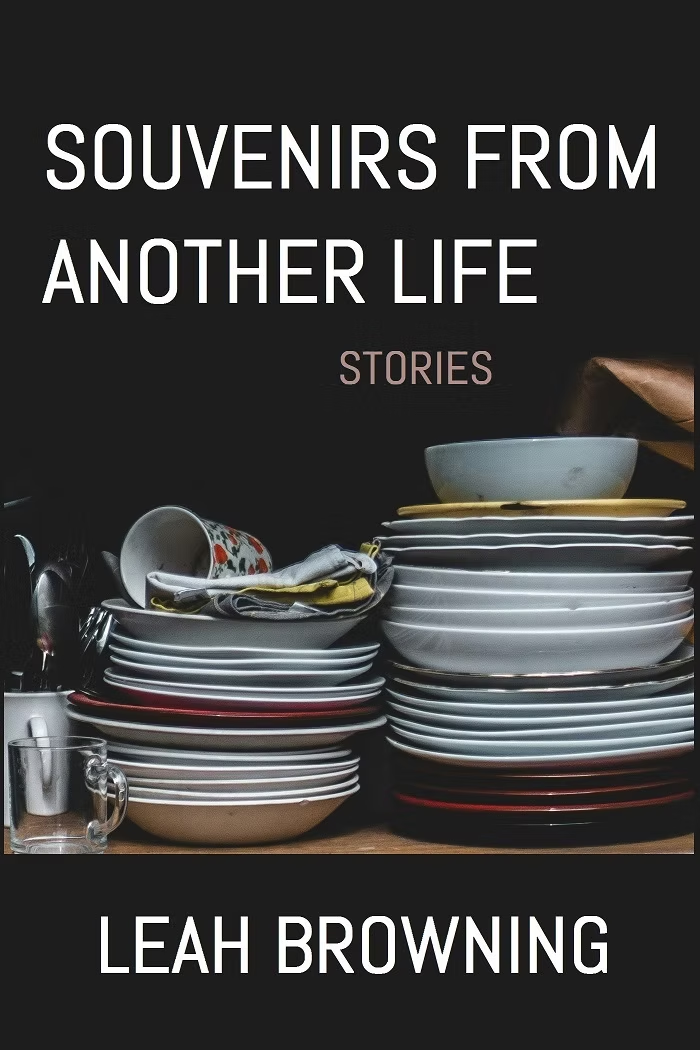
Leah Browning’s Souvenirs from Another Life (Quiet Ocean Studio & Press, 2026) is the first full-length short fiction collection from the author, but the latest in a long line of chapter books, non-fiction, and poetry. With over thirty publications having originally featured many of the stories, this collection is an amalgamation of multiple years of work and dedication to the craft. At its core, the collection is a series of vignettes featuring life at its truest: in relation to others. From first loves to last days, the shutter closes on glimpses of parents, children, friends, lovers, and strangers as they navigate what it means to live a life.
In form, Souvenirs from Another Life is diverse. Its diversity is most evident in its inclusion of everything from full-length literary fiction to microfiction. The variation in the length, content, and perspective of each story maintains an engaging pace. With every page turned, completely new expectations are set. In theme, it feels almost voyeuristic, looking on at these faceless characters as they navigate the most arduous or joyous days of their lives. They have plain names and minimal physical descriptions, lending to that anonymity. We absorb these moments in singularity, often completely unaware of their backstory.
This book is the embodiment of the feeling when you are sitting at a cafe, sipping on your americano, when two best friends sit down at the table beside you. Just over the noise of the busy street, you overhear fragments of their conversation. One of them is breaking up with their boyfriend or dealing with a terrible landlord. You know you are eavesdropping, and you know you should not, but curiosity gets the better of you. That quiet thrill is what keeps you reading Souvenirs from Another Life.
In particular, the collection truly shines in its briefest stories. While the few plots that were linked were always fascinating, I found myself most struck by the ones that lasted a few mere paragraphs.
As I read on, I was particularly intrigued by the idea of absence. Without being able to sit with a character for very long, there is an intentional lack of intimacy between the reader and the narrator. You are being held at arm’s length by the form while Browning’s high stakes and distinct characterization pull you closer. But the less there is to know, the more room it gives for the reader to insert their own thoughts, beliefs, and interpretations. It invites an open dialogue, encouraging you to contend with the story and reflect on your own memories.
“If I had more time, I would have written you a shorter letter.” Often wrongly attributed, the quote can be traced to a philosopher, Blaise Pascal. During my undergraduate studies in Creative Writing, my professors often cited a similar idea. Series are easier to master than a standalone novel. A short story is painstaking. A poem is completely, utterly excruciating. A single sentence can torment you.
See, an excerpt from “WORLDS,” a story that, in length, was under a page:
“But in the middle of the night, she’d lent me a toothbrush, and I’d watched her floss her teeth” (Browning 95).
In under twenty words, Browning masterfully presents setting, character, and action. Newness, uncertainty, and awe permeate the world of the narrator. There is an air of domesticity working in contrast to unfamiliarity. It is almost tangible. The cool night air, the white tiles, the silence. But all of that is there without actually being said. It is that absence that allows you to make a world feel whole without a whole novel to bring it to life. The story is colored by your own memory of longing. It is an invitation to reflect.
The intent of the collection is epitomized in the title story of the collection, from the point of view of an unnamed character:
“The photographs I found all over the apartment were proof that these things had happened: my courtship, my wedding, the birth of my child” (Browning 142).
At its most literal level, the narrator examines souvenirs of a life that was once hers but no longer is. We feel her grief, her regret, and her remorse. Many of these emotions permeate these stories, prompting the audience to use an insular moment to imagine a life that they are not privy to. Perhaps it even evokes nostalgia for former versions of ourselves. Times when we were still in love with that girl, living with our college roommate, or simply a time in which we did not understand heartbreak in the way we do now. The stories in this collection are steeped in sentimentality for life, in all its beauty and all its discomfort. It is an act of remembrance about what it means to be human.
The last line of the collection reads, “As she crossed the yard, Stacy had watched her, feeling the metal of the house key, warm against her skin” (Browning 220).
As we cross into the next chapter of our lives, may we always use Browning’s examination of memory as a reminder to look at our own souvenirs with grace and reverence for our past selves.
Souvenirs from Another Life is available from Quiet Ocean Studio & Press.

Reina Maiden-Navarro is an editor, writer, and photographer. She recently graduated from UC Irvine with a degree in Film & Media Studies and a minor in Creative Writing, cum laude. She also works as an Editor at Prompt and an Outreach Coordinator at Bookstr. If she is not reading or writing, she can be found traveling, painting, or baking cookies.

- The Wardrobe’s Best Dressed: All Water Has Perfect Memory by Nada Samih-Rotondo - September 18, 2026
- The Wardrobe’s Best Dressed: All Water Has Perfect Memory by Nada Samih-Rotondo - September 17, 2026
- Meet Our New Intern: Corina Yi - September 16, 2026