We Call Upon the Author to Explain—Jackie Domenus

For this month’s installment of We Call Upon the Author to Explain, our editorial intern, Reina Maiden-Navarro, interviews author Jackie Domenus about their first book, No Offense: A Memoir in Essays (ELJ Editions, 2025). The memoir blends anecdote with sociopolitical fact to take a critical lens to the microaggressions that persist from an individual adolescence to adulthood, reflective of a larger experience in the LGBTQ+ community since the turn of the century. Domenus is honest, confessional, and passionate, crafting a book that is both relatable and educational. 

Reina Maiden-Navarro: Can you explain your decision to organize your memoir non-chronologically? How did you look at structure and flow in terms of craft?

Jackie Domenus: When it comes to queer and trans memoirs (and really any memoir for that matter), I believe in the structure matching the content. My understanding of myself, of my sexuality, and my gender, was/is not linear. As is the case for more “traditional” memoirs, I didn’t have a clear beginning, middle, and end with a neat resolution, so the essays in No Offense came out non-chronologically naturally. In order to determine what order I’d put them in, I took post-it notes and wrote the ages that were mentioned in each essay. From there, I arranged and re-arranged the post-its to follow a loose arc from my earliest, formative moments and microaggressive conversations, to the latest. So ultimately, the order of the essays is somewhat chronological, but the threads in each individual essay jump around in time and surround a central theme or idea.

RMN: How do you believe outside anecdotes, facts, and statistics contribute to the telling of such a personal story? What did your research process look like?

JD: For me, incorporating anecdotes, facts, and statistics into this book was a means of zooming out of my own personal experience and proving that the issues I am addressing exist in a larger context, meaning they affect others beyond just me. For instance, in the essay “Blind Spots,” I include statistics about women in the automotive business as a means of supporting my own experience of being ignored at a car dealership. Or in the essay “Thoughts and Prayers,” I include quotes from politicians reacting to the Pulse Nightclub massacre, to demonstrate that their words cause direct harm to the LGBTQ+ community at large. My research process is not very organized—it’s a lot of searching for a bunch of supporting evidence on the Internet, copying and pasting links into random documents, and deciding later which sources to actually incorporate.

RMN: The year before you published this book, you were a resident at the Sundress Academy for the Arts (SAFTA). How did stepping away from your day-to-day life help you write about it?

JD: Spending time at the Sundress Academy for the Arts (SAFTA) was so refreshing for my creative process. Having dedicated time away from day-to-day life gave me the opportunity to catch up on some reading, to start drafting some new material outside of the book, and perhaps most importantly, to rest. Writing-wise, I started scratching the surface of some different themes like grief and mental illness, which I hope will be an early step toward a new, full-length project. I also had no experience with farm life before Sundress, so feeding the goats and collecting eggs from the chicken coop was a first for me and an added bonus!

RMN: You’re both a writer and a former English teacher. Yet, you also speak at length about the films that shaped your understanding of your sexuality, particularly in the chapter “Queer or Crazy.” Do you think there is a unique power in visual visibility? How do you think written forms compare?

JD: I think visibility in any artistic medium is equally powerful. If I had access to books with the same sort of sapphic representation that films like the ones I write about in “Queer or Crazy” offered, I might have written about those instead. In my opinion, it’s less about comparing the forms and more about making sure representation is offered in every medium, so folks have easily accessible options, no matter their preference for books versus music versus on screen, etc.

RMN: Can you speak to the separation of past and present self when it comes to your personal perception of your gender identity? How did your evolution of identity impact the editing of the book?

JD: My perception of my gender and the evolution of my identity was perhaps what made for the trickiest part of editing the book. I had written some of the earliest essays when I was still very femme-presenting and adhering to cis norms, so the perspective of the voice in those pieces was very different from my perspective now. I struggled with deciding whether to leave those early essays as-is, to revise them from my current point of view, or to remove them from the manuscript completely. Ultimately, I ended up keeping most of them as-is, but adding a foreword at the beginning of the book to explain my decision and make that differentiation.

RMN: How do you approach writing your story with authenticity, even when it comes to divulging your own missteps?

JD: The missteps are what make us human. Personally, I would not enjoy reading a memoir where the narrator speaks as if they are perfect, or as if everyone else they’ve ever encountered is a villain in their story. I think maybe the best example of writing with authenticity and truth in No Offense is in the essay “Burden of Proof,” where I talk about my first year teaching high school and had a trans student who was mistreated by the school and his peers. My lack of understanding of transness at that point, mixed with my naivety and non-tenured status as a new teacher, ultimately led to some missteps in how I interacted with that student and failure to advocate for him properly. To write myself as some queer savior would have been inauthentic and false, and no one wants to read inauthentic, false creative nonfiction.

RMN: As an educator, what is the value of exposing students to diverse lived experiences, particularly through literature? How do you hope your own writing contributes to that purpose?

JD: When I was teaching high school English, students who got their hands on books where they could see their own experiences reflected back at them were always the most enthusiastic to read or to talk about what they read, as were students who read about a character that led them to a new realization about themselves. Again, in the same way they might have access to Netflix shows or new movies, having the opportunity to pick up a book with diverse representation or lived experiences can open up a whole new world of understanding. As far as No Offense goes, my main audience priority has always been other LGBTQ+ folks who can relate, but I also hope it can reach people who are not a part of the community and offer them a new perspective or make them think twice the next time they go to say or ask something potentially harmful.

RMN: Finally, do you have any new projects you’d like to tell us about?

JD: The project I’m super focused on and very excited about at the moment is The QT (Queer & Trans) Nonfiction Podcast! It’s a weekly show I’m hosting that explores the best of today’s memoirs, essay collections, journalism, and more by LGBTQ+ authors. Folks can listen in on discussions of nonfiction forms, craft, language, publication, and beyond. Some fiction and poetry QTs, as well as supportive allies, will even be sprinkled in throughout! Reading and sharing true stories from queer and trans perspectives feels more important now than ever. Our words are proof of our existence, which is now, in and of itself, a form of resistance. I’ve had some incredible writers and friends on so far, such as KB Brookins, Zoë Bossiere, and Edgar Gomez, to name a few. It’s available on Podbean, Spotify, and Apple.

No Offense: A Memoir in Essays is available through ELJ Editions

[A white person is standing in front of a row of wooden bookshelves, brimming with colorful books. They have white skin, cropped brown hair, and brown eyes. They are wearing a blue and white jean jacket over a black shirt and a silver chain, their hands in the pockets of the jacket.]

Jackie Domenus (they/she) is a queer, gender nonconforming writer from South Jersey. Their first book, No Offense: A Memoir in Essays (ELJ Editions), was named a finalist for a 2025 Publishing Triangle Award and a Notable Small Press Book of 2025 by Literary Hub. A former Sundress Academy for the Arts resident and Tin House Workshop graduate, Jackie’s work has appeared in HuffPost, The Normal School, Foglifter Journal, and elsewhere. They are the host of the new Queer & Trans Nonfiction Podcast.

[A white woman is standing in front of a tree in a grove. She has short, dark red hair. She is wearing a black dress with white trim and a blue graduation stole with the words "UC Irvine" embroidered on it with gold thread.]


Reina Maiden-Navarro is an editor, writer, and photographer. She recently graduated from UC Irvine with a degree in Film & Media Studies and a minor in Creative Writing, cum laude. She also works as an Editor at Prompt and an Outreach Coordinator at Bookstr. If she is not reading or writing, she can be found traveling, painting, or baking cookies.

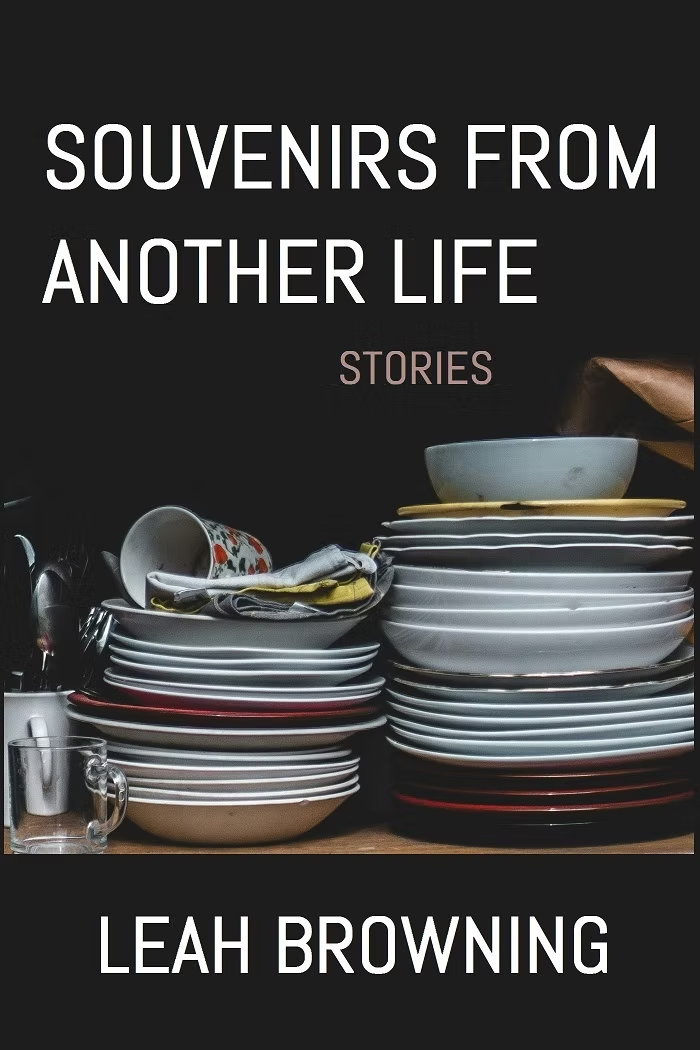
Sundress Reads: Review of Souvenirs from Another Life

Sundress Reads

Leah Browning’s Souvenirs from Another Life (Quiet Ocean Studio & Press, 2026) is the first full-length short fiction collection from the author, but the latest in a long line of chapter books, non-fiction, and poetry. With over thirty publications having originally featured many of the stories, this collection is an amalgamation of multiple years of work and dedication to the craft. At its core, the collection is a series of vignettes featuring life at its truest: in relation to others. From first loves to last days, the shutter closes on glimpses of parents, children, friends, lovers, and strangers as they navigate what it means to live a life.

In form, Souvenirs from Another Life is diverse. Its diversity is most evident in its inclusion of everything from full-length literary fiction to microfiction. The variation in the length, content, and perspective of each story maintains an engaging pace. With every page turned, completely new expectations are set. In theme, it feels almost voyeuristic, looking on at these faceless characters as they navigate the most arduous or joyous days of their lives. They have plain names and minimal physical descriptions, lending to that anonymity. We absorb these moments in singularity, often completely unaware of their backstory. 

This book is the embodiment of the feeling when you are sitting at a cafe, sipping on your americano, when two best friends sit down at the table beside you. Just over the noise of the busy street, you overhear fragments of their conversation. One of them is breaking up with their boyfriend or dealing with a terrible landlord. You know you are eavesdropping, and you know you should not, but curiosity gets the better of you. That quiet thrill is what keeps you reading Souvenirs from Another Life.

In particular, the collection truly shines in its briefest stories. While the few plots that were linked were always fascinating, I found myself most struck by the ones that lasted a few mere paragraphs.

As I read on, I was particularly intrigued by the idea of absence. Without being able to sit with a character for very long, there is an intentional lack of intimacy between the reader and the narrator. You are being held at arm’s length by the form while Browning’s high stakes and distinct characterization pull you closer. But the less there is to know, the more room it gives for the reader to insert their own thoughts, beliefs, and interpretations. It invites an open dialogue, encouraging you to contend with the story and reflect on your own memories.

“If I had more time, I would have written you a shorter letter.” Often wrongly attributed, the quote can be traced to a philosopher, Blaise Pascal. During my undergraduate studies in Creative Writing, my professors often cited a similar idea. Series are easier to master than a standalone novel. A short story is painstaking. A poem is completely, utterly excruciating. A single sentence can torment you.

See, an excerpt from “WORLDS,” a story that, in length, was under a page:

“But in the middle of the night, she’d lent me a toothbrush, and I’d watched her floss her teeth” (Browning 95).

In under twenty words, Browning masterfully presents setting, character, and action. Newness, uncertainty, and awe permeate the world of the narrator. There is an air of domesticity working in contrast to unfamiliarity. It is almost tangible. The cool night air, the white tiles, the silence. But all of that is there without actually being said. It is that absence that allows you to make a world feel whole without a whole novel to bring it to life. The story is colored by your own memory of longing. It is an invitation to reflect.

The intent of the collection is epitomized in the title story of the collection, from the point of view of an unnamed character:

“The photographs I found all over the apartment were proof that these things had happened: my courtship, my wedding, the birth of my child” (Browning 142).

At its most literal level, the narrator examines souvenirs of a life that was once hers but no longer is. We feel her grief, her regret, and her remorse. Many of these emotions permeate these stories, prompting the audience to use an insular moment to imagine a life that they are not privy to. Perhaps it even evokes nostalgia for former versions of ourselves. Times when we were still in love with that girl, living with our college roommate, or simply a time in which we did not understand heartbreak in the way we do now. The stories in this collection are steeped in sentimentality for life, in all its beauty and all its discomfort. It is an act of remembrance about what it means to be human. 

The last line of the collection reads, “As she crossed the yard, Stacy had watched her, feeling the metal of the house key, warm against her skin” (Browning 220).

As we cross into the next chapter of our lives, may we always use Browning’s examination of memory as a reminder to look at our own souvenirs with grace and reverence for our past selves.

Souvenirs from Another Life is available from Quiet Ocean Studio & Press.


Reina Maiden-Navarro is an editor, writer, and photographer. She recently graduated from UC Irvine with a degree in Film & Media Studies and a minor in Creative Writing, cum laude. She also works as an Editor at Prompt and an Outreach Coordinator at Bookstr. If she is not reading or writing, she can be found traveling, painting, or baking cookies.

Sundress Reads: Review of Under The Rain

Ayo Deforge’s second adult novel, Under the Rain (Witsprouts Books 2025), is a second-chance romance novel set in stormy Lagos, Nigeria. Spanning from childhood to adulthood, the story follows two lovers, Bolaji and Shola, who have been torn apart by diverging aspirations, but time ultimately brings them back together. With two weeks before Shola returns to the United States of America for good, the story invites readers to question whether the possibility of a life together is worth giving up all that they have built while apart. Taking place in both the past and present, the novel also functions as an examination of the lived experiences and sociopolitical realities of those affected by sickle cell anemia. 

Part One of Under the Rain is set in the present. Told from the perspective of middle-aged Bolaji, the reader follows him as he returns to his childhood hometown with his wife, Yetunde, and their children. A prolific medical professional, he is outspoken and knowledgeable, seemingly having it all. Yet, there is an undercurrent of dissatisfaction in his life, most evident in the discomfort within his romantic relationship, which the opening pages present through the aftermath of a sexual encounter. While the scene is intended to showcase Bolaji’s apathy towards his wife, it made me want to know more about her character and the cultural expectations surrounding her. After all, so much of this book goes beyond a simple romance and treads into social commentary on the human experience.  

However, much of this apparent dissatisfaction is almost immediately swept away by an idyllic “what if” scenario. 

What if the love of your life showed up in your hometown? What if you still were in love with them? What if the feeling was mutual? What if what once existed could be recreated?  

Chapter 2 opens with immediate narrative momentum. From the moment Shola returns to Lagos, the couple falls back into stride, learning more about each other’s current lives and confessing their lingering feelings. The reader, thus, is swept into a whirlwind second-chance romance that paves the way for the rest of the story. 

The novel’s heightened drama creates immediate interest for Part Two, when the book returns to the past to trace how the pair found each other, fell in love, and eventually fell apart. Although this glorious romance lies at the heart of the book, their story is often colored by tragedy—in particular, Bolaji’s brother Bamidele’s diagnosis with sickle cell anemia. What Deforge ultimately constructs is a tension-filled, introspective drama centred on grief, growth, and the decisions that alter a life. 

The novel’s treatment of sickle cell anemia is what truly captivated me. It is introspective, empathetic, and grounded. During the early years of Bolaji’s life, I found myself compelled by his experience as a caretaker for his brother, a relationship that mirrors my childhood experience taking care of ill and disabled family members.  

The reader can sense the weight borne by both him and his younger brother, particularly in passages such as: 
 
“Since that day, Bamidele had never broached the subject of death again, and Bolaji had never tried to speak to him about it. After all, what did he himself truly understand about death?” (Deforge, 20) 

The depth provided by this secondary narrative affords the novel an urgent sense of topical vitality. The health-related storyline was handled in broad strokes, but the risk of including more intricate, layered themes eventually paid off. In terms of narrative development, Bamidele’s story provides a direct, yet meaningful framework for understanding Bolaji’s career trajectory while also laying the groundwork for later tensions. It was the first spark of genuine empathy I felt for his character. 

As the novel progresses into its later chapters, the reader is presented with more emotionally charged moments, heartfelt declarations, and romantic development. Alongside this, the narrative reveals a wider breadth of trauma and conflict shaping the characters’ lives, including familial violence and death. Gradually, as the plot transitions between the past and the present, a more nuanced understanding emerges of why Bolaji and Shola had previously broken up. Most notably, both characters discover that they are carriers of the sickle cell anemia trait.  

When reflecting on their past relationship, Bolaji thinks, “Allowing their passion to reignite would only inflict harm upon others. Like a volcanic eruption, nothing in its vicinity would remain unscathed.” (Deforge, 88) 

Bolaji’s internal conflict regarding their diagnosis adds nuance to the story, proving Deforge’s commitment to highlighting complicated and difficult stories. The protagonist’s fears operate on two levels: concern for their health, particularly in relation to starting a family, and the potential disruption of their existing lives with their respective families.  

While I felt that, by the end of this book, more empathy could have been extended to Bolaji’s wife, I cannot deny the importance of the conversation around sickle cell anemia. For this reason, this book can be considered innovative, including its open engagement with reproductive rights. Deforge is to be applauded for constructing a work with significant social stakes while operating within the conventions of a genre that rarely foregrounds such themes. 

Under the Rain is available from Witsprouts Books


Reina Maiden-Navarro is an editor, writer, and photographer. She recently graduated from UC Irvine with a degree in Film & Media Studies and a minor in Creative Writing, cum laude. She also works as an Editor at Prompt and an Outreach Coordinator at Bookstr. If she is not reading or writing, she can be found traveling, painting, or baking cookies.

Sundress Reads: Review of Follow This Blood to Find a Dead Thing

Sundress Reads

Charles K. Carter’s Follow This Blood to Find a Dead Thing: Poems and Tales (Fernwood Press, 2026) is an explorative, alluring collection of flash fiction, vignettes, free verse, and more. Divided into four sections, the book transforms a vessel of ecopoetics into an examination of human relationships, sexuality, and mental health. Carter’s sophomore release paints pictures of stunning, overgrown, and lustrous landscapes while simultaneously tearing at the most heart-wrenching and isolating aspects of the modern experience. 

In Follow This Blood to Find a Dead Thing: Poems and Tales, the author’s interest in what they were writing about stood out immediately. Writing about animal and plant life so cleverly requires a fundamental understanding of the named specimens. Early on, it is clear that Carter has a true affinity for nature. Their fascination is tangible on the page, from visual allusions to orchids and willow trees to vibrant references to gnats and grasshoppers. Their enthusiasm for these ecological subjects made the collection all the more compelling, as I was eager to learn more about how they could transform this knowledge into poetry. 

See, from Part I, an excerpt from the poem entitled “Blooming”: 

“Many native prairie flowers grow close together / to help each other carry the weight of the world, / to help each other stand tall” (Carter, 22). 

It is true that prairie flowers tend to congregate. It is an evolutionary response to surviving in areas with high winds. To root their imagery in truth, the author needs to have a concrete understanding of the nature that they are referencing. Carter does. That attention to detail strengthens their writing and forms trust between the reader and the book.  

Throughout this collection, Carter uses facts like those about the various flowers in “Blooming” and intermingles them with potent metaphors. They utilize natural examples of destruction and perseverance to argue for the same possibilities in human life. It was imagery that I understood and was easily able to relate to. What I did not know, I researched. Then, I was able to apply that concrete visual allusion to the picture of my own friend group and the collective support I feel through their presence. In that, Carter’s writing, despite being very emotionally-driven, is simultaneously scientific.  

Often, these grounded metaphors lead to a feeling of observation. Many of the poems read like hypotheses, long mulled over after following and evaluating a creature in its natural habitat. 

“An ant, used to relying on her colony to survive, / will purposely leave her home if she is infected with a disease” (Carter, 38). 

Then, a stanza later… 

“One of my coworkers / Couldn’t even be bothered to wear a mask for ten minutes in Walgreens” (Carter, 38). 

Often, emotions like aggression and territoriality are attributed to having an “animal instinct.” Carter subverts this notion, challenging readers to think about the sense of community and altruism that exists in the animal kingdom. At the same time, the author is also turning a spotlight on the greed and self-interest that have created division between people in the last few years. Can selfish interests be chalked up to an animalistic instinct, or is it also true that community building and preservation are innate qualities?  

The thing that most often captivates me about Follow This Blood to Find a Dead Thing: Poems and Tales is the contrast. Within a short excerpt, not only can you feel the author’s admiration for the ant, but you can also feel their disdain for the actions of their fellow humans. By placing these two examples in opposition, especially considering Carter’s affection for nature, it becomes clear what their standpoint truly is. 

Yet, despite this frustration, much of the collection is still about humans and human moments, whether fictional or not. In particular, the flash fiction of this collection showcases truly human relationships, dialogue, and actions. They are moments shared over dinner, in old houses, or on a day out. They are between lovers, friends, or family. Whether comforting or unsettling, the conversation still revolves around human life. It is aggravating, humiliating, and captivating all at the same time. It is one more outlet for the author to confront trauma, heartbreak, and loneliness as humanity struggles to find its humanity.  

Finally, in Part IV of the collection, the human comes face-to-face with nature, entering a conversation where they reckon with their impact on the natural world. In Earth’s last moments, a human speaks to an eagle, whale, cockroach, and dog. The penultimate piece solidifies the ecological, anthropological, and political message of the collection. It is a call to action. 

From “The Last Night on Earth”: 

“What a lonely night it would be if they still pretended not to / hear one another” (Carter, 72). 

Now, the character of the human must finally contend with what the human author has been urging them to hear all along. And, as a reader, the most important thing this collection did was encourage me to listen. I hope others will, too. 

Follow This Blood to Find a Dead Thing: Poems and Tales is available from Fernwood Press


Reina Maiden-Navarro is an editor, writer, and photographer. She recently graduated from UC Irvine with a degree in Film & Media Studies and a minor in Creative Writing, cum laude. She also works as an Editor at Prompt and an Outreach Coordinator at Bookstr. If she is not reading or writing, she can be found traveling, painting, or baking cookies.

An Interview with Dani Janae, Author of Hound Triptych

Upon the release of her debut poetry collection, Hound Triptych, Dani Janae spoke with Sundress Publications editorial intern Reina Maiden-Navarro. Here, they discussed navigating the intersections of girlhood and motherhood as a Black adoptee, the legacies of trauma, loss, and grief, the process of rebuilding and reclaiming chosen identities, and the importance of love and forgiveness.

Reina Maiden-Navarro: Why did you choose to separate your collection into three sections, a “triptych”? How is it significant to the construction of a larger narrative?

Dani Janae: I’m not one to necessarily believe in numerology but the number three kept coming up as I was writing the poems in this book. There are three “Go Ask” poems and three sonnets. My mother’s birthday is in the third month of the year. Things just kept coming to me in threes, and I took that as a sign. I also think there was a temptation to divide the book into beginning, middle, and end, which I resisted. The three parts aren’t totally chronological, they are more divided by a theme.

The first section of the book is where I introduce the hound narrative. The second part is about inhabiting that narrative, and the third part seeks to deconstruct it.

RMN: Can you speak to the significance of hounds in your work?

DJ: When I realized that the poems I was writing were becoming a book, I started thinking about the title more seriously. I knew I wanted it to be “X Triptych” but thought “Dog Triptych” seemed lacking in specificity and didn’t quite capture the theme. Hound came to me as I was working through the physical search for my mother. Hounds are hunting dogs, they have sharp senses, some sight, some smell. In a sense, I was hunting for my mother, hunting for the truth of what her life was like and why she gave me up. Furthermore, because I had never met her, never seen her, my sense of her was entirely constructed out of myth. I imagined what she looked like, what her voice sounded like, what she would say when we met. I had built a whole sensory world for her by the time I found out her name.

Hounds are also quite physically striking, and one of the things I learned about my mother when looking for her was that she was a striking woman with “expressive eyes” as the poem in the book documents.

I spent my childhood hoping that I looked like her, that my features were hers, that I would grow into the beauty I imagined she was known for. This also informed how hounds came into the poems.

RMN: How does sobriety affect your approach to the subject of addiction?

DJ: First and most obvious is that if I wasn’t sober, I wouldn’t have been able to write these poems. I started writing loosely about my mother in college, when I first started looking for her. Those poems were frantic and often veered off topic because my heart was broken and I couldn’t face what I perceived as her rejecting me. I also was becoming a career drunk in college, and I was less concerned about writing beautiful poems and more concerned about my next high.

Being in active addiction takes a lot from you. Not only physically but mentally; I truly don’t think I had the mental or emotional capacity to write about my addiction while I was in the muck of it.

Secondly, I personally am firmly in the camp of only writing about addiction if you have experienced it yourself. If someone loves an addict, I think they can write about just that, but I wouldn’t want to read a book about addiction from a non-addict.

In the book, I say the corner tenet of my sobriety now is forgiveness, and forgiveness plays a big part in the book overall. When I was in active addiction, I wasn’t able to forgive anyone. Not my mother, not even myself. I was hellbent on the “get-back.” On suffering and making my pain plain to those around me. I wanted my mother to see how her giving me up for adoption had hurt me when I started searching for her at 18. When I revisited my search as a sober 31-year-old, I came to it with grace.

I also talk about grace a lot in the book. I think I had to give my mother grace in order to see her and myself clearly. I couldn’t hold on to the narrative that I had been abandoned without love any longer if I wanted to open my heart to knowing who she was.

RMN: How do naming dedications, individual poems, and a collection serve as a reclamation of chosen identity?

DJ: Wow this is a great question. My personal experience (and some readers may also have this experience) was one of having my identity imposed upon me. My adoptive mother told me who I was, and what she had to say was mostly negative. I was worthless, ugly, too emotional, too much in general.

In the poem “Call” I discuss this, how even despite years and distance, I still struggled to see myself outside of her vision of me. Writing this book brought me closer to full and flawed woman that was my biological mother, which brought me closer to the self I have been building all these years.

I had to teach my inner monologue to approach the self with loving kindness, and part of that is also having a spiritual life. I don’t believe in a Christian God, or any capital G God of organized religion anymore, but I do believe in a guiding force, a light, that moves through me. That light was covered when I was a child, and this book, this life I’ve built has kind of served as a great uncovering.

I also have had so many lovely people who have reflected back to me a loved version of myself. My brothers David and Dakota, my best friend Shanai, my friends and writing group members Cale and Diehl. If I didn’t have these things I would still be the abused, admonished child I knew growing up. She still lives inside of me, I don’t think that hurt will ever disappear, but I’ve become someone else around her, a protective force.

RMN: The poem “To Unlearn the Narrative of the Dog” has a direct address to the reader. What are you hoping to have readers contend with by giving them a name?

DJ: This is linked to question four, but I brought the reader into the poem at that moment because it is easy for me to let other people tell me who I am. In a sense, to perform for others approval and recognition. In “Adoptee Log #9” I talk about decentering the mother, and while having grace and respect for my mother was important for me and this book, I had to also let go of the idea that only she could tell me who I am.

“To Unlearn the Narrative of the Dog” is about just that, literally piecing myself together without worrying about how my mothers or my readers would perceive me.

RMN: What is the significance of Rita Dove as an influence in your writing, namely in Section III?

DJ: What Rita Dove does in her poems “Adolescences I” and “II” is capture this essence of not just girlhood, but Black girlhood, that I also wanted to bring into my work. I wanted to be able to do that without big red arrows pointing saying “THIS POEM IS ABOUT RACE.” I do have poems that are more directly about race in the book, but I loved the subtlety with which Dove approaches the subject in her poems.

I started reading her in college, specifically around the time I was writing my senior thesis, and I was immediately smitten and in awe of her work. The sharpness and expansiveness of the language she uses, especially in II were so important and influential for me.

RMN: How does the use of white space serve as its own vessel for communication and a reverberation of the theme of absence throughout your collection?

DJ: Having spent years not knowing my mother was, in a sense, a white space that permeated throughout my life. Sometimes it was apt to fill that white space with words, other times I had to let the starkness, the silence, speak for itself.

When I was little, I had a recurring dream where my biological mother showed up at my childhood home and demanded my adoptive mother unhand me and return me to my rightful home. In the dream, my mothers are yelling at each other, and I open my mouth, and nothing comes out.

The white space is this too, the things I could not say and the things I never said. To either of my mothers. I never got to tell Sarah I love her. I never got to tell my mom that raised me how she broke my heart. So much lives in that. It was important for me stylistically and emotionally to have that white space be a part of the collection.

RMN: Section II is entirely comprised of poems entitled “Adoptee Log [#1-10].” Tell us about your development in contending with the intersections of girlhood and motherhood as an adoptee.

DJ: For me, this section was vital. I wanted to describe the day to day yearning I experienced as a daughter, while also working through my thoughts on what it meant to be a mother. I am not a mother myself, but I knew I had to say what I had to say, and then leave room for compassion to flow through. I do have poems that express frustration, sadness, and heartache, but at the center of those poems too is a profound love for my mother, and an understanding of the difficulty in the decision she made.

Through therapy, I learned that adoptees especially tend to be more preoccupied with the mother figure than the father. There is a biological reasoning for this but also a social one. Mothers tend to take on most of the work of child rearing. There’s a popular video segment on a late-night television program where street interviewers ask fathers “who is your child’s pediatrician?” “What is the name of your daughter’s best friend?” These fathers can’t answer or get the answer wildly incorrect, even birthdays or other important milestones in a child’s life. Then, the mother comes on screen and gets a perfect score.

Yes, these interviews are cherry-picked and edited, but they also speak to something true. We put the brunt of the weight on mothers to know it all and do it all. So, when I was searching for my mother, I put the onus on her to heal the wounds that had been foisted upon me in my girlhood. This, of course, was very unfair. A big part of the collection is coming to admit that to myself and starting to see my mother as a full, realized human being who is not just the woman who gave birth to me, then let me go.

RMN: If your birth mother could read one poem from this collection, which one would you want it to be and why?

DJ: “Poem as Motherless” not only because it is a direct address, but also because it is a true love poem for her. It doesn’t paint me in this bucolic light either, I admit to blaming her for things that just aren’t her fault, but I admit to it, and this poem in a way, serves as an apology.

The love I have for her is not uncomplicated, but it drives this collection. I wouldn’t be on this earth if it wasn’t for her. I wouldn’t be alive. Despite the abuse I experienced as a girl, I still grew up in a place where I always had clean clothes, food, a roof over my head. She made a sacrifice for what she thought was best for me, and who is to say if it was truly best, but I believe her decision was heart-forward and selfless, and I have to thank her for that.

There was some discussion with my editor about changing the last poem in the book, but I really fought for the last poem to stay in its place. I wanted the last thing in the book to be a gesture toward my mother, not a meditation on myself or addiction or abuse. I wanted to have one final declaration of love.

Hound Triptych is available to order now!


Dani Janae is a Black lesbian poet and journalist from Pittsburgh, Pennsylvania. Her work has been published by Longleaf Review, SWWIM, RHINO Poetry, and South Florida Poetry Journal, among others. She posts on Substack at “No Skips,” “Fig Widow,” and “Ask a Queer Doctor,” and she can be found at https://danijanae.com/.

A white woman is standing in front of a tree in a grove. She has short, dark red hair. She is wearing a black dress with white trim and a blue graduation stole with the words "UC Irvine" embroidered on it with gold thread.

Reina Maiden-Navarro is an editor, writer, and photographer. She recently graduated from UC Irvine with a degree in Film & Media Studies and a minor in Creative Writing, cum laude. She also works as an Editor at Prompt and an Outreach Coordinator at Bookstr. If she is not reading or writing, she can be found traveling, painting, or baking cookies.

Meet Our New Intern: Reina Maiden-Navarro

For a long time, I was told my writing was “proficient.” Not good, not even okay, but proficient. In fact, every single one of my papers was marked with this word in a large red scrawl. 

You see, my elementary school had a rather peculiar grading scale. It looked something like this:

A: Advanced (90–100%)

P: Proficient (80–89%)

B: Basic (70–79%)

BB: Below Basic (60–69%)

F: Failed (0–59%)

More than anything, I wanted to be an advanced writer. The words almost sparkled to me. My teachers never had anything bad to say, always praising my competency and citing my growth, but it never felt like I was good enough. Looking back, I now understand. I was primarily raised by my deaf and Spanish-speaking mother. While she always reinforced my reading habit, communicating my own thoughts in words and constructing my own sentences in English hadn’t always come easily to me. 

In my last year of elementary school, I finally received my first-ever “advanced” on a paper about Rosa Parks. My teacher, Ms. Brace, said it was the first time she heard my “voice” in an essay. 

Throughout my life, I’ve fallen in and out of love with the written word, but the whole time, I’ve learned to lead with my voice by imbuing my passion into my writing.

On the first floor of the Ayala Science Library at UC Irvine, I became an advanced writer professionally. For two years, I worked at my university’s writing center, serving as both a Writing Tutor and a Community Outreach Coordinator. It was the best part of my college experience. I met with hundreds of peers, many of whom were first-generation or international students. We bonded over language barriers and cultural storytelling. My favorite part was seeing the growth of my repeat students experienced over the course of a quarter or a year as they came into their identity as new writers. I finally understood what Ms. Brace meant about using my voice. I tried to help others do the same.

This passion for ushering in the stories of underrepresented writers is what led me to Sundress Publications. As I begin my role as an Editorial Intern, I hope to continue to use my story to connect with readers and find common ground with the authors I work with.


A white woman is standing in front of a tree in a grove. She has short, dark red hair. She is wearing a black dress with white trim and a blue graduation stole with the words "UC Irvine" embroidered on it with gold thread.

Reina Maiden-Navarro is an editor, writer, and photographer. She recently graduated from UC Irvine with a degree in Film & Media Studies and a minor in Creative Writing, cum laude. She also works as an Editor at Prompt and an Outreach Coordinator at Bookstr. If she is not reading or writing, she can be found traveling, painting, or baking cookies.