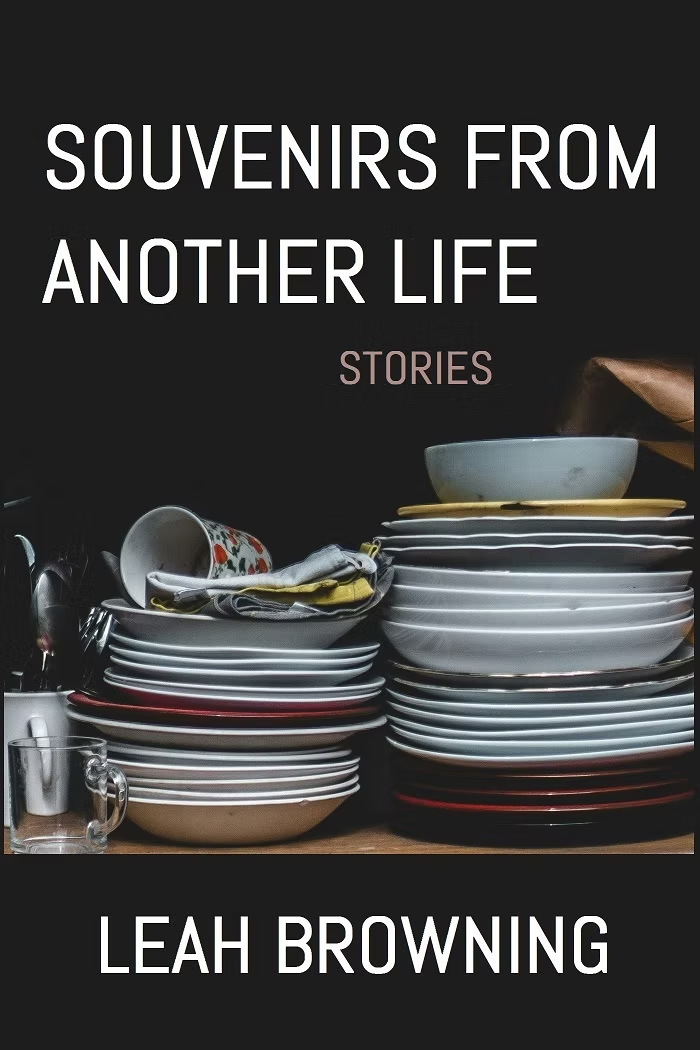
Sundress Reads: Review of Souvenirs from Another Life

Sundress Reads

Leah Browning’s Souvenirs from Another Life (Quiet Ocean Studio & Press, 2026) is the first full-length short fiction collection from the author, but the latest in a long line of chapter books, non-fiction, and poetry. With over thirty publications having originally featured many of the stories, this collection is an amalgamation of multiple years of work and dedication to the craft. At its core, the collection is a series of vignettes featuring life at its truest: in relation to others. From first loves to last days, the shutter closes on glimpses of parents, children, friends, lovers, and strangers as they navigate what it means to live a life.

In form, Souvenirs from Another Life is diverse. Its diversity is most evident in its inclusion of everything from full-length literary fiction to microfiction. The variation in the length, content, and perspective of each story maintains an engaging pace. With every page turned, completely new expectations are set. In theme, it feels almost voyeuristic, looking on at these faceless characters as they navigate the most arduous or joyous days of their lives. They have plain names and minimal physical descriptions, lending to that anonymity. We absorb these moments in singularity, often completely unaware of their backstory. 

This book is the embodiment of the feeling when you are sitting at a cafe, sipping on your americano, when two best friends sit down at the table beside you. Just over the noise of the busy street, you overhear fragments of their conversation. One of them is breaking up with their boyfriend or dealing with a terrible landlord. You know you are eavesdropping, and you know you should not, but curiosity gets the better of you. That quiet thrill is what keeps you reading Souvenirs from Another Life.

In particular, the collection truly shines in its briefest stories. While the few plots that were linked were always fascinating, I found myself most struck by the ones that lasted a few mere paragraphs.

As I read on, I was particularly intrigued by the idea of absence. Without being able to sit with a character for very long, there is an intentional lack of intimacy between the reader and the narrator. You are being held at arm’s length by the form while Browning’s high stakes and distinct characterization pull you closer. But the less there is to know, the more room it gives for the reader to insert their own thoughts, beliefs, and interpretations. It invites an open dialogue, encouraging you to contend with the story and reflect on your own memories.

“If I had more time, I would have written you a shorter letter.” Often wrongly attributed, the quote can be traced to a philosopher, Blaise Pascal. During my undergraduate studies in Creative Writing, my professors often cited a similar idea. Series are easier to master than a standalone novel. A short story is painstaking. A poem is completely, utterly excruciating. A single sentence can torment you.

See, an excerpt from “WORLDS,” a story that, in length, was under a page:

“But in the middle of the night, she’d lent me a toothbrush, and I’d watched her floss her teeth” (Browning 95).

In under twenty words, Browning masterfully presents setting, character, and action. Newness, uncertainty, and awe permeate the world of the narrator. There is an air of domesticity working in contrast to unfamiliarity. It is almost tangible. The cool night air, the white tiles, the silence. But all of that is there without actually being said. It is that absence that allows you to make a world feel whole without a whole novel to bring it to life. The story is colored by your own memory of longing. It is an invitation to reflect.

The intent of the collection is epitomized in the title story of the collection, from the point of view of an unnamed character:

“The photographs I found all over the apartment were proof that these things had happened: my courtship, my wedding, the birth of my child” (Browning 142).

At its most literal level, the narrator examines souvenirs of a life that was once hers but no longer is. We feel her grief, her regret, and her remorse. Many of these emotions permeate these stories, prompting the audience to use an insular moment to imagine a life that they are not privy to. Perhaps it even evokes nostalgia for former versions of ourselves. Times when we were still in love with that girl, living with our college roommate, or simply a time in which we did not understand heartbreak in the way we do now. The stories in this collection are steeped in sentimentality for life, in all its beauty and all its discomfort. It is an act of remembrance about what it means to be human. 

The last line of the collection reads, “As she crossed the yard, Stacy had watched her, feeling the metal of the house key, warm against her skin” (Browning 220).

As we cross into the next chapter of our lives, may we always use Browning’s examination of memory as a reminder to look at our own souvenirs with grace and reverence for our past selves.

Souvenirs from Another Life is available from Quiet Ocean Studio & Press.


Reina Maiden-Navarro is an editor, writer, and photographer. She recently graduated from UC Irvine with a degree in Film & Media Studies and a minor in Creative Writing, cum laude. She also works as an Editor at Prompt and an Outreach Coordinator at Bookstr. If she is not reading or writing, she can be found traveling, painting, or baking cookies.

The Wardrobe’s Best Dressed: Leah Browning’s “Early Morning”

Image

EARLY MORNING

The woman emerged from the forest
behind the house, as if she’d become lost

in an intricate dream, or a fairy tale:
as if she’d been wandering in the wood

for so long that her hair had turned gray
and her clothes were worn to rags.

It was one of those cool, gray mornings
where the mist clings to the treetops,

and one of the stories in the newspaper
was about a mysterious shower of apples

falling from the sky over a small British town,
and any otherworldly thing seemed possible.

I was sitting on the back porch with a cup
of hot coffee in my hand, steam rising

in the cold air, and I watched as if in a dream
as the woman slowly grew closer.

Her hair, fine as cobwebs, was pulled up
in a knot at the back of her head,

and the pale fabric of her nightgown
dragged behind her in the thick grass.

I set my cup on the table and rose.
It would take only a moment

to walk down the wooden steps
and cross the grass to meet her,

to stand close enough to see her face,
deeply lined, still soft from sleep.

I already knew that she would
mistakenly call me by her daughter’s name,

and I would take her inside for a blanket
and a cup of hot tea, and together,

we would sit near a bowl full of roses
and look through the phone book

for the familiar number
that she could no longer recall.

But for as long as I walked down
the wooden steps and crossed the thick grass

she was still wandering out of the forest,
in search of elusive words of advice or a magic ring,

or the single kiss that would turn back time
and break the spell.


This selection is from Leah Browning’s chapbook, In the Chair Museum, available from dancing girl pressPurchase your copy here!

Leah Browning is the author of three nonfiction books for teens and pre-teens and three chapbooks.  Her most recent chapbook, In the Chair Museum, was published by Dancing Girl Press in 2013.  Browning’s fiction, poetry, essays, and articles have previously appeared in publications including Queen’s Quarterly, Queen’s Feminist Review, 42opus, The Saint Ann’s Review, Blood Orange Review, 300 Days of Sun, Corium Magazine, Heron Tree, The Citron Review, Halfway Down the Stairs, Sweet: A Literary Confection, Dressing Room Poetry Journal, and Per Contra, as well as on a broadside from Broadsided Press, on postcards from the program Poetry Jumps Off the Shelf, and in several anthologies.  Her fourth chapbook, Out of Body, is forthcoming from Dancing Girl Press.  In addition to writing, Browning serves as editor of the Apple Valley Review.  Her personal website is located at www.leahbrowning.com.


Erin Elizabeth Smith is the Creative Director at the Sundress Academy for the Arts and the author of two full-length collections, The Fear of Being Found (Three Candles Press 2008) and The Naming of Strays (Gold Wake Press 2011). Her poems have appeared in numerous journals, including Mid-American, 32 Poems, Zone 3, Gargoyle, Tusculum Review, and Crab Orchard Review. She teaches a bit of everything in the English Department at the University of Tennessee and serves as the managing editor of Sundress Publications and Stirring.

THE WARDROBE’S BEST DRESSED: LEAH BROWNING’S “ALMOST A YEAR AFTER HIS SUICIDE”

Image

Almost a Year After His Suicide
 
After a glass of wine, it no longer seems possible
that he’s dead. You weren’t close, toward the end
of his life, and it’s been months since he has floated
into your thoughts, unbidden, out of the blue. 

Now, sitting on the back porch,
you can remember every line
of his last letter. He had sounded at peace
then, just a few short weeks before. 

The wisteria is in bloom, with its thick,
fragrant bunches of lavender flowers,
and the lemon tree is heavy with fruit.
At sunset, the dead seem close by, 

present, lingering in your peripheral vision.
And for a moment, in the golden light,
this has to be heaven, because how could anyone
truly be dead, here amidst so much beauty?


This selection is from Leah Browning’s chapbook, In the Chair Museum, available from dancing girl pressPurchase your copy here!

Leah Browning is the author of three nonfiction books for teens and pre-teens (Capstone Press) and three chapbooks: In the Chair Museum (Dancing Girl 2013),  Picking Cherries in the Española Valley (Dancing Girl Press, 2010) and Making Love to the Same Man for Fifteen Years (Big Table Publishing, 2009).  Browning’s fiction, poetry, essays, and articles have previously appeared in a variety of publications, including Queen’s Quarterly, Queen’s Feminist Review, 42opus, The Saint Ann’s Review, Blood Orange Review, Tipton Poetry Journal, Brink Magazine, Halfway Down the Stairs, Sweet: A Literary Confection, and Per Contra, as well as on a broadside from Broadsided Press, on postcards from the program Poetry Jumps Off the Shelf, and in several anthologies.  In addition to writing, Browning serves as editor of the Apple Valley Review.  Her personal website is located at www.leahbrowning.com.


Erin Elizabeth Smith is the Creative Director at the Sundress Academy for the Arts and the author of two full-length collections, The Fear of Being Found (Three Candles Press 2008) and The Naming of Strays (Gold Wake Press 2011). Her poems have appeared in numerous journals, including Mid-American, 32 Poems, Zone 3, Gargoyle, Tusculum Review, and Crab Orchard Review. She teaches a bit of everything in the English Department at the University of Tennessee and serves as the managing editor of Sundress Publications and Stirring.

The Wardrobe’s Best Dressed: Leah Browning’s “Halfway Through the Biography of Anne Sexton”

Image

HALFWAY THROUGH THE BIOGRAPHY OF ANNE SEXTON

Things begin to fall apart. The kids are sick,
the car’s engine won’t turn over, all the light bulbs are breaking.
My fingers swell in the night. It’s the salt, the sugar, the heat—
but it seems symptomatic of some larger failing.

Autumn. It’s been raining for days and days, and she’s back
in the hospital again—is it the third time, the fourth?
I can’t help thinking of the skirts she used to wear, the position
of her hand on the banister, all the secret codes and signs.

The old life—the two of them holding hands on the porch,
children running on the summer grass—
did it all melt like ice under the smoldering weight
of the words in her head? Or did it ever exist at all?

Outside, the rain falls heavily, like sparrows
striking the roof. Her body is so slight, so fragile—
and yet we are all silent, standing here in the dark, waiting
once more for even a hint of breath, or a soft rush of wings. 


This selection is from Leah Browning’s chapbook, In the Chair Museum, available from dancing girl pressPurchase your copy here!

Leah Browning is the author of three nonfiction books for teens and pre-teens (Capstone Press) and three chapbooks: In the Chair Museum (Dancing Girl 2013),  Picking Cherries in the Española Valley (Dancing Girl Press, 2010) and Making Love to the Same Man for Fifteen Years (Big Table Publishing, 2009).  Browning’s fiction, poetry, essays, and articles have previously appeared in a variety of publications, including Queen’s Quarterly, Queen’s Feminist Review, 42opus, The Saint Ann’s Review, Blood Orange Review, Tipton Poetry Journal, Brink Magazine, Halfway Down the Stairs, Sweet: A Literary Confection, and Per Contra, as well as on a broadside from Broadsided Press, on postcards from the program Poetry Jumps Off the Shelf, and in several anthologies.  In addition to writing, Browning serves as editor of the Apple Valley Review.  Her personal website is located at www.leahbrowning.com.


Erin Elizabeth Smith is the Creative Director at the Sundress Academy for the Arts and the author of two full-length collections, The Fear of Being Found (Three Candles Press 2008) and The Naming of Strays (Gold Wake Press 2011). Her poems have appeared in numerous journals, including Mid-American, 32 Poems, Zone 3, Gargoyle, Tusculum Review, and Crab Orchard Review. She teaches a bit of everything in the English Department at the University of Tennessee and serves as the managing editor of Sundress Publications and Stirring.

The Wardrobe’s Best Dressed: Leah Browning’s “In the Chair Museum”

Image

IN THE CHAIR MUSEUM

On Christmas Day, we drove north
to spend the afternoon with friends.

I was homesick for New Mexico
and brought biscochitos in the shape of stars.

We all walked to Montara State Beach
where it was cold and windy and beautiful

and watched the sun set like a piece of golden glass
over the ocean. I couldn’t believe it was truly

December. On the way back to the house
I held his little mitten in my gloved hand.

He was getting older and it felt like the last time
this might happen, like I needed to remember it.

We took the longest route and stopped to look
at strings of Christmas lights in the front yards.

By the time we returned, the men had built
a fire in a metal bowl on the back porch.

Later, after dinner, I looked through a book
with one of the boys, a very thick book about chairs.

He sat close to me on the couch and I wanted time
to stop for a moment so we could go on forever

turning page after page of glossy color photographs
of all the different colors and types of chairs.

Christmas ended, and New Year’s. The book dissolved,
all of it did, as though it had never happened.

A few months later, I dreamed that I was a doll,
walking on my little legs through the chair museum.

Next door was the table museum, and on the other side
of it was the spoon museum, and so on. You get the idea.

The chairs in my museum were very large,
and I felt so small as I walked between them.

I wasn’t sure why I was there, or what I was supposed to be
learning, but I knew that I had to be there for a reason.

So all night, I walked around in my little stockings and
my little black felt slippers with the straps across the tops.

All night, I walked around and around the museum,
peeking up at chairs through my little glass eyes,

certain that all of the answers were right there in front of me
if only I knew where to look.


This selection is from Leah Browning’s chapbook, In the Chair Museum, available from dancing girl pressPurchase your copy here!

Leah Browning is the author of three nonfiction books for teens and pre-teens (Capstone Press) and three chapbooks: In the Chair Museum (Dancing Girl 2013),  Picking Cherries in the Española Valley (Dancing Girl Press, 2010) and Making Love to the Same Man for Fifteen Years (Big Table Publishing, 2009).  Browning’s fiction, poetry, essays, and articles have previously appeared in a variety of publications, including Queen’s Quarterly, Queen’s Feminist Review, 42opus, The Saint Ann’s Review, Blood Orange Review, Tipton Poetry Journal, Brink Magazine, Halfway Down the Stairs, Sweet: A Literary Confection, and Per Contra, as well as on a broadside from Broadsided Press, on postcards from the program Poetry Jumps Off the Shelf, and in several anthologies.  In addition to writing, Browning serves as editor of the Apple Valley Review.  Her personal website is located at www.leahbrowning.com.


Erin Elizabeth Smith is the Creative Director at the Sundress Academy for the Arts and the author of two full-length collections, The Fear of Being Found (Three Candles Press 2008) and The Naming of Strays (Gold Wake Press 2011). Her poems have appeared in numerous journals, including Mid-American, 32 Poems, Zone 3, Gargoyle, Tusculum Review, and Crab Orchard Review. She teaches a bit of everything in the English Department at the University of Tennessee and serves as the managing editor of Sundress Publications and Stirring.

The Wardrobe’s Best Dressed: Leah Browning’s “The Night He Broke His Collarbone”

Image

THE NIGHT HE BROKE HIS COLLARBONE

The diaper commercials never show
all the waiting:

the outer room at the dentist or
the living room when he’s out late or

at his bedside, in the emergency room,
waiting to take the X-rays or hear the results.

Or now, standing outside in the driveway
in the dark, waiting for the ambulance.

My son is sitting in the front
passenger seat of my car,

trying not to move too much
or cry or throw up, and

I stand in the wedge of light
from the car’s open door.

Earlier tonight, when the sun was still low,
he hit a bump on the BMX track

and slammed into the ground
shoulder-first. He is not quite thirteen.

His friend had to borrow a cell phone
to call his father and ask him to drive over

and pick them up in his SUV.
At the time, it didn’t seem so serious.

The neighbors have come outside,
one already in her nightdress and robe,

wringing her hands. There is nothing left
to say. Mostly, it is quiet. Other cars drive past,

and at the end of the street, a city bus stops
to collect its passengers before grinding away again.

One night, on a school trip, there was an accident—
but it was twenty years ago and all I remember now

is filing off a bus in the dark, and seeing
a teenage boy laid out on his back

in a parking lot, in some unfamiliar state—
in another lifetime, it seems now.

But it is all called back by the faint sound of the siren
rising from the bottom of the hill,

eliciting a familiar sense of relief. The ambulance
pulls to a stop in front of us, and the back doors are opened

to reveal its inner workings: the raised white cot,
the long gray bench, a series of cupboards, and then

the confident, efficient machine of the paramedics
emerging with their clipboards and backboard

and gloves and stethoscope,
and the pair of silver scissors they’ll use

to cut his shirt off his body, deftly,
like magicians performing a deceptively complex trick,

and in that moment I almost expect to see rising smoke
and a flurry of milk-white doves

as they set aside the glittering mirror of the scissors
and whisk back the colored cloth.


“The Night He Broke His Collarbone” is from Leah Browning’s chapbook, In the Chair Museum, available from dancing girl pressPurchase your copy here!

Leah Browning is the author of three nonfiction books for teens and pre-teens (Capstone Press) and three chapbooks: In the Chair Museum (Dancing Girl 2013),  Picking Cherries in the Española Valley (Dancing Girl Press, 2010) and Making Love to the Same Man for Fifteen Years (Big Table Publishing, 2009).  Browning’s fiction, poetry, essays, and articles have previously appeared in a variety of publications, including Queen’s Quarterly, Queen’s Feminist Review, 42opus, The Saint Ann’s Review, Blood Orange Review, Tipton Poetry Journal, Brink Magazine, Halfway Down the Stairs, Sweet: A Literary Confection, and Per Contra, as well as on a broadside from Broadsided Press, on postcards from the program Poetry Jumps Off the Shelf, and in several anthologies.  In addition to writing, Browning serves as editor of the Apple Valley Review.  Her personal website is located at www.leahbrowning.com.


Erin Elizabeth Smith is the Creative Director at the Sundress Academy for the Arts and the author of two full-length collections, The Fear of Being Found (Three Candles Press 2008) and The Naming of Strays (Gold Wake Press 2011). Her poems have appeared in numerous journals, including Mid-American, 32 Poems, Zone 3, Gargoyle, Tusculum Review, and Crab Orchard Review. She teaches a bit of everything in the English Department at the University of Tennessee and serves as the managing editor of Sundress Publications and Stirring.