This feature, chosen by Guest Editor EMDASH and Managing Editor Merrick Sloane, is from Lone Yellow Flower by Erika Gill (Querencia Press 2025).
Mouse Tea
My mother didn’t know how to love me with enough affection hugs too strong-armed infrequent
so I fortified myself maternally with dime store paperbacks by women who wrote boldly and pedantic
the women who wrote characters not insecurities magic but no nonsense
who taught me things crime scene etiquette (always wear the booties) that you can make a tea so strong a mouse might walk on it
that swords can be heavy how to curse and mean it
that there are men who will chase after smart and witty and brazen
that you can love so hard it’ll make you hurt that you can break things be broken and keep a straight face through any insult or wield your anger (and your tongue) like a weapon.
Erika Gill (they/them) lives on unceded Tséstho’e (Cheyenne), Očhéthi Šakówiŋ, hinono’eino’ biito’owu’ (Arapaho), and Núu-agha-tʉvʉ-pʉ̱ (Ute) land in Denver. Erika is Editor in Chief of Alternative Milk Magazine. Their poetry appears in Rigorous, MORIA, beestung and others. Their debut collection of poetry, Lone Yellow Flower, is available now from Querencia Press.
Photo Credit: Juan Camillo Garza
EMDASH a.k.a Emily Lu Gao (高璐璐) (she/they) is a poet-who-also-writes-fiction, educator, and daughter of Chinese immigrants. She writes to heal, grow, and decolonize. They’ve received support from LAMBDA, McCormack Writing Center, Sundress Publications, Bread Loaf Environmental Writers Conference, The Chinese American Museum of LA, Jersey City Arts Council and more. She has learned as much from community organizing and open mics as she did from her Rutgers-Newark MFA in Poetry. They’re published in Poetry Northwest, ANMLY, Alocasia, Underblong and elsewhere. She proudly hosted, produced, and curated The Word Bookstore Open Mic for two years.
Merrick Sloane (they/them) is a neuro-Queer 90’s kid and nonbinary poet, editor, and researcher from Oklahoma. They hold an MFA in creative writing from the University of Tennessee, Knoxville and are Associate Poetry Editor of Doubleback Review. A 2026 Best of the Net and 2025 AWP Intro Journal Awards winner, Merrick’s poetry appears in citizen trans* {project}, Seattle Journal for Social Justice, Fruitslice, Puerto del Sol, and elsewhere. When they are not writing or editing, Merrick loves to serve as a pillow for their cat, Kitten, while getting lost in new worlds written by other dreamers. Merrick is deeply committed to helping create a world that liberates us all.
This feature, chosen by Guest Editor EMDASH, is an excerpt from All Water Has Perfect Memory by Nada Samih-Rotondo (Jaded Ibis Press 2023).
LEARNING TO SWIM
The water, All of the time
Tayali, Binti the waters whisper. Come,my daughter. I teach my children to respect the water; never fear it. One moment, you might be jumping waves in a comfortable
rhythm and in the next, a fierce wave could drag you under, take you off guard. “Don’t fear hitting the bottom,” I tell them. “It gives you something to propel from.”
…
Yalla, Tayali, Yafa’s waters call. I feel her urgent tugging in the tides of my body, my limbs inching toward the shore like a magnet. Soon, I tell her. I’ll be back soon.
Nada (she/her) is a multi-genre Palestinian writer, educator, and mother deeply attuned to her adopted land’s stories. A refugee English language learner, Nada grew up deeply impacted by family separation and state violence both in Palestine and on Narragansett land or so called Rhode Island. As a working class caretaker, Nada aims to create innovative, anti-imperialist works of literature that play at the intersections of the more than human world, expands imaginations, illuminates connections between land and body, and inspires joyful resistance. Her writing has appeared in Masters Review, Gulf Stream Literary Magazine, and others. All Water Has Perfect Memory, a multigenerational hybrid memoir, is her first book.
Photo Credit: Juan Camillo Garza
EMDASH a.k.a Emily Lu Gao (高璐璐) (she/they) is a poet-who-also-writes-fiction, educator, and daughter of Chinese immigrants. She writes to heal, grow, and decolonize. They’ve received support from LAMBDA, McCormack Writing Center, Sundress Publications, Bread Loaf Environmental Writers Conference, The Chinese American Museum of LA, Jersey City Arts Council and more. She has learned as much from community organizing and open mics as she did from her Rutgers-Newark MFA in Poetry. They’re published in Poetry Northwest, ANMLY, Alocasia, Underblong and elsewhere. She proudly hosted, produced, and curated The Word Bookstore Open Mic for two years.
This feature, chosen by Guest Editor EMDASH, is an excerpt from All Water Has Perfect Memory by Nada Samih-Rotondo (Jaded Ibis Press 2023).
NEW WORLD
Johnston, Rhode Island 2001
My fullname is Nada TayserMohamed-SamihJaber, I wanted to scream. Howmany white peoplehavea name like that? Later, I attended that professor’s office hours to hand in the final assignment. “Oh, I wanted to tell you,” she said excitedly, “I teach this same class at Providence College, and a group of students there said the same thing as you. They are from Egypt. I guess you’re not white after all,” she concluded, beaming with the arrogance of discovering land long settled.
Nada (she/her) is a multi-genre Palestinian writer, educator, and mother deeply attuned to her adopted land’s stories. A refugee English language learner, Nada grew up deeply impacted by family separation and state violence both in Palestine and on Narragansett land or so called Rhode Island. As a working class caretaker, Nada aims to create innovative, anti-imperialist works of literature that play at the intersections of the more than human world, expands imaginations, illuminates connections between land and body, and inspires joyful resistance. Her writing has appeared in Masters Review, Gulf Stream Literary Magazine, and others. All Water Has Perfect Memory, a multigenerational hybrid memoir, is her first book.
Photo Credit: Juan Camillo Garza
EMDASH a.k.a Emily Lu Gao (高璐璐) (she/they) is a poet-who-also-writes-fiction, educator, and daughter of Chinese immigrants. She writes to heal, grow, and decolonize. They’ve received support from LAMBDA, McCormack Writing Center, Sundress Publications, Bread Loaf Environmental Writers Conference, The Chinese American Museum of LA, Jersey City Arts Council and more. She has learned as much from community organizing and open mics as she did from her Rutgers-Newark MFA in Poetry. They’re published in Poetry Northwest, ANMLY, Alocasia, Underblong and elsewhere. She proudly hosted, produced, and curated The Word Bookstore Open Mic for two years.
The earliest stories I absorbed were variations of Korean folktales and myths from my parents. We don’t have heirlooms or gold, but we do have stories. There’s a story about a prankish frog who always does the opposite of what his mother tells him to do. When the mother frog falls ill, she asks her son to bury her body by the gloomy riverbank, hoping he will do the opposite by burying her by the sunny mountainside instead. But the son listens to her dying wish and buries her by the riverbank. This always made me teary-eyed, and I vowed not to disobey my parents, though I frequently did. There’s another story I remember about someone airing out all their dirty secrets into an empty forest where they think no one will hear, but really the trees are listening and catching the secrets like chlorophyll. I always laugh at the thought of that. But I suppose I’d be fine if all the trees in the world knew my secrets. I trust trees.
I don’t remember the first book I read, or the first story I wrote as a kid. I wish I could attest to some transformative narrative about my journey as a writer, something that sparked in me one day, but the truth is I was always writing. What I do remember is being weirdly competitive during elementary school book log competitions, and going through so much loose-leaf paper that my parents eventually bought me a mini laptop so I could type my stories. I’m drawn to various forms of storytelling, but especially writing that doesn’t take itself too seriously—the kind that’s playful, theatrical, campy, satirical, absurd, nonsensical. I’m propelled by inventive writing that experiments and isn’t afraid to break rules. I love this quote by Ray Bradbury that alludes to imagination and play as generative tools: “You must stay drunk on writing so reality cannot destroy you.”
In high school, I came across Jenny Zhang’s “How It Feels,” which felt transformative and eye-opening for a teenage girl and a young poet who was a lot more dramatic and angsty than she would have liked in hindsight. There’s a line by Zhang that has since stuck with me: “Why are some people’s feelings so repellent and others so madly alluring?” It begs the question of why people care to write. Or why people care to express themselves. I think about this across other forms of art too—some songs and films about suicides or breakups or family divorces or growing up are considered earnest and romantic, while others are cringe, tacky, off-putting. I remember being so embarrassed to express myself or attempt anything, but then again, isn’t that how everyone feels about living? To me, language is living. Language is transformative.
One book I’m currently reading is White Cat, Black Dog by Kelly Link, a collection of short stories that retell classic fairy tales in contemporary and futuristic settings, with lots of spins on pop culture. I remember finding this book in my friend’s dorm about a year ago and flipping through the first story, which features an ostentatious billionaire who sends his sons on a series of goose chases and cats in lab coats who operate a cannabis farm. I thought it was so brilliant; Kelly Link is a writer who performs play well, and her writing is gritty and otherworldly. Other writers who perform play on the page and inspire me are Carmen Maria Machado, K-Ming Chang, Toni Morrison, and Franny Choi. I’m drawn to the funky stuff that reimagines and reinvents worlds. I love stories about mythical creatures, queer desire, ghosts, lineage, strange neighbors, annoying teenagers, bad breakups, altered states of consciousness, transformation, collective memory, and messy embodiments of women and girlhood.
I’m grateful for the opportunity to work alongside bright, compassionate, and inspiring people at Sundress Publications, a nonprofit press that platforms diverse, imaginative, and cutting-edge voices. Send me a DM on Instagram @corinayii if you’d like to talk about writing, swap book recommendations, or just chat!
Corina Yi (she/her) is a student at Pomona College studying English and Creative Writing. She serves as the Editor-in-Chief of Agave Review, the literary magazine at the Claremont Colleges consortium. She likes collecting postcards, painting, drinking tea, cafe hopping, and going on spontaneous adventures.
This feature, chosen by Guest Editor EMDASH, is an excerpt from All Water Has Perfect Memory by Nada Samih-Rotondo (Jaded Ibis Press 2023).
COLORATURA
Johnston, Rhode Island 2002
Some of us need to parent ourselves, I’d often tell myself. I fixed my face into the picture of perfect composure, and pretended I didn’t know what I was capable of. A good actress.
Nada (she/her) is a multi-genre Palestinian writer, educator, and mother deeply attuned to her adopted land’s stories. A refugee English language learner, Nada grew up deeply impacted by family separation and state violence both in Palestine and on Narragansett land or so called Rhode Island. As a working class caretaker, Nada aims to create innovative, anti-imperialist works of literature that play at the intersections of the more than human world, expands imaginations, illuminates connections between land and body, and inspires joyful resistance. Her writing has appeared in Masters Review, Gulf Stream Literary Magazine, and others. All Water Has Perfect Memory, a multigenerational hybrid memoir, is her first book.
Photo Credit: Juan Camillo Garza
EMDASH a.k.a Emily Lu Gao (高璐璐) (she/they) is a poet-who-also-writes-fiction, educator, and daughter of Chinese immigrants. She writes to heal, grow, and decolonize. They’ve received support from LAMBDA, McCormack Writing Center, Sundress Publications, Bread Loaf Environmental Writers Conference, The Chinese American Museum of LA, Jersey City Arts Council and more. She has learned as much from community organizing and open mics as she did from her Rutgers-Newark MFA in Poetry. They’re published in Poetry Northwest, ANMLY, Alocasia, Underblong and elsewhere. She proudly hosted, produced, and curated The Word Bookstore Open Mic for two years.
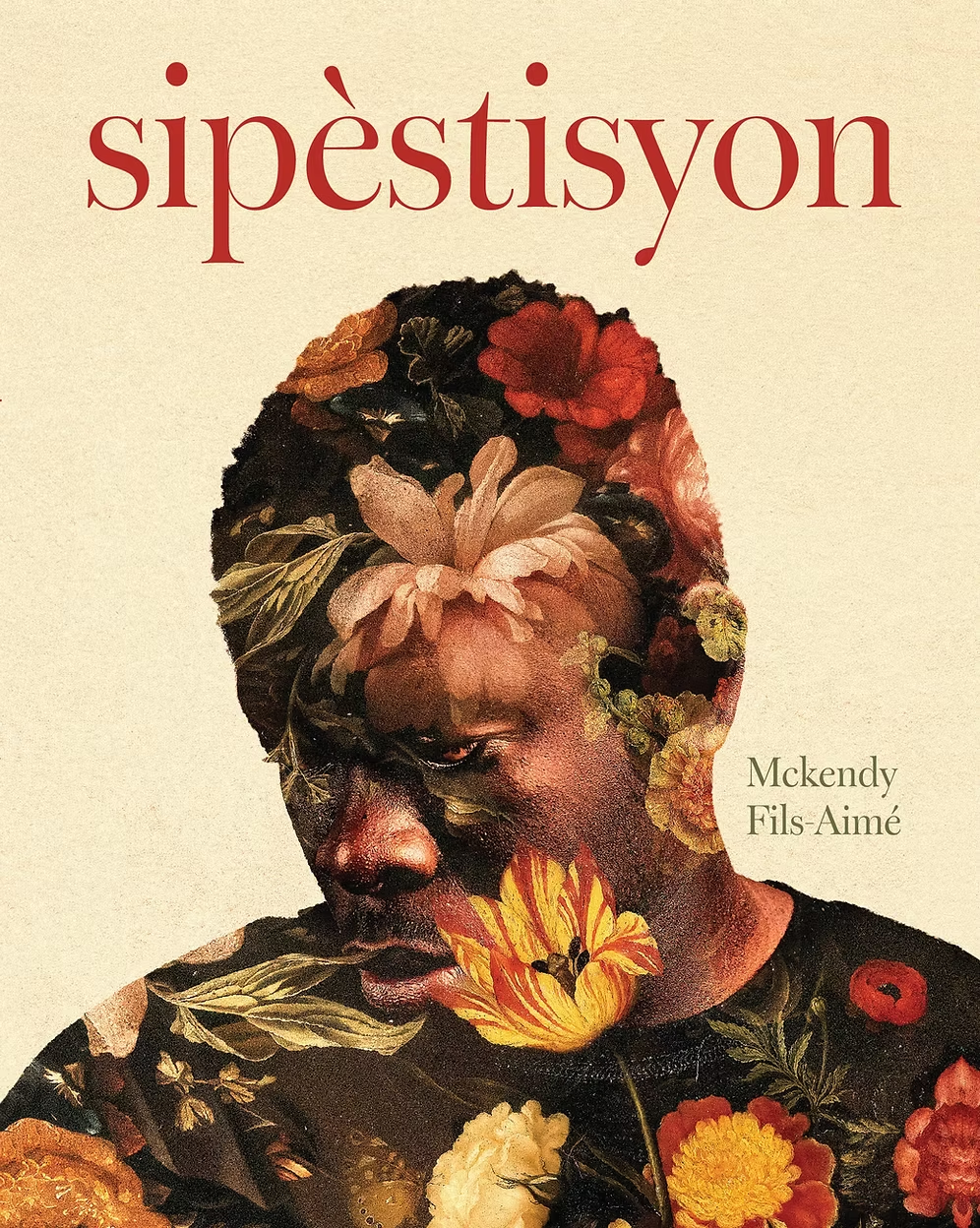
This month we had the honor of speaking with Mckendy Fils-Aime about their powerful debut collection sipèstisyon. The collection is an exploration of memory, both personal and cultural. Mckendy’s poems are visceral and immersive, each one plunging you into the deep end whether you’re ready for it or not, but always giving you a moment to return to the surface and breathe; to reflect alongside the poet about the good, the bad, and the unbelievable. These are poems that deserve to be read again and again, and they will reward you each time you do. The collection is available at Yes Yes Books right now; our interview is below.
Ada Wofford: Many of the poems share the same title as the collection and have a superstition serving as the epigram. Can you speak about the superstitions you chose for your epigrams and what they mean to you? Or if that’s too broad, why did you want to share these specific superstitions with readers? I was particularly interested in the first one, “If you comb your hair at night, you will lose your memory.”
Mckendy Fils-Aime: I started writing superstition poems during a 30/30 in 2017 as an additional challenge to myself. Many of my favorite collections featured a group of poems with a shared naming convention. In the past, I had tried my hand at writing such a series, but failed. The self-imposed challenge in 2017 was another attempt. I picked Haitian superstitions because they felt familiar to me and were a fresh way to explore the topic. I treated the superstitions like open-ended prompts and wrote to the ones I thought were the most interesting to me. When I was putting together sipèstisyon, I picked the superstition poems that were the strongest and complemented the project’s narrative. Like all books, some poems didn’t make the cut. There are a handful of superstition poems that I adore, but left out because they weren’t serving the book.
AW: Building off of that, memory plays a large role in the book. From personal memories, to passed-down memories, to cultural history. The poem “what we sacrificed” plays with the imagery of you and your family around a fire pit, throwing in “the furniture pieces turned javelins / meant for my mother’s skull. / my mother throws in a photo album/of other men…I throw in a wedding ring…I throw in letters / to a future self.” The poem ends, “it’s hard to tell when a flame is working / what is memory & what is kindling.” Can you speak about this idea of memory being both a solace and a burden, something that can soothe but also burn?
MF: Memories can be places of refuge or great sites of pain depending on your point of view, who you’re asking, or even when you’re asking. There are moments in sipèstisyon where the speaker and addressees have different perspectives on traumatic experiences, and that results in conflict. Our brains can be untrustworthy record-keepers, but they’re also our first confidants. Sometimes they’re all we’ve got. In sipèstisyon, there’s an impulse to forget, and with good reason, but that’s not conducive to healing. That also risks throwing away the small joys that can exist alongside terrible periods. Thankfully, the speaker understands this by the end of the book.
AW: In the poem “on superstitions,” you write about a pastor calling “superstitions the devil’s / proverbs.” I take from this the concept of fear. That superstitions are meant to invoke a sense of fear, but culturally they can be fragments of wisdom as well; small phrases or stories to remind us to keep our wits about us (e.g., don’t walk under a ladder). You touch on this in your interview with Shō Poetry Journal, saying, “I didn’t write the superstition poems out of fear or the need for control, but an interest in exploring these sayings that I grew up hearing.” May I ask you to build on that a bit and speak about the role you see superstitions playing in our daily lives, either positive or negative, either as a source of fear or of wisdom? Do they play a role in your life today?
MF: Regardless of their nature, I think all superstitions are a type of cultural artifact. Even the silliest ones have a history attached to them. Superstitions are just another attempt at preserving the beliefs and stories of the past. Are they a form of magical thinking? Sure. Are they an attempt at control? Sure. They’re also proof of what we can carry through time with just our voices and language. The superstitions in sipèstisyon are cultural signifiers and points of nostalgia. They remind me of my youth and act as markers of identity. I love when other Haitians and Caribbeans come up to me after I read a superstition poem and say “Oh yeah, I remember hearing that as a kid” or “Have you heard this one?” Those moments mean a lot to me.
AW: The imagery of a car crash is repeated throughout the collection; you write about nearly getting hit by a car as a kid, and in “the first accident” you write about a car accident from the point of view of a passenger. Can you speak about the significance of this imagery and the theme of experiencing a “near miss” in this collection? And do these near misses relate to the concept of superstitions in any way?
MF: sipèstisyon is about the aftermath of surviving harm. Sometimes harm comes from a visible source like a vehicle or physical violence, and sometimes it’s systemic, which can be invisible. One of the final poems in sipèstisyon is called “ode to the gris-gris bag,” and it explores the moments in my life where I’ve narrowly escaped death. The poem references an ancestral force that is looking out for me. I think often about survival and the unseen, about the unobserved forces, whether spiritual or manmade, that help us stay on earth a little while longer. Maybe superstitions are an attempt at rescue before we even encounter the “near miss.”
AW: In the opening poem you compare memory to a museum, later you ask if “naming is a culture’s way of colonizing a body,” and in another you write, “solitude is a kind of death when a home / is remade into a mausoleum.” All of these images relate to the concepts of intention and context. This is something the art world has been dealing with since Duchamp placed a urinal in a gallery (and probably long before that, but he’s the most famous example); the idea that how one frames something (or someone, for that matter) dictates how the rest of us are supposed to see it/understand it (i.e., it’s art if it’s in a gallery, or in terms of museums: “it’s not grave robbing if you’re an archeologist”). In your poem, what was once a home is now remade into a mausoleum through its context, through how it relates to how that space is being inhabited. How do these concepts (intention and recontextualization) play into your collection’s other themes of identity and selfhood?
MF: Early in my writing journey, I discovered the world of poetry slam and spoken word. I learned and still learn so many things from that space. One of my first lessons was the importance of framing. In slam, how an idea is presented to an audience can be the difference between whether or not a poem succeeds. Framing applies to so many other mediums, whether we’re talking about writing, other forms of oration, or visual art. Even in therapy, when we reframe, we’re altering our perspective of an event or experience in hopes of uncovering some insight to better heal. I couldn’t write about trauma, relationship, selfhood, and identity by looking at events from the same angle. I see each reframe as a new chapter in the narrative of sipèstisyon. To reach the collection’s conclusion and the speaker’s views of himself, I had to change my vantage point, and that required intentionality.
AW: From dissecting the Pokémon movie to musing on WrestleMania, the book explores not just nostalgia, but specifically millennial nostalgia; can you speak about the significance of incorporating your nostalgia for pop culture and how these pop, one might even say “lowbrow” (though of course I’m not saying it!) influences like Pokémon and Wrestling can function within a form like poetry?
MF: In sipèstisyon, the poems that reference pop culture help situate the book in time. I wrote them because I wanted to reflect on past experiences as an adult. But equally as important, I wrote them because I’m a big nerd. I’m a millennial, so Pokémon and WWF are key parts of my childhood. To this day, I’m still a huge fan of anime and video games. Leaning into pop culture and nostalgia is one of the ways I have fun with my writing and share my personality and interests with the audience. It’s an additional connection point between me and the reader. Poets can be so serious, myself included, and I think writing about nostalgia or our current nerdy/niche interests can be healthy and balancing. I also want to say that the exciting thing about writing and reading poems is that they can be inspired by so many different things. I’ve read poems in the shape of nutrition labels that are dope. As long as they’re not offensive and executed well, I’m here for the pop culture poems.
AW: What are you looking forward to as a writer-in-residence at Sundress?
MF: I’m really looking forward to the dedicated time to write. Life is pretty busy right now, so I know I’ll appreciate the change of scenery. I have a few projects that I’m working on that I really want to focus on during that week. I’m also interested in seeing how being on a farm will influence my poems.
AW: And lastly, is there anything I didn’t touch on that you would like to talk about? Any new projects we should look out for?
MF: I’m working on a few different manuscripts right now, but nothing is close to completion. I’ve been working on my second poetry manuscript, a collection of poems about a shapeshifter in Haitian folklore called a lougawou. I’m also in the early stages of a chapbook that explores identity and labor. I’m hoping to have a working draft of the former by the spring.
Mckendy Fils-Aimé is a New England-based Haitian American poet, organizer, and teaching artist. He has received fellowships from Callaloo, Cave Canem, The Watering Hole, CantoMundo, and Periplus. His debut poetry collection, sipèstisyon, was published by YesYes Books in 2026.
Ada Wofford (they/them) holds MAs in both English and Library Studies. In addition to working at a rare book shop, they are an associate poetry editor at Sundress Publications, the editor of We Call Upon the Author to Explain, and the non-fiction editor at Stirring: A Literary Collection. Their writing has appeared in The Blue Nib, McSweeney’s Internet Tendency, Autostraddle, Capable Magazine, Sundress Reads, and more. Their chapbook, I Remember Learning How to Dive, was published in 2020, part of which earned them a Pushcart Prize nomination.
Forty Bouts in the Wilderness (MoonPath Press, 2025) by Katy E Ellis is a poetic memoir that plays with the multiple meanings of “bouts” and “wilderness.” It’s about becoming homeless due to one’s spiritual beliefs and finding one’s place when family becomes equivalent to alienation. The book is split into three major parts, giving readers multiple reflections on what family can mean for the family outcast and how powerful grief can lead to reinvention, and a new acceptance.
The first part is forty tercets describing the speaker’s family unexpectedly “calling her from the dust” for her father’s emergency hospitalization in the ICU. Every day is “like the first day of kindergarten” to her, being surrounded by siblings who act as if they never shunned her for years. Visually, the tercets stand upright with immediate tension, as if bringing us into the claustrophobic medical setting with her.
In footnotes, Ellis provides context to the unmooring disassociation she feels with her attendance, including anecdotes of how she questioned her family’s Christianity and its purpose, leading to her religious rejection and isolation from her family. As she binds these episodes with stunning metaphors of nature and fantasy, the imagery brings to the fore beautiful, unsettling grief. One of my favorite sets of lines concludes “Bouts 19~21”’s ninth footnote; during a period of personal distress, “[her] mother and sisters stood in a nearby pasture, bleating mournfully across the strong budding vines of pink-red climbing roses that enveloped the low, fieldstone wall I’d built between us.”
We are with her as she untangles the complexity of her memories with the urgent reality of her father’s comatose state, followed by his faltering health and memory whenever he wakes from his “grisly hibernation.” Her father is the parent who she found the most comfort in before and during her ostracization, and she openly laments his fractured mind:
“What if my father opens his eyes, sees
me as stranger among his children’s ranks?
Brother-sister tides push me out to sea.
A child lost, found, or—? His face a blank.
I fear I won’t survive another sleep
and wade the shadows where forget flows deep.”
Within the footnotes, Ellis also weaves in her family’s history of miscarriages. Another unwanted loss of family that was shared but then hushed, parallel to her experiences as the black sheep. The speaker miscarries twice, a daughter and a son, and her pain for the loss haunts her throughout the chapbook. Miscarriages are brushed aside by her family, and, again, she is comfortable not conforming to their mentality of rarely mourning the dead children. She practices private rituals for hers. In the seventeenth footnote for “Bouts 28~30,” the moon guides her soul to “the pearl’s blue center, where a child resides,” her love for her lost son embraced, kept precious and eternal.
Part two, “Pilgrim’s Pace,” recalls the speaker’s globe-trotting with her husband to cities of divine respite through Europe and Asia. It is done to help validate herself and to heal from her painful miscarriages. Her free-flowing journey of spiritual exploration and healing contrasts with memories of her stricter Christian upbringing, and her quiet disappointments with her family’s stagnant and willful dismissal of her life-changing experiences. In “Dear Istanbul,” Ellis writes:
“Yesterday, my grandparents offered me weak coffee, cookies and Bible verses… They forgot they found my presence more harrowing than my absence, that my voice no longer harmonizes with the plodding organ pipes that pound Easter hymn-notes like wooden stakes into my heart of doubts.”
What’s powerful about this part to me is that the speaker wrestles with the idea of forgiveness. Forgiveness to whom? For what? Her younger mind once thought she was the one who needed her family’s forgiveness. But through her travels, she gradually witnesses other practices for letting go, for worship, for death, and she reconsiders. In the cityscape of Fatima (“Worthy of Belief”), she makes peace with her wounded spirit, realizing that grace can shape into many forms “like a time-lapse film of a seed come to light / when spirals burst open and sunflowers appear. / She knows my prayers before I do.” It’s a heartwarming section of self-acceptance that feels poignant after her somber childhood recollections.
It is during her travels in part two that she mentions she and her husband had been trying for a child again, and she rejoices in finding a new sense of home in part three, “[Re]turnings.” After she and her husband’s globe-trotting and healing, a period compared to floating in space, they return to North America. First, for mourning, due to her beloved uncle’s passing, her father’s decline, and her lost son.
And she celebrates her five-year-old daughter throughout the grief. Whether it has been her daughter’s playful obsession with gemstones or her careful nursing of a hurt robin, she has been an innocent joy in the speaker’s life, her motherhood helping her “earth into place.” To her daughter (“When You Grow Up and Read This”), she fondly writes:
Feel your breath lift green glass beads faceted amethyst each ring of silver on the long chain where I hung a lighthouse, a Tahitian pearl or a compass— each morning choosing a talisman more than lucky enough.
Forty Bouts in the Wilderness has stayed with me long after reading. Ellis’ touching wordplay for truly belonging makes this book unforgettable to me.
Heather Takenaga is a poet and writer born and raised in Riverside, CA. She is currently writing short stories and poetry. When she is not volunteering, she is drooling for cat cuddles, moonlit walks, and a reading vacation.
This feature, chosen by Guest Editor EMDASH, is an excerpt from All Water Has Perfect Memory by Nada Samih-Rotondo (Jaded Ibis Press 2023).
SILENT PERIOD
Rhode Island, 1990
My body is drawn to bodies of water. I was born in Kuwait City, minutes from the shores of the Persian Gulf. For six summers I waded in the waters of the Persian Gulf, the same waters my grandfather fished after leaving Palestine to settle in Kuwait. He had a boat he would take out in the morning with his brothers, returning in the evening with piles of slip- pery fish. My grandmother gutted, cleaned, dressed, and fried or roasted this gift from the sea for the family. My mother and her siblings were born and raised along those shores, but were never granted Kuwaiti citizenship: a coveted prize rarely awarded to descendants of the Palestinian diaspora. Nevertheless, Kuwait was home to my family, as it was to 400,000 other Palestinians. At age six I ended up in the United States, specifically in Rhode Island, aptly nicknamed the Ocean State. I’ve spent the last thirty years inhaling the salty Atlantic, the tips of my fingers pruned, my curly hair matted and waterlogged. I grew up wide-eyed and feral, stomping along muddy riverbanks barely recovered from industrial ravage. But it was always the Mediterranean—the turquoise shores of Yafa—that my blood ebbed toward.
Nada (she/her) is a multi-genre Palestinian writer, educator, and mother deeply attuned to her adopted land’s stories. A refugee English language learner, Nada grew up deeply impacted by family separation and state violence both in Palestine and on Narragansett land or so called Rhode Island. As a working class caretaker, Nada aims to create innovative, anti-imperialist works of literature that play at the intersections of the more than human world, expands imaginations, illuminates connections between land and body, and inspires joyful resistance. Her writing has appeared in Masters Review, Gulf Stream Literary Magazine, and others. All Water Has Perfect Memory, a multigenerational hybrid memoir, is her first book.
Photo Credit: Juan Camillo Garza
EMDASH a.k.a Emily Lu Gao (高璐璐) (she/they) is a poet-who-also-writes-fiction, educator, and daughter of Chinese immigrants. She writes to heal, grow, and decolonize. They’ve received support from LAMBDA, McCormack Writing Center, Sundress Publications, Bread Loaf Environmental Writers Conference, The Chinese American Museum of LA, Jersey City Arts Council and more. She has learned as much from community organizing and open mics as she did from her Rutgers-Newark MFA in Poetry. They’re published in Poetry Northwest, ANMLY, Alocasia, Underblong and elsewhere. She proudly hosted, produced, and curated The Word Bookstore Open Mic for two years.
This feature, chosen by Guest Editor EMDASH, is an excerpt from All Water Has Perfect Memory by Nada Samih-Rotondo (Jaded Ibis Press 2023).
MERCY
Yafa, Palestine 1920
Til-yat-ruh-he is an Arabic phrase meaning “my soul rose up,” describing an experience so troubling that your soul almost leaves your body. I’ve heard my mother say til-yat-ruh-he when referencing something being strenuous, painful, or even boring if she was being ironic. I also heard her describe her experience of birthing me this way.
Nada (she/her) is a multi-genre Palestinian writer, educator, and mother deeply attuned to her adopted land’s stories. A refugee English language learner, Nada grew up deeply impacted by family separation and state violence both in Palestine and on Narragansett land or so called Rhode Island. As a working class caretaker, Nada aims to create innovative, anti-imperialist works of literature that play at the intersections of the more than human world, expands imaginations, illuminates connections between land and body, and inspires joyful resistance. Her writing has appeared in Masters Review, Gulf Stream Literary Magazine, and others. All Water Has Perfect Memory, a multigenerational hybrid memoir, is her first book.
Photo Credit: Juan Camillo Garza
EMDASH a.k.a Emily Lu Gao (高璐璐) (she/they) is a poet-who-also-writes-fiction, educator, and daughter of Chinese immigrants. She writes to heal, grow, and decolonize. They’ve received support from LAMBDA, McCormack Writing Center, Sundress Publications, Bread Loaf Environmental Writers Conference, The Chinese American Museum of LA, Jersey City Arts Council and more. She has learned as much from community organizing and open mics as she did from her Rutgers-Newark MFA in Poetry. They’re published in Poetry Northwest, ANMLY, Alocasia, Underblong and elsewhere. She proudly hosted, produced, and curated The Word Bookstore Open Mic for two years.
This feature, chosen by Guest Editor EMDASH, is from The Night Is What It Eats by Danielle Hanson (Codhill Press 2026).
St Barnabas in the Afterlife
Heaven is just a storage locker for ghosts with no one to haunt. I spend my days wringing out the laundry of my flesh, airing it like a braid of garlic from the ceiling. My martyrdom requires upkeep—patching and darning, and always the slipping of the parts of me that haven’t yet let go.
Danielle Hanson (she/her) is author of The Night Is What It Eats (Elixir Press Prize), Fraying Edge of Sky (Codhill Press Poetry Prize), and Ambushing Water (Finalist, Georgia Author of the Year), and editor of the poetry anthology Objects in This Mirror (Press 53) and a book of literary criticism. She is Marketing Director for Sundress Publications, inaugural Poet Laureate of Costa Mesa, California, and Writer-in-Residence at UC Irvine.
Photo Credit: Juan Camillo Garza
EMDASH a.k.a Emily Lu Gao (高璐璐) (she/they) is a poet-who-also-writes-fiction, educator, and daughter of Chinese immigrants. She writes to heal, grow, and decolonize. They’ve received support from LAMBDA, McCormack Writing Center, Sundress Publications, Bread Loaf Environmental Writers Conference, The Chinese American Museum of LA, Jersey City Arts Council and more. She has learned as much from community organizing and open mics as she did from her Rutgers-Newark MFA in Poetry. They’re published in Poetry Northwest, ANMLY, Alocasia, Underblong and elsewhere. She proudly hosted, produced, and curated The Word Bookstore Open Mic for two years.