Project Bookshelf with SAFTA Intern Nora Walsh-Battle

I don’t own a physical bookshelf. Not even a cluster of milk crates stacked together, or one of those cheap wire monstrosities that warp spines and dent pages so thoroughly you might as well have just sent your books through the dryer. No bookshelf, no windowsill where even a perpetually closed pane will still lead to some water damage. And I can’t see myself changing that any time soon, so target someone else with your ads, IKEA–except the oversized stuffed animals, particularly the DJUNGELSKOG. I would like very much to keep seeing those ads, thank you.

Books have always been an essential part of my life, from my childhood where I spent hours tied up in titles I had no intention of buying in the cafe of my local, now-defunct Borders Bookstore to my college years, where I majored in English but more often than not found myself ignoring assigned coursework for the delights of the campus library’s ‘New Releases’ shelf. My main rebellion of undergrad was beginning to acquire books that I had only read once or sometimes hadn’t read at all, judging by cover blurbs or word of mouth alone. Textbooks were a sterling exception to this tendency and I’m proud to say I made it four years only purchasing two, renting less than a dozen. 

When I explain to people the strict criteria my parents had enforced for acquiring books, they assume this minimalism extends to all aspects of their consumption. This is not the case at all and in almost all other circumstances, my parents could be classified as hoarders. Middle-aged when they had me, their only child, our relationship has always been more like that of a landlord and tenant. My parents had packed our house to the brim by the time I was old enough to want for things and, aware of the impediments this want had caused them, they tried their best to curtail it by limiting my possessions and insisting they stay confined to my bedroom. Avid readers themselves, this aversion to accumulating books seems poignant to me. Like they recognized the escape reading provided and refused to risk it becoming tainted by the very thing I would need to escape from. 

In the years since I’ve been out in the world, my collection of books has grown considerably. Currently, they live against one wall of my room, stacked in two rows that rotate regularly with no variation asserting any aesthetic value that would suggest anything other than laziness on my end. The frontmost contains fresh reads, the books which I acquired unread, and pressing re-reads, the books I keep coming back to. The back row contains volumes I’ve read so many times I don’t find myself needing to reach for them, as well as those I’m hoping to trade in at my local used bookstore. Jeffrey Eugenides’ Middlesex stands as a pillar of the back row, once comfortably in the former category as one of the first books I read upon my exodus from the YA section, but seemingly more and more like the latter following the increasing criticism of its portrayal of intersexuality and the accusations of sexual misconduct against its author. The front row is also home to: the classic Middlemarch which I have many times feigned familiarity with, Spinning, Tillie Walden’s graphic memoir, not one, not two, but three copies of Crush by Richard Siken, all annotated differently with my own marks and those of borrowers, the latest Ottessa Moshfegh novel, and the behemoth Infinite Jest, which after years of derision I aspire to revisit, although it keeps finding its way back to the bottom of the stack every time I unearth it. 
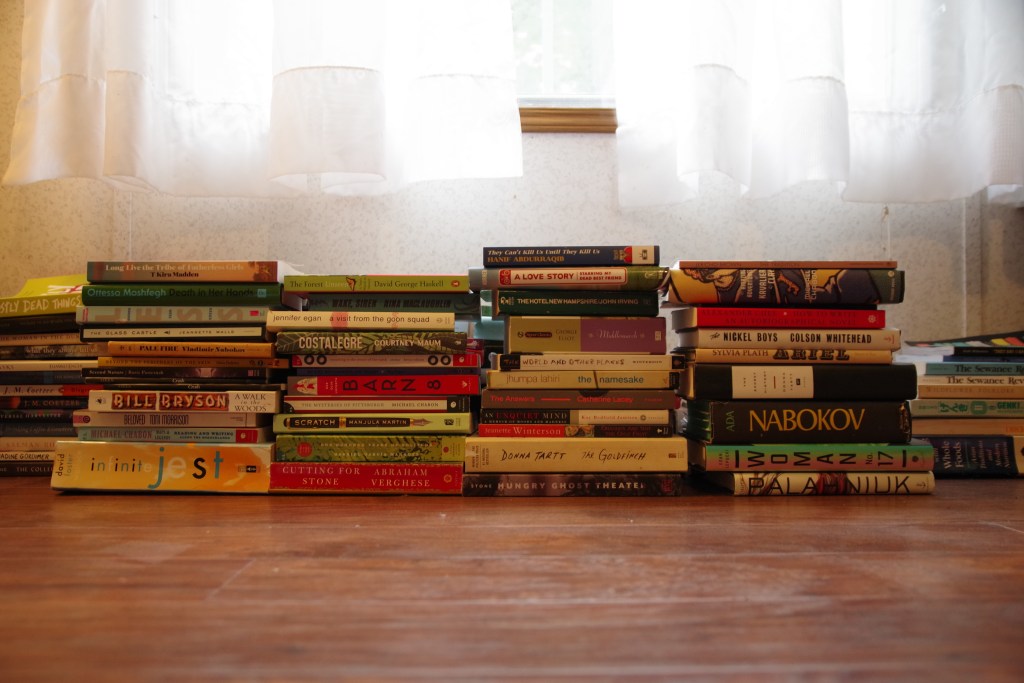
To further complicate this already haphazard system, lately copies of The Amazing Adventures of Kavalier and Clay by Michael Chabon (a perennial favorite that catapulted me out of the YA section in the first place and shaped my reading sensibilities for years after), They Can’t Kill Us Until They Kill Us by Hanif Abdurraqib, and Long Live The Tribe of Fatherless Girls by T Kira Madden hopscotch between these subjective designations without objectively, as actual objects, landing in either place, instead waiting dog-eared on my bedside table or splayed open at my workspace, ready to be picked up and penciled with abandon. If this admission has made you raise a hand to your heart in disbelief or concern, I’m sorry! Despite their novelty, I can’t bring myself to regard the books I own with any preciousness. My logic is that I won’t ever be the same as I did in the moment I acquired them or the same as I was before reading, regardless of the impact of the book, so why try to maintain that illusion as far as the pages themselves? 

It’s for this same reason that I’m reluctant to acquire an actual bookshelf. Reluctant to commit myself to owning one more thing I’ll have to be responsible for, and likely fail at, maintaining. As long as my books remain unshelved, I feel like I’m still engaged with them, like my reading list is less like a catalogue and more like a creed, a statement of my belief in the written word’s importance. 

Nora Walsh-Battle is a recovering stand-up comedian currently living and working on an organic farm outside of Asheville while she plans her next move. She is endlessly enraptured by the poetry of Richard Siken, considers Wikipedia to be a primary source, and is a certified Excel pro.

Sundress Academy for the Arts Presents: October Virtual Reading Series

The Sundress Academy for the Arts is proud to present “A Virtual Reading Series” on October 28th, 2020 from 7-8PM EST on Zoom. Access the event at tiny.utk.edu/sundress. The password is safta.

Tamara J. Madison is a writer, poet, instructor, and editor.  Her critical and creative works have been published in various journals and anthologies. Madison earned a BA from Purdue University and MFA from New England College. She also studied at the University of Strasbourg (France). She is a professor of English and Creative Writing at Valencia College, Orlando, Florida and contributing editor for aaduna, an online adventure with words and images. Madison is the author of Kentucky Curdled(poetry and essay) and Collard County,(fiction).  Her most recent poetry collection is Threed, This Road Not Damascus, published by Trio House Press

Julie Marie Wade teaches in the creative writing program at Florida International University in Miami. She has published 12 collections of poetry and prose, most recently the book-length lyric essay, Just an Ordinary Woman Breathing (The Ohio State University Press, 2020) and the hybrid-forms chapbook, P*R*I*D*E(VCFA/Hunger Mountain, 2020). A winner of the Marie Alexander Poetry Series and the Lambda Literary Award for Lesbian Memoir, Wade makes her home in Dania Beach with her spouse Angie Griffin and their two cats.

Robin Gow is a trans poet and young adult author from rural Pennsylvania. They are the author of Our Lady of Perpetual Degeneracy (Tolsun Books) and the chapbook Honeysuckle (Finishing Line Press). Their first young adult novel, A Million Quiet Revolutions is forthcoming in 2022 with FSG. Gow’s poetry has recently been published in POETRY, New Delta Review, and Washington Square Review. Gow received their MFA from Adelphi University where they were also an adjunct instructor. Gow is a managing editor at The Nasiona and MAYDAY magazine.

Project Bookshelf with Social Media Intern Sydney Peay

Photo of a small black bookshelf filled with items and a large mirror on tops

Because I live in a small apartment in Fort Sanders, my bookshelves work to house more than just books. My favorite bookshelf in my apartment is the small black bookshelf that sits in my bedroom, which is approximately 25 percent books, 25 percent altar space, and 50 percent miscellaneous storage.

On the top of the shelf is my altar space. I practice witchcraft, so this space is dedicated to my practice. Most of the items on are symbols of Aphrodite, who I worshipped for the majority of the last year. My witchcraft practice has changed quite a bit with the major changes to my daily life over the past few months, so I plan on redesigning this space soon. My favorite pieces of my altar are this gorgeous mirror that I got for just 8 dollars on Facebook Marketplace, as well as the books I have placed on my altar: The Parable of the Sower by Octavia E. Butler, Black Feminist Thought by Patricia Hill Collins, Emergent Strategy by adrienne maree brown, and I Know Why the Caged Bird Sings by Maya Angelou. Each of these books has been incredibly formative to my worldview, and I see these women as teachers in many ways, so I gave them a special place on my altar.

Photo of a single shelf of books

Beneath my altar space is the only actual shelf of books in my room. While most of my school books reside in my living room, these are (mostly) books that I was using for my former thesis project, which was interested in the intersection between science fiction depictions of fascism and fascism in American politics. There’s also a few witchy books, as well as my favorite young adult novel series, The Chaos Walking Trilogy by Patrick Ness, which sits on my shelf in hopes of being reread one day soon.

These days, most of my reading is for class. As it turns out, when studying literature is your major, it makes it difficult to read for pleasure. When I do find time for pleasure reading, most of what I read is nonfiction. I started reading nonfiction because I could no longer see myself in the young adult novels that dominate my bookshelf at my parents’ house, but I still can’t quite see myself in fiction for “grown-ups” yet either. Now, I genuinely enjoy reading nonfiction, particularly about social topics such as race, class, and gender, and I hope to one day be able to write my own work of nonfiction if I ever get a handle on my writing style and research interests which are, currently, extremely scattered.

Most of the other items on this shelf are simply things I couldn’t find a better space for on my dedicated storage shelf. However, if the goal of this post is to get to know me, I think it is important to share the massive stack of sketchbooks that resides on the bottom shelf. Back at my parents’ house, I have a box with about eight times more sketchbooks ranging back to my first real sketchbook that I must have gotten around age eight or nine. Art has always been an important part of my life, especially in dark times as it became a meditative practice to illustrate my emotions and cope with stress. I’ve been having trouble finding the motivation to draw since the pandemic started.

The rest of my books reside in my living room, split between a few different shelves and interspersed with my girlfriend’s books. These are mostly school books, but there are a few that I bought for myself back when I could still go to McKay’s every other weekend. They aren’t organized any particular way, which is probably why I can never find my books when I’m looking for them.

I worry that my bookshelves highlight more about the kinds of classes I take than the kind of person I am, but I hope that by sharing the multipurpose space that is my bookshelf, you are able to better understand who I am as a person.


Photo of Sydney Peay

Sydney Peay is a senior studying sociology and English literature at the University of Tennessee. In addition to interning at Sundress Publications, they serve as the social media coordinator for the Voices Out Loud Project, an LGBTQ+ archive of East Tennessee. They are also a student library assistant at Hodges Library, and they hope to pursue a masters of library sciences after they graduate.

Sundress Reads: Magnolia Canopy Otherworld

Erin Carlyle’s debut book of poetry, Magnolia Canopy Otherworld, compels readers to ask themselves where the line between animalistic and humanistic lies. This book shows the blurred lines between human and inhuman, especially in relation to young girls and the objectification of their bodies. 

Carlyle’s poetry beautifully presents growing up as a young girl in the impoverished South during the opioid crisis. These poems, shown through an animalistic and naturalistic lense, seamlessly presents themes of death, womanhood, motherhood, sexuality, and nature. 

The book opens with the quote “Family is family, but even love can’t keep people from eating eachother” by Dorothy Allison. It perfectly sets the tone of the book and constantly floats in the back of the reader’s mind. There are multiple poems within the book about watching parents struggle with  alcohol and opioid addiction as well as connecting with their children. 

The collection consists of three parts, the first one showing the overall themes that will be present in the parts that follow. The majority of them are about the problems women face for simply being women. Carlyle writes “you are on a bed/ he made of other women’s bodies. He tells you not/ to look, but you can’t/ shut your eyes” in her poem titled “Tales.” 

The second part opens with the poem “On the Horizon of Recollection” and shows the reader a soothing image of women in white skirts raising you up from the water, almost like a baptism, but it’s not. “This is not a baptism,/ but a call back to your life after you crawled out of the cave of your mother,/ that old danger.” This is also where the reader’s are introduced to “The Animal” which is a representation of the narrator herself, however the pronouns for The Animal is it/its. The Animal is trying to navigate life and dealing with things such as first blood, sexual awakening, and family trauma.

The majority of part three is about the search of a girl who the narrator had a connection with. This part is the most haunting; the feeling of hopelessness and helplessness reaches out from the page. The book ends with the narrator standing among the dead in the poem “The Afterlife of Women” and they can “smell the oldest/ danger in the air– magnolia on the wind” but their mother calls them home. This theme of motherhood opens the book and closes it. The circularity of motherhood is embraced in this book as well as the hardships and comforts that comes with it. 

These poems are based on the stories of Carlyle, the stories of women Carlyle has known in her life, and the stories of women Carlyle has seen on the news. Carlyle’s poetry of these women, including herself, are raw, uncensored, and unapologetic. It’s real, they’re real, and they need to be heard. They need to be felt. 

Magnolia Canopy Otherworld magnificently shows the importance of place. The poetry is sharp in the right places, always ready to strike and expose the gory interior when necessary. The collection is a delightful and impactful read, the beauty of the poems perfectly juxtaposes with the darkness of the content. I highly recommend this book, especially to those who understand the animalistic tendencies of men. 

Magnolia Canopy Otherworld is available at Driftwood Press


Bethany Milholland is a senior at The University of Evansville majoring in Creative Writing. She is the former Co-Editor-in-Chief of The Evansville Review. She is also a former intern for her University’s magazine The Crescent. In her spare time, she enjoys earning a cat’s love and shopping at every thrift store within a thirty-mile radius.

Meet Our New Intern: Mary Sims

There’s something to be said for the lasting impact of childhood fascination. When I was fifteen, my fascination led me to the purchase of my first poetry collection.

Kay Ryan’s The Best of It sat on my lap in my local Barnes & Nobel, cracked open as I scanned through the pages. I still don’t remember exactly what I was looking for when I picked up her collection. I think I had wanted something new—some revolutionary concept I had not found in the marketable fiction I was the target of. I wanted something different yet familiar; I wanted something I didn’t know how to want. And in traveling down that pathway, Ryan’s collection was just the beginning. 

Before this, I hadn’t invested much of my own time into poetry. Instead, I associated the genre with the fond memories I had with my grandmother when she would read Emily Dickinson to me. But even then, I didn’t enjoy Dickinson for her poems so much as the time I could spend together with my grandmother, lying in her bedroom and listening to her read in the Tennessee heat. I was too intimidated by the line breaks and condensed language to read poetry on my own, even if I found it striking. I would sit, soaking up the sun and watching shadows of trees on the walls, and think, what makes poetry so different? I couldn’t put my intrigue into words. 

At fifteen, I still didn’t have the answer. I don’t remember if I was even conscious of that same question when I picked up Ryan’s collection. I was simply struck by the want of something new, the denied childhood closure of understanding that I still hadn’t found. I spent a week reading through her collection before something clicked and my spiral into poetry began.

Ryan led into Mary Oliver who led into Jamaica Kincaid, leading then into other contemporary poets like Franny Choi and Kaveh Akbar. I spent the rest of high school consuming any collections I could get my hands on; I thrived off of local second-hand bookshops and their mixed collections of renown and local poets. I read so much I felt I had to start writing just to have a place to put it all down. 

At eighteen, I entered college and became involved in my local literary community. I joined literary clubs and attended public readings. I got involved with book festivals to promote others as well as present my own work; I took a poetry workshop class that changed my life for the better.

I started submitting to journals and applying to open editor positions for magazines. Currently, I co-run a poetry club and work as a poetry editor for Waymark Literary Magazine, a magazine I joined with my friends. My fascination with poetry as a child, the intimidation I felt from the genre, manifested into one of my favorite things. The opportunities and the friends I have gained from my impulsive decision to pick up Kay Ryan’s book is rooted in my unanswered childhood fascination. 

At the very beginning of 2020—years after I had picked up my copy of The Best of It—I would get the privilege of attending one of Kaveh Akbar’s lectures, during which my childhood question would once again come up: What makes poetry so different? I would realize, through the opportunities and events that had led me here, that there is no single, solid answer. That the “difference” I had always associated with the genre was just another way of alienating an art form that seeks to understand as well as communicate.

Poetry is not something that begs a consistent understanding of itself but rather a genre that thrives off its ability to empathize and to feel, a form that is remarkable because it surpasses the barriers of language instead of adhering to them. I would listen, learn, and speak with the poets around me, and I would find that poetry is not a method of intimidation but a gift of communication attempting to bridge the ever-present gap between each of us.

This gift has led me down many wonderful pathways, but I am especially thankful to have been directed to this one: where I am more than happy to work for Sundress Publications and to contribute back to the community that has kindly given so much to me.


Mary Sims is an undergraduate writer working toward her BA in English at Kennesaw State University. She is currently a poetry editor for Waymark Literary Magazine and a former student editor for the Atlanta based magazine Muse/A. Her work has appeared in Glass: A Journal of Poetry, The Poetry Annals, Peach Mag, and more. She can often be found filling her shelves with poetry collections, roaming antique stores, or laughing over raspberry cappuccinos with friends.

Sundress Publications Staff to Present at The Plot Summit: Escape the Plot Forest

Sundress Publications’ own Megan Cass, Samantha Edmonds, and Saba Syed Razvi will present Surprise, Strangeness, and Story on October 24, 2020 at 3:30 pm EST during The Plot Summit: Escape the Plot Forrest, a virtual fiction writing conference. 

Meagan Cass is Assistant Editor at Sundress Publications and Associate Professor of English at the University of Illinois, Springfield. She won the Katherine Anne Porter Prize in Short Fiction for her story, “AcitvAmerica.” Some of her other stories were published in Joyland, DIAGRAM, andMississippi Review, among others. Cass holds an MFA in Fiction from Sarah Lawrence College.

Samantha Edmonds, a PhD student in creative writing at the University of Missouri, is Assistant Editor at Sundress Publications. She is the author of the chapbooks Pretty to Think Soand The Space Poet. Her fiction and nonfiction have appeared in The New York TimesGay MagazineNinth LetterMichigan Quarterly Review, and The Rumpus.

Saba Syed Razvi is Associate Fiction Editor at Sundress Publications and Assistant Professor of English and Creative Writing at the University of Houston. She holds aPhD in Literature & Creative Writing from the University of Southern California. Razvi is the author of In the Crocodile Gardens and heliophobia and several chapbooks, including Limerence & Lux, and Beyond the Harem’s Veil

The Plot Summit is centered around staying confident while writing your first draft, building mystery, developing characters, structuring your tale around revelations, and earning your ending. The final day will include sessions on how to build your audience and market your book. 

Register by Wednesday for a chance to win a FREE all-access pass!

Free registration includes full workshop attendance and replay access for 24 hours. Registrants can purchase a Plot Pass for unlimited replay access. 

Sundress Publications Editorial Internship Open Call

Sundress Publications is an entirely volunteer-run 501(c)(3) nonprofit publishing collective founded in 2000 that hosts a variety of online journals and publishes chapbooks, full-length collections, and literary anthologies in both print and digital formats. Sundress also publishes the annual Best of the Net Anthology, celebrating the best work published online, runs Poets in Pajamas, an online reading series, and the Gone Dark Archives, preserving online journals that have reached the end of their run.

The editorial internship position will run from January 1 to July 1, 2021. The editorial intern’s responsibilities can include writing press releases, composing blog posts and promotional emails, proofreading manuscripts, assembling press kits, collating editorial data, research, managing spreadsheets, and more. The intern may also be responsible for writing copy, conducting interviews with Sundress authors, reviewing newly released books, and promoting our catalog of titles.

Preferred qualifications include:

· A keen eye for proofreading
· Strong written communication skills
· Familiarity with WordPress, Microsoft Word, and Google Suite
· Ability to work under a deadline and multitask
· Knowledge of and interest in contemporary literature a plus

This is a REMOTE internship with the team communicating primarily via email and text messages and is therefore not restricted to applicants living in any particular geographic area. Interns are asked to devote 10 hours per week to their assignments.

While this is an unpaid internship, all interns will gain real-world experience of the ins and outs of independent publishing with a nationally recognized press while creating a portfolio of work for future employment opportunities. Interns will also be able to attend all workshops at the Sundress Academy for the Arts at cost.

We welcome, encourage, and are enthusiastic to see a diverse array of applicants in all areas, including race, ethnicity, disability, gender, class, religion, education, immigration status, and more.

To apply, please send a resume and a brief cover letter detailing your interest in the position to incoming Staff Director Kanika Lawton at sundressstaffdirector@gmail.com by November 20, 2020.

A detailed application and interview guide can be found here.

SAFTA Announces Winners of Spring Residency Scholarships

The Sundress Academy for the Arts (SAFTA) is pleased to announce Michael Chang, Ashley Taylor, Kelly McQuain, Kyle Dillon Hertz, and Gauri Awasthi as winners of the Spring residency scholarships. These residencies are designed to give artists time and space to complete their creative projects in a quiet and productive environment. 

The two winners of the Lambda Literary Fellowship are Michael Chang and Ashley Taylor

A Lambda Literary fellow, Michael Chang (they/them) was awarded the Kundiman Scholarship at the Miami Writers Institute. A finalist in contests at the Iowa Review, BOMB, NightBlock, & many others, their poems have been nominated for Best of the Net. Their manuscript, <big shot manifesto>, was selected by Rae Armantrout as a finalist for the Fonograf Editions Open Genre Book Prize.

Ashley Taylor [she/they] is a poet performer and an MFA candidate at Spalding University’s School of Professional and Creative Writing. They develop programming that amplifies emerging marginalized voices, focuses on themes of resistance and joy, and engages with texts that address themes of identity, conformity, and the body politic. Ashley is the co-creator and designer for Lipstick University, an online writing program for spoken word poets, as part of an artist collective with Rheonna Nicole (Lipstick Wars Poetry Slam) and Louisville Literary Arts. She is the founder of the reading series River City Revue and collaborative writing workshops Keep Poetry WEird, the author of The Metamorphosis of Narcissus (Damaged Goods Press, 2019) and a teacher at the Jewish Community Center in Louisville, Kentucky. You can find out more @ www.ashleytaylorpoet.com

The winner of the Dr. Kristi Larkin Havens Memorial Fellowship is Kelly McQuain

Kelly McQuain is the author of Velvet Rodeo, which won the Bloom chapbook poetry prize. His prose, poetry and illustrations have appeared in The Pinch, Painted Bride Quarterly, The Philadelphia Inquirer, Rogue Agent, Spunk, Assaracus and Cleaver, as well as such anthologiesasThe Queer South, Drawn to Marvel, LGBTQ Fiction and Poetry from Appalachia, Eyes Glowing at the Edge of the Woods: Fiction and Poetry from West Virginia, andRabbit Ears: TV Poems. As a visual artist, McQuain has won prizes from the Barnes Foundation and the William Way LGBTQ Center, and his series of writer portraits appear as cover illustrations at Fjords Review. He has been a Sewanee Tennessee Williams Scholar and a Lambda Literary Fellow, and he has received two fellowships from the Pennsylvania Council on the Arts. www.KellyMcQuain.wordpress.com

The winners of the Fellowship for Marginalized Writers are Kyle Dillon Hertz and Gauri Awasthi.

Kyle Dillon Hertz received his MFA in fiction from NYU, where he received the Writer in the Public Schools Fellowship. He is at work on The Lookback Window, a novel. He can be found on instagram @kyledillonhertz or at www.kyledillonhertz.com.

Gauri Awasthi is an Indian poet and sustainability activist. She is currently an MFA candidate at McNeese State University in Louisiana, where she has been awarded the John Wood Poetry Prize. When not writing, she runs The Vegan Wardrobe (@theveganwardrobe) to raise awareness about cruelty-free fashion. Her writing has been previously published in The Wire, in two anthologies by Penguin (India), Buzzfeed, and others.

Project Bookshelf with Ashley Hajimirsadeghi

I have a confession to make, one that can be quite sinful or scandalous: I stack my books on the floor of my apartment. Unfortunately, I am roughly three-hundred miles away from my apartment, so for now the image above will be the sole representation of my hoarding. This is from my dorm room, where I stacked all of my books on the windowsill. I’m quite a fan of a vertical book stack; my Instagram saved section can vouch for this (it’s all book stacks and nothing else).

At my college, I work in the library. It’s literally my dream job. For hours on end, I shelve books on topics I’d never personally explored. I find myself constantly taking pictures of the spines for future reference, because yes, in the future, I will want to read a book about Chinese feminism, traditional Islamic art, or a biography of Mary Wollstonecraft. I recommend everyone who loves books to just wander in a library for a couple of hours, looking through every single section, and pick out random books. You’ll discover new books that you never would’ve imagined existed.

I recently swore off buying any physical books that aren’t poetry, because my tiny New York City apartment is tiny. As a result, I want to cultivate a little poetry library in the space I do have. I tend to buy my fiction and nonfiction on an e-reader in order to accommodate this new agenda. The books I do own, however, are sacred. I consider myself to be a wordsmith, and whenever I see a word that I like or find poetic, I highlight it in my physical copies.

The only apartment book picture I’ve salvaged while editing; the stacks run all along the right wall of my apartment & are organized by genre and nation of origin.

My copy of Ocean Vuong’s On Earth We’re Briefly Gorgeous is one of the books that’s almost completely covered in highlights. The books I’d have to dub as my favorites in my current collection have to be Autobiography of Death by Kim Hye-soon, Oculus by Sally Wen Mao, and Drifting House by Krys Lee. The most recent book that I’ve picked up is a copy of Cho Nam-ju’s Kim Ji-young, Born 1982 and I’m very excited to read it.

I want my book collection to be the truest representation of myself.  I study trauma, specifically international ideas of trauma when it comes to post-colonialism and the treatment of women, so many of the books I read are by women. When it comes to national narratives, I aim to use poetry as a gateway to learn more about cultures unfamiliar to my own. I love not understanding what I’m reading, or picking up a book that will challenge me, because I know in the end I’ll seek out more context about the country’s culture and history.

Books are special little memories, especially when you annotate them. Some might think I’m a hoarder, but I find it really hard to get rid of books, especially once you have a personal history with them. I bought a copy of Carolyn Kizer’s Yin at a used bookstore near the Iowa Writers’ Workshop, a copy of Call Me By Your Name in the heart of Seoul, a copy of Nicole Sealey’s Ordinary Beasts at a reading she had at my school. Others I might’ve just read at particular stages of my life. I think it would be sad to get rid of any of them. They’re historical documents, a timeline of growth and learning. They’re objects I’ll cherish forever.

Ashley Hajimirsadeghi is an undergraduate at the Fashion Institute of Technology. Her work has appeared in Into the Void, Corvid Queen, and cahoodaloodaling, among others. She attended the International Writing Program’s Summer Institute and was a Brooklyn Poets Fellow. Currently, she is trying to figure out a happy intersection between her writing, film, and photography endeavors.

Sundress Announces the Release of Donna Vorreyer’s To Everything There Is

Sundress Publications announces the release of Donna Vorreyer’s To Everything There Is. A reflection, an exploration of growing, and an honouring of the beauty and the love that keeps one afloat, Vorreyer tries to deconstruct the space we occupy as we navigate a spectrum of emotions in a difficult world.

Sometimes with softness, sometimes with teeth, this book of poems will startle you with glimpses into the life of someone who has been smothered with emptiness after loss. Donna Vorreyer’s To Everything There Is unplugs every gaping hole inside the body to confront the inner turmoils, aches of desire, and tangles of sin simmering inside. While struggling through faith and journeying into a fantastical world to deal with grief, these poems question what there is to life other than discovering death’s soft humming. Yet, even at the lowest point, where one might, “slice at the swell of the skin’s blue-green river,” there is something to hope for. Although we may encounter dark roads in our lives, Vorreyer pushes us toward self-acceptance, resilience, and love—toward the beauty of life. And whether the voices in the poems are preening their feathers and coming to a rebirth, or finding somewhere or someone to belong to, To Everything There Is will have you longing to make the time you have left, “lit by some sort of fire.”

Kelli Russell Agodon, author of Dialogue with Rising Tides says of To Everything There Is, “We travel into the details of life, death, and grief with an observer’s eye through a place where, as the poet writes, ‘there is no handbook, no map.’ These tender, honest, and incredibly moving poems pull us into a story where what is holy is all around us, where Vorreyer’s words are ‘blending all the bro-ken parts together/in a silhouette that resembles prayer.’ It is a skillful poet who can recognize the grief, and through poetry, carve light where loss was and endure what we think we can’t.”

Order your copy of To Everything There is, today.


Donna Vorreyer is the author of To Everything There Is (2020), Every Love Story is an Apocalypse Story (2016) and A House of Many Windows (2013), all from Sundress Publications. Her poems, re-views, and essays have appeared in Rhino, Tinderbox Poetry, Poet Lore, Sugar House Review, Wax-wing, Whale Road Review, and many other journals. She currently serves as an associate editor for Rhino Poetry.