

This month we had the honor of speaking with Mckendy Fils-Aime about their powerful debut collection sipèstisyon. The collection is an exploration of memory, both personal and cultural. Mckendy’s poems are visceral and immersive, each one plunging you into the deep end whether you’re ready for it or not, but always giving you a moment to return to the surface and breathe; to reflect alongside the poet about the good, the bad, and the unbelievable. These are poems that deserve to be read again and again, and they will reward you each time you do. The collection is available at Yes Yes Books right now; our interview is below.
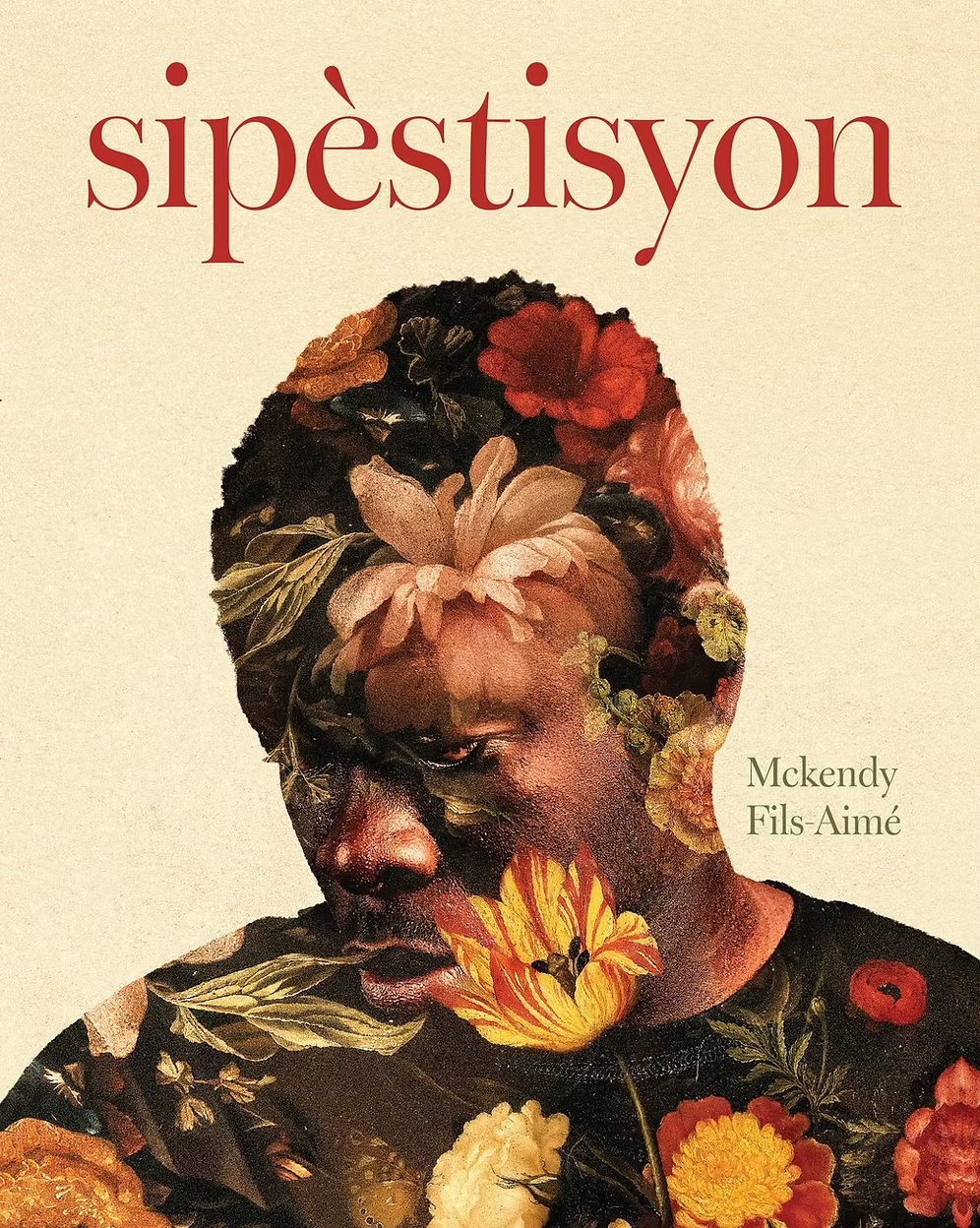
Ada Wofford: Many of the poems share the same title as the collection and have a superstition serving as the epigram. Can you speak about the superstitions you chose for your epigrams and what they mean to you? Or if that’s too broad, why did you want to share these specific superstitions with readers? I was particularly interested in the first one, “If you comb your hair at night, you will lose your memory.”
Mckendy Fils-Aime: I started writing superstition poems during a 30/30 in 2017 as an additional challenge to myself. Many of my favorite collections featured a group of poems with a shared naming convention. In the past, I had tried my hand at writing such a series, but failed. The self-imposed challenge in 2017 was another attempt. I picked Haitian superstitions because they felt familiar to me and were a fresh way to explore the topic. I treated the superstitions like open-ended prompts and wrote to the ones I thought were the most interesting to me. When I was putting together sipèstisyon, I picked the superstition poems that were the strongest and complemented the project’s narrative. Like all books, some poems didn’t make the cut. There are a handful of superstition poems that I adore, but left out because they weren’t serving the book.
AW: Building off of that, memory plays a large role in the book. From personal memories, to passed-down memories, to cultural history. The poem “what we sacrificed” plays with the imagery of you and your family around a fire pit, throwing in “the furniture pieces turned javelins / meant for my mother’s skull. / my mother throws in a photo album/of other men…I throw in a wedding ring…I throw in letters / to a future self.” The poem ends, “it’s hard to tell when a
flame is working / what is memory & what is kindling.” Can you speak about this idea of memory being both a solace and a burden, something that can soothe but also burn?
MF: Memories can be places of refuge or great sites of pain depending on your point of view, who you’re asking, or even when you’re asking. There are moments in sipèstisyon where the speaker and addressees have different perspectives on traumatic experiences, and that results in conflict. Our brains can be untrustworthy record-keepers, but they’re also our first confidants. Sometimes they’re all we’ve got. In sipèstisyon, there’s an impulse to forget, and with good reason, but that’s not conducive to healing. That also risks throwing away the small joys that can exist alongside terrible periods. Thankfully, the speaker understands this by the end of the book.
AW: In the poem “on superstitions,” you write about a pastor calling “superstitions the devil’s / proverbs.” I take from this the concept of fear. That superstitions are meant to invoke a sense of fear, but culturally they can be fragments of wisdom as well; small phrases or stories to remind us to keep our wits about us (e.g., don’t walk under a ladder). You touch on this in your interview with Shō Poetry Journal, saying, “I didn’t write the superstition poems out of fear or the
need for control, but an interest in exploring these sayings that I grew up hearing.” May I ask you to build on that a bit and speak about the role you see superstitions playing in our daily lives, either positive or negative, either as a source of fear or of wisdom? Do they play a role in your life today?
MF: Regardless of their nature, I think all superstitions are a type of cultural artifact. Even the silliest ones have a history attached to them. Superstitions are just another attempt at preserving the beliefs and stories of the past. Are they a form of magical thinking? Sure. Are they an attempt at control? Sure. They’re also proof of what we can carry through time with just our voices and language. The superstitions in sipèstisyon are cultural signifiers and points of nostalgia. They remind me of my youth and act as markers of identity. I love when other Haitians and Caribbeans come up to me after I read a superstition poem and say “Oh yeah, I remember hearing that as a kid” or “Have you heard this one?” Those moments mean a lot to me.
AW: The imagery of a car crash is repeated throughout the collection; you write about nearly getting hit by a car as a kid, and in “the first accident” you write about a car accident from the point of view of a passenger. Can you speak about the significance of this imagery and the theme of experiencing a “near miss” in this collection? And do these near misses relate to the concept of superstitions in any way?
MF: sipèstisyon is about the aftermath of surviving harm. Sometimes harm comes from a visible source like a vehicle or physical violence, and sometimes it’s systemic, which can be invisible. One of the final poems in sipèstisyon is called “ode to the gris-gris bag,” and it explores the moments in my life where I’ve narrowly escaped death. The poem references an ancestral force that is looking out for me. I think often about survival and the unseen, about the unobserved forces, whether spiritual or manmade, that help us stay on earth a little while longer. Maybe superstitions are an attempt at rescue before we even encounter the “near miss.”
AW: In the opening poem you compare memory to a museum, later you ask if “naming is a culture’s way of colonizing a body,” and in another you write, “solitude is a kind of death when a home / is remade into a mausoleum.” All of these images relate to the concepts of intention and context. This is something the art world has been dealing with since Duchamp placed a urinal in a gallery (and probably long before that, but he’s the most famous example); the idea that how one frames something (or someone, for that matter) dictates how the rest of us are supposed to see it/understand it (i.e., it’s art if it’s in a gallery, or in terms of museums: “it’s not grave robbing if you’re an archeologist”). In your poem, what was once a home is now remade into a mausoleum through its context, through how it relates to how that space is being inhabited. How do these concepts (intention and recontextualization) play into your collection’s other themes of identity and selfhood?
MF: Early in my writing journey, I discovered the world of poetry slam and spoken word. I learned and still learn so many things from that space. One of my first lessons was the importance of framing. In slam, how an idea is presented to an audience can be the difference between whether or not a poem succeeds. Framing applies to so many other mediums, whether we’re talking about writing, other forms of oration, or visual art. Even in therapy, when we reframe, we’re altering our perspective of an event or experience in hopes of uncovering some insight to better heal. I couldn’t write about trauma, relationship, selfhood, and identity by looking at events from the same angle. I see each reframe as a new chapter in the narrative of sipèstisyon. To reach the collection’s conclusion and the speaker’s views of himself, I had to change my vantage point, and that required intentionality.
AW: From dissecting the Pokémon movie to musing on WrestleMania, the book explores not just nostalgia, but specifically millennial nostalgia; can you speak about the significance of incorporating your nostalgia for pop culture and how these pop, one might even say “lowbrow” (though of course I’m not saying it!) influences like Pokémon and Wrestling can function within a form like poetry?
MF: In sipèstisyon, the poems that reference pop culture help situate the book in time. I wrote them because I wanted to reflect on past experiences as an adult. But equally as important, I wrote them because I’m a big nerd. I’m a millennial, so Pokémon and WWF are key parts of my childhood. To this day, I’m still a huge fan of anime and video games. Leaning into pop culture and nostalgia is one of the ways I have fun with my writing and share my personality and
interests with the audience. It’s an additional connection point between me and the reader. Poets can be so serious, myself included, and I think writing about nostalgia or our current nerdy/niche interests can be healthy and balancing. I also want to say that the exciting thing about writing and reading poems is that they can be inspired by so many different things. I’ve read poems in the shape of nutrition labels that are dope. As long as they’re not offensive and
executed well, I’m here for the pop culture poems.
AW: What are you looking forward to as a writer-in-residence at Sundress?
MF: I’m really looking forward to the dedicated time to write. Life is pretty busy right now, so I know I’ll appreciate the change of scenery. I have a few projects that I’m working on that I really want to focus on during that week. I’m also interested in seeing how being on a farm will influence my poems.
AW: And lastly, is there anything I didn’t touch on that you would like to talk about? Any new projects we should look out for?
MF: I’m working on a few different manuscripts right now, but nothing is close to completion. I’ve been working on my second poetry manuscript, a collection of poems about a shapeshifter in Haitian folklore called a lougawou. I’m also in the early stages of a chapbook that explores identity and labor. I’m hoping to have a working draft of the former by the spring.

Mckendy Fils-Aimé is a New England-based Haitian American poet, organizer, and teaching artist. He has received fellowships from Callaloo, Cave Canem, The Watering Hole, CantoMundo, and Periplus. His debut poetry collection, sipèstisyon, was published by YesYes Books in 2026.

Ada Wofford (they/them) holds MAs in both English and Library Studies. In addition to working at a rare book shop, they are an associate poetry editor at Sundress Publications, the editor of We Call Upon the Author to Explain, and the non-fiction editor at Stirring: A Literary Collection. Their writing has appeared in The Blue Nib, McSweeney’s Internet Tendency, Autostraddle, Capable Magazine, Sundress Reads, and more. Their chapbook, I Remember Learning How to Dive, was published in 2020, part of which earned them a Pushcart Prize nomination.

- We Call Upon the Author to Explain: Mckendy Fils-Aime - September 15, 2026
- Sundress Reads: Review of Forty Bouts in the Wilderness - September 15, 2026
- The Wardrobe’s Best Dressed: All Water Has Perfect Memory by Nada Samih-Rotondo - September 15, 2026