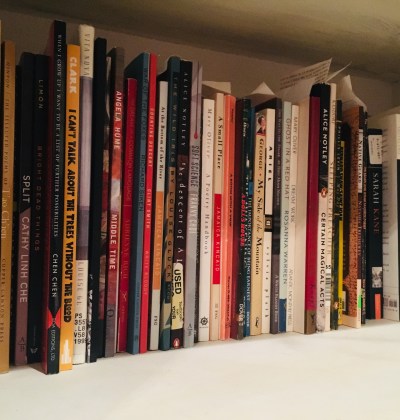
Sundress Publications is thrilled to announce the results of the 2020 open reading period for full-length poetry manuscripts. The winning selections are: Mackenzie Berry’s Slack Tongue City, Jason B. Crawford’s How We Fed the Hunger, and Amanda Galvan Huynh’s Lotería. Each is slated for publication in 2022.
Mackenzie Berry is from Louisville, Kentucky. She has an English – Creative Writing BA from the University of Wisconsin-Madison through the First Wave Program. Her poetry has been published in Vinyl, Up the Staircase Quarterly, Hobart, and Broadsided Press, and she has read and performed her poems at various events and festivals, including the 2019 Open Book Festival in Cape Town, South Africa. She has an MA in Race, Media, and Social Justice from Goldsmiths, University of London through a Marcus L. Urann Graduate Fellowship. She is currently pursuing her MFA in Creative Writing – Poetry at Cornell University. You can find some of her work at mackenzieberry.com.
Jason B. Crawford (They/He) is a black, nonbinary, bi-poly-queer writer born in Washington DC, raised in Lansing, MI. In addition to being published in online literary magazines, such as SplitLip Magazine, Voicemail Poems, Glass Poetry, and Kissing Dynamite, they are the Chief Editor for The Knight’s Library. Crawford has their Bachelors of Science in Creative Writing from Eastern Michigan University. Their debut chapbook collection Summertime Fine is out through Variant Lit. Their second chapbook Twerkable Moments is due from Paper Nautilus Press in 2021.
Amanda Galvan Huynh (she/her) is a Mexican American writer and educator from Texas. She is the author of a chapbook, Songs of Brujería (Big Lucks 2019) and Co-Editor of Of Color: Poets’ Ways of Making: An Anthology of Essays on Transformative Poetics (The Operating System 2019). Her writing has been supported by fellowships and scholarships from MacDowell, Robert Rauschenberg Foundation, Community of Writers at Squaw Valley, Monson Arts, and Virginia Center for the Creative Arts.
Congratulations also to this year’s finalists and semifinalists!
Finalists:
Brian Clifton, Beast-Headed Matthew E. Henry, The Colored Page Emily Hockaday, Naming the Ghost Brett Elizabeth Jenkins, How to Be a Good Animal Athena Nassar, Little Houses Joshua Nguyen, Come Clean
Semi-finalists:
Babette Cieskowski, Blood In The Garden Miranda Dennis, My Sister Who is Not My Sister Jonathan Louis Duckworth, Night, Translated Maggie Graber, Swan Hammer: an Instructor’s Guide to Mirrors Paula Harris, Attack of the 50 Foot Wāhine Sarah Lilius, Dirty Words Anne Haven McDonnell, Breath on a Coal Todd Osborne, The Overview Effect Todd Smith, The Shape of Other Lives in You Lindsay Wilson, The Day Gives Us so Many Ways to Eat
Thank you for joining us this week for Lyric Essentials! Emma Hine joins us to read Elizabeth Alexander and explores how poetry can give us the tools to communicate, thrive, and connect with one another during a time of political healing.
Erica Hoffmeister: Why did you choose to read Elizabeth Alexander for Lyric Essentials?
Emma Hine: I’ve loved and regularly returned to Elizabeth Alexander’s work for years, but I’ve been thinking about her especially during the past few weeks. Partly, this is because my first encounter with her poetry was actually at Obama’s first inauguration, standing in the foot-numbing cold on the Washington Mall—a memory that has felt both terribly distant and wonderfully potent for a long time since. Then, in 2017, I heard Alexander in conversation with Maria Popova at an event hosted by the Academy of American Poets at Housing Works. She was talking very explicitly about the role poetry could play in the current political climate and its rhetoric of hate and distrust; she said, “We’ve got something better than that spew that comes out; we’ve got something more precise; we’ve got something that names one another; we’ve got something that sees one another. We’ve got something that connects people instead of separating them. This is what we’ve got, so let’s use it. Let’s believe in it.”
I can’t get over this description of poetry as something that precisely names and sees and connects us, and in my experience with Alexander’s work, this definition seems especially true. Many of Alexander’s poems feel profoundly familiar to me—poems I wish I had written or was able to write—and reading them makes me feel both seen and named. At the same time, across her body of work she is speaking to an identity and to experiences that I have no personal knowledge of but still feel like I can inhabit fully as a reader. I feel connected.
And I’ve had the privilege of seeing firsthand how Alexander’s poems connect with other readers and make them feel seen and named. At the Academy of American Poets, I produced four years of the annual Dear Poet Project, where students wrote letters in response to individual poems. In 2018, one of the included poems was Alexander’s “Tending,” and scores of students sent in letters about how this piece affected them personally. A sixth grader from Sacramento wrote, “It felt like the poem was speaking to me, even though my life was nothing like the life that you described. It really felt like you were speaking to me.” This is how her poems make me feel, too.
EH: What drew you to choose these two poems of Alexander’s, specifically?
EH: I love how muscular and lyrical these poems are, how tight the syntax is, and yet how much room they still make for wildness. “On suffering, which is real” is just such an incredible way to start a poem, and then to move into the gorgeous specificity of a toddler’s voice before taking us out, again, to an almost sublimely adult understanding of death—I return to “Autumn Passage” both as a lesson in craft and a lesson in feeling. The same goes for “Equinox,” which, at fifteen lines, is structured like a long sonnet, with its three thematic sections and the final pivoting couplet. This ending is also something I return to often, for how it holds both love and unabashed honesty, and how sonically that last line just lifts from the page.
If we’re talking about the Alexander’s poetry as a vehicle for naming, seeing, and connecting, I should add that I had a lot of trouble selecting which poems to read—partly because I love so much of Alexander’s work, and partly because recording someone else’s poems in my own voice felt like an invasion of intimacy and of identity. Alexander’s “Stray,” for instance, is a poem I read often, but when I tried to record it for this series, my voice seemed to rob it of some of its power and privacy. In a similar vein, many of my favorite poems by Alexander—“Apollo,” say, and “Haircut”—speak specifically to her experience as a Black woman; I didn’t want to impose my own voice on these poems in the recording, but I hope anyone reading this interview will seek out this work as well.
EH: Is there a personal connection with Alexander’s writing that inspires your own work as a poet?
EH: Her work has definitely inspired mine, through what it has taught me about craft and language and kindness. She’s one of a few poets I turned to most often while writing Stay Safe—along with Brigit Pegeen Kelly, Tracy K. Smith, Ada Limón…. Like I said, there’s something about both the precision and freedom in her language and syntax that I find fully captivating, and familiar in the best poetic sense of the term—familiar because it needed to exist and therefore feels right when it does, not because it’s like anything we’ve already seen.
EH: Lastly, is there anything you are currently working on that you’d like to share with our readers?
EH: Thanks for asking! About two-thirds of the way through Stay Safe is a long, lyrical prose poem sequence, which was the last part of the book to come together for me. This sequence is set in space, on a fleet of generation ships centuries after the loss of Earth. While I was submitting Stay Safe to publishers and contests, I started working on a novel set in this same world, partially because I couldn’t let go of the idea and partially just as a distraction from submission anxiety. It’s been two years now, though, and I’ve recently finished a first full draft! I’m excited to continue working it, but I’m also excited to start writing poetry more consistently again soon.
Elizabeth Alexander is a widely recognized poet, memoirist, playwright, and cultural advocate from Harlem. Alexander is the author of eleven collections of poetry, of which American Sublime (2005) was a finalist for the Pulitzer Prize. Most recently, she published the memoir The Light of the World, which earned 2015 best book of the year pick by Michelle Obama, Elizabeth Gilbert, and several others and was a New York Times bestseller. She recited her poem “Praise Song for the Day” for Obama’s 2009 inauguration, making her only the fourth poet to read at a Presidential Inauguration. Dr. Alexander worked as a professor at Smith College, Columbia, and Yale for 15 years, and currently president of The Andrew W. Mellon Foundation, the nation’s largest funder in arts and culture, and humanities in higher education.
Further reading:
Purchase Alexander’s poetry collection Praise Song for the Day. Watch Alexander read “Praise Song for the Day” and discuss then and now for Library of America. Read this profile on Alexander’s memoirThe Light of the World in The Washington Post.
Emma Hine is the author of Stay Safe, which received the 2019 Kathryn A. Morton Prize and is forthcoming from Sarabande Books in January 2021. Her poems have recently appeared in The Baffler, Copper Nickel, The Paris Review, and The Southern Review, among others, and her essays have appeared or are forthcoming in Alaska Quarterly Review, Guernica, and Poets & Writers.
Further reading:
Preorder Hine’s debut collectionStay Safe from Sarabande Books, available January, 2021. Visit Hine’s contributor page for the Academy of American Poets to read her lesson plans for teaching poetry. Read Hine’s poem “Dipping Achilles” in The Missouri Review, which was a finalist for the 2016 Jeffery E. Smith Editor’s prize.
Erica Hoffmeister is originally from Southern California and earned an MFA in Creative Writing and an MA in English from Chapman University. Currently in Denver, she teaches college writing and advocates for media literacy and digital citizenship. She is an editor for the Denver-based literary journal South Broadway Ghost Society and the author of two poetry collections: Lived in Bars (Stubborn Mule Press, 2019), and the prize-winning chapbook, Roots Grew Wild (Kingdoms in the Wild Press, 2019). A cross-genre writer, she has several works of fiction, poetry, creative nonfiction, articles and critical essays published in various outlets. Learn more about her at http://ericahoffmeister.com/
I first became aware of Tara Isabel Zambrano’s stunning flash work when reading for a local literary magazine in Cleveland, Gordon Square Review. Tara’s story that appeared in the issue I read for was called “Sandalwood Remains,” and was about a romantic and sexual encounter on a bus between Jaipur and Jaisalmer. I began following Tara’s published work with a lot of excitement and was thrilled when I heard her collection Death, Desire, and Other Destinations would be published through Okay Donkey Press. The collection includes stories about destination weddings on the moon, love, loss, fabulism, and through it all runs Tara’s careful prose and startling juxtapositions.
When indie publicist Lori Hettler of The Next Best Book Club reached out to me to interview Tara, I jumped at the chance. We talked about inventiveness, the difference between flash and prose poetry, and writing good sex scenes, among other things.
Alex DiFrancesco: I’ll admit that flash is a little new to me, so bear with this question about form! Your book is a series of stories, most no longer than three or four pages. They often read like plotted, anchored prose poetry. How do you balance the care with language and the plotted aspects in terms of these stories?
Tara Isabel Zambrano: Thank you so much, Alex, for reading my work and taking the time. You are right. To someone new to flash, these stories might come across as prose poetry and hence the care in choosing details and language to describe them. Since they are stories, they have a snapshot of a plot and conflict. And the whole challenge amounts to picking details that propel the story and yet come across as a fresh approach to something you are used to seeing over and again. It takes a lot of editing–stirring the simmering pot, as I call it–and then stop when you have reached the right consistency and volume.
AD: You often have extremely fantastical elements in these stories–destination weddings on the moon, a moon that disappears, a girl who lives inside another girl. Do you feel these elements come easily to you? Does an excess of them inform your choice to write shorter pieces?
TIZ: It’s an instinctive process; stories with fantastical elements often come to me as an opening phrase or an image that I write down and develop, edit and re-edit to see if the concept sticks, and if it has gravity to settle on a ground of reality. I do get a lot of these ideas. Not all of them are able to create a story. Some stay in the background for months, years, or sometimes become parts of other stories. The choice to write shorter or longer pieces depends on the plot, the characters, and the process of how a story represents it. It should be in terms of length, density, and impact. It’s a function of the creative processes within every idea and not their volume.
AD: Location also plays a big part in these pieces. Many take place on the U.S. and in India. Do locations inspire these stories or do they come after other elements for you?
TIZ: The plot, the characters, and the cultural elements that weave them define the location for me. For example, the story “Alligators” is set in India; the road trip and the setup appeared in my head as the characters made their journey and I stayed true to it. “Lunar Love” is based in the U.S. because that’s how it made sense in terms of its characters and their interaction with their surroundings.
AD: You write stunning sex scenes! Do you have any tips for other writers on those? (Many writers don’t do this quite as well as it’s done in this book!)
TIZ: Thank you so much, Alex! Sex is a culmination of desire and to do it effectively and aesthetically, there should be an emotional resonance between the readers and the words. There should be a strong human element in its execution and the little details that are significant to relate to, flawed or perfect. I sound like a broken record when I say that I edit a lot. I let a story sit and then read again to see if the passion in a scene moves me.
AD: At times, I felt as if I was getting to know the narrators of these stories as the stories progressed. Do you start with distinct voices, or are you learning the narrators as they come out on the page?
TIZ: I do start with a distinct voice, but on occasion I have changed it depending on how the story progresses and how the characters transform. And that’s a revelation I always wait and hope for, to have my mind surprise me and take me somewhere where I didn’t think I’d end up. So bold, so new, so unsettling. Just show me the glimpse of that space-time coordinate and I’ll work out the rest.
AD: Another flash question: you manage to portray, at times, decades within a few paragraphs. Where do you decide a scene ends? Are the blank spots between just as important, and are we to fill them in with the guidance of what’s on the page?
TIZ: Yes, blank spots are key. Flash breathes in these white spaces. For me, there is always this sense of urgency between sentences, between words. Almost all the time, something is happening, even if it’s a thought train going at full speed about to fall off its rails. You need these breaks to allow the readers to fill in the details as they perceive it. It places them amid the story, engaged. To answer your question, to end a scene is to fold it and tuck away in a manner that suspends the conflict or begins the confusion. It’s an innate process, so I try different stakes in time and mood to see where these clearances provide the muscle and transformation I need in the story.
AD: The title of this series comes from one of my favorite songs, which contains the line, “Prolix, prolix, nothing a pair of scissors can’t fix,” so my last interview questions here is always: if you had to cut one thing from this book, from a word up to a scene or story, what would it be?
TIZ: That’s a trick question! I would shorten my Acknowledgements page to just, “Thank you everyone who has touched my life.” Because this book is the resultant to all those experiences and the imaginations that came with them.
Tara Isabel Zambrano works as a semiconductor chip designer. Her work has been published in Tin House Online, The Southampton Review, Slice, Triquarterly, Yemassee, Passages North and others. Her stories have been featured in Best Microfiction and Best Small Fictions, and have been nominated for the Pushcart Prize and the Best of the Net. She served as the Flash Fiction editor for Newfound. She lives in Texas with her husband and two grown-up kids.
Alex DiFrancesco is a multi-genre writer who has published work in Tin House, The Washington Post, Pacific Standard, Vol. 1 Brooklyn, The New Ohio Review, Brevity and more. In 2019, they published their essay collection Psychopomps (Civil Coping Mechanisms Press) and their novel All City (Seven Stories Press), which was a finalist for the Ohioana Book Awards. Their short story collection Transmutation (Seven Stories Press) is forthcoming in 2021. They are an assistant editor at Sundress Publications.
Growing up Iranian-American, there was this sense of division within the diaspora community I grew up in: of what came before and what came after the traumatic conflicts that led us to the United States. In Tariq Luthun’s collection How the Water Holds Me, his poetry delves into similar ideologies that I had noticed in my community, but from the unique experience of the Palestinian diaspora. Published by Bull City Press and selected for publication in the 2019 Frost Place Chapbook Competition, Luthun’s poems explore the devastation that Palestinians and Palestinian-Americans have faced, giving life, memories, and meaning to a group of people that are often reduced to and judged by the conflict they are trapped within, even when they are displaced far away from their original homeland.
The very first poem in the chapbook immediately sets the tone for what’s to come. Titled “The Summer My Cousin Went Missing,” the Luthun uses language like “buried” to describe how busy their khalto (which is Arabic for the aunt on your mother’s side) was. The lines “Child upon child goes, and someone’s mother / is no longer a mother.” The pivot from the speaker’s aunt to a generalization encompasses universal grief, one felt among an entire community. It is here where we, as readers, come to realize that this isn’t an isolated incident. As the poem continues onwards, it shifts again. The focus is no longer on their aunt’s suffering, shifting from “she” to “we.” The speaker asks “how will we ever stay fed” and “how ever / will we live long enough to grieve,” leaving a sense of lingering for both the reader and the speaker.
Throughout the collection, something that caught my eye was how Luthun weaved together his personal experiences, one as a Palestinian-American coming of age, to touch upon universal themes. In the poem “Al-Bahr,” he says “but I saw / a boy that could have become / me wash up on a shore.” A common story among refugees, particularly Palestinian ones, is drowning in the act of seeking a new home. This is a stark juxtaposition to the poem “Upon Leaving the Diamond to Catch 14 Stitches in My Brow,” where Luthun describes how when struck with a bat, how their “off-white noise” showed division between “us” and “them.” Their accented English, their darker skin, makes the neighbors “see us / bleed and think: / prey.” Comparing “Al-Bahr” to “Upon Leaving the Diamond to Catch 14 Stitches in My Brow,” Luthun navigates between the personal and the political. While the conflict in youth may have been the fourteen stitches, it evolves into something more, something so much more sinister, by seeing boys like him drowning and leaving their community behind to seek out a new community that might not ever even accept them.
There are moments in the book that act as cultural preservation as well. Even long after Luthun is gone, his poems have preserved mundane practices and rituals, such as going out to pick mint leaves for his mother, or, how he says in the poem “We Already Know This”: “I want to be sure / everyone knows where my parents / hail from.” This is particularly evident in the poem “After Spending an Evening in November Trying to Convince My Mother That We’ll Be Fine,” where the poet describes how “it isn’t easy / to accept that the coverage of / the world outside can be spun so much.” The final lines of that poem are “a country that cannot have him–/ a country that does not want him.” “Him,” in this line, refers to Luthun’s father. Palestine is the country that cannot have him, while America is the country that didn’t want him. For marginalized communities like Palestinian-Americans, it is brave to speak out like this, to say that this isn’t what they experienced. This their truth and reality, not what is on television.
In Tariq Luthun’s collection How the Water Holds Me, while it explores the tragedy of the Palestinian diaspora, it offers hope and preservation to their unique experience. In the actual formatting of the book, next to the page numbers, there is a little key. This represents the Palestinian right of return; keys have become a symbol for Palestinians, as many kept the keys to their original home, to represent how one day they will be able to return to their ancestral home. While many Palestinians cannot go home, Luthun offers a metaphorical home in his work, one that comes from a place of both loss and understanding. In the poem “People, Drunk at Parties, Tell Me Love” he says it’s difficult for him to say “I love you.” The poems in How the Water Holds Me show this devotion, this unspoken love.
Tariq Luthun’s How the Water Holds Me can be purchased here.
Ashley Hajimirsadeghi is an undergraduate at the Fashion Institute of Technology. Her work has appeared in/forthcoming from Rust+Moth, Into the Void, Corvid Queen, and cahoodaloodaling, among others. She attended the International Writing Program’s Summer Institute and was a Brooklyn Poets Fellow. Currently, she is trying to figure out a happy intersection between her writing, film, and photography endeavors.
The Sundress Academy for the Arts is proud to present “A Virtual Reading Series” on November 25th, 2020, from 7-8PM EST on Zoom. Access the event at tiny.utk.edu/sundress. The password is safta.
Sarah Giragosian is the author of the poetry collection Queer Fish, a winner of the American Poetry Journal Book Prize (Dream Horse Press, 2017) and The Death Spiral(Black Lawrence Press, 2020). The craft anthology, Marbles on the Floor: How to Assemble a Book of Poems, which is co-edited by Sarah and Virginia Konchan, is forthcoming from The University of Akron Press. A two time winner of the Best of the Net, Sarah’s writing has appeared in such journals as Orion, Ecotone, Tin House, and Prairie Schooner, among others. She teaches at the University at Albany-SUNY.
Sabrina Sarro is a current social worker in the state of NY. They hold an LMSW from Columbia University and are currently pursuing an MFA from the City College of New York—CUNY. As a queer non-binary writer of color, they are most interested in investigating the intersectionalities of life and engaging in self-reflection and introspection. They are an alumnus of the LAMBDA Literary Emerging Voices for LGBTQIA* Writers Retreat, the Bread Loaf Writers’ Conference, the Yale Writers’ Workshop, and many others. They have received scholarships from The Martha’s Vineyard Institute for Creative Writing and the Community of Writers at Squaw Valley.
Roseanna Alice Boswell Recchia is a queer poet from Upstate New York. Her work has appeared or will soon appear in: Driftwood Press, Jarfly Magazine, Capulet Magazine,and elsewhere. Roseanna holds an MFA from Bowling Green State University and is currently a Ph.D. candidate in English at Oklahoma State University. Her first collection, Hiding in a Thimble, is forthcoming with Haverthorn Press January 2021. Find her on Twitter @swellbunny posting about feminism and her love of exclamation marks.
Kelly Fordon’s I Have the Answer is a brilliant collection of short stories that offers poignant slices of suburban life. Each story examines a different facet of difficult relationships, of love, of loss, of life. Her characters are as rich as the world they inhabit, and each is unique while managing to be incredibly universal.
Everyone knows that relationships are complicated, but it seems no one knows more so than Fordon in these stories. Whether it’s parent-child dynamics changing as they get older, like in “Why Did I Ever Think This Was a Good Idea?”; adult friend groups learning to adapt to new jobs, kids, and other time demands, as the first-person plural narrators of “How It Passed” try to do; reacting to family members’ loss of sanity, as in “Jungle Life” and “Where’s the Baby?”; or simply trying to navigate the tumultuous life we all live, these stories capture facets human emotion and relationships so wonderfully that you can’t help but laugh and cry right along with them. They’re all seeking answers to the biggest and smallest of questions, just like all of us.
Though not all the stories are connected, there are occasional overlapping characters. This gives the reader the sense that each story is happening in its own home but on the same street, or in the same neighborhood. Each story’s cast is different and their narratives are diverse, but those small moments of connection—when you get to go, “Ah, I remember that character”—tangibly place people, families, and places in the world of the collection. It gives the reader the sense that the grass isn’t always greener once you know what the people in the house next door are going through as well.
This collection is perfectly timed—all of our shared experience in the pandemic makes us crave normalcy, but also validation that we’re not the only ones feeling the way we do. I Have the Answer is a perfect fill for that feeling. The stories go through a huge range of experiences, showing that there is a way to get through the every-day difficulties as well as the monumental events. There’s so much to be found in the pages of this collection, and thoroughly I enjoyed every page.
Bayleigh Kasper is a senior creative writing major at the University of Evansville. She dreams of owning a tiny home in Colorado where she can adopt cats, make music, write, and eat very judge-worth amounts of chocolate without actually being judged.
One of my favorite pastimes to this day is exploring local second-hand bookstores. In middle school, my mom would take me to a small store close to our house, blending our time there with the small coffee shop across the street. My summers were spent rotating between them both and my local library, which was also within walking distance. After all of these years, I can’t count how many books I have bought from that store, but I know it was enough to have filled my childhood bookshelf.
Presently, I still visit that bookstore, and I love it just as much. Perhaps the biggest change I’ve experienced in the routine is the shift in content on my bookshelves. My days of Percy Jackson and John Green were left behind for my growing love of classics and poetry. Woolf and Wilde replaced Rowling; Mary Oliver and Danez Smith took the place of C.S Lewis. My break from middle school was marked by my transition into new genres. I became obsessed with classic literature and contemporary poetry. Kay Ryan’s The Best of It was the beginning collection that steered me into poetry. Even now, the book is still on my shelf, crowded against the more recent collections I’ve enjoyed.
In taking one look at my bookshelf, my favorites become obvious. Poetry and plays litter the upper shelf, organized carefully so that no author overshadows another. Sarah Kane is able to meet Tiana Clark without distraction and Mary Oliver sits beside Franny Choi in an organized chaos of styles. This shelf is not only important to me because of the community they represent, but because these collections have inspired me to pursue poetry. Louise Gluck’s The Wild Iris introduced me to the importance of movement within a poem. I would spend my time reading this collection between my classes and job, marveling at her ability to shift within her stanzas; I remember sitting out on my university library’s steps and highlighting lines in the sunlight.
In addition to Gluck’s collection, Kaveh Akbar’s Calling a Wolf a Wolf is one of my most treasured books. This collection was my gateway into contemporary poetry as it showed me how to love poetry in all its different forms. I was fortunate enough to get it signed in January and keep it displayed proudly. Sitting beside Akbar’s poems is another one of my more recent purchases: Franny Choi’s Soft Science. This collection taught me the imperative role form plays in conducting the message of a poem. Beyond what I have learned from it, this collection holds a special place in my heart as it contains one of my favorite poems: Introduction to Quantum Theory. The first time I read this poem, I felt the world around me melt away. Predictably, reading Soft Science had the same effect as I tore through it.
Many other notable books I still find myself enraptured by are Richard Siken’s War of the Foxes, Araclis Girmay’s Kingdom Animalia, Sarah Kane’s collected plays, and Hieu Minh Nguyen’s This Way To The Sugar. Siken’s collection was a gift I received two Christmases ago after I had devoured his first collection Crush in under a day. His ability to condense emotion into action devastated me, and I simply had to have more of it. The relationship of the speaker and the reader seemed foundational to Siken’s emotional construction. Oftentimes, his poems gave the impression of an intentionally fragile structure, waiting to be torn apart. Similarly, Girmay’s collection is one I had on my list for a long time. I finally purchased my copy for a directed study course I took with one of my favorite professors. As expected, her collection was hypnotic. I was fixated on her use of images to place her reader into each poem as well as remove them just as quick. Her ability to deconstruct interaction within her own work was breathtaking, and I couldn’t tear myself away.
This past fall I was able to visit with family friends in Seattle, Washington — one of my favorite places to be — where I picked up a copy of Nguyen’s book at a local bookstore I come to each time I’m in the city. I carried his collection across the city and then over the ocean as I started to read it. Of course, it’s no surprise how quickly i became immersed. Nguyen’s use of careful violence in each poem entangled me, leading me to continuously marvel at each image he crafted. Sarah Kane’s plays were something I discovered indirectly, but I am very glad I did. Last summer I came across her work in a short quote shared by a book-review blogger I follow. I was so entranced; I hadn’t read many plays outside of school assignments, and I wanted to correct that. I ordered her collection, finishing the whole thing in two days. I was torn apart; I was resurrected. There is no other way to describe how I felt reading her work.
My second shelf is a little more disorganized, which also reflects my relationship with fiction. There is a blend of university assigned readings, high school fascinations, and ‘to-read’ piles all pressed together. This shelf contains my collected fiction and non-fiction. Writers like Jamaica Kincaid and Bram Stoker meet each other within the chaos. Last year I became very invested in non-fiction; I picked up the exploration that was Cat Marnell’s How to Murder Your Life and snowballed from there. On my bookshelf is one of Terry Tempest Williams’ books Refuge, which continues to inspire me even a year after my first reading. I was stunned by her ability to blend dreamscapes with reality while remaining within her non-fiction genre. The structure of each realization throughout was framed by a careful preciseness, leaving the reader with a constant impression of standing at the edge of a cliff and refusing to look directly downwards.
My love for fiction fluctuates between fixation and fascination. During my sophomore year of university I set a challenge to read fifty books I hadn’t read before. J. D. Salinger’s The Catcher and the Rye was something I had been recommended by a friend in passing and thus became the first on my list. Though the novel is surrounded by controversy, it is still one of my favorite classics. Stream of consciousness is something I lean heavily towards — my annotated copy of Woolf’s Mrs. Dalloway speaks for itself — so it may come as no surprise that I found Holden Caulfield’s narrative intriguing and relatable. Lastly, lying beside Catcher in the Rye is another classic that influenced me heavily— Oscar Wilde’s The Picture of Dorian Gray. I started this novel in high school after one of my best friends recommended it to me; I would finish my classwork early to read it at my desk, glancing over at my friend occasionally as if to say, can you believe this? She would simply raise one eyebrow across the room, and I knew we were in agreement.
Literature is an imperative piece of the person I am. If I were to explain my personality in objects, books would certainly be a necessary part of the picture. I am sure these pictures of my bookshelf reveal more about me than I have written, but I do hope that the stories I’ve tied to each book help to shape a perspective. I think the most important part in my journey with literature is where it started. I didn’t learn the importance of literature from my school system growing up, but rather I learned it from who I discovered each genre with. I found literature with the people I care most about: my mother and that bookstore, my best friend and Wilde, my coworkers and I arguing over Stephen King’s inability to write a decent ending.
Mary Sims is an undergraduate writer working towards her BA in English at Kennesaw State University. She is currently a poetry editor for Waymark Literary Magazine and a former student editor for the Atlanta based magazine Muse/A. Her work has appeared in Glass: A Journal of Poetry, The Poetry Annals, Peach Mag, and more. She can often be found filling her shelves with poetry collections, roaming antique stores, or laughing over raspberry cappuccinos with friends.
Welcome back to Lyric Essentials! This week, we welcome Barbara Costas-Biggs who reads Jane Kenyon for us and offers a moment of solace and emotional check-ins through poetry during an exceptionally chaotic time. Thank you for reading!
Erica Hoffmeister: Why did you choose to read Jane Kenyon for Lyric Essentials?
Barbara Costas-Biggs: My mind immediately went to her. I read her a lot—for inspiration or to find a moment of calm in this crazy world. I feel a connectedness to Kenyon’s poems, the way she works things out with particular attention to the natural world. When our children were very small, my husband and I moved into his grandmother’s old farmhouse in eastern Kentucky and thought we’d make a go of it as (very) small scale organic farmers. Really, we had a large garden and a few cows and chickens, enough to keep friends and family in eggs and vegetables. It felt very foreign to me, this new way of life we had chosen. I think that’s when I really started to want to understand her work better. In prepping for this interview, I read a lot of old articles about her, went back into her books and her own words. One thing I think that people who aren’t more familiar with her think is that she wrote nice little poems about nature, and that her work might not stack up against the work of her husband (which is a crazy notion that I hadn’t really thought about myself, but the idea is out there). Here’s one of Donald Hall’s responses when asked about their stylistic differences: “Yeah,” he’d say, “her style is a glass of water – a 100-proof glass of water.” I think that sums it up pretty well.
EH: Was there a particular reason you chose the poems “The Pear” and “Heavy Rain” from Kenyon’s expansive oeuvre?
BCB: It might be a bit of a cop-out, but I think I chose The Pear because I recently had a birthday, my 44th, and there is so much in this poem that resonates with me right now. This wild year has had me all over the place. I’ve spent 2020 all over the emotional charts, and I know many others have, too. This poem, 10 lines & 53 words, is a powerhouse. In it, I read desperation and fear, but also a warning of sorts in that last stanza. I spend too much time worrying and thinking on the things that I have lost, and when Kenyon writes “and you may not be aware/ until things have gone too far”, it gives me pause. It’s a reminder to me that the desolation she also speaks of in the poem can be stemmed with a bit of self-preservation and emotional check-ins. I know that this is a deeply personal reading, and that not everyone might see it that way, and that’s ok.
Heavy Summer Rain might be my very favorite poem, so choosing that one was easy. I think again, she is working with the natural, looking for ways that the world (and ourselves) can “right itself”. And also again, her work with vowels is just so lovely: “Everything blooming bows down in the rain”. It’s almost an incantation, asking to be repeated in a holy way. The images in this poem are just so clear to me, like my own backyard. Knowing where the deer bed down, watching the poppies that my husband’s grandmother planted fall in a storm. And that middle stanza, the one that takes a personal turn, is just too perfect. “I miss you steadily, painfully”, exactly like the falling rain.
EH: Your simple, almost anecdotal yet powerfully emotionally resonant poetry style seems to share some of those elements with Kenyon’s work. Do you find a particular inspiration from her poetry?
BCB: Oh, yes, and that is really much too kind. I think I have probably answered this question before getting to it officially. There are two writers that I feel a special kinship with. Kenyon, obviously, and also Barbara Kingsolver. I think it’s because they write so much about place and relationship to that place. I have spent most of my life in Appalachia, and I don’t think you can live here without feeling a strong connection to the hills and dales. I can’t imagine trying to write without bringing in mayapples, river trout, sycamore trees. For me, like Pound said, the natural object is always the adequate symbol. I met and studied with the poet Cathy Smith Bowers while I was working on my MFA, and she gave me wonderful advice: Always go back to Jane. And I do. When I get stuck in a poem or in my head, I pull out Kenyon and try to get back to work.
EH: Lastly, is there anything you are working on now that you’d like to share with readers?
BCB: I’m slowing putting together a second collection of poems (which seems funny since the first one is still unpublished!), and I’m also expanding a chapbook that I wrote which contains poems about my father and his death. It’s called The Other Shore, and was recently a finalist for the Washburn Prize from Harbor Review. My father was a music fanatic and a guitarist, and the title comes from an arrangement of Good Shepherd by Jefferson Airplane. Music plays a large part in those poems. I also have 4 poems forthcoming in The Appalachian Review.
Jane Kenyon is an acutely midwestern American poet, born, raised and educated in Ann Arbor Michigan. In her lifetime as a translator, poet and essayist, she published four collections of poetry and championed the art of translation, translating Anna Akhmatova’s poems from Russian to English. The wife of poet Donald Hall, Kenyon’s poetry is distinctly focused on rural and naturalist themes while addressing depression and melancholy, as is famously outlines in her acclaimed poem “Having it out with Melancholy.” She was the poet laureate of New Hampshire when she died of leukemia at just 47 years old.
Barbara Costas-Biggs is a poet and librarian from Appalachian Southern Ohio. Her work has appeared recently or is forthcoming from Appalachian Review, Lost Balloon, Northern Appalachian Review, Mothers Always Write, Glass, Ghost City Press, 8Poems, and others. Her poem “Naked in the Macy’s Changing Room, Trying to Think About Anything Other Than the Election” won the Split This Rock Abortion Rights poetry contest in 2017, and her chapbook, The Other Shore, was a finalist for the Washburn Prize from Harbor Review. Her MFA is from Queens University of Charlotte, and her MLIS is from Kent State.
Erica Hoffmeister is originally from Southern California and earned an MFA in Creative Writing and an MA in English from Chapman University. Currently in Denver, she teaches college writing and advocates for media literacy and digital citizenship. She is an editor for the Denver-based literary journal South Broadway Ghost Society and the author of two poetry collections: Lived in Bars (Stubborn Mule Press, 2019), and the prize-winning chapbook, Roots Grew Wild (Kingdoms in the Wild Press, 2019). A cross-genre writer, she has several works of fiction, poetry, creative nonfiction, articles and critical essays published in various outlets. Learn more about her at http://ericahoffmeister.com/
The Sundress Academy for the Arts at Firefly Farms, a 501(c)(3) non-profit organization, is seeking two editorial interns. The position’s responsibilities include the preparation of documents necessary to run an independent writers residency, as well as online participation in literary events including readings and workshops. This part-time internship would consist of approximately 5-10 hours of work per week and run from January 1st to June 30th, 2021.
The Sundress Academy for the Arts (SAFTA) is an entirely volunteer-run organization that hosts residencies, workshops, and retreats centered on creative writing in all genres. Located on a 45-acre farm twenty minutes from downtown Knoxville, SAFTA’s mission is to give writers of all levels a chance to workshop with nationally renowned professionals in their field as well as uninterrupted time to focus on their creative work.
The editorial intern’s responsibilities will include writing press releases, composing blogs, proofreading, working with social media (Facebook, WordPress, etc.), collating editorial and residency data, research, and more. The intern will also be needed to help facilitate Zoom readings and events.
Preferred qualifications include:
A keen eye for proof-reading
Strong written communication skills
Experience with WordPress, Zoom, and other online mediums
Knowledge of contemporary literature a plus
Due to the current health crisis, this position can be done remotely, and therefore we are accepting applications regardless of your current location.
While this is an unpaid internship, all interns will gain real-world experience in working with online event planning, nonprofit management, running a residency, communications, and more while creating a portfolio of work for future employment opportunities. Interns will get to work alongside members of both the local and national literary community through SAFTA workshops and readings, which interns are able to attend for free during their tenure with the organization.
To apply, please send a resume and a brief cover letter detailing your interest in the position to the Staff Director, JoAnna Brooker, at saftastaffdirector@gmail.com. Applications are due by December 1st, 2020.
Ever since I was assigned this article I have looked in all the devices I own and in all the Drive accounts I have for a picture of my bookshelf, to realize that I have none. I think I owe this to the superstition my parents had that people admiring my huge bookshelf would cast an evil eye on it, and cause something bad to happen. So we never took pictures of it.
But we have also been moving about quite a bit, from one place to another, owing to my parent’s work and my studies. Even at University, I have changed dorm rooms six times in four years, and the bookshelves in the rooms are more of an ornament than a bookshelf. In these four years, I have never been able to use the table in my dorm room, because it’s always full of books.
But I have always been proud of my enormous collection, and rather selfish about it too. I have carefully collected almost every single book from my child, including the tiny picture books about baby animals that were my first ever collection. I have also inherited my parents’ books, and I treasure these closely, to a point that one summer, I actually sat down and made a catalog of them. For a single, quiet child who was almost always bullied in school, my collection of books was what I was proud of. While my classmates boasted of PlayStations and smart phones and fancy devices, I quietly felt proud of myself for my bookshelf and of all the books I had read.
Being bullied constantly also makes you want to escape into a different world constantly, and that is what reading did for me. I did not talk about it at home, because my overprotective parents would go berserk on those kids, and that would just lead to more trouble. So I turned to reading, and every free minute I got, I was buried inside a book: in the car, at meals, in between homework, and before sleeping. I was living two lives simultaneously: one in the real world around me, and one in the book I was reading. I almost always became a character in that universe, because it made reading more fun. I would imagine myself in situations that my favorite characters were in, and this helped me deal with a lot of problems in my own world. Taking Literature up as an undergrad student has dissolved boundaries between reading for academics and reading for leisure, especially because I wanted to work on fiction. I am trying to bring that back now, after having graduated and taking a break from academics with a small job not completely related to my degree.
Being a student of literature also opened me up to the gaps in my bookshelf. Until mid-2016, most of the books I read were the ones that Dad brought home. He would bring me lots of carefully chosen fiction: nothing too violent, sexual, what he thought was problematic (like queer fiction, for instance), or age inappropriate. I remember what he told me when he handed me a copy of Thirteen Reasons Why: “This doesn’t happen in real life, it’s just a story.” I grew up reading lots of Enid Blyton, Roald Dahl, J K Rowling, Rick Riordan, Suzanne Collins and Stephanie Meyer alongside other stories of Indian mythology, and comics like Amar Chitra Katha and Tinkle.
It’s only after Dad passed away, and I became a student of literature did I understand how restricted my reading was. I have now started being more careful about what I read, in terms of theme, genre and content. I have elaborate lists of to-reads that have been recommended by various people arranged theme-wise, and I send screenshots of these lists to my friends on my birthday or when someone wants to treat me.
I bought this set of feminist literature last week in an attempt to not only try and read more books on women but to also try and read books from various parts of the world.
I don’t have a bookshelf currently: I am living in a temporary house until I find an apartment, and all my books are in boxes. However, my last bookshelf was the most haphazard it had been: my books were all over the place, and I had no time to organize them, or for the first time, care. As a teenager, my books had been arranged genre wise, but right now, I feel like I have been given a clean slate with the new apartment to choose both the size of my bookshelf and how I would arrange my books. I am generally an organized person, but final year of college drove me crazy, and I hope I do justice to my new bookshelf! I am thinking of a genre and color-based organizational paradigm, but knowing me, it’s going to go out of the window the minute I actually start arranging them on the shelves.
Gokul Prabhu is a graduate of Ashoka University, India, with a Postgraduate Diploma in English and creative writing. He works as an administrator and teaching assistant for the Writing and Communication facility at 9dot9 Education, and assists in academic planning for communication, writing and critical thinking courses across several higher-ed institutes in India. Prabhu’s creative and academic work fluctuates between themes of sexuality and silence, and he hopes to be a healthy mix of writer, educator and journalist in the future. He occasionally scribbles book reviews and interviews authors for Scroll.in, an award-winning Indian digital news publication.