The Wardrobe’s Best Dressed: 28,065 Nights by Katie Manning

I Haven’t Eaten Fried Bologna Since You Died

When I spent my days with you, I’d watch you fry a pink circle brown,
unwrap bright yellow cheese, and squeeze ketchup onto bread. You’d
cut the sandwich in two and put half on each plate. Then we’d sit down
together on the couch, and I’d ask, Can I have your half? And you would swap
our sandwiches, even though they were the same, even if mine already had
a bite taken out. Still, thirty years later, I swear your side tasted the best.


This selection comes from 28,065 Nights, available from River Glass Books. Purchase your copy here! Our curator for this selection is Erin Elizabeth Smith.

Katie Manning is the founding editor-in-chief of Whale Road Review and a professor of writing at Point Loma Nazarene University in San Diego. She is the author of Tasty Other, which won the 2016 Main Street Rag Poetry Book Award, and her fifth chapbook, 28,065 Nights, is newly available from River Glass Books. Her poems have appeared in American Journal of Nursing, december, The Lascaux Review, New Letters, Rogue Agent, Stirring, THRUSH, Verse Daily, and many other venues. Twitter Handle: @iamkatmann

Erin Elizabeth Smith is the Creative Director at the Sundress Academy for the Arts and the Managing Editor of Sundress Publications. She is the author of three full-length collections of poetry, and her work has appeared in Guernica, Ecotone, Crab Orchard, and Mid-American. Smith is a Distinguished Lecturer in the English Department at the University of Tennessee.

Sundress Reads: A Review of Spinster for Hire

A fear of and fascination with loneliness dominates Julia Story’s Spinster for Hire, a collection whose poems move back and forth between the speaker’s Midwestern upbringing and her adulthood, following moments of isolation and misconnections with others as she ages. Solitude in Spinster for Hire is specifically Midwestern in its Indiana childhood homes and rural farmlands and churches, yet its hauntings wrestle with larger existential questions that mystify the speaker at any point in her life. Story does not include romantic love as a goal for the speaker, never classifying her as a “spinster” in a stereotypical sense. In a series of devastatingly blunt narrative poems, Spinster for Hire reckons with being seen and unseen, with the known and the unknown, and instead of resolving these issues, Story demonstrates that the speaker’s interior world offers more respite than any person could give her.

Though the speaker’s childhood self in Spinster for Hire is afraid of being alone, she still seeks out loneliness for a sense of familiarity and freedom. In one of the book’s opening poems, “Indiana Problem (Alone),” the speaker states, “To wake meant / get on the bike, / try every day / to look for a place / to be alone.” Many of Story’s poems describe these repeated, solitary, and seemingly pointless actions. There are twelve “Indiana Problem” variations throughout the book, many of which are separated into three brief sections gulfed by silent pauses and emptiness. In “Indiana Problem (Three Steaks),” after describing babysitters, Barbies, and TV dinners, the speaker admits, “I […] walked into / the firefly-packed / dark green dark and / no one looked / for me.” The divided structures of these poems read as miniature suburban portraits, echoes of familiar childhood images and the speaker’s lack of recognition among them. In “Indiana Problem (Mousetrap),” noting the “dark Hosier sadness” closing in on her home one evening, the speaker says, “I didn’t plan this / second kingdom: / not exactly in the mind / or the heart but in the dullness between / them, a waiting so long it made another / body in case this one got too lonely.” As these images of the speaker arriving, departing, and waiting in darkness or stillness culminate, they serve as blunt reminders that her isolation is a quintessential part of her childhood, just like watching Small Wonder and Little House on the Prairie, or playing Mousetrap and Lite Brite.

As an adult, the speaker tests for proof of her own existence in the physical world as she is often not recognized by others. In “Barely There,” Story writes, “I had touched the weeping birch in the cemetery so many times that there was a small mark, / a grease mark or worn place where my hand had rested, trying to feel the spinning that connected it / to some invisible underground pathway.” Story combats the dullness and ordinariness of the Midwest with haunted houses and ghosts, the familiar, flat landscapes made strange. In the title poem, the speaker instructs, “If you look up you can see / me in my window, one spot / of life in our hibernation, / our long orchard of silence.” Story often renders the divide between the speaker and others physically so that she is an observer to a world in which she does not belong. The speaker is terrified by the spiritual realm, and one night stays up thinking about demonic possession, skeletons, and the dark. In “Moth,” the speaker compares herself to the insect, stating, “I hid in the walls, / white and dusty. There is / no one to hear me say it / and there is no voice / to say it with: I was loved.” Time and again, the speaker worries her existence does not matter because no one is there to recognize it. Fears that should subside after childhood, like being afraid of the dark, continue to plague the speaker, and age offers no clarity or answers to her existential questions; she is simply alone.

Rather than forming any lasting attachments to anyone, Story’s speaker accepts isolation as a part of herself, inseparable from any memory and toward which she always moves. Her ex-husband is only briefly mentioned, but without any hate or longing. After discovering that he will marry the woman he cheated on her with, the speaker confesses, “Bubbles / rose in me over / and over. Grief, / I thought, finally. / But it was joy.” None of the speaker’s ruminations on loneliness revolve around lost or unrequited romantic love, defying assumptions about the way a “spinster” is typically cast. In the following poem, “Romantics,” the speaker dreams of living in the spaces she once feared: “Now my head / is filled with as many empty houses as I dream / as I creak around their closets, dangerous balconies, / the dark tragic corners of their basements.” The speaker now knows she wants to occupy a world in which her worth is not dependent on others. In Spinster for Hire’s last poem, “And the Waters Prevailed,” the speaker declares, “Underneath [the rain’s] constant muttering / is the anthem of the ground: Until further / notice, I’m alive.” Story moves the speaker completely away from the narrative of the life we expect to follow, one that includes marriage, children, etc. All that matters is that the speaker knows she is here and that she controls the life she wants to live.

Spinster for Hire is rich in nostalgic details from an Indiana upbringing: the after-dinner lull with Ripley’s Believe it or Not on the TV, playing an Addams Family pinball game, or a dog chasing a kid down a country road. Yet loneliness and emptiness cast a gloom over all the speaker’s memories, no matter how quaint they seem. While one might assume that the speaker would change, fall in love, or find clarity as she ages, she instead learns that her interior life and individual experience are as valuable as a life shared with others. Story’s work arrives at a time when many of us do not know how to navigate this year’s profound isolation, yet Spinster for Hire stares headlong into uncertainty with clear-eyed determination and grace.

Spinster for Hire is available at The Work Works


Emmalee Hagarman earned her MFA in poetry at The Ohio State University, where she served as poetry editor of The Journal. Recently her work was selected by Kenyatta Rogers to receive the Academy of American Poets Award/The Arthur Rense Prize, and also selected by Ruth Awad to receive the Helen Earnhart Harley Fellowship in Poetry. Her poems have appeared in Waxwing, Tupelo Quarterly, and The Laurel Review, among others.

The Wardrobe’s Best Dressed: 28,065 Nights by Katie Manning

Thomas Anthony

You didn’t even know your mom was pregnant. She sewed new dresses to
hide it. When the time came, all of you kids were sent off to the neighbor’s
house, and your oldest sister had to tell you why. Your mom gave birth, but
the boy was blue. It looked so perfect otherwise, you’d say, the still body an “it”
in your child’s memory, more like a doll than a real baby. If he were born today,
he’d live, you’d sometimes add, making him real again. Then we’d talk about
your mother and make ourselves heavy with her loss. The last time you told
me this story, I realized I’d never asked the baby’s name.


This selection comes from 28,065 Nights, available from River Glass Books. Purchase your copy here! Our curator for this selection is Erin Elizabeth Smith.

Katie Manning is the founding editor-in-chief of Whale Road Review and a professor of writing at Point Loma Nazarene University in San Diego. She is the author of Tasty Other, which won the 2016 Main Street Rag Poetry Book Award, and her fifth chapbook, 28,065 Nights, is newly available from River Glass Books. Her poems have appeared in American Journal of Nursing, december, The Lascaux Review, New Letters, Rogue Agent, Stirring, THRUSH, Verse Daily, and many other venues. Twitter Handle: @iamkatmann

Erin Elizabeth Smith is the Creative Director at the Sundress Academy for the Arts and the Managing Editor of Sundress Publications. She is the author of three full-length collections of poetry, and her work has appeared in Guernica, Ecotone, Crab Orchard, and Mid-American. Smith is a Distinguished Lecturer in the English Department at the University of Tennessee.

The Wardrobe’s Best Dressed: 28,065 Nights by Katie Manning

Your Death Explained in Birds

Death is the great egret at the swamp, picking newly hatched green herons
from their cypress nest. I am the pregnant woman on land looking for
something to throw. I am the mother heron, too small to fight back, and the
runt deep in the nest. Death is the egret dropping fresh young birds into
the swamp with barely a ripple. I am the pregnant woman standing horrified
and helpless. I am the mother heron shrieking and snapping on the branch
below. I am the smallest green heron in the nest. I stick my head out in the
stillness after everyone else has gone.


This selection comes from 28,065 Nights, available from River Glass Books. Purchase your copy here! Our curator for this selection is Erin Elizabeth Smith.

Katie Manning is the founding editor-in-chief of Whale Road Review and a professor of writing at Point Loma Nazarene University in San Diego. She is the author of Tasty Other, which won the 2016 Main Street Rag Poetry Book Award, and her fifth chapbook, 28,065 Nights, is newly available from River Glass Books. Her poems have appeared in American Journal of Nursing, december, The Lascaux Review, New Letters, Rogue Agent, Stirring, THRUSH, Verse Daily, and many other venues. Twitter Handle: @iamkatmann

Erin Elizabeth Smith is the Creative Director at the Sundress Academy for the Arts and the Managing Editor of Sundress Publications. She is the author of three full-length collections of poetry, and her work has appeared in Guernica, Ecotone, Crab Orchard, and Mid-American. Smith is a Distinguished Lecturer in the English Department at the University of Tennessee

Sundress Academy for the Arts Presents: Poetry Xfit

The Sundress Academy for the Arts is excited to present Poetry Xfit. This generative workshop event will take place on Sunday, January 17th, 2021 via Zoom. Join us at the link tiny.utk.edu/sundress with password “safta”.

Poetry Xfit isn’t about throwing tires or heavy ropes, but the idea of confusing our muscles is the same. This generative workshop series will give you prompts, rules, obstructions, and more to write three poems in two hours.

Writers will write together for thirty minutes, be invited to share new work, and then given a new set of prompts. The idea isn’t that we are writing perfect final drafts, but instead creating clay that can then be edited and turned into art later.

Prose writers are also welcome to attend!

While this is a free workshop, donations can be made to the Sundress Academy for the Arts here: https://sundress-publications.square.site/product/donate-to-sundress/107?cs=true

All donations received will be split with the Beck Cultural Exchange Center, a nonprofit museum featuring a range of local & national African-American history exhibits & artifacts here in Knoxville, TN. 

Call for Applications: Graphic Design Internship

Sundress Publications is an entirely volunteer-run 501(c)(3) nonprofit publishing collective founded in 2000 that hosts a variety of online journals and publishes chapbooks, full-length collections, and literary anthologies in both print and digital formats. Sundress also publishes the annual Best of the Net Anthology, celebrating the best work published online, runs Poets in Pajamas, an online reading series, and the Gone Dark Archives, preserving online journals that have reached the end of their run. 

The graphic design internship position will run from March 15, 2021 to September 15, 2021. The design intern will assist with creating promotional graphics, digital flyers, logos, social media images, and brochures, etc. Responsibilites may also include designing the interior and exterior of e-books, formatting manuscripts, and/or designing and editing promotional materials. Applicants must be self motivated and be able to work on a strict deadline.

Preferred qualifications include:

  • Graphic design or visual art experience 
  • Familiarity with Adobe Photoshop, InDesign, and/or Illustrator
  • Knowledge of contemporary literature a plus

Applicants are welcome to telecommunicate and therefore not restricted to living in the Knoxville area.

While this is an unpaid internship, all interns will gain real-world experience in designing books and promotional materials for a nationally recognized press while creating a portfolio of work for future employment opportunities.

To apply, please send a resume and a brief cover letter detailing your interest in the position to our Managing Editor, Erin Elizabeth Smith at erin@sundresspublications.com by February 20, 2021

The Wardrobe’s Best Dressed: The Way Home by Ashley Inguanta

Healer

A psychic once took me by the body, my whole body, and sat me down, called me “healer,” told me I could heal with my hands. We sat by the ocean in Key West. It was about to rain. She said I could have babies if I chose, even get married. I wanted to believe her. Back then, at eighteen, I hadn’t menstruated in two years. I wasn’t planning on bleeding, either. Bones were more important. But this woman, she said I could heal with my hands. The thought of touching another made me flinch. I wanted to love this woman who told me I could heal. Years would pass and I’d want to love other women, too, but it wouldn’t work. The psychic wouldn’t tell me this. Instead, she stood to leave. I paid her, and night settled.

Years later, at twenty-three and on my period, I went to some trendy bar and there was a by-donation psychic. I donated, put my beer in a corner, sat down. She took my hands, placed them palm up. You have lost everything, she said, and will only fall in love if you allow it. I wanted to tell her I haven’t loved a lover in my whole life, and I wasn’t planning on it.

I wanted to tell her how bitter I was, the choice I made to exist on the outskirts of another
woman’s life.

But I didn’t tell her. There were others waiting, and my friends were asking me to dance.


This selection comes from The Way Home, available from The Dancing Girl Press. Purchase your copy here! Our curator for this selection is Nilsa Rivera.

Ashley Inguanta is a poet and art photographer whose work often focuses on romantic love, the spirit, landscape, and place. Most recently, you can find her poems in Contrary Magazine, The Santa Fe Literary Review, and The Familiar Wild: On Dogs & Poetry. Her newest short collection of poetry, The Island, The Mountain, and the Nightblooming Field is forthcoming in May of 2020. You can learn more about Ashley’s poetry, art, and teaching at ashleyinguanta.net.

The Wardrobe’s Best Dressed: The Way Home by Ashley Inguanta

Shells

I remember getting this hard feeling in my chest when I looked at the woman, as if my whole body would collapse. I wanted to kiss the woman, but those rocks in my chest. I couldn’t move.

When I started losing weight, it felt exciting.


This selection comes from The Way Home, available from The Dancing Girl Press. Purchase your copy here! Our curator for this selection is Nilsa Rivera.

Ashley Inguanta is a poet and art photographer whose work often focuses on romantic love, the spirit, landscape, and place. Most recently, you can find her poems in Contrary Magazine, The Santa Fe Literary Review, and The Familiar Wild: On Dogs & Poetry. Her newest short collection of poetry, The Island, The Mountain, and the Nightblooming Field is forthcoming in May of 2020. You can learn more about Ashley’s poetry, art, and teaching at ashleyinguanta.net.

Sundress Academy for the Arts Now Accepting Residency Applications for Summer 2021

The Sundress Academy for the Arts (SAFTA) is now accepting applications for short-term writing residencies in all genres—poetry, fiction, nonfiction, playwriting, screenwriting, journalism, academic writing, and more—for their summer residency period which runs from May 17 to August 22, 2021. These residencies are designed to give artists time and space to complete their creative projects in a quiet and productive environment.

Each farmhouse residency costs $300/week, which includes a room of one’s own, as well as access to our communal kitchen, bathroom, office, and living space, plus wireless internet.

Residencies in the Writers Coop are $150/week and include your own private dry cabin as well as access to the farmhouse amenities. Because of the low cost, we are rarely able to offer scholarships for Writers Coop residents.

Residents will stay at the SAFTA farmhouse, located on a working farm on a 45-acre wooded plot in a Tennessee “holler” perfect for hiking, camping, and nature walks. The farmhouse is also just a half-hour from downtown Knoxville, an exciting and creative city that is home to a thriving artistic community. SAFTA is ideal for writers looking for a rural retreat with urban amenities.

SAFTA’s residencies, which also include free access to workshops, readings, and events, offer a unique and engaging experience. Residents can participate in local writing workshops, lead their own workshops, and even have the opportunity to learn life skills like gardening and animal care.

For the 2021 summer residency period, SAFTA will be offering the following fellowships only:

  • Black & Indigenous Writers Fellowships: one full and one partial fellowship for Black and/or Indigenous identifying writers
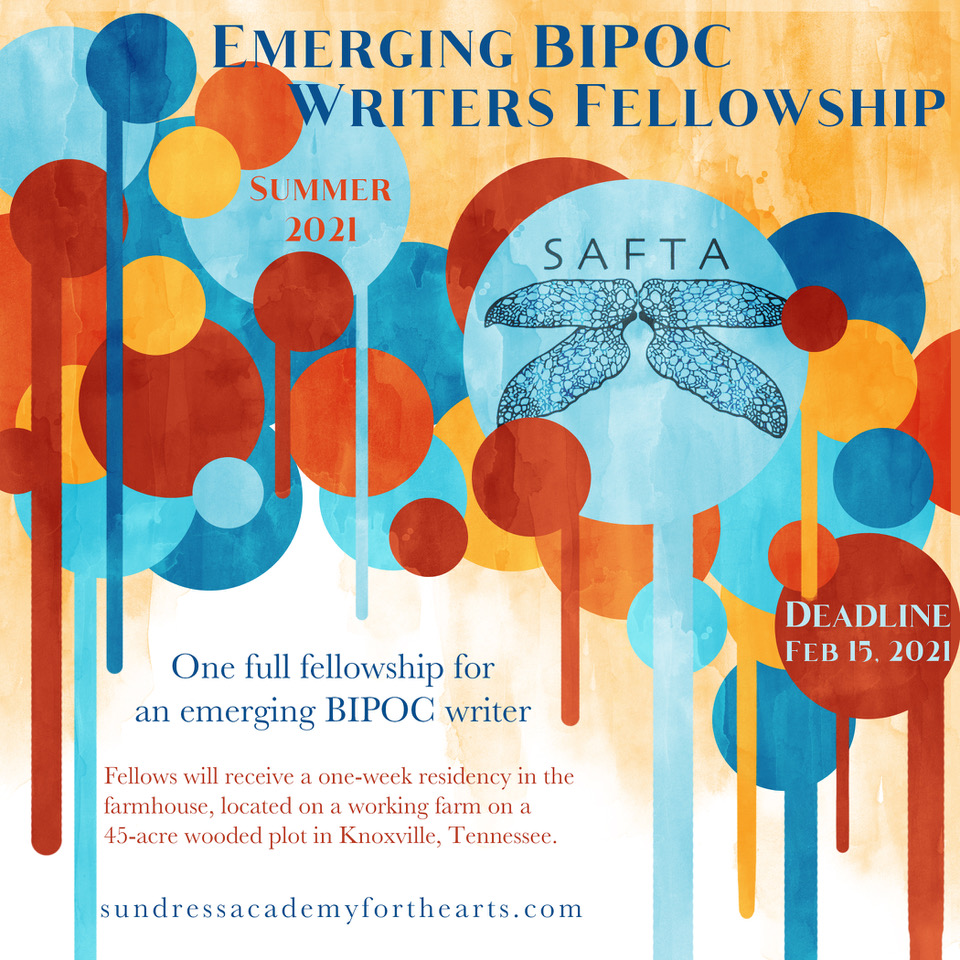
  • Emerging BIPOC Writers Fellowship: one full fellowship for an emerging BIPOC identifying writer

Please note in your application if you are applying for one of these fellowships.

As part of our commitment to anti-racist work, we are now also using a reparations payment model for our farmhouse residencies which consists of the following:

  1. 3 reparations weeks of equally divided payments for Black and/or Indigenous identifying writers at $150/week
  2. 3 discounted weeks of equally divided payments for BIPOC writers at $250/week
  3. 6 equitable weeks of equally divided payments at $300/week

Black and/or Indigenous identifying writers are also invited to apply for a $350 support grant to help cover the costs of food, travel, childcare, and/or any other needs while they are at the residency. We are currently able to offer two of these grants per residency period (spring/summer/fall). If you would like to donate to expand this funding, you may do so here.

The application deadline for the summer residency period is February 15, 2021. Find out more about the application process at www.sundressacademyforthearts.com.

The application fee is waived for all BIPOC identifying writers. For all fellowship applications, the application fee will also be waived for those who demonstrate financial need; please state this in your application under the financial need section. Limited partial scholarships are also available to any applicant with financial need.

Apply today!

Sundress Reads: A Review of Heartland Calamitous

In this remarkable collection of stories, Heartland Calamitous, now available from Autumn House Press, Michael Credico paints for us the experience of what it means to occupy and navigate the Midwest. He describes, through almost lyric-like-not prose, both the feeling of living in the center of the world and yet, at the same time, existing, among slaughterhouses and fast food joints, in the margins. 

Michael Credico’s short fiction has appeared widely in print and online, including Black Warrior Review, The Collagist, Columbia Journal, Denver Quarterly, DIAGRAM, Hobart, New Ohio Review, NOÖ Journal, Puerto del Sol, Quarterly West, and others. He earned an MFA in Fiction from the Northeast Ohio Master of Fine Arts program at Cleveland State University. Credico received an Individual Excellence Award from the Ohio Arts Council, and lives and works at Cleveland, Ohio.

This book is a peek into the elements that chart and construct the Midwest, diving deep, with stunning imagery and boundless imagination, into what it means to survive in what is called the Heartland of the United States. Full of humor, grief, and even the weird and the ugly, these stories span and put together what one would call a dystopian novel. The not-very-long stories carefully explore, in perhaps an exaggerated and wacky fashion, the myths around what it means to be Midwestern. The intricate details force the reader head-on into the universe and witness parts of their lives. The slippery confusion and chaos, mythical creatures, zombies, comic violence, shapeshifters, and startling quantities of fish become symbols/motifs, more often than not, for the journey of the characters as they struggle to articulate their identities. The masterful articulation brings the reader close to the characters in the book (a little too close sometimes) and their desire to leave for someplace better as problems of climate change and degradation, growing old, depression and the sheer everyday-ness that goes beyond care,  weigh heavy on them.

The simultaneous focus on the set-up of the space of the Midwest and the characters is a challenge to the reader, one that Credico makes extremely interesting. The motifs and symbols—of God, fish, cannibalism, grief, loss, and despair–also add an extra layer to the already complicated mesh of language and feelings. These layers question the politics of what it means to be Midwestern and the myths around what it means to survive with what it offers to those occupying it. However, to construct the characters as representatives of the space they occupy is to almost humanize the space itself—a political act, perhaps, that brings the reader closer to the space and empathize with it.

The space is both loud, speaking through the imagery, and silent, as it sits quietly in the background, accessible to those who are ready to unlearn what they know about it and start a new journey through this book. In that sense, the reader almost becomes a character in these stories, discovering, alongside these characters, some bits of themselves, and asking questions of what it means to exist as a social being, maintain relationships, and deal with both the joy and the pain that comes with them. 

Accompanying these complexities is the stunning language that defines Credico’s prose. The sentences in the book strike a balance between those that are poetic and those that are sharp and a smack in the face with reality. They help the reader on the journey they will go on with the characters, but also kick them into reality before it gets too much. It serves as a reminder for the reader not to get too lost in the darkness but to also enjoy what’s being offered, creating, perhaps, a friendly distance between the book and the reader. That way, what Credico’s text perhaps offers is also a lesson in reading, by giving the reader the space, the choice and the accessibility to read as deep as they would like into the text, but also make sure they are returned to the reality of the spaces they occupy. The length of the stories also help with this. This constant back and forth is perhaps what being Midwestern means, and the language of the text successfully embodies that spirit. 

Heartland Calamitous is, therefore, a must-read, especially for those who are looking for those willing to travel with its strange characters.


Gokul Prabhu is a graduate of Ashoka University, India, with a Postgraduate Diploma in English and creative writing. He works as an administrator and teaching assistant for the Writing and Communication facility at 9dot9 Education, and assists in academic planning for communication, writing and critical thinking courses across several higher-ed institutes in India. Prabhu’s creative and academic work fluctuates between themes of sexuality and silence, and he hopes to be a healthy mix of writer, educator and journalist in the future. He occasionally scribbles book reviews and interviews authors for Scroll.in, an award-winning Indian digital news publication.