

Imagine, for a moment, a skateboarder…
What image immediately pops into your mind? Perhaps a grungy rebellious teenager in the streets of New York City, grinding down a handrail and landing on the concrete below with a flourishing kickflip. Or maybe Mr. Skateboard himself, Tony Hawk, hand to the nose of his board as he effortlessly slides up a half-pipe under a gleaming California sun.
These are absolutely quintessential concepts of ‘a skateboarder,’ a sport/hobby that is almost always associated with a certain demographic: white cishet men on the West or East Coast. How often have we envisioned a Black woman in her 40s shredding the pipe? A blind man steadily running down a rail with impeccable balance?
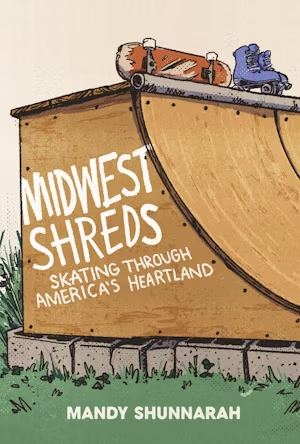
In Midwest Shreds: Skating Through America’s Heartland (Arcadia Publishing, 2024), Mandy Shunnarah (they/them) confronts our socialized concept of a skateboarder, attempting to expand our idea of who can skate—and for whom skating is made accessible. Shunnarah begins with interrogating the assumption that all of skate culture is localized on the coasts, especially California, and instead locates us in the USAmerican Midwest, a region more often associated with wheatfields than wheelies.
The book opens with a brief history of how skateboards were developed, which immediately situates the Midwest in the heart of skate culture through the Chicago Roller Skate Company, a skate manufacturer during the early 1900s. From there, the book meanders through the region, visiting anywhere from conventional skate parks to DIY skate spots in abandoned churches and the deep backwoods of Ohio. With an engaging journalistic style of prose, Shunnarah brings readers in conversation with skaters across the Midwest who are involved at every level of the culture; from skate shop owners to equipment manufacturers to on-the-ground competitive skaters, Midwest Shreds pulls readers right into the thick of things. We learn about the nitty gritty details that go into fostering a thriving skateboard community through interviews with a charismatic cast of characters across the region.
But the riders in Midwest Shreds aren’t confined to four wheels on a board: Shunnarah has interviewed not only skateboarders, but also rollerskaters, riders in wheelchairs, and even a unicyclist—and that’s only the beginning of the diversity on the scene that the book explores. Shunnarah importantly points out the differences in experience between white skaters and skaters of color, noting how Black and Brown skaters inherently run more risk of getting harassed by cops for skating (Shunnarah xxiv), and how that creates a more hostile, unapproachable space for many skaters of color. Shunnarah introduces us to groups who are working to make safe places, like froSkate in Chicago, an organization born out of a desire to see more Black and Brown girls on boards. Or the persistence of disabled skaters who push for parks with more accessible ramps, whether for chairskaters or blind skaters.
Midwest Shreds is a commentary on the impact of the Midwest on skate culture specifically, highlighting a region that is so often written off as ‘flyover states’ that don’t have much to pay attention to. Shunnarah states that the ultimate question of Midwest Shreds is “when will midwestern and Rust Belt skaters get their due?” (Shunnarah xx). Through a lens of skateboarding, Shunnarah pays Midwesterners our due by learning about our region with genuine curiosity and care.
Throughout the book, an interesting thread began to appear: What motivates skaters to turn to skating? In Columbus, Ohio, the narration posits, “What is skating, if not an attempt to escape something, even if it’s yourself?” (Shunnarah 9) Skateboarding is commonly associated with freedom and rebellion from social norm, with skateboarders themselves often seen as lone wolves. But a uniting theme appeared throughout—a desire to create safe, welcoming spaces for skaters of all kinds. Jon of Skate Naked, Ohio, says, “Before, [Skate Naked] was such a closed community, and now it’s wide open” (Shunnarah 11). Ariel runs skate shop in Chicago that is “trying to be inviting to the skaters who wouldn’t necessarily come to the shop and park because they might not feel lit it’s a place for them” (Shunnarah 93). That’s what this book is really about: community, created with intention.
Whether you’re interested in Midwest history and culture; the concept of community bonds and how we can cultivate it; or just looking for skating tips and tricks (I know I definitely noted some of Shunnarah’s advice), Midwest Shreds is a lovingly written book that will certainly be a worthwhile read. Shunnarah writes that their curiosity about Midwest skate culture “is what led me, a twenty-eight-year-old, plus-size, and otherwise nonathletic person in Columbus, Ohio, to fulfill a childhood dream to lace up my quads and shred ’til I’m dead” (Shunnarah xx). And now, feeling inspired by Shunnarah’s words, I, a twenty-nine-year-old Latine lesbian from Chicago with bad knees, am ready to do my part in joining my community and shredding the Midwest.
Midwest Shreds is available from Arcadia Publishing

Isabeau J. Belisle Dempsey (they/them) is a proud Chicagoan, Belizean, Lesbian, and Capricorn. They hold a BA in International Studies & Spanish and are currently earning an MA in English Literature & Publishing, and they hope to eventually put their obsession with commas to good use as an in-house editor. History book co-author, amateur poet, freelance copyeditor, and generally just along for the ride, you can find Isabeau in your local bookstore surreptitiously fixing the shelves—they were once a bookseller and never quite broke the habit.

- The Wardrobe’s Best Dressed: Lone Yellow Flower by Erika Gill - September 24, 2026
- Sundress Reads: Review of Horizon Hong Kong: Selected Stories - September 23, 2026
- The Wardrobe’s Best Dressed: Lone Yellow Flower by Erika Gill - September 23, 2026