The Wardrobe’s Best Dressed: Wilderness//Kingdom by Jory Michelson


This selection, chosen by Managing Editor Krista Cox, is from Wilderness//Kingdom by Jory Michelson, released by Floating Bridge Press in 2019. 

Dear Federico

It’s late. I’ve stood for hours
watching swallows strike
and swivel at the insects’
commas. The certain
circling they commit to
feed themselves. We first
acknowledged one another
on the bridge above their frenzy,
in the growing dark. We tethered
together, all pause and follow,
while streetlights burst
amber over tulip poplars
that guide the river’s dark cord.

On the empty steps of my apartment,
you offer me a cigarette, and I take it
simply to touch your hand,
even though I haven’t smoked
in years. Federico, I don’t understand
your poems with their silverlipped
volcanoes and your
obsession with the dangers
of the moon: all salted, all boot
crushed, all clovered in mold.

As if I dreamt the careful linen
of your shirt, the undoing of the black
slick of your hair in the concrete’s shy
heat. I was afraid you’d mistake
my hesitation for the bleeding of juniper
into the air, the long tongue of the sky
refusing, a zipper’s seam split open.


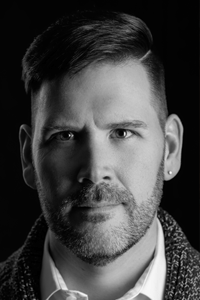
Jory Mickelson is the inaugural winner of the Evergreen Award Tour prize form Floating Bridge Press for their book Wilderness//Kingdom. Their poems have appeared in print and online in Harvard Divinity Bulletin, diode, Jubilat, The Rumpus, Vinyl Poetry, the Mid-American Review, Ninth Letter, and other journals in the US, Canada, and the UK. They were awarded an Academy of American Poets Prize and have received fellowships from the Lambda Literary Foundation and The Helene Wurlitzer Foundation of New Mexico. They hold an MFA in Poetry from the University of Idaho. Originally from Montana, they now live in the Pacific Northwest.

The Wardrobe’s Best Dressed: Wilderness//Kingdom by Jory Michelson


This selection, chosen by Managing Editor Krista Cox, is from Wilderness//Kingdom by Jory Michelson, released by Floating Bridge Press in 2019. 

Divination

The long body of the Buick
is brown like a doe. The open
hood reveals inscrutable

innards of iron. Steam
rises from the cavity, the open
stomach of a deer on a hard

November field. Both
Buick and doe can carry
a man through winter.

My father reaches into
that space, his back
bent with effort as if

through haruspicy he will
solve the mystery of what
doesn’t work. I can’t tell

him where gears go
wrong, but I know
what stopped the doe.


Jory Mickelson is the inaugural winner of the Evergreen Award Tour prize form Floating Bridge Press for their book Wilderness//Kingdom. Their poems have appeared in print and online in Harvard Divinity Bulletin, diode, Jubilat, The Rumpus, Vinyl Poetry, the Mid-American Review, Ninth Letter, and other journals in the US, Canada, and the UK. They were awarded an Academy of American Poets Prize and have received fellowships from the Lambda Literary Foundation and The Helene Wurlitzer Foundation of New Mexico. They hold an MFA in Poetry from the University of Idaho. Originally from Montana, they now live in the Pacific Northwest.

Sundress Reads: Review of The Body He Left Behind

Are there nuanced steps—complicated travels—between the shapes of vulnerability and viciousness, prey and predator? How do we, as humans, form these shapes when we face loss? These are only a few questions that arise from Reese Conner’s debut poetry collection, The Body He Left Behind (Cider Press Review, 2021). An homage to Conner’s father and his cat Lewis, The Body He Left Behind provides a unique space where animalistic movements initiate a poetic voice that calls attention to the way grief, love, or violence can shape us just as tangibly as our own bones.

The Body He Left Behind pulls from a kaleidoscope of observances about human and animal nature that weave together so interchangeably throughout the collection’s five parts that they seem causal and interdependent. In repeating images of toothpicks, rubber bands, spillages, and balsa wood, Conner constructs human and animal bodies according to a material vulnerability, thus exposing the way that humankind stands to bind both themselves, and the nature surrounding them, to a physical compartmentalization and self-imagined organization. “The Rapture”, for instance, illustrates a vomiting ocean as analogy to our view of an exposed human materialism: “a gentle murmur / spread in the bellies of the observant, / who saw even the ugly things begin to ascend—blobfish, Smart Cars, murder weapons, every issue of Us Weekly—and they began to think: / What about us?” In “The Necessary”, Conner points to the losses that occur at the intersection between nature and humanity’s material constructions: “if roads, cars, and quick commutes / mean one, two, one thousand dead cats, then / the choice is still clear: It would be far too expensive, / not to mention logistically irresponsible, / to make cat-retardant roads, so, of course, / a run-over tabby or two is necessary / unpleasantness.” By so clearly pointing to the downfall of human efficiency, Conner makes congruencies between human and animal survival—both of which, at times, reach towards the same beauty—the same menace.

Throughout The Body He Left Behind, the tricky intersection between nature, nurture, and survival becomes the similarity between humans and animals. The need for humans to build their world, to frame the bodies of other people, holds the same mindset as a cat with a dying chipmunk, urging its prey “[t]o move differently, / willing her back to the life he took / so that his purchase / might be made again”. Similarly, the way emotions are sharpened, changed, and buried within a person’s mind holds the same survivalist instincts as a cat licking the cyst on his forepaw: “It is the logic he knows, but it will not work. He’ll lick. It will blue… He’ll lick. It will burst”. The speaker of this collection not only acknowledges these similarities, but takes ownership in the connection, confessing, “I am the reason / the cat, domestic and heavy / with wet food, still kills the cockroach—tears it limb by limb by limb, by limb… Forgive him, he is a violent shape.” In weaving between these images, Conner grants all the room necessary to air the true dichotomy of violent shapes in our world, creating ruminations that ask whether, “desire, even with menace / has meaning”, “how many monsters suffocate / the things they love, and how many / call it kindness,” or if “Frost was right about gold, / about every type of happiness ending / in a quiet violence.”

The dichotomies in The Body He Left Behind not only lead to a forgiving tone throughout the collection, they contribute to a dynamic contemplation about the self and its relationship to loss. As the speaker ruminates on the death of their father and the passing of their cat Lewis, they also question how one reacts to an encounter with impermanence, and how there could ever be a right way to do so. This is particularly prominent in the poem “Thank You,” when the speaker notes that their father: “received the bag / full of Lewis, / who, / like all dead cats / that are carried, / became broken rubber bands / heavy as ball bearings, / and said thank you / as if it were a kindness / to yank a dog / from the cat it killed, (13-21).

Speaking to another loss in the title poem “The Body He Left Behind”, the speaker moves from the act of politely concealing emotion in “Thank You” to describing the adamant desire to let go of a loved one’s image: “It’s time to let go / of the body he left behind, / the one that’s lodged / in your eye like a floater…Yes, it’s time to let go / of the body he left behind. / It’s lodged / in your throat—you mistake it for breath.” It is the struggle to both intimately feel and pull beyond the absence of a loss, the stress in both knowing of an end and ignoring it, that Conner places as a centerpiece in his work. In recognizing the loss of their cat Lewis, for example, the speaker comes to the bittersweet understanding that, “My father told me the saddest stories / are not about broken things—no, the saddest stories are the happy ones / told in past tense because we know everything is broken and we have to see it untouched first, we have to do the breaking ourselves.” By so dynamically illustrating the feeling of recognizing a goodbye that is already in the room, Conner looks unflinchingly towards grief, while also allowing it to hold its own gentle, dismantling character—just as humans, just as animals. “I am lonely for my father,” the speaker says in “Bring Flowers to What You Love.” “I am lonely for my cat” they say in “Lost Cat”. These statements, if any, encompass The Body He Left Behind—they speak to the violent, beautiful impressions humans and animals trace into one another and the way naming that impression, claiming it, is powerful for the same reason naming a cat is: “because naming a cat / does not make him ours, / it makes him us.” Conner’s work shows us how we do that naming, over and over again. 

The Body He Left Behind is available at Cider Press Review


Hannah Olsson holds a double BA in Cinema and Creative Writing English from the University of Iowa. During her time in Iowa, Hannah was the president of The Translate Iowa Project and its publication boundless, a magazine devoted to publishing translated poetry, drama, and prose. Her work, both in English and Swedish, has been featured in boundless, earthwords magazine, InkLit Mag, and the University of Iowa’s Ten-Minute Play Festival, among others.

The Wardrobe’s Best Dressed: Wilderness//Kingdom by Jory Michelson


This selection, chosen by Managing Editor Krista Cox, is from Wilderness//Kingdom by Jory Michelson, released by Floating Bridge Press in 2019. 

Prelude

The restless build of song:
my own too-young-

to-drive, too-far-from-city
self broke out in pacing

while parents monitored
my every switched direction.

I grew brusqueful, breathless threw
myself down on couches and beds

trying to break apart the monotony
of my body—got back up to pace,

to swim in the slow circle
of adolescence. In some car

in a city out of reach, there—
someone was up to everything.


Jory Mickelson is the inaugural winner of the Evergreen Award Tour prize form Floating Bridge Press for their book Wilderness//Kingdom. Their poems have appeared in print and online in Harvard Divinity Bulletin, diode, Jubilat, The Rumpus, Vinyl Poetry, the Mid-American Review, Ninth Letter, and other journals in the US, Canada, and the UK. They were awarded an Academy of American Poets Prize and have received fellowships from the Lambda Literary Foundation and The Helene Wurlitzer Foundation of New Mexico. They hold an MFA in Poetry from the University of Idaho. Originally from Montana, they now live in the Pacific Northwest.

Sundress Academy for the Arts Now Accepting Residency Applications for Summer 2022

Sundress Academy for the Arts (SAFTA) is now accepting applications for short-term writing residencies in all genres—poetry, fiction, nonfiction, playwriting, screenwriting, journalism, academic writing, and more—for their summer residency period which runs from May 16 to August 21, 2022. These residencies are designed to give artists time and space to complete their creative projects in a quiet and productive environment.

Each farmhouse residency costs $300/week, which includes a room of one’s own, as well as access to our communal kitchen, bathroom, office, and living space, plus wireless internet. Residencies in the Writers Coop are $150/week and include your own private dry cabin as well as access to the farmhouse amenities. Because of the low cost, we are rarely able to offer scholarships for Writers Coop residents.

Residents will stay at the SAFTA farmhouse, located on a working farm on a 45-acre wooded plot in a Tennessee “holler” perfect for hiking, camping, and nature walks. The farmhouse is also just a half-hour from downtown Knoxville, an exciting and creative city that is home to a thriving artistic community. SAFTA is ideal for writers looking for a rural retreat with urban amenities.

SAFTA’s residencies, which also include free access to workshops, readings, and events, offer a
unique and engaging experience. Residents can participate in local writing workshops, lead their own workshops, and even have the opportunity to learn life skills like gardening and animal care.

As part of our commitment to anti-racist work, we are now also using a reparations payment model for our farmhouse residencies which consists of the following:
1) 3 reparations weeks of equally divided payments for Black and/or Indigenous identifying
writers at $150/week
2) 3 discounted weeks of equally divided payments for BIPOC writers at $250/week
3) 6 equitable weeks of equally divided payments at $300/week

Black and/or Indigenous identifying writers are also invited to apply for a $350 support grant to
help cover the costs of food, travel, childcare, and/or any other needs while they are at the
residency. We are currently able to offer two of these grants per residency period
(spring/summer/fall). If you would like to donate to expand this funding, you may do so here.

For the 2022 Summer residency period, SAFTA will be offering the following fellowships only:

Black & Indigenous Writers Fellowship: one full fellowship for Black and/or Indigenous
identifying writers

Writers of Color Fellowships: one full and two 50% fellowships for BIPOC identifying
writers

K-12 Educators Fellowship: one full fellowship for a K-12 educator, which includes teachers, teachers’ aides, school nurses, librarians, counselors, occupational or physical therapists, food service workers, custodians, or any other person employed full or part-time in K-12 education

The application deadline for the summer residency period is February 15th . Find out more about the application process at www.sundressacademyforthearts.com.

The application fee is waived for all BIPOC identifying writers. For all fellowship applications,
the application fee will also be waived for those who demonstrate financial need; please state this in your application under the financial need section. Limited partial scholarships are also
available to any applicant with financial need.

The Wardrobe’s Best Dressed: Wilderness//Kingdom by Jory Michelson


This selection, chosen by Managing Editor Krista Cox, is from Wilderness//Kingdom by Jory Michelson, released by Floating Bridge Press in 2019. 

Night Shifts

               to the memory of Alfred Petrovich

How good the green air felt
when I broke from the foundry’s door
leaving behind the vulcan light
we pounded thin for thirteen hours

until it turned more delicate
than wire, became a tracery of orange
against the skin. How the hammer
echoed in the ear and fettered me

to sleep. How loud the body’s metronome.
Below the tic of cooled muscle, eyes
dim in their sockets, the web
of breath remains. The headlamp mind,

released from the body’s tether, drifts toward
soft-edged trees. How similar the road at waking
to the one bound for rest. How the hammer
of the heart swings, as if for hours, in hand.


Jory Mickelson is the inaugural winner of the Evergreen Award Tour prize form Floating Bridge Press for their book Wilderness//Kingdom. Their poems have appeared in print and online in Harvard Divinity Bulletin, diode, Jubilat, The Rumpus, Vinyl Poetry, the Mid-American Review, Ninth Letter, and other journals in the US, Canada, and the UK. They were awarded an Academy of American Poets Prize and have received fellowships from the Lambda Literary Foundation and The Helene Wurlitzer Foundation of New Mexico. They hold an MFA in Poetry from the University of Idaho. Originally from Montana, they now live in the Pacific Northwest.

The Wardrobe’s Best Dressed: Wilderness//Kingdom by Jory Michelson


This selection, chosen by Managing Editor Krista Cox, is from Wilderness//Kingdom by Jory Michelson, released by Floating Bridge Press in 2019. 

Kingdom

If desire fell from the tree
of knowledge then let me build

a kingdom of apples. The kingdom
will be like this:

ten young men crowned in lilacs,
ten young men reclining on cedar boughs,

ten young men moving like night rain
among saguaros.

Forget the parable
about the five wise virgins who prepared

for the bridegroom’s arrival, they will keep
their oil. This kingdom

is built from the generosity of a kingfisher’s
breast, the thallus of lichen, three agates in the hand

of a boy who’s rowed to shore. In this kingdom there is
no how-to-be-desired, no treasure

to be found in a field, because it shall not be
hidden from you. No, it is

on the lips of every lighted face that seeks
to kiss you welcome.


Jory Mickelson is the inaugural winner of the Evergreen Award Tour prize form Floating Bridge Press for their book Wilderness//Kingdom. Their poems have appeared in print and online in Harvard Divinity Bulletin, diode, Jubilat, The Rumpus, Vinyl Poetry, the Mid-American Review, Ninth Letter, and other journals in the US, Canada, and the UK. They were awarded an Academy of American Poets Prize and have received fellowships from the Lambda Literary Foundation and The Helene Wurlitzer Foundation of New Mexico. They hold an MFA in Poetry from the University of Idaho. Originally from Montana, they now live in the Pacific Northwest.

Sundress Academy for the Arts Presents December Reading Series

The Sundress Academy for the Arts (SAFTA) is pleased to announce the guests for the December installment of our virtual reading series. This event will take place on Wednesday, December 29, 2021, on Zoom (http://tiny.utk.edu/sundress, password: safta) from 7-8 PM EST.


Ae Hee Lee was born in South Korea and raised in Peru. She is the author of three poetry chapbooks: Dear bear, (Platypus Press, 2021), Bedtime || Riverbed (Compound Press, 2017), and most recently, Connotary, which was selected as the winner for the 2021 Frost Place Chapbook Competition. Her poetry has been published or is forthcoming at Poetry Northwest, The Georgia Review, Poetry, New England Review, and Southern Review, among others.

Christopher Citro is the author of If We Had a Lemon We’d Throw It and Call That the Sun (Elixir Press, 2021), winner of the 2019 Antivenom Poetry Award, and The Maintenance of the Shimmy-Shammy (Steel Toe Books, 2015). His honors include a 2018 Pushcart Prize for poetry, a 2019 fellowship from the Ragdale Foundation, Columbia Journal‘s poetry award, and a creative nonfiction award from The Florida Review. His poetry appears in Alaska Quarterly Review, American Poetry Review, Best New Poets, Iowa Review, Ploughshares, Gulf Coast, West Branch, and elsewhere. He lives in Syracuse, New York. 

Chaya Bhuvaneswar is a physician, writer and PEN American Robert W. Bingham Debut Fiction Prize finalist for WHITE DANCING ELEPHANTS: STORIES whose work has appeared in The New York Times, Narrative Magazine, Salon, Tin House, Electric Literature, The Millions, Joyland, Large Hearted Boy, Chattahoochee Review, Michigan Quarterly Review, and elsewhere.  Her work was selected for Best Small Fictions 2019 and she has received fellowships and residencies from MacDowell, Sewanee Writers Workshop, and Community of Writers. 

The Wardrobe’s Best Dressed: This. This. This. Is. Love. Love. Love. by Jennifer Wortman


This selection, chosen by Managing Editor Krista Cox, is an excerpt from This. This. This. Is. Love. Love. Love. by Jennifer Wortman, released by Split Lip Press in 2019. 

Excerpt from “Which Truth, Patricia?”

            Nathan’s driving but it feels like falling, and in the fading day he sees nothing but the road, not the wooded hills or cornfields or farms or the nice new houses on the outskirts of town or the shabby houses at town’s edge, and even the road he barely sees, having driven it so many times years ago, the road between his small college town and her bigger small town, between his house and her smaller house, and as he approaches her Nixon-era ranch on a street of like ranches, he seems to float, a parachute spreading as he drifts to ground. Dead leaves, the same sapphire-gray as everything in the dimming light, layer the yard. The big oak. Shrubs. Decorative brick. His mother suddenly dead; his sudden trip home; his father telling the story—“I came home and . . . ” —again and again; the excess of flowers and well-meaning people; the ludicrous God-talk from church-going locals; the absurd comforts from professors who believed nothing; the brand-new holiness of his mother’s piles of crap; the siege of all the ways he’d been a bad son: all leading here, always here, to Angie’s door.


            He’s here. She can feel it. That opening in her throat; that perfect awareness of her mouth. Consumed by the need to consume. Keep washing. Bubbles sparkle. Sponge whispers against plate. When you wash dishes, wash dishes, Buddhists say.

            He’s here!

            Her sponsor said not to go to the service and she didn’t. Because she’s learned to be good and careful. Every fucking minute of the day. Plus, how much better that he came to her? Some part of her knew he would. The same part that’s been waiting six years for this, the same part that always wants a drink. Then again, she doesn’t really know he’s here. It could be—is probably—her wishful addict’s thinking. She should open the door and check. But her mother. Her daughter. Wash the dishes. Bubbles. Plate.

            All those years, her mother had trusted her because it was less work to trust her and her mother already worked so hard. Before Nathan, Angie had stayed out of trouble, kept up in school. With boys, just kisses, not sex. If she ever fell in love, she’d thought, she would have so much sex. Sex was the opposite of being abandoned. Had her parents stopped having sex? Is that why her dad left? Her mother blamed the booze. It was easier than blaming herself. In that picture Angie had kept under her bed, her dad wore old jeans and a brown plaid shirt, a farm-boy cap, his feet a good yard apart, making a mountain out of his skinny self. His eyes are shadowed, his grin, huge. As if the grin itself is a joke. On the person behind the camera: her mom. On the viewer: her.

            Now she’s an adult, so to speak; her mother doesn’t trust her anymore and she’s glad. Maybe if her mother had been a different so of person, lazy, happy, unpragmatically less trusting, maybe if her mother had been the opposite of herself then she, Angie, would be the opposite of herself. Would be better.


Jennifer Wortman is the author of the story collection This. This. This. Is. Love. Love. Love. (Split/Lip Press, 2019), named the Westword Best of Denver 2020 pick for best new short-story collection, the 2019 Foreword INDIES bronze winner for short stories, and a finalist for the Colorado Book Awards and the High Plains Book Awards. Her work appears in TriQuarterly, Hayden’s Ferry Review, Electric Literature, Brevity, Best Small FictionsBest Microfictions, and elsewhere, and has been cited as distinguished in Best American Short Stories. A recipient of fellowships from MacDowell and the National Endowment for the Arts, she lives with her family in Colorado, where she teaches at Lighthouse Writers Workshop and serves as associate fiction editor for Colorado Review.

The Wardrobe’s Best Dressed: This. This. This. Is. Love. Love. Love. by Jennifer Wortman


This selection, chosen by Managing Editor Krista Cox, is an excerpt from This. This. This. Is. Love. Love. Love. by Jennifer Wortman, released by Split Lip Press in 2019. 

Excerpt from “This. This. This. Is. Love. Love. Love.”

It was the time of day when the sky starts to lose color and the city hasn’t lit up yet and people leaving work spill into the streets. I walked in a haze of exhaust and cheap food smells past the screamers and winos and prostitutes on East Colfax. I’d lived here for four years, my longest time in one place since leaving my small Ohio hometown. Before moving to Denver, I hopped along the Front Range, trying to follow a map for salvation: a new school here, a new boyfriend or job there. But it always ended in failure and new or increased meds. Denver was different. I kept my life simple and aimed low. Walking along Colfax, my heart still raced. And not just from fear. I felt like a kid at a fair. Maybe the games cost too much and the rides scared me. But still, a fair! I could step onto a side street and buy crystal meth. I could find strangers to pay me for sex. Everywhere, chances to ruin my life. And so everywhere, chances not to. In other words, as my dad perpetually reminded my mom, it could always be worse.


I’d been avoiding men until the mythical era when I would be capable of having a healthy relationship. But Rick raised my hopes. Each week, we watched Animal Psychic from the scuffed Goodwill loveseat I used when I closed my Murphy bed for guests. Pitched forward and cupping his chin, he examined the screen; soon I’d find myself pitched forward and cupping my chin too, as if Evelyn had led us in a peculiar yoga pose. Sometimes he’d turn to me and say something like, “Why doesn’t the tiger ever say, ‘Get me the fuck out of this cage’? They always just want more variety in their diet or someone to sing to them.”

            I’d laugh. “I’d ask for a chunk of my captor’s flesh. Do you think Evelyn censors them?”

            “She’s got to. But,” he’d add in a mock reverent voice, “Evelyn’s censorship is never evil and always wise.”

            Our visits started lasting longer than the show. He told me stories from his using days, which he conveyed with a mixture of wonder and shame. “People think you’ve gone wild. But I didn’t feel wild. I felt more focused than ever. I always knew what I wanted and my whole being worked to get it. It was like serving a God that actually did something: it made you feel really good, and if you forsook it, it whipped your sorry ass. I was the best fucking liar. You should have seen me. My ex got clean before I did, when she got pregnant. I pretended to get clean too. But it wasn’t even pretending. It was a total, sincere effort to do what I had to do to keep using. She made me take this home drug test and I was genuinely appalled by her distrust. When the results came back positive, I was genuinely appalled by that. Look how everything, even science, was against me, trying to take what I cared about most. Would you believe that I actually convinced my ex, a former junkie herself, that the test results were false? I did research, I made arguments, I found expert witnesses, I looked deep into her eyes, the whole bit. All that trouble, and then she catches me in the bathroom midday because I wanted my fix too much to wait.”

            I loved watching him speak at length: he became a flurry of motion, his hands leaping around, his face acrobatic. But sometimes he’d say something like “between you and I,” and my dad’s voice would break in: “You think you sound smart, but you don’t,” words he often lobbed at some local newscaster on TV. And in my head, I’d argue, “Don’t be so superficial. He is smart. And look how he loves his son.”

            Rick often talked about Reggie, who loved Arnold Lobel books and wouldn’t eat broken food. “At least that’s how it was the last time I saw him,” he said. “These things change. You wouldn’t believe how fast.”

            “I would,” I said.


Jennifer Wortman is the author of the story collection This. This. This. Is. Love. Love. Love. (Split/Lip Press, 2019), named the Westword Best of Denver 2020 pick for best new short-story collection, the 2019 Foreword INDIES bronze winner for short stories, and a finalist for the Colorado Book Awards and the High Plains Book Awards. Her work appears in TriQuarterly, Hayden’s Ferry Review, Electric Literature, Brevity, Best Small FictionsBest Microfictions, and elsewhere, and has been cited as distinguished in Best American Short Stories. A recipient of fellowships from MacDowell and the National Endowment for the Arts, she lives with her family in Colorado, where she teaches at Lighthouse Writers Workshop and serves as associate fiction editor for Colorado Review.