

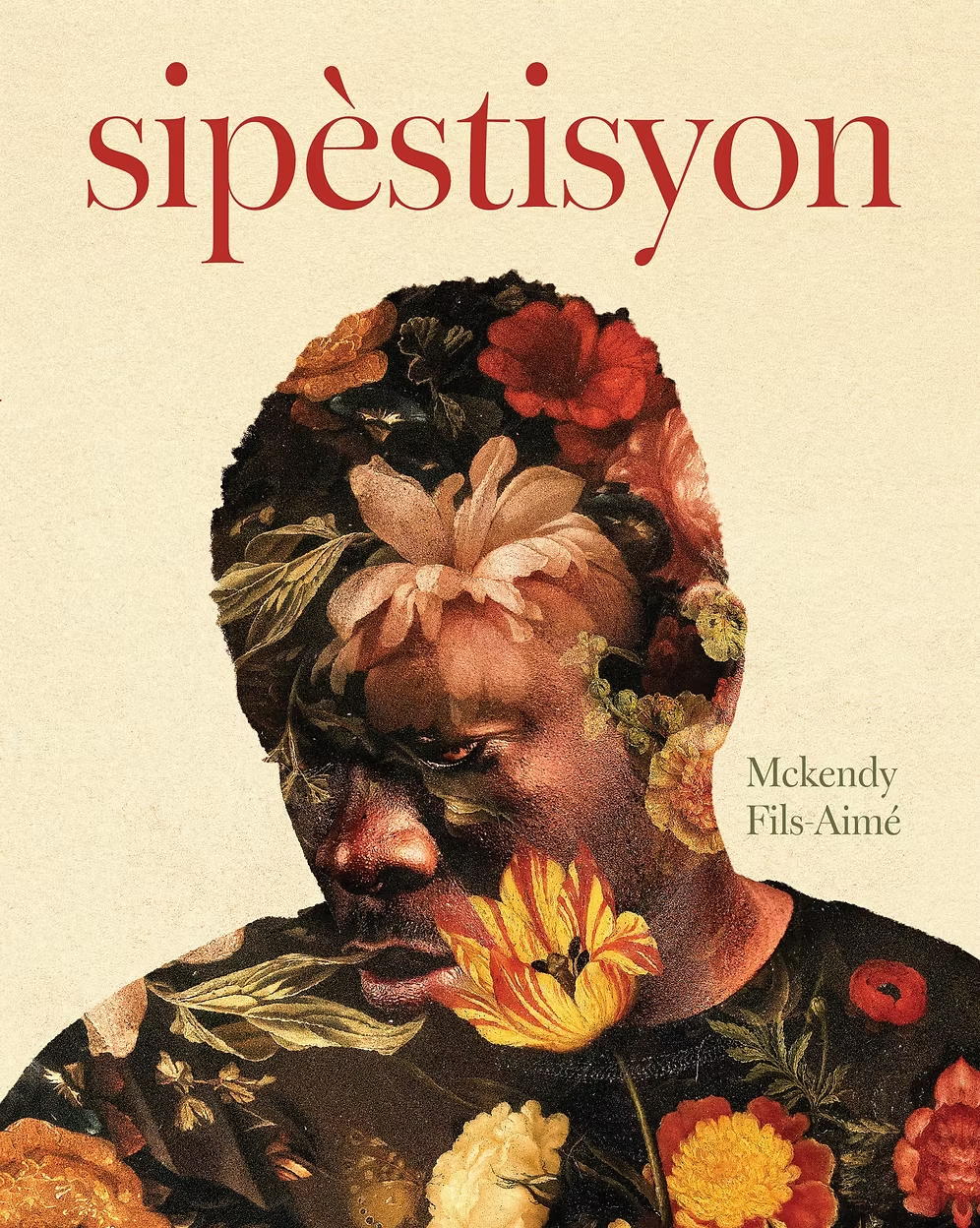
In sipèstisyon (YesYes Books, 2026), Mckendy Fils-Aimé’s debut poetry collection, language is lacerated by the breath of memory. Titled sipèstisyon, the Kreyol word for superstition, the collection speaks through and against the smothering regime of English by assembling a sonic Kreyol terrain. The oral form of superstitions is invoked to elevate the acoustics of resistance and revival. Truth-telling, herein, does not merely vibrate the ache of trauma and violence but appears as an affective experience suspending us within the temporal orientation Fils-Aimé’s speaker migrates us toward. Vanishing lines are brought closer and vocabularies overflow.
Though memory is often attributed to interiority and the past, Fils-Aimé writes it as a lived condition, as history. It is the marrow from which all contemplations, anguish, and wounds surface and coincide. The first poem, “sipèstisyon” comes to warn us of the fragility of memory: “If you comb your hair at night, you will lose your memory” (6) all the while it is made into an entity, an object of interest that can be plundered, with the speaker asking, “if memory is a museum // what happens if it’s ransacked?” (6). It is here where Fils-Aimé’s collection dilates: in the collapse of memory’s infrastructure. We are thrust into the nonlinearity of remembering—its illegibility, obscurity, and entropic tendencies. How, then, must we speak of ruin after it has happened? How do we absorb the shame, not so much as an exercise of erasure, but of personal absolvement? The speaker answers within a position he has occupied, in the register of the interstitial aftermath.
“mwen pa pale kreyòl” (which translates to “I don’t speak Creole”) agitates his own shame of linguistic in-betweenness when, in telling a story in Kreyòl to someone, the speaker is criticized for the nasally sound he’s making, “laughing at the kreyòl i create / from the cinder blocks & cement // of english” (9). Here, his usage of Kreyòl appears to be awkward, clumsy, with the person listening condemning him that he has made a mockery of their architecture by building it with American machinery (9). The speaker laments this remark and at the same time accentuates the linguistic hybridity he settles between: “owning two skyscrapers // of dialect pressed against the skyline of speech. // i dream of two thin tongues, one in each of my nostrils / & how to sever the one closest to you / at the root” (9). The lexicons of Kreyòl are diluted through the sedimented structure of English, the body of words stiffening in its utterance; and seemingly, at once, the speaker has in front of him a hallway of locked doors with not enough keys to open them (9).
Fils-Aimé vertebrates the somewhat gelatinous nature of memory through language. In the following poem “my father apologizes for giving me a western name,” we are placed at the mouth of the speaker. He wonders if “naming is a culture’s way of colonizing a body, / if my tongue is just another island impaled / by French & American flags” (10). “soup joumou” finds itself in the speaker’s mother’s tongue as well, “shriveling like a snail / in the salt / of my English / i wanted to swim / against the current / of whitewash” (11). What I found striking is how the locus of the mouth is seemingly where Haitian heritage is reinforced as a migrant, reconstituting what it means to institutionalize the very voice they use as something that can both be disciplinal and transgressive. There is this, likewise, an excess and abscess of two languages; and oscillating between them is an embodied but disorienting experience. When the cadence of Kreyòl bleeds into English’s rhythm, the dissonance experienced from being an immigrant becomes less conceptual and more operational. Suddenly, visibility is determined on which is more audible.
Though Fils-Aimé lingers in the tension of what I observe as “unbelonging,” we see in the poem “bilingual” that reconciliation of being fragmented. He writes:
too bad we can’t push the rewind button
on a lost language, can’t rewrite an alphabet
on the chalk-brushed blackboard of erasure.
best we can do is fill in the fissures
of our vernacular & smooth out the chipping.
listen, pay your teachers no mind
when they say we speak broken French.
they’ve never had to reassemble the remnants
of their mother tongues after mourning (48).
Here, the speaker reconfigures fracture into fascination—“we open the china drawer / of our mouths, there’s copper / more than anything else” (48). These lines ultimately resonated with me because I understand this continuous, cascading residue that colonialism leaves within a language, this enduring afterlife of language compounded into a container that co-opts it. But Kreyòl is not complicit in becoming a spectacle of the English language. As it fills its own fissures and remedies its own precarities, the isolated fragments, at once, choreograph its autonomy. What Fils-Aimé does here is essentially translating that echo of a lost language into resonance, apprehending the vanishing voice not by strangling it (like what America does to non-English vernaculars), but by suturing it within the already existing polyphony coalescing in the myths, folklores, and superstitions he already understands.
Language gives memory texture, friction, fibrous moments. In “Invocation for the God of Laughter,” language is exhalation, “a boisterous song // from the quiet orchestra of our lungs…. / O language excavated / from the moments when language is lost” (57). This is perhaps one of my favorite poems out of the collection as it nears its closing. I am fond of this idea—of this interstice—where language cannot be flattened into a smooth surface; that there is this disruption in voice: song, laughter, the very act of breathing. Actions that operate on the very basis of sound and community and are therefore non-isolatable. It is from here I find the power in sipèstisyon. Superstition becomes saturated with chortles, guffaws, rapturous ruckus, bellows, wheezes, giggles (57-58), aural elements which cannot be colonized into syllables. Though what they do is splinter and multiply across the sky.
We return to the mouth by the last “sipèstisyon.” At this point, superstition has become almost like an inquiry into the possibility of fruition, of the future, of foundation. It reminded me of Natalie Diaz’s “Postcolonial Love Poem” where her speaker has “learned Drink in a country of drought” because Fils-Aimé’s speaker is a “seedless orchard—a drought in a grove / called potential. but I’m as resilient as a fig, / as defiant as a field of echinacea” (66). Both speaking about the aftermath of colonial violence, there is this fluidity that is bred from trembling at the perimeter of loss and reclamation. Fils-Aimé ends his collection with arms unfurling, “to stuff / fistfuls of sunlight into my mouth. / watch me nourish & be nourishment. / watch me become my own harvest.” (66). It ends in a truth we all know too well: there is resonance that remains after undoing power. Language noises out its own emancipation and immersion. And it breaches syntactic containment, seeping, leaking, and unraveling memory with it.
Purchase your copy of sipèstisyon today!

Zie Madayag (she/her) is a writer and academic from Metro Manila. She is a recent graduate of a Bachelor of Arts in Comparative Literature: European Literature at the University of the Philippines-Diliman. She has worked and volunteered at non-profit organizations and cultural institutions promoting artistic and literary production. Both critical and creative, her research interests include corporeality and materiality, spatio-temporal entanglements, ecologies, and the rhizomatic potentiality of the periphery.


