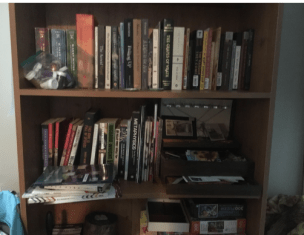
Though I love the concept of Project Bookshelf, I am slightly embarrassed to share my own shelves with the internet. In a purely aspirational dimension of the universe, an ideal version of myself maintains a beautifully curated book collection, properly whittled down to only the most worthy titles and complete with the most aesthetically pleasing editions faced out for the benefit of my house guests.In fact, I recently saw an Instagram post from one of my favorite poets, Kaveh Akbar, in which he showed off his and his partner’s gorgeously lit, museum-like library, and I thought to myself yes, that is what I would like my books to look like. The key here, of course, is that they don’t. My partner and are I not a literary power couple, but a couple of twenty-somethings who just moved into a ramshackle house from the 1920s in semi-rural Oregon. And, admittedly, neither of us are particularly neat. Our books are cherished. But they are also scattered everywhere.

You may see here that I’ve attempted to organize some childhood books, poetry collections, and nonfiction titles on the white bookshelves, along with my slightly embarrassing collection of Plath biographies (a teenage obsession that I know is considered a writer’s cliche). The other bookshelf, though, the light brown one, has a decidedly pragmatic function. It is protecting a mixture of my partner’s and my own books from moving- and construction-related damage. Look more closely, and you might see a fair amount of doubles in this mess of a library, an issue that was undoubtedly caused by two graduate students in English moving in together.
 Once, while talking with my dad about getting rid of all of these extra copies of Walden and Leaves of Grass and To the Lighthouse, he looked at me with concern and said, “I don’t know, honey … are you sure you are ready for that?”I think my dad’s reaction is pretty indicative of my abiding love for these mostly beat-up tomes. Like many of us here at Sundress, my physical books tell stories other than the ones that they harbor inside them, and my humble library—though not so pretty to look at—is the most valuable feature of my home.
—
Athena Lathos is a poet and nonfiction writer from Santa Maria, California. She currently lives in Oregon’s Willamette Valley, where she works part-time as a Student Accessibility Technician at Chemeketa Community College and part-time as a freelance writer and editor. Her work can be found in Enizagam and Verseweavers, as well as on her blog, Bertha Mason’s Attic. Her recent blog post about the job market, “I Applied to 200 Jobs and All I Got was this Moderate-Severe Depression,” was featured as an Editor’s Pick on Longreads. Lathos completed her MA thesis, “A Sea of Grief is Not a Proscenium: Claudia Rankine’s Citizen and the Spectacle of Racist Violence in Cyberculture,” at Oregon State University’s School of Writing, Literature, and Film in May of 2017. Lathos was a finalist for the 2016 Princemere Poetry Prize.


 And then there are my ever-present (and ever-growing) piles of books I want to read or re-read, stacked on the floor after I ran out of shelf space. These are old and new books, books I’ve borrowed from friends and books of my own. These paper towers contain everything from books of short stories by F. Scott Fitzgerald and Tom Hanks to Dave Eggers’ The Circle and Station Eleven by Emily St. John Mandel. No matter how much time I spend reading, these piles never seem to grow smaller, but I’m okay with that—it means I always have something new to throw myself into. Tellingly, there’s a beige plastic bag sitting on my floor at this moment, partially enveloping my recent purchases of Circling the Sun and The Age of Miracles.


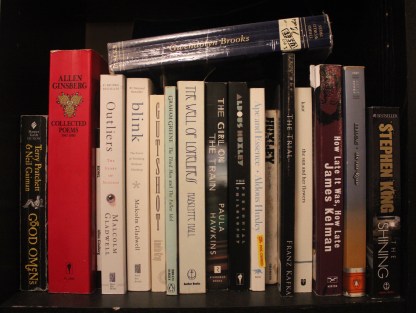

 would have had some tea to spill with each other, right?
 When I peruse the titles housed in my bookshelves, I see the rooms in which I first stacked and sorted them, hear the music that was playing the first time I cracked their spines. These books have traveled with me widely, from state to state, from life to life.
 These books are heavy with history. I didn’t write, or even contribute to, the overwhelming majority of them. But there is a sense of ownership that comes with collecting literature. These are my books. Not just in physicality, but in spirit. The stories I’ve shaped in my readings of these texts are mine alone. Nobody can see what I see in these spines. This is the intimacy of accepting the life of a writer, of choosing to experience the world through the internalized processes of a dedicated reader. There’s plenty of pain in these shelves, but there’s comfort there, too. These books will continue to take on new shapes and new lives as I do. There’s breath in these shelves.