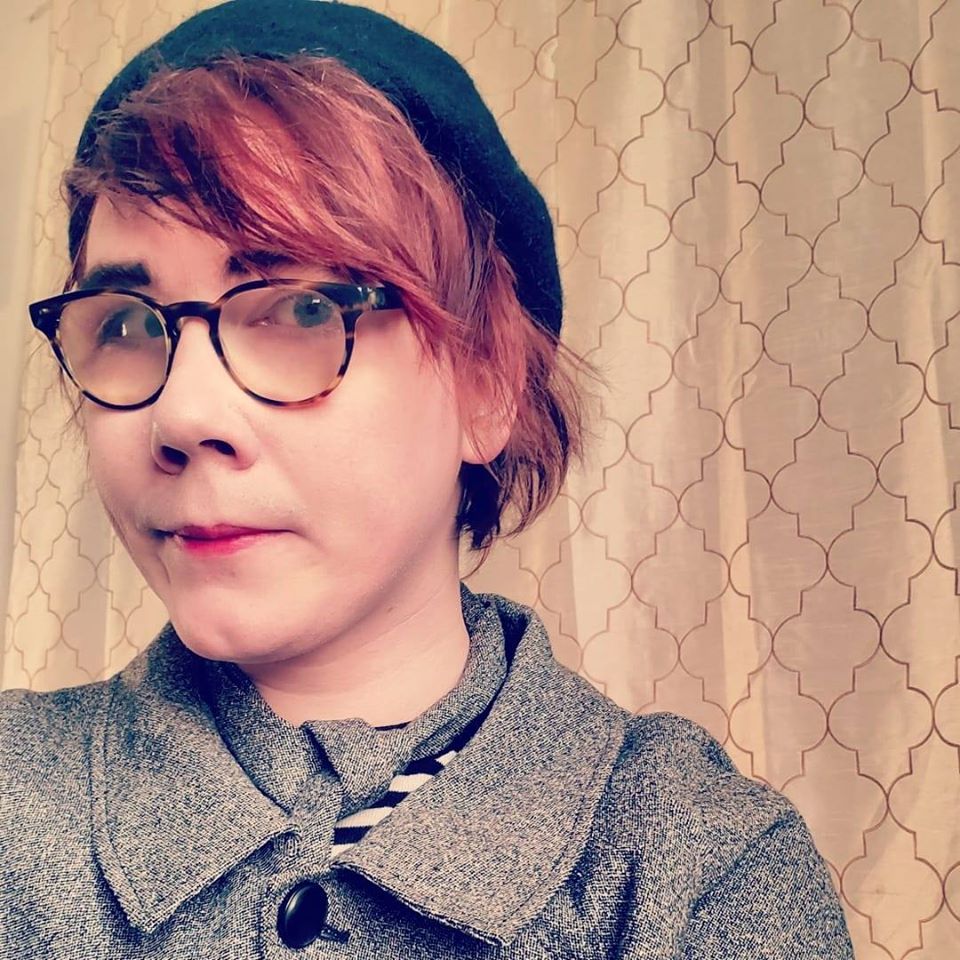
This month we had the honor to speak to Brooklyn-based poet and musician Elizabeth Devlin about her poetry collection Milk Spine (Dancing Girl Press & Studio, 2024). Her writing is visceral, rhythmic, sinuous. It’ll prick your palm then crawl inside your ear and get stuck in your head—in a good way! The poems reward multiple reads, and like a great song on a newly discovered playlist, they inspire you to keep hitting play, to keep going back and reveling in the anticipation of that one perfect hook. When everything comes together, the whole thing just clicks! Devlin has that in spades, and it was a treat to get to pick her brain about her process and the intersection of poetry and music.

Ada Wofford: The collection opens with “Milk Fat,” which begins, “For three years, I stopped living, / so I could give life.” This is such a powerful opening. On the one hand, it seems to pit living as something against giving, but one could also see giving as living; that they are two sides of the same coin. Can you speak about how you view the relationship between giving and living and why you chose to open the collection with this observation?
Elizabeth Devlin: “For three years, I stopped living, / so I could give life,” is a reference to the sacrifices one makes when choosing to become a conscientious parent. There is a dissolution of self, and ego, in service of one’s progeny. I agree that giving is an attribute of living; some of the most rewarding things I have done in my life came from positioning myself in a role of service. But what that line specifically refers to is the devotion required of parenthood; there is little freedom, autonomy or sense of self, once one chooses to be a good parent, especially at the beginning. Parenting a newborn is challenging but is also an exhilarating and powerful act of service, selflessness and love.
AW: In “Up/Pick Me,” you work in a call and response pattern that depicts what a woman is or needs versus what she gets, how she is perceived, “I am in need of religion/It must be a sin to look that fine.” The writer Anne Lamott once quoted a friend of hers as saying, “You’re not a body having a spiritual experience, you’re a spirit having a body experience.” On the surface, the poem is about sexism, but that sexism is rooted in the denial of the spirit (or inner self) via seeing the body as an object. Can you speak about this idea of spirit or inner self versus the corporeal, and how poetry might function as a conduit between the two?
ED: Most days, I feel like a moderately evolved ball of nerves, bouncing from one sensation to the next, hiccupping through a series of physiological and chaotic responses to internal and external stimuli. My poetry lives, and finds color and smell, in the awareness of my corporeal self. Whether I am appreciating my body or not; I have never been able to dissever the two. I do not believe I have a “soul,” nor do I subscribe to any religiosity that purports humans possess an essence separate from the body that is exclusive to us or other sentient beings, or the byproduct of being the chosen progeny of an all knowing, omnipresent being god/goddess. I do not believe there is another plane on which people exist after they die, where individuals will be divvied out their punishments or prizes. I believe that this life is it.
So, when you ask me to speak about this idea of spirit or inner self versus the corporeal, and how poetry might function as a conduit between the two, I am at a loss. We are made of stars, and no energy is created or destroyed. Considering this, I could not separate my corporal form from a literal or metaphorical idea of soul. They are interlinked bedfellows. This all said, I do feel there are things we have yet to understand, or define, and I identify these things as metaphysical, and some may consider that an indication of “spirit/soul.” I love the idea of having a soul because it allows me to contemplate fanciful things and exist in the realm of woo.
AW: You write with a lot of rhythm and rhyme (I didn’t realize until I finished the book and read your bio that you are also a musician), “relative to the / rickety-racket, / bury-that-hatchet,” and in another, “but I love you like a sister / or a brother, / from another mother, / with your free, Whitehall condoms, / cell-phone-bling, pawn-that-ring brokers / and the elevated rittle-rattle.” This produces musicality in the poems that I find quite refreshing. Can you speak about these elements and what they mean to you as a poet?
ED: Humor and play are very important to me, in life, and in poetry. I am so pleased that you received these lines in this way; thank you for sharing your reflections. The musicality of the world is undeniable. I hear melodic voices in all things; poetry is just another instrument, or vehicle, through which we may construct songs. Alliteration, onomatopoeia, the flow, verbiage and syntax, and how beats and syllables flow from the mouth when read aloud, this is where the fun lies. Whenever I write, I am always reading out loud, to hear that rhythm and ensure its presence.
AW: To build on this (and if you’ve already answered this, then just ignore), written poetry is inherently a visible medium while music is not. How do you think of poetry as something visual and what can the page accomplish that sound can’t?
ED: Sound is visual to me, in that, it induces literal visual responses, which can cast my sight in shades of color and feeling. I do not have chromesthesia, but sound does change my sight and the way I perceive shape and color, so, in this way, when I hear poetry read aloud, particularly lyrical poetry, the sound does have a visual effect. I put great consideration into how words appear on the page, as well; format and line breaks, and the play that can exist within, allow poetry to have visual impact outside of the sound. Both things are important.
AW: I’m very curious about the title of the collection, it conjures in my mind a spine molded out of curdled milk, seemingly solid but viscous the moment you touch it. Can you speak about your inspiration and why you chose the title Milk Spine?
ED: I love this; “it conjures in my mind a spine molded out of curdled milk” is right on point. Milk Spine was a reference to being a milk producing mammal and how my life was ruled by the hunger of my child’s need to suckle. It’s also a playful way of referring to the spine of a book. The book’s spine and the spine of the body, give structure, definition, support, and much of what is spoken about in this manuscript, is about the corporeal body, organs, spine, blood, fat, so the title was a reference to that, as well. Breastfeeding is such an animalistic, ecstatic and sensual ritual. It bonds mother to child in a parasitic way that is emphatically welcomed by both participants. There are some mutual benefits to breast feeding but, at times, I also felt I was submitting fully to this being I had created. The poem “Letdown” addresses the complexity of this relationship in detail. I have never felt so simultaneously powerful and helpless, as when I was breastfeeding. The mammary imagery does include images of curdling, and I hope that the narrative of a failed relationship is illustrated by that. The milk, and the romantic love, outside of the mother/baby relationship, is sweet and fatty and life giving, until it is not.
AW: The concept of religion and spirituality appear throughout the collection, though sometimes in contradictory ways; in “Flushing Ave,” you write, “if there was still religion / lifting these two boot souls to God, / But there isn’t.” Later in the collection, you have a poem titled, “Church of the Orishas: A mother’s prayers: after Psalm 143:1” in which you write, “OH GODDESS, hear my prayer, / Give ear unto my supplications, / In Thy faithfulness answer me—in Thy righteousness.” I’m going to leave this as broad as I can because I know this is such a complex topic to discuss, but if you’re comfortable, can you talk about what religion and/or spirituality means to you as a poet? And if you’d like to speak about the specific poems I quoted, please do.
ED: I was raised in strict, patriarchal religiosity; it was the source of a great deal of confusion and oppression in my childhood and catharsis in my adult life. Harkening back to your previous question about spirit, while I do not subscribe to a particular faith or religion, and do emphatically believe that what we have in this life is what we get, and nothing more, I do think there are undefined components of our existence which elude us, and so we refer to these things as magic and/or spirituality. Within this abstract understanding of the word spirituality, as a metaphysical human contemplation, I do feel greatly influenced by that which I feel, and believe I am acting within, but for which I do not have a name or defined understanding. It all feels intuitive, as life, and language, and song, and verse, feel intuitive. I enjoy playing with the idea, that, if there is a god, she is woman, and in direct opposition to that which confined me in my upbringing. Since nature, evolution, reproduction and life, feel inherently feminine to me, when giving a voice, description and narrative to an omniscient being, I want her to be female identifying. In “Church of the Orishas: A mother’s prayer,” I chose to juxtapose these narratives. Yemaya is a goddess in, and with whom, I can identify and have faith in. She is relatable and invokes faith in me; utilizing her to relay my personal narrative as a young mother, allows space for womanhood, and a sense of peace and strength, that was not present, or considered, in the religion of my childhood.
AW: In “Letting Go is Hard,” you write, “I’m not a person / but a place, a thing.” Is this echoing the type of objectification discussed in “Up/Pick Me” or is this touching on a different form of dehumanization/alienation? And if so, in what way?
ED: Yes, this is certainly echoing the same type of objectification that we discussed in “Pick Me Up.” When I wrote these poems, I was joyfully and painfully aware of how my physical body both elevated and inhibited my experiences. I appreciate you picking up on this and connecting these contradictions. Many of the poems in MS are struggling with this same contemplation and trying to make sense of the narrator’s personhood and concept of self.
AW: You have such a knack for association that it makes not quoting you at length difficult but there’s a great section in “As Things Developed She Was to Have All Manner of Revelation” that I’d love to ask you about. “Leaning on an enlightened pillar / of debt and obligation, / there is no catharsis / in communism, / or Christ in capitalism, / just a solo communion, / Yeezus and / I AM GOD (DESS).” There is so, so much happening in such a small space. I took it to be an exploration (or fever dream) of spiritual hunger; one goes to higher education (“enlightened pillar”) to expand their horizons, only to be fed a bunch of corporate speak and rubrics, spit into a society that cares only about the material, and with celebrities as the only thing resembling something like a divine figure for us to worship. Can you speak about this poem and is this interpretation anything like what you were going for?
ED: Oh my god, what you wrote here is so on point and beautiful and full of understanding. Thank you so very much for giving my work such generous and insightful consideration. I appreciate you and yes, yes, yes to everything you said; I have nothing to add.
AW: And to follow up, can you speak about your use of association in your poems, making one line suddenly change meaning by its context with the next line and what you enjoy about this close-knit style of writing?
ED: Are you referring to enjambment and the line breaks?
AW: Yes, I am.
ED: I have a close friend, Barbara Schwartz, with whom I have been in a poetry writing group for over eleven years now, and she is the queen of enjambment! She has taught me the power and playfulness of leaning into this poetry mechanism, to keep the reader on their toes! It is part of my poetic playfulness. When the question, the conflict, the contemplation, the meaning, the understanding can change abruptly, from one line to the next, that is exciting!
AW: And lastly, is there anything else you’d like to talk about? Any new projects, albums, collections?
ED: I currently have a full-length MS that I am sending out to publishers. I have also been sitting on a full-length, recorded and mastered, album that I am going to release in the future. My personal life has presented some extreme challenges in the last year that have left my professional life in shambles. So, there are many things cooking but, without trying to sound trite, I really have no idea what the future holds, currently.
Milk Spine is available through Dancing Girl Press & Studio

Elizabeth Devlin is a visual artist, poet, singer and multi-instrumentalist. Her debut poetry chapbook, Milk Spine, was published by Dancing Girl Press in 2025. Her art and poetry have appeared in Cobramilk Issue 2, The Opiate, Bomb Magazine, We the Tender Hearted and elsewhere. Elizabeth is a three time recipient of the Writers Residency, at Firefly Farms, through Sundress Academy, Knoxville, TN. Between 2017-2021, she was the curator and Founding Director of Bessie’s Brooklyn, a private art salon, which hosted numerous art, music, and literary events including: The Highwaymen NYC, pRose By Any Other, The POETrap and Token Folk Acoustic
Devlin has toured internationally for close to two decades. An autoharpist/singer-songwriter with avant-garde-folk sensibilities, she defies traditional song structures, weaving small worlds where magic and fantasies collide. Elizabeth’s third full-length album, Orchid Mantis (2017), received 4.5/5 from Impose Magazine and was the follow-up to the previously released albums: For Whom the Angels Named (2011), Ladybug (2011) and All Are Relative (2009). In Fall 2021, Devlin released her fourth album, Conscientious Objector (What A Mess! Records, FR). Devlin continues to tour and will release her fifth full-length album, My Father’s Country, in 2026. Elizabeth can be found in Brooklyn, living with her large family, loving on a ridiculously hairy dog, gardening and sipping a Thai iced Bubble tea, or, at elizabethdevlinmusic.com.

Ada Wofford (they/them) holds MAs in both English and Library Studies. In addition to working at a rare book shop, they are an associate poetry editor at Sundress Publications, the editor of We Call Upon the Author to Explain, and the non-fiction editor at Stirring: A Literary Collection. Their writing has appeared in The Blue Nib, McSweeney’s Internet Tendency, Autostraddle, Capable Magazine, Sundress Reads, and more. Their chapbook, I Remember Learning How to Dive, was published in 2020, part of which earned them a Pushcart Prize nomination.