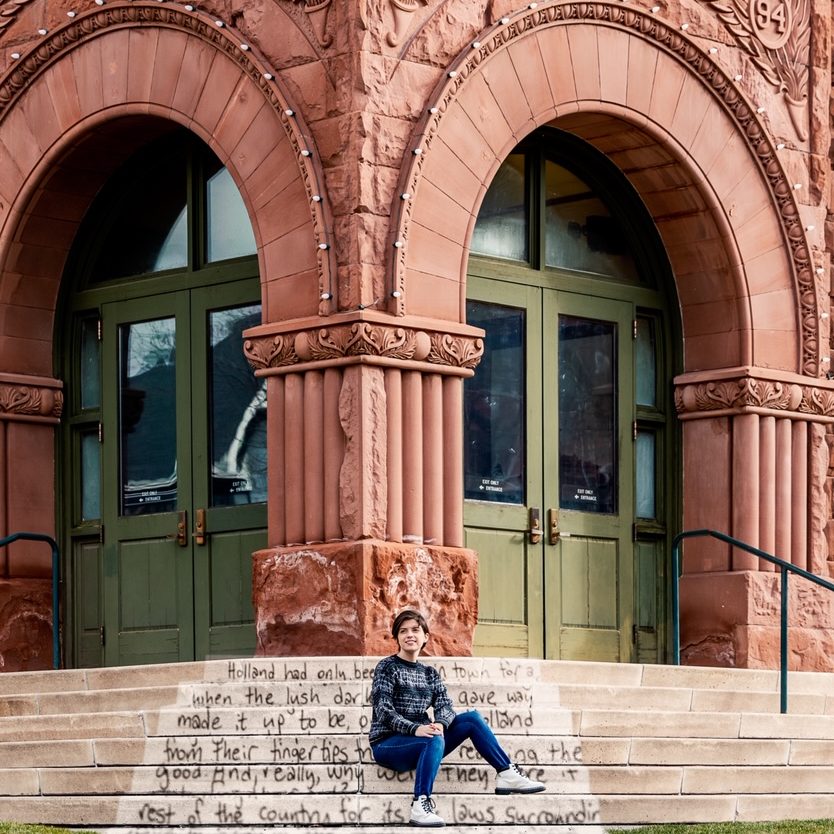
i am black like all things black wanted for everything but the flesh noise to anything arrhythmic an ankle of gold shackled to an ankle of gold the skin rubbing to flake off ash letting something of the name be free but ain’t all skin dead once left homeland ain’t all tongues a north star until dimmed a boy with a taste for the river but yet in fear of any body of water that he can’t spit out
This selection comes from Summertime Fine, available from Variant Literature. Purchase your copy here! Our curator for this selection is Nilsa Rivera.
JASON B. CRAWFORD (He/They) is a black, nonbinary, bi-poly-queer writer born in Washington DC, raised in Lansing, MI. In addition to being published in online literary magazines, such as High Shelf Press, Wellington Street Review, Poached Hare, The Amistad, Royal Rose, and Kissing Dynamite, he is the Chief Editor for The Knight’s Library. Jason is a cofounder of the Poetry Collective MMPR, a group of poets who came together for laughs, bad memes, and nerd culture. He is also the recurring host of the poetry section for Ann Arbor Pride. Crawford has his Bachelors of Science in Creative Writing from Eastern Michigan University.
Nilsa Rivera Castro writes about gender and diversity issues. She’s also the Managing Editor of The Wardrobe and the Non-Fiction Editor of Doubleback Review. Her work appears or is forthcoming in Huffington Post, 50 GS Magazine, Six Hens Literary Journal, Assay: A Journal of Nonfiction Studies, Selkie Literary Magazine, and Writing Class Radio. She’s currently an MFA Nonfiction candidate at Vermont College of Fine Art and lives in Riverview, Florida.
Welcome back to Lyric Essentials! This week, Sundress author féi hernandez reads Natalie Diaz for us while reflecting beautifully how it feels to experience, write, read, and become poetry. Thank you for reading!
Erica Hoffmeister: Why did you choose to read Natalie Diaz for Lyric Essentials?
féi hernandez: When I finished reading Natalie Diaz’ “When My Brother was an Aztec” I had an otherworldly impulse to turn back to the title page and two inches beneath the title write: “Natalie Diaz is God and I’m dead in her heaven.” I went to my room from the living room and put my sneakers on and went out for a run, I wanted to fly. With the statement I wrote didn’t mean to aggrandize or over sensationalize a fellow spell casting poet, nor do I not see the God in myself or in other writers that have changed me like Danez Smith or Patricia Smith or Ocean Vuong, but it was heavenly to find a place to rest, one where I could always be safe and be clearly seen. Every poem struck my bones like precise lightning, electrifying my spirit to write. I had finally found tracks that could teach me to be a better hunter and simultaneously prey. Natalie Diaz unfurls, demystifies a lot of the usually tangled or overgeneralized notions of identity, which is what my work is determined to do. Specificity. Through Natalie Diaz’ work I felt closer to my ancestors, I felt my voice more capable of bringing them to life through my written word. Every poet, new and old, needs to experience the work of Natalie Diaz.
EH: What connection do you have to the particular poems that you chose to read?
fh: “Blood-Light” reminded me of internal and external turmoil I’ve experienced with my own family and interestingly, with myself. I am “brother” to myself in this poem as much as I am the narrator whose words/ alacranes, “In them is what stings in me – / it brings my brother to the ground,” in this case “brother” is my family. The way light and darkness works in this piece reminds me of the flick-of-the-light combustion that erupts in these moments of contention where, “The only light left is in the scorpions – / there is a small light left in the knife too.” This flash of war happens in 14 couplets. Couplets: love, family, ties, commitment, and togetherness all amidst the falling apart, the violence, the hurt. The last couplet destroys me: “One way to open a body to the stars, with a knife. / One way to love a sister, help her bleed light.”
As for “Abecedarian Requiring Further Examination of Anglikan Seraphym Subjugation of a Wild Indian Rezervation” all I will state are two very long things: 1. Aside from the title taking up its well deserved smarts and space, the first line sets up the poem perfectly: “ Angels don’t come to the reservation.” 2. The dichotomy of the reservation/ native land and the outsider, intrusive Anglican colonizers are pit against against each other over and over. For example: Saint Gabriel and Gabe, an Indian who stays in the reservation after a POWOW who “Sure he had wings, / jailbird that he was. He flies around in stolen cars. / Wherever he stops, / kids grow like gourds from women’s bellies.” What matters here is Gabe, his life, and not some “white god”/ angel who was part of the history of destruction bestowed upon the world, but in this case the reservation. My favorite line of the poem is “You better hope you never see angels on the rez. If you do, / they’ll be marching you off to / Zion or Oklahoma, or some other hell they’ve mapped out / for us.” Clearly tying this all back to violent histories in the United States and warning their people to avoid any “angels,” the colonizers they are. This poem specifically grounds me in the work I aspire to create which can capture the historical tensions not just in content, but in the decisions I make in the writing, like foiling concepts and characters and what they represent.
EH: Diaz’ has said that myth, to her, is—in contrast to written histories—“the truest of truths.” You too, write about myth and identity, particular to your nonbinary, non-white, radical immigrant experience. Can you speak to your relationship with myth and truth in this vein?
fh: The spiritual blends right in with myth. I grew up with so many stories that were supposed to instill fear in me like La Llorona, or highway spirits, or tales of the devil, but to me they felt the closest to my own truth: being trans, non-binary, being a childhood arrival from Chihuahua, México, growing up in Inglewood, Spanish my first tongue, and being displaced from so much: first the land and people I was born from (Pi’ma, Tarahumara, and trans-Atlantic ancestors), a nationalistic identity of Mexicanness, and being loudly queer growing up in the hood. I am La Llorona, wailing for all that’s been lost even if it’s been from my own volition. I am the devil: misunderstood, demonized, ostracized, a snake. I am a highway spirit begging someone to take me home, wherever that is. My truth is the biggest folklorist, makeshift truth for many people that may not understand how I’m “trans” if I have a full beard and my transition doesn’t look like the trans that’s traditionally accepted as demonizable. I agree with Natalie Diaz that the truest of truths are the stories, myths, left behind. I am, in that way, made of things that can fly, are magical and glow in the dark, things that can transmutate, disappear and appear, and I’ve never been more close to the truth of life. Myths are my favorite dance and where most of my ancestor-unearthing work with my family has begun.
EH: Lastly, your debut poetry collection from Sundress, Hood Criatura was recently released. Is there anything else you are working on right now (in relation to that book or not) that you’d like to share with readers?
fh: I am currently working on a book of illustrations that will follow the chronological trajectory of Hood Criatura (Sundress Publications, 2020)! I’m really excited to bring to life my poems visually! I am also working on a book of personal essays and my second full length poetry manuscript, but shhhhhh, don’t tell anyone!
Natalie Diaz is a queer, Mojave poet, activist, and educator, born and raised in the Fort Mojave Indian Village in Needles, California. She is the author of When My Brother Was an Aztec (Copper Canyon Press, 2012) and Postcolonial Love Poem (Graywolf Press, 2020). She has earned several accolades, including the 2018 MacArthur Foundation Fellow, a Lannan Literary Fellow, a Native Arts Council Foundation Artist Fellow, a Bread Loaf Fellowship, the Holmes National Poetry Prize, a Hodder Fellowship, a PEN/Civitella Ranieri Foundation Residency, as well as being awarded a US Artists Ford Fellowship. She is an enrolled member in the Gila River Indian Tribe and currently teaches at the Arizona State University Creative Writing Program.
Further reading:
PurchaseWhen My Brother Was an Aztec by Natalie Diaz, from Copper Canyon Press. Read a recent interview with Diaz from PEN America. Watch this reading and conversation with Diaz about “Postcolonial Love Poem” from The Greene Space.
féi hernandez (they/them) was born in Chihuahua, México and raised in Inglewood, CA. They are a trans non-binary visual artist, writer, and healer. féi is the author of Hood Criatura, published by Sundress Publications, 2020. Their writing has been featured in Poetry, Oxford Review of Books, Frontier, NPR’s Code Switch, Immigrant Report, Nonbinary: Memoirs of Gender and Identity (Columbia University Press, 2019), Hayden’s Ferry Review Issue 64, BreakBeat Poets Volume 4: LatiNEXT, and PANK Magazine. féi is a certified Reiki and Akashic Records practitioner who utilizes a decolonial approach to ancestral energetic healing. They collect Pokémon plushies. féi is the Board President of Gender Justice Los Angeles and is a Co-Founder of the ING Fellowship.
Further reading:
PurchaseHood Criatura from Sundress Publications. Read more about Hernandez in this interview with VoyageLA. Stay updated with Hernandez and their work by following them on Twitter.
Erica Hoffmeister is originally from Southern California and earned an MFA in Creative Writing and an MA in English from Chapman University. Currently in Denver, she teaches college writing and advocates for media literacy and digital citizenship. She is an editor for the Denver-based literary journal South Broadway Ghost Society and the author of two poetry collections: Lived in Bars (Stubborn Mule Press, 2019), and the prize-winning chapbook, Roots Grew Wild (Kingdoms in the Wild Press, 2019). A cross-genre writer, she has several works of fiction, poetry, creative nonfiction, articles and critical essays published in various outlets. Learn more about her at: http://ericahoffmeister.com/
We give black boys so much grief for their bones Rip the teeth from the gum and let them hang What body of melanin does not drown? Search for a life raft to rescue the skin, the mouth, the eyes, the hair, the culture lost Don’t love songs still end in a funeral? We sing the songs about our children gone The dust in an empty room left behind The marching on stolen soil last so long And yet those children never return home We chant/and chant/and cry/and chant/and chant and chant/and chant/and chant/and chant/and chant And still the boy stays in the ground all bone
This selection comes from Summertime Fine, available from Variant Literature. Purchase your copy here! Our curator for this selection is Nilsa Rivera.
JASON B. CRAWFORD (He/They) is a black, nonbinary, bi-poly-queer writer born in Washington DC, raised in Lansing, MI. In addition to being published in online literary magazines, such as High Shelf Press, Wellington Street Review, Poached Hare, The Amistad, Royal Rose, and Kissing Dynamite, he is the Chief Editor for The Knight’s Library. Jason is a cofounder of the Poetry Collective MMPR, a group of poets who came together for laughs, bad memes, and nerd culture. He is also the recurring host of the poetry section for Ann Arbor Pride. Crawford has his Bachelors of Science in Creative Writing from Eastern Michigan University.
Nilsa Rivera Castro writes about gender and diversity issues. She’s also the Managing Editor of The Wardrobe and the Non-Fiction Editor of Doubleback Review. Her work appears or is forthcoming in Huffington Post, 50 GS Magazine, Six Hens Literary Journal, Assay: A Journal of Nonfiction Studies, Selkie Literary Magazine, and Writing Class Radio. She’s currently an MFA Nonfiction candidate at Vermont College of Fine Art and lives in Riverview, Florida.
The title is set in Visby, but I think it is more apt to fondly call it an Avril Lavigne font. The cover of That Ex by Rachelle Toarmino (Big Lucks, 2020) immediately sets a loud, confident, unapologetically femme tone that I cannot disengage from. Toarmino masterfully layers dozens of clever, understated cultural references to create a cohesive and fun portrait of the life of a 20-something in 2020s America. That Ex, Toarmino explains, is titled as such because every man has a story about a “crazy ex” who, more likely than not, was human, and her poems reflect the human intimacy of sincere self-confidence others may look down upon. Toarmino’s engagement with form helps the book embody a wholly contemporary experience, immersing her audience in the emotional weight of finding love, family, and yourself while being bombarded by phone notifications and the plight of social media.
Toarmino, Editor-in-Chief of Peach Magazine, swiftly summarizes this experience in 103 weighty pages of poetry. While the collection moves quickly, themes and emotions building between pages, each poem is worth sitting with individually. Holistically, this book reads like tending to a plant stretching up under the neon purple of a grow light—something tender, assisting natural growth and life through artificial means to supplement that which we cannot get otherwise. Individual poems read like lip gloss shimmer catching the light from below in a bar; the light that cracks through pre-installed starter apartment curtain blinds; streetlights smearing onto the wet pavement of an empty parking lot at night. Lines become enjambed and run over each other, interrupting one thought with another, fast callbacks and callouts and calls for attention to the minutiae of daily turmoil. And it is beautiful.
With references from Anne Carson to the Twitter account @SheRatesDogs (which posts anonymous screencaps of male entitlement, often in dating app screenshots or private messages on social media), from Anish Kapoor and Stuart Semple’s color privatization disputes to Marie Kondo’s concept of items sparking joy, Toarmino captures the whirlwind of constant cultural references that comes with living in the digital age. These references come in quick succession, and the reader is expected to keep up. Both of the above sets of references occur within the same line, rocketing us back and forth between flickers of the cultural imagination. Toarmino’s spry connections are not just for immersion, but to lend an anchor point for empathy: understanding the subversions, inversions, and thick vacillations between optimism and pessimism about the situations at hand often feels like staring at someone else’s life through a thick pane of glass. In “People You May Know,” the speaker calls interpersonal interactions “looking at each other / through the wrong end / of binoculars” and comments that “it is so gaudy / and gruesome.” Toarmino is right, and That Ex consolidates this experience, tracing the move from putting yourself together to falling back apart to putting yourself back together but for real this time, I promise.
That Ex uses physical forms, in all its shifts and breaks and shapes, to its advantage throughout the book. For example, “If You Love Attention Make Some Noise,” is composed only of one phrase—“I am easy to love,”—that is repeated 104 times. The final line cuts off the phrase partway through: “I am easy.” The repetition creates a perfect block of text, a rectangle easy enough to skim through like a mantra you have to tell yourself even when you don’t believe it, followed by an interjection, or perhaps an intrusion, of what you really do believe, or what others tell you that you should believe.
“I Said Okay” is the first of two poems where single lines and stanzas stand on their own, spread across eighteen pages, a handful of words and images swimming in blank space. The last image, “okay / I said okay / I will Okay” uses capitalization for emphasis, as though we’re hearing one side of a phone conversation with a disgruntled mother. These fragments feel like reading texts pop up on someone else’s phone screen—stripped of context, yet deeply intimate and emotional. You cannot know what that context is without intruding, and Toarmino doesn’t shy away from the bombardment and interference that has become a cornerstone of young contemporary lives. Other shapes, literal images of a ravioli food truck or a computer mouse bringing the speaker’s body to the trash described as bracketed asides in “Week of Waking Thoughts No. 2” or the lightning-bolt zig-zag of alternatingly off-centered lines in “You Up?”, are emotional touchstones without ever feeling self-serving or self-sacrificing. In particular, “[visual of mouse cursor dragging my body to Trash] / mark yourself safe” from “You Up?” highlights the speaker’s feelings of catastrophe by moving herself to the electronic disposal system and, in the very next line, clarifying that she is okay by means of Facebook’s algorithm for updating family and friends after a disaster.
“there is the first moment / when you realize // that someday you will know this person / very intimately // but it will feel like / returning to something.” That Ex brought me back to shuffling through profiles on Tinder, keeping my fingers crossed for the prospect of finding someone worth my love, and trying to convince myself that I was just as worthy of it as others. Its lyric stirrings brought that purple light overhead, returning me to an intimate corner of myself I’d nearly forgotten about, but never truly could.
Lee Anderson is a nonbinary MFA student at Northern Arizona University, where they are the Managing Editor of Thin Air Magazine. They have been published sporadically but with zest, with work appearing or forthcoming in The Rumpus, Columbia Journal, and Back Patio Press.
Julia Madsen and I met through the mechanisms of the Internet, like many writers do. We had posted similar comments on a mutual’s thread for the need for support amongst artists rather than starvation-economy competition tactics. When Julia posted a few days later about her new chapbook, Home Movie, Nowhere, I reached out for a possible interview. The minute I looked at the haunted, gothic Midwestern landscape of the book’s cover, I knew I wanted to dive right in. What I found in this work was a brilliant blending of genre, from poetry, to nonfiction, to film—a breaking down of the categories that writing is often put into, and, in turn, an exploration of the same categories the self sometimes tucks neatly into. This pithy, dark, brilliant book says a resounding “no” to these over-simplifications. In the following interview, Julia and I discuss craft, working class backgrounds in the arts, and much much more.
Alex DiFrancesco: This chapbook takes a level of detachment in the form of film. How necessary was that, for you as a writer, to telling this highly personal history?
Julia Madsen: I love this question to which there are a multiplicity of answers but I will try to streamline as clearly as I can think of them, and as clearly as they emerged for me when writing this chapbook. First, I was teaching Guy Maddin’s My Winnipeg (a film I had watched on repeat for years) for an undergraduate creative writing course on the personal and cinematic essay. My Winnipeg is an essay film—a personal documentation of homeplace and the ghosts of history that hover over / are buried below the landscape. It really focuses on the uncanny, gothic, or darker histories of Winnipeg, including Maddin’s own experience of wanting to escape the city but being unable. I felt the same about my small, working class hometown in rural Iowa (which goes by multiple names but is colloquially known as “Frytown”), which is where the line of connection with Maddin’s work was formed. Not only this, but in the film he mentions “the forks” where the Red and Assiniboine Rivers meet, a place of First Nations lore where supernatural events are said to occur. This was the beginning of the chapbook, in coming to understand my own “home movie” as a personal documentation of place which hinges on the fact of having lived just past the fork in the road, which my work figures as a historical marker of things that have come to pass as well as the “crossroads.” Whenever anyone would visit, we would say “just take a right at the fork.” So I had to learn how to re-locate myself back home. And truthfully had to uncover histories that I had kept hidden even from myself.
But there is another answer to your question which addresses my own preoccupation (obsession?) with pre- and early cinema. Georges Méliès—a filmmaker and illusionist known for his phantasmagorias—haunts the body of the work. Alongside My Winnipeg, I was watching Saving Brinton, a documentary about how historian Michael Zahs found Méliès lost work in a box marked “look for historical value” in a basement not far from my hometown. I started screening Méliès’s turn of the century work on a projector against a white sheet at home. His work is electric, spectacular, and almost unfathomable. Through watching his films I found incorporating elements of the phantasmagoria to be an exciting way of trying to tell this personal history which contemplates magic, supernatural events, and ghosts of the past alongside coming-of-age experiences.
I hope this begins to answer your excellent question about form and content. Did I mention that Maddin and I have the same birthday? I don’t think this matters much, but it is a birthday we share with Michel de Montaigne.
AD: Something in the stars that day! Can I ask you to talk more about the process of writing as an uncovering of things kept hidden even from oneself? Were there a lot of drafts? Was there an a-ha moment when some of the hidden things became revealed?
JM: I wrote out answers to these questions a few times over but cannot find any of my notes, so I will start afresh here and now! What percolates for me in the present moment regarding your questions: I think it is important to note that at the time I wrote this chapbook I felt I was under some kind of duress with job and circumstance, as I was making $1,000/month adjuncting and drinking maybe three sodas a day to stay alert and awake for work and was pretty stressed generally. I was also finishing my dissertation and pushing to meet that goal. I felt a lot was at stake with this project in particular. I promise this gets to the meat of your questions—especially your emphasis on the revelation of what’s hidden (for me, revelation itself was crucial for writing the text). I would write in my office before class and late after midnight and through the morning. I would write to try and dig deeper each time and as a result multiple drafts and a lot of material was produced which do not appear in the chapbook. Important elements that revealed themselves over time had to do with work, sex, passion, loneliness, and family history as they relate to my own coming-of-age. Because where I’m from you’re not supposed to talk about yourself, I had to uncover and come to terms with experiences that to this day bring a lot of pain and grief, and had to get comfortable even talking about and representing my own life. I never thought, for instance, that working morning and night at the hardware store in high school was very remarkable until I started to attune myself back to that time. I found a constellation of feelings, images, and associations waiting or maybe yearning to be discovered. It was also a process of remembering why I write by coming to understand my rural working class roots as something that is important to represent.
AD: Because of the film format, there is a level of blocking of space that comes in early. How would you say you used that to build the world and orient the reader?
JM: The prose blocks are significant in acknowledging the geography of the landscape itself, which is a square grid through which a single angular road creates a pivot (“the forks”). There is the sense of being contained within that frame and wanting to escape but being unable to escape. It becomes a frame similar to that of film. I wanted to push on those square boundaries and limits through crossing over between genres—poetry, prose, essay—and through the content itself where death crosses over into life.
I also had a theory I was working with which seeped its way into my skin and bones over the course of years of re-reading and being-with it. For me, Gilles Deleuze and Felix Guattari’s idea of the “body without organs”—that flat surface, plane, or plateau—came to represent the flat, endless Midwestern landscape which I imagined became a “recording surface” for memory. I started thinking about the Midwestern terrain as a filmstrip or VHS tape, and how this re-presentation of place engages with processes of deterritorialization/reterritorialization.
AD: On page 7, comments are marked with “true” and “false.” The next page contains a speculative scenario. Since this work bends genre and takes what it needs from them, I’m curious if this is a commentary on the nature of creative nonfiction? Does adding the false statement about stepping into a puddle acknowledge the nature of memory and desire in creative nonfiction for you?
JM: Yes, this is such a good reading and yes. I think truth needs to fit the music, not the other way around, to paraphrase from Richard Hugo’s “The Triggering Town.” I didn’t feel the need to write strictly the facts, because there wouldn’t be much of a story then, but rather gave myself creative permission to explore elements of fantasy and the supernatural inspired by the phantasmagoria tradition. In the process of writing I felt like memory and desire were fleeting and ephemeral, almost mirage or fog-like (again with that image of ghosts of history hovering above the landscape)—though there are certainly non-fictional elements that emerged as a result of research and investigation into Frytown’s history. This research took hours pouring over texts at the State Historical Society and on the internet. Often I felt I had to fill in the gaps and absences in history seeing as how there is relatively little information. I felt the impulse to provide space for the collaboration between fantasy and non-fiction as a way of trying to tell a captivating, revelatory story.
AD: There is wonderful use of footnotes here, which start out very straightfoward and then move into a deeper use throughout the text. Can you tell us about your intention with them within the work?
JM: The nested footnotes seemed necessary and arrived organically because of the stories-within-stories about my homeplace that I was compelled to tell. I see the footnotes as maybe “below” the text in that they are submerged and come to the surface of the page as innermost thoughts, desires, memories, etc. They often venture down roads that the text itself does not, so in a way they extend and expand the work. In writing them, they came out like a flood and seemed to be buoyed by hidden truths. The act of writing them alone helped these truths come to the surface.
AD: You identify, in your author’s bio as a first-gen writer, author, and scholar. Many of the themes in this book are working class ones, even when they just appear in a few lines. There is the rural landscape with its unused farming relics, the skinning of animals for sustenance, and mystic prophets, to name a few. Can you discuss more how these themes inform your work both here and as a writer and scholar in a larger sense?
JM: I grew up working class, my dad was a mechanic at a gas station making under $7.50/hr to start with, and my sense of class-awareness has been even more heightened by having worked within academia and the field of creative writing. I try often to raise discussions about socioeconomic class in creative writing and scholarship, which is why these themes are almost always apparent in my work (I also recently published a critical article entitled “Reframing Place and Labor History: Working Class Politics and the Archival Image in Midwestern Labor Documentaries”). My class background is not unrelated to some tragedies and intergenerational traumas that have befallen my family, which I continue to write about—like in “Home Movie, Nowhere” and in my lyric essay “The Straight Story” which dives into/investigates a family murder. A murder over money, some family members have said, though it is hard to know what is “true” and “false” or even if those binaries exist in this case. My great-grandmother killed my great-grandfather and the rest of the story unfolds from there in newspapers and court documents. She was his housekeeper, he was a farmer, and they had gotten married and had two kids (the oldest being my grandfather). After the crime took place she told my grandfather and his brother to go run out in the bean field after getting her truck stuck in a ditch from rain (this was both in the court documents as well as the story my grandfather told me). I think of that early morning scene—the dream of it—the rain, unending rain, washing everything away (like in the movie Rain, of whom Martin Scorsese is the executive producer, set in a similarly rural small town in Iowa with an eerily similar crime scene). For me, family history, intergenerational trauma, class, and film serve as some kind of feedback loop.
AD: The chapbook also makes use of interconnected flash form, in a way, part of the hybridization of genre found here. In what ways did this stylistic choice relate to the larger project of film and scene?
JM: The choice to write in-between genres relates in a lot of ways to the Midwestern landscape as an in-between space, and also to the “in-betweenness” of the gothic, which begins to account for the boundary-crossings between life and death in this text. In some ways the interconnected prose blocks also work as an extended portrait of self and place, or of self in relation to place, the kind of portrait that necessitates an encounter with multiple forms as a way of living at the crossroads. Each prose block is like a mini-portrait, snapshot, or two-way mirror.
AD: This work, to me, feels highly poetic in that associations made through word choice and language make up some of the direction the prose moves in. There is a muddying of prose clarity that works very well, to me, in terms of the larger things happening with structure here. Can you comment on uses of such poetics in prose? Or the use of such prose in poetics, as it may be?
JM: I was watching F for Fake by Orson Welles a lot while writing this (in addition to the other films mentioned) and almost think that this work is poetry that “fakes” prose, or maybe the other way around. I use wordplay and had a really fun and enjoyable time writing most of this, honestly! Writing through association and the music of language was pleasurable and my hope is that the reader finds this pleasurable too.
AD: I love this idea of genres faking each other—can you tell us more about what that means to you in terms of hybrid genre and writing in-betweenness?
JM: Now I’ve gone down a rabbit hole thinking about the word “fabrication,” which signals something constructed or manufactured but also “an invention; a false statement; a forgery” (from OED). I love that little definition. Perhaps documentary poetics writ large pushes one to invent, experiment, and extend their practice and praxis into new forms and ways of storytelling through attempting to document or “capture” everything inner, outer, and beyond. I am thinking now too of the word “poiesis” and how that suggests bringing something into material existence as with making something, like poetry or art. There is a relationship between the construction/making of the text and the construction/making of the landscape. The lines between genres are like the ruler lines of the grid cast upon the landscape—itself a kind of fabrication that becomes real in the imagination.
AD: It seemed to me, that the heart of this book is encapsulated in the line “In root I found a place to return to, a depth we must plumb, the radix from whence we come and the unanalyzable etymon which precludes our powers to say so.” This line is so tight, so well-written that I’m almost embarrassed to ask you to expound on it—but I am!
JM: This is an example of that wordplay and muddying of prose clarity you mention, haha! I believe I was thinking about homeplace and ancestral lineage as roots and how that relates to the roots of language/words. There is something ultimately unanalyzable about diving into family history and the landscape itself through language—you go so far deep that everything disappears and you’ve reached the vanishing point.
AD: The name of this interview series comes from a song I love, which contains the line, “Prolix, prolix, nothing a pair of scissors can’t fix!” and so the last question of every interview is: If you had to cut one thing from this book, from a word, to a scene, what would it be?
JM: I love the word “prolix” so this question makes me smile so much! I’m not sure this answers the question entirely, but there is a scene in here which mentions a story my father used to tell me before bed about a ribbon and a pair of scissors. It haunts me to this day. All I can think of is that pair of scissors snapping off the ribbon and her head: “I imagine that gleaming double-edge cutting the ribbon binding life and death, her head rolling endlessly, disembodied, over hills and floating across the river conducting souls from one world to the next.”
Julia Madsen is a first-gen writer, scholar, and educator. She earned an MFA in Literary Arts from Brown University and a PhD in English/Creative Writing from the University of Denver. Her first book, The Boneyard, The Birth Manual, A Burial: Investigations into the Heartland (Trembling Pillow Press), was listed on Entropy’s Best Poetry Books of 2018. Her chapbook, “Home Movie, Nowhere,” is forthcoming from DIAGRAM/New Michigan Press (you can preorder here). Blue-collar born and raised in the Midwest, she is a Web & Events editor at Denver Quarterly, video editor at Reality Beach, and has shown video poetry and multimedia installations at &Now: A Festival of Innovative Writing, Outlet Fine Art Gallery, No Nation Art Gallery, Counterpath Gallery, Cabal Gallery, the Humanities, Arts, Science, and Technology Alliance and Collaboratory, and Denver’s Unseen film festival. Her video work has appeared in VICE’s “The Creators Project,” and her poems, reviews, and multimedia work have also appeared or are forthcoming in jubilat, Tarpaulin Sky, Fence Digital, Tupelo Quarterly, Omniverse, Anomaly, Caketrain, Black Warrior Review, Alice Blue Review, Flag+Void, Word for/Word, Cloud Radio, Small Po[r]tions, Deluge, Dreginald, Tagvverk, La Vague Journal, Devil’s Lake,Versal, Cartridge Lit, CutBank, Dream Pop Press, Entropy, Fanzine, Full Stop, and elsewhere. This winter, she was a resident at the University of Colorado-Boulder’s Media Archaeology Lab.
Alex DiFrancesco is a multi-genre writer who has published work in Tin House, The Washington Post, Pacific Standard, Vol. 1 Brooklyn, The New Ohio Review, Brevity, and more. In 2019, they published their essay collection Psychopomps (Civil Coping Mechanisms Press) and their novel All City (Seven Stories Press), which was a finalist for the Ohioana Book Awards. Their short story collection Transmutation (Seven Stories Press) is forthcoming in 2021. They are an assistant editor at Sundress Publications.
My entire life, I have been drawn to stories. Each night, my parents read to me before I fell asleep at night, and each time, I would ask for another story before exhaustion won out. When I learned how to read Braille, a world was unlocked for me where I could read everything and anything I wanted. Growing up, I loved series like The Baby-Sitters Club and The Twilight Saga and, as I grew older and more sophisticated in my reading habits, I began to gravitate toward The Hunger Games and similar books. Now, I read a wide variety of memoir, fiction, and anything that allows me to step into a world in which I get to learn something new about humanity.
My writing life began in journalism—though I was always making up stories and writing them down. For the last two years of high school and the first two of college, I made a career as a features reporter. I loved the interview process, and absolutely loved shaping the story of another into an article, but did not feel creatively fulfilled. I never realized I could have a career as a creative writing professor until a professor suggested I apply to graduate school and set my life on a different trajectory. It was not until I took my first class in creative nonfiction and began to read the true life stories of others that I realized the story I needed to tell was the one I was living: as a person who is blind and living a successful, fulfilled life despite the challenges I have faced. Once I decided to make creative writing my career, everything seemed to fall into place. It all made sense—why I have always loved stories, why country music draws me in more than any other genre with its attention to intentional lyrics, the way that I am constantly seeking to listen to the stories and experiences of others.
Now, my dreams are coming true. I am working on a memoir while pursuing my MFA at the University of South Florida, teaching brilliant students about writing and finding new ways to support the literary community. I look forward to the work I will have the opportunity to engage in with Sundress Publications and am especially passionate about highlighting diverse voices and stories over the next six months.
Nikki Lyssy (@blindnikkii) is an MFA candidate studying creative nonfiction at the University of South Florida. Her essays have appeared in Hobart, Sweet, and Essay Daily. When she is not working, she can be found in a coffee shop.
a sunday dinner at big mama’s house where everyone opens a container of come here
and is fed for the summer big mama cooks from the heritage of open house where every mouth has a spot at the table a neighborhood of kin whipped dark linda always used to talk about the celebration
we would stir into the pot a boiled heep of unfiltered laughs
seasoned and held in the bottom of the jaw ain’t nothing else ever been that baked into us and ain’t nothing else ever will be again
This selection comes from Summertime Fine, available from Variant Literature. Purchase your copy here! Our curator for this selection is Nilsa Rivera.
JASON B. CRAWFORD (He/They) is a black, nonbinary, bi-poly-queer writer born in Washington DC, raised in Lansing, MI. In addition to being published in online literary magazines, such as High Shelf Press, Wellington Street Review, Poached Hare, The Amistad, Royal Rose, and Kissing Dynamite, he is the Chief Editor for The Knight’s Library. Jason is a cofounder of the Poetry Collective MMPR, a group of poets who came together for laughs, bad memes, and nerd culture. He is also the recurring host of the poetry section for Ann Arbor Pride. Crawford has his Bachelors of Science in Creative Writing from Eastern Michigan University.
Nilsa Rivera Castro writes about gender and diversity issues. She’s also the Managing Editor of The Wardrobe and the Non-Fiction Editor of Doubleback Review. Her work appears or is forthcoming in Huffington Post, 50 GS Magazine, Six Hens Literary Journal, Assay: A Journal of Nonfiction Studies, Selkie Literary Magazine, and Writing Class Radio. She’s currently an MFA Nonfiction candidate at Vermont College of Fine Art and lives in Riverview, Florida.
Sundress Publications announces the release of Anna Meister’s What Nothing. A reckoning with the past, a bargain with memory, and a prayer for forgetting, What Nothing gives voice to someone for whom sadness is more than a feeling; it’s a place of residence, familiar as a home and strange as a sudden storm.
In her debut poetry collection, Anna Meister asks: how do you learn to live in a place like this? For someone who craves oblivion like salt, who knows what nothing is, staying alive is a lifetime of work. She discovers power in recognizing the dark — though naming it doesn’t make it any brighter but provides a way of seeing the shadows and giving them shape. With a persistent tenderness, Meister finds the somethings that lay a path and the someones who will guide the way, as they “queerly [weave] light into all my dark.” This is what we owe to one another: a hand in the darkness, a promise to be there on the other side.
Aracelis Girmay, author of The Black Maria, and a Whiting Award recipient, said of What Nothing, “Stagger, I stagger to meet these sensuous, brilliant poems stirring, now, in my branches. Here, form is shaped by urgency, and images carry their own weather and summon The Gone. Such poems sudden the blood, make new openings in the sense—awakening what poems can awaken across registers and feeling. See: ‘Look how young I was with my silence. Look at the cruel coat it wore.’ And: ‘I know what I’m talking about. / Please don’t die.’ They are so true, so idiosyncratic, so strange that I change shape to read them.”
Anna Meister is the author of two chapbooks, most recently As If (Glass Poetry Press, 2018). Meister studied poetry/memory/maps at Hampshire College and earned an MFA in poetry from New York University, where she served as Goldwater Writing Fellow. Her poems have appeared in BOAAT, Redivider, Kenyon Review, The Rumpus, and elsewhere. She lives in Des Moines, IA with her wife and son.
As kids, we used to mix every flavor at the Slurpee Machine. Didn’t matter if it was Coke, melon, blue raspberry, and apple. We’d drink until our tongues turned a dull purple and laughed at the first person to get a brain freeze. Every Friday, we begged to go down to Dairy Queen for a large cone. Mama always got hers dipped in chocolate, rolled in nuts. Ryan and I would race to see who could finish our ice cream first, cone and all, then complain that nothing was left for us to enjoy. We never even gave it time to melt on my mama’s backseat. See, that was my childhood, understanding everything would be temporary. The boy who became my best friend from down the street, until he moved and we moved and I watched him change. Started to only get the cherry slushies and somehow the tongue came out pink. I tucked everything about my old block in my toy box, left it at the house when I moved away. Ain’t nothing sweet left for me in that hood. Where the ice cream stays temporary, time keeps moving until it’s gone.
This selection comes from Summertime Fine, available from Variant Literature. Purchase your copy here! Our curator for this selection is Nilsa Rivera.
JASON B. CRAWFORD (He/They) is a black, nonbinary, bi-poly-queer writer born in Washington DC, raised in Lansing, MI. In addition to being published in online literary magazines, such as High Shelf Press, Wellington Street Review, Poached Hare, The Amistad, Royal Rose, and Kissing Dynamite, he is the Chief Editor for The Knight’s Library. Jason is a cofounder of the Poetry Collective MMPR, a group of poets who came together for laughs, bad memes, and nerd culture. He is also the recurring host of the poetry section for Ann Arbor Pride. Crawford has his Bachelors of Science in Creative Writing from Eastern Michigan University.
Nilsa Rivera Castro writes about gender and diversity issues. She’s also the Managing Editor of The Wardrobe and the Non-Fiction Editor of Doubleback Review. Her work appears or is forthcoming in Huffington Post, 50 GS Magazine, Six Hens Literary Journal, Assay: A Journal of Nonfiction Studies, Selkie Literary Magazine, and Writing Class Radio. She’s currently an MFA Nonfiction candidate at Vermont College of Fine Art and lives in Riverview, Florida.
I trained my eyes to see, in real time, the morning
when the gravel and ice moved back and stumps and logs still bearing
roots and bark appeared like storied relics,
exposed for the first time in a thousand years.
The helicopters hovered and boats collided
in the dazzled blink of a thousand eyes and cameras and phones
reflecting on the ice. What remained of its blue veins
fractured and tumbled into the bay. The earth sprang up and we felt
a perishing groan. Men and women in white coveralls
and white helmets bent down with magnifying
glasses to examine the chattermarks and striations
left as it cut away, as it melted, as it broke off, as it surged into the inlet
And what no one considered was the snowflea eating algae
and the bear’s wet paw prints drying in the brash light of us.
This selection comes from The Last Glacier at the End of the World, available from Split Rock Press. Purchase your copy here! Our curator for this selection is Nilsa Rivera.
Vivian Faith Prescott was born and raised in Wrangell, a small island community is Southeastern Alaska. She lives in Wrangell at her family’s fishcamp—Mickey’s Fishcamp. She holds an MFA from the University of Alaska and a PhD in Cross Cultural Studies from the University of Alaska Fairbanks. She’s a founding member of Community Roots, the first LGBTQ group on the island. Prescott is also a member of the Pacific Sámi Searvi, and writes frequently about Sámi diaspora and climate change in Alaska. She is a two-time recipient of a Rasmuson Fellowship (2015, 2019) and a recipient of the Alaska Literary Award (2017). Prescott is the author of four chapbooks, two full-length poetry books, and a short story collection. Her work has been nominated for Pushcart Prizes and Best of the Net. Along with her daughter, Vivian Mork Yéilk’, she writes a column for the Juneau Empire called Planet Alaska. For more information, visit: vivianfaithprescott.com. Twitter: planet_alaska and poet_tweet.
Nilsa Rivera Castro writes about gender and diversity issues. She’s also the Managing Editor of The Wardrobe and the Non-Fiction Editor of Doubleback Review. Her work appears or is forthcoming in Huffington Post, 50 GS Magazine, Six Hens Literary Journal, Assay: A Journal of Nonfiction Studies, Selkie Literary Magazine, and Writing Class Radio. She’s currently an MFA Nonfiction candidate at Vermont College of Fine Art and lives in Riverview, Florida.