The Wardrobe’s Best Dressed: Lucky by Amy Watkins


This selection, chosen by Managing Editor Krista Cox, is from Lucky by Amy Watkins, released by Bottlecap Press in 2019.

Each poem is an answer to a prompt from Facebook’s “Did You Know” widget, innocuous questions that become risky when answered honestly: “A toy I always wanted but never had,” “One thing my dad always told me,” “If I could bring one person back to life…” The past, like the rural Florida landscape, is beautiful and dangerous.

A toy I always wanted but never had…

My friend says, “It’s not a real Care Bear.”
She says it with disdain, though we are too old
to care about toys, and this one
is a single holdover, one childhood treasure
I keep visible in my teenager bedroom.
She says, “It’s not a real Care Bear,”
and it shouldn’t matter that she’s right,
that it isn’t, that my aunt had a friend
who made the patterns, sewed a different
knockoff bear for each of my siblings
and cousins and me one year for Christmas.
I remember the adults repeating,
“Isn’t it good? Isn’t it clever?
Isn’t it just like the real thing?”


Amy Watkins is the author of the chapbooks Milk & WaterLucky, and Wolf Daughter. She lives in Orlando with her husband and daughter and a 65-pound lap dog. Find her online at RedLionSq.com or @amykwatkins on Twitter.

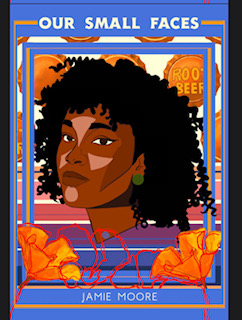
Doubleback Books Announces the Release of Jamie Moore’s Our Small Faces

Doubleback Books announces the release of Jamie Moore’s Our Small Faces. With its generous focus on characterization, Moore’s novella charts the intertwined stories of self-discovery and self-preservation.

Selma and Zeke are two teenagers living in small-town California. Feeling trapped by their community, the persistence of racism and responsibility to family define their imagined possibilities. Navigating friendship and loss, they consider who or what their way out is and what they may sacrifice with those choices. Our Small Faces explores how young people learn the limits of love, lead foolishly with heart, and often grow up too fast. 

The novella is a lyrical, heartbreaking trip back to the moment childhood ends for all of us, when we leave our families and neighborhoods and begin to venture out in the wider world. In its pages, Selma and Zeke learn that inevitably, “we all become someone different with time.” And when the protections of childhood dissolve, they discover that all along they’ve been living in a world of casual hatred, of cruelty, and loss, and longing.

Download your copy of Our Small Faces for free on the Doubleback Books website.

Jamie Moore is a writer and professor in California. She received her MFA in fiction and is a Kimbilio Fiction Fellow. She is an alumna of the VONA writers and Mendocino Coast writers workshops. She can be found on social platforms at @mixedreader

The Wardrobe’s Best Dressed: Salt Body Shimmer by Aricka Foreman


This selection, chosen by Managing Editor Krista Cox, is from Salt Body Shimmer by Aricka Foreman, released by YesYes Books in 2019.

ALWAYS SOMETHING HERE TO REMIND ME

I face myself when I hear the news
Driving toward the mall to buy the kind

of camouflage it takes to be a woman
say I’m good The summer mild-long,

my sister still warm in her grave
I feel most dead these days, grief a tick

latched at my neck I am most lonely
when I feel this dead In the parking lot

the engine runs The podcast hosts press
I am so fucking tired, I’m tired of being

peaceful I’m tired of this shit What else

do we have to do to be treated human?

A woman slows her walk toward her mini-
van, my volume full blast She winces

I realize how hard I’m sobbing I don’t
recognize my sound I don’t wipe my face

I walk inside, tell the counter-woman without
looking NW 47 and the blot powder

in deep dark Please
And when she no, no
that can’t be right, you’re much lighter than that,

I stare And she stares and waits And I stare, say
nothing and we go on like this under the flickering

fluorescence until she retrieves a foundation
two shades lighter, opens it, taps it on a mirrored disk,

dabs her sponge And she doesn’t ask before reaching
And I don’t pause before grabbing her wrist

Just Get Me What I Asked For
And she stares
and I stare, the lights still buzzing and maybe

I haven’t been dead but living in this second stage
of grief, this rage that drops its red hot pin on a map:

Missouri, Michigan, Florida, New York,
Mississippi, California Where I look for other

words for meadow marrow crow I want more
than what I get Where there are no more black dresses

or mothers with carnations pinned to their blouses
No causes and no news outlets to say alleged

when they mean deserved it In a different world
I don’t have to face myself I don’t take a white lover

only to take something back I pull into the driveway
on a safe tree-lined street Set my bags on the counter

My lover texts How are you? I type his name like a prayer
Michael Michael Michael Michael Michael

Who?
she asks Who?


Aricka Foreman is a poet, editor and educator from Detroit. Author of Dream with a Glass Chamber and Salt Body Shimmer (YesYes Books 2019), she has received fellowships from Cave Canem, Callaloo, and the Millay Colony for the Arts. Her poems, essays and features have appeared in The Offing, Buzzfeed, Vinyl, RHINO, The Blueshift Journal, Day One, shuf Poetry, James Franco Review, THRUSH, Please Excuse This Poem: 100 New Poems for the Next Generation (Viking Penguin), among others. She lives in Chicago.

The Wardrobe’s Best Dressed: Salt Body Shimmer by Aricka Foreman


This selection, chosen by Managing Editor Krista Cox, is from Salt Body Shimmer by Aricka Foreman, released by YesYes Books in 2019.

STILL LIFE OF ACME IN SPRING

for francine, for Detroit

From my mouth, forgive me: friend, woman
When I said there are no flowers here, I forgot
to mention the bloom of lace around a young girl’s

ankle at Easter, her peony shaped afro puffs,
carnelian carnations pinned to dresses honoring
those mothers not lost Spectrum of May collected from

Eastern Market, rowed in mismatched rainbows
in red wagons or inside the phantom box of a son’s
arms I forget the cured meat spread out from the black

barrel of a barbeque, bushel of yarn sopped with sauce,
unlike the gauze full of blood from a young boy’s head
Dear God the plankton of music dying our faces in the hot

summer streets, fever of jazz, blush of blues: raw heart
confront me This city, always in my face Bouquet of
incense, apothecaries with shea and oils Give a dollar

and I’ll show you a conductor, his white bucket symphony
No I haven’t forgotten the fire, molotov shards spreading
orange and gold flames as a field of dahlia across our

living room licking my mother’s heels, the heroine wolf
dragging me from my bed I don’t blame the addict
who didn’t know which house to huff and blow down,

or the firemen arriving late And yes, angels too
A neighbor who let me, knees pressed to sternum, watch
from his porch as our house ashed itself clean We have

to see the truth of things Did I say there was no flora here?
No pollen shaken from the anthers round head,
the yellow dust settling in the cracks of windshield?
I meant: give me a plot I’ll dig to the rich black


Aricka Foreman is a poet, editor and educator from Detroit. Author of Dream with a Glass Chamber and Salt Body Shimmer (YesYes Books 2019), she has received fellowships from Cave Canem, Callaloo, and the Millay Colony for the Arts. Her poems, essays and features have appeared in The Offing, Buzzfeed, Vinyl, RHINO, The Blueshift Journal, Day One, shuf Poetry, James Franco Review, THRUSH, Please Excuse This Poem: 100 New Poems for the Next Generation (Viking Penguin), among others. She lives in Chicago.

Sundress Academy for the Arts Announces Winners of Summer 2021 Residency Fellowships

Sundress Academy for the Arts Announces
Winners of Summer 2021 Residency Fellowships

Knoxville, TN: The Sundress Academy for the Arts (SAFTA) is pleased to announce Yamilette Vizcaíno Rivera and Levi Cain as the winners of fellowships for summer 2021 residencies. These residencies are designed to give artists time and space to complete their creative projects in a quiet and productive environment. 

Yamilette Vizcaíno Rivera is a Black Dominican-American writer and educator, based in Brooklyn. She is the HUES Nonfiction Fellow as well as the writer in residence at Velvet Park Media. She is nominated for Best Small Fictions 2021 and was the winner of the 2019 Cosmonauts Avenue Nonfiction prize. She was also the 2020 Oyster River Pages Creative Nonfiction intern, as well as a Tin House and VONA alum. Her words can be found online at Barrelhouse, The Offing, and Watermelanin Magazine, as well as in a forthcoming chapbook from The Hellebore Press.

Levi Cain is a gay Black writer who was born in California, raised in Connecticut, and currently lives in Massachusetts. A two-time Pushcart Prize nominee, their work has also been nominated for Best of the Net and Best New Poets, as well as shortlisted for Brain Mill Press’s National Poetry Month contest. Their first poetry chapbook, dogteeth., was published by Ursus Americanus Press in the fall of 2020.

Finalists for this summer’s fellowships included Maria Isabelle Carlos, Caliche Fields, Manny Loley, Meher Manda, DW McKinney, and Tochukwu Okafor.

***

The Sundress Academy for the Arts (SAFTA) is a writers residency and arts collective that hosts workshops, retreats, and residencies for writers in all genres including poetry, fiction, nonfiction, journalism, academic writing, playwriting, and more.

Web: sundressacademyforthearts.com Facebook: SundressAcademyfortheArts

Email:   safta@sundresspublications.com Twitter: @SundressPub

The Wardrobe’s Best Dressed: Salt Body Shimmer by Aricka Foreman


This selection, chosen by Managing Editor Krista Cox, is from Salt Body Shimmer by Aricka Foreman, released by YesYes Books in 2019.

FEAR LEAVES BEHIND ITS OWN LIE

content warning for sexual assault

It wasn’t that bad
                                He wasn’t quick Was slow,
and the cane creak sticks
                                He didn’t finish In a dream
had you touch him where Grits were stirred
                                It was a Saturday morning It was summer
Season for running He said after
                                Titties gettin’ big You dreamed it
The hallway Pressed your hair between two hot metal plates
                                Bathroom suffocated by sweet stink
He stood inside the doorway You stood together in the dark
                                backyard of the dream He’s dead now
Who’s Side Is It Anyway Grass megawatt as the moon
                                Who sings to you from the deep
Oil cracks, sizzles Pastel peels Dreams
                                him inside the doorways
Now you’re grown in the car toward
                                another late bar shift
After little sleep You dream again and don’t
                                know the truth The expert on NPR says
Fear leaves behind its own scent He reached for you
                                It wasn’t him who tried your mother
You learn later but can’t tell the difference
                                A friend says over your birthday dinner
You want chicken or steak Get Over It Who ain’t been raped
                                You want to spit Sometimes it’s not Him but him
This ain’t about desire so let’s stop talking
                                It’s a bbq, lighten up Everything’s alright
Ribs on the grill, turning, tender Which picked herbs
                                to suture? He points toward the yard,
There, a gold fountain In the dream he knows what he means
                                A good man will kill for his, erect
A monument You can’t run around with no bra on
                                You can’t run Around it was quick ,
the turning Tinder Tender The dream creaks
                                Primes the season for stirred mornings
Fear leaves us behind It owns some kind of lie


Aricka Foreman is a poet, editor and educator from Detroit. Author of Dream with a Glass Chamber and Salt Body Shimmer (YesYes Books 2019), she has received fellowships from Cave Canem, Callaloo, and the Millay Colony for the Arts. Her poems, essays and features have appeared in The Offing, Buzzfeed, Vinyl, RHINO, The Blueshift Journal, Day One, shuf Poetry, James Franco Review, THRUSH, Please Excuse This Poem: 100 New Poems for the Next Generation (Viking Penguin), among others. She lives in Chicago.

The Wardrobe’s Best Dressed: Salt Body Shimmer by Aricka Foreman


This selection, chosen by Managing Editor Krista Cox, is from Salt Body Shimmer by Aricka Foreman, released by YesYes Books in 2019.

BLUE MAGIC

Equipped from the siege it takes detangling
a tender-headed child’s hair, mema arms herself

Thick-toothed comb parting fields of naps
Bushels of soft kink pulled through

rubber bands, roots grown into stalks, brown-
bound by metallic threaded black,

the click of two bright-marbled orbs Each
Saturday night we’d do this dance when

she had no room for my mother’s and my libretto:
our fussing, the rafter pitch of my wail

Just right of her reach, a thin yellow promise
to pop my balled-up fists should I think

of breaking loose A thunderhead after washing,
drops of conditioner-thick water plump tufts

of crowded strands She pulled the plaits tight,
slathered my raw scalp with Blue Magic

Phyllis sings When I Give My Love (This Time)
I’m gonna make it last forever And perhaps

this too is how I’m wrought, the steel of being
beautiful: tears for what hands can do: wrangled

wild rind corkscrewed from the fruit, making
my grandfather’s line repent but O those wayward

vines of riverine: the devil is a lie: in the name
of hot-combs, hair picks, bobby pins and satin scarves

I wonder if my mother saw herself in the schoolyard
as I smoothed down the feral edges of my hair watching

some brilliant black boy backflip across the grass.
In the morning mirror, gel on the bristles of a slender

brush, I scooped the baby hairs along my temple
into shells We drove down 7 Mile singing

Anita Baker, too early for all that heartbreak
I must have refused her kiss at least once at drop-

off At least once she must’ve squinted with worry
at my newfound love for adornment Her knuckles

white as she pulled away I don’t remember looking back


Aricka Foreman is a poet, editor and educator from Detroit. Author of Dream with a Glass Chamber and Salt Body Shimmer (YesYes Books 2019), she has received fellowships from Cave Canem, Callaloo, and the Millay Colony for the Arts. Her poems, essays and features have appeared in The Offing, Buzzfeed, Vinyl, RHINO, The Blueshift Journal, Day One, shuf Poetry, James Franco Review, THRUSH, Please Excuse This Poem: 100 New Poems for the Next Generation (Viking Penguin), among others. She lives in Chicago.

Sundress Reads: Review of Excursion

It’s hard to capture what Silvina López Medin’s Excursion (Oversound Press, 2020) is about. Rather, readers grasp only at what it does. Even its table of contents evades “aboutness.” At first glance, it functions somewhat like a poem. The pieces are titled by their first lines, resulting in entries such as “Breath,” and “Do you hear that creak?” that invite each row of the table of contents to spill into the next.

The collection’s 24 pieces reference the 24 frames per second that, in film, conjure movement from static images. Medin’s work is similarly incremental, each fragment an essential installment that makes the titular journey possible.

The pieces are split among two parallel and possibly converging scenes. One features a couple in a hotel; the other is set on a moving boat populated by the narrator and her brother.

The first hotel piece is “INT. HOTEL / BEDROOM—NIGHT”, while the titles of the others are variations of this template. The scenes, rooted in the “interior,” are thus defined by their positionality. Throughout Excursion, the couple is afforded a radius of movement that extends to the hallway, the bedroom during the day, the doorway. 

The boat poems, though, lack distinct titles. Our narrator is glaringly location-less, left bereft. In poem 4, a woman demonstrates life vest procedure “in case of a wreck.” The narrator reacts immediately: “I sink into the word / wreck, into what possible loss”. In this unmoored state, even the suggestion of harm enacts it; the narrator sinks while aboard. 

The narrator’s search for grounding is one of the collection’s more extractible themes. Somewhat unexpectedly, this desire continuously and newly leads her to words. As the boat embarks and accelerates, the narrator asks her brother questions, primarily because “the metal sound of his words / soothes me.” 

Words become metallized and machine-like just as the machine that transports them becomes humanized. Perusing the brother’s dictionary of nautical terms yields the converging realization that “a ship has a body, / this is the sway”. Importantly, this humanization of the ship is brought about because of the dictionary, which is itself a tool: a technical, near-mechanized approach to words.

Throughout this journey, it’s not immediately clear whether our four characters undergo any changes. But one development is certain: the vessels of word and ship become increasingly alike. Words, once thought of as vessels of meaning, are revealed to be in equal parts mechanical.

Perhaps the best example of this superimposition, and certainly some of the most memorable lines of the collection, rests in 23: “He dries his body and describes / a rudder’s mechanism / the way a surface breaks / the strength of a current thus imparting / the craft a controlled turning.” The brother mechanizes his own body in describing it; simultaneously, the naturalness of the current is contrasted with the contrived and “controlled” movement it generates. The brother embodies the composite “craft” that makes motion possible, giving this knowledge—“imparting” it—to our narrator.

With little narrative clarity to hold onto, the reader finds themselves clinging to the collection’s title as material guidance. But Medin plays with the notion of an excursion, too.

The hotel setting, which at first seems to be a tangible destination for a journey, is revealed gradually to be unnavigable, unable to be located at all. The “INT.” of their titles refers to their interior location, yet also gestures towards an intimacy that secludes them from our knowledge. In “INT. DAWN” near the collection’s end, the hotel itself finally dissipates: “The hotel room / could be what a hotel room is expected / to be, a background / for those film frames: / no image, no image, no image,”. 

Still, the collection continuously leaves us wondering where the boat departs from and heads to. As readers, we never become privy to its directionality—we only witness the motion as it occurs. 

Medin makes us aware of the impossibility of capturing destination in writing. At one point, the boat accelerates; its sails are hoisted. “it’s not said, it happens”, she writes, plaintively. “the scene becomes the final one / there’s no The End / what follows is a black screen”. Words can’t signal the end, but rather, the black screen —the very lack of words.

The speaker must spell this lesson “letter by letter” for us: “an excursion implies displacement / … you move forward / within certain limits”. Motion is defined by its bounds; what we can understand and what we can capture is preconditioned with limits.

If a piece of writing is an excursion, as she suggests when she writes “I’ve traversed the distance / from a word to a body,” then Medin has shown us the limits of the word. In the end, it is simply a small piece of machinery, just like the ship.

Similarly, the individual poem acknowledges these limits: as readers encounter the assertion “you move forward / within certain limits,” the line break itself is a form of limitation that hinders movement. 

Medina’s work is not an easy one. Deeply concerned with interiority, it speaks to itself, folds into itself. It presents characters that are distinctly uncharacteristic; the hotel inhabitants, identified as “she” and “he,” are especially formless, only existing against a backdrop of vague danger. It does not do the work of making itself understood for you. Instead, it provides passages of words to be mapped onto physical passage. It asks: what is the difference between the two?

Excursion is available at Oversound Press


Claire Shang is a freshman at Columbia University, where she is an editor with The Columbia Review. She is a writer of poetry and creative nonfiction, and a reader of mostly everything. Her work has appeared in or been recognized by Peach MagNoDear Magazine, and Smith College.

The Wardrobe’s Best Dressed: Salt Body Shimmer by Aricka Foreman


This selection, chosen by Managing Editor Krista Cox, is from Salt Body Shimmer by Aricka Foreman, released by YesYes Books in 2019.

MENARCHE MALARKEY
THE BEGINNING THE END

Neither of us were ready for it
My poor mother dealing The Talk
as the crisis came—sex and the bloom
that preceded it—like a war room
preparation She came with what she
knew: doctrines on the lathe of life,
how to hide secrets Ashamed of
the slick brown tributary, I tucked
the cotton into my pants pocket, sure
it’d be missed in the weekend wash
My poor mother, her hands full
of questions
               when did it/ why hadn’t I/ the lies
falling from my mouth like dead stars
I held each cramp of shedding,
clotted tissue, scrubbed stains, hid
evidence How we’re taught to think
ourselves criminal, perpetuate
elaborate hoaxes: all witches,
sinners All women, witches:
maybe If I could go back, I’d ask
what’s in the blood? She’d say
of our miraculous machinery—
handing me a tampon, a divacup,
a wrench, a pick axe for this
business of ritual—listen, get to work


Aricka Foreman is a poet, editor and educator from Detroit. Author of Dream with a Glass Chamber and Salt Body Shimmer (YesYes Books 2019), she has received fellowships from Cave Canem, Callaloo, and the Millay Colony for the Arts. Her poems, essays and features have appeared in The Offing, Buzzfeed, Vinyl, RHINO, The Blueshift Journal, Day One, shuf Poetry, James Franco Review, THRUSH, Please Excuse This Poem: 100 New Poems for the Next Generation (Viking Penguin), among others. She lives in Chicago.

The Wardrobe’s Best Dressed: Foxlogic, Fireweed by Jennifer K. Sweeney


For the brown widow who laid her eggs
under my son’s bicycle seat

You are searching the domed
curves of shelter, a haunt
of darkness to forge

a pair of eggs larger
than your body.
Anchor and parachute,

wisp and captor,
you cast your nets
cast and cast all directions

then time unspools before you.
Under lip of flowerpot
a lawnchair’s crook

against the weighted clanger
of the chime,
I’ve never spotted your starry

orbs without your fiddleback
your hollow mouthparts
perched in the filigree.

How I’ve dug the stick in
crushed the papery shells into dirt
then pulled you through the wreck.

My apology is thin. I don’t know
where to let you live.
He practiced in the driveway.

It only took a few yards
before he found the midpoint,
that precarious balance of belief

in the center of everything.
One foot pushes off
and the other pumps back,

divine symmetry.
I took him out to the track
where once he circled, he lit,

purposeful. Windmaker,
looping the afternoon to dusk,
how could the sky not

have been an anthem?
He wheeled;
you held. The eggs

spackled in their basket
feeling what of this world.
Laying the bike on its side

we saw your sticky lair,
he had reached under
earlier as he propped himself on.

Had we not dismantled
you would have continued
through the mornings,

the late afternoons,
as he learned how to take a hill
a fall, you would have stayed

until the breaking open
your divine
teal-metal entrance.

A wind here can take
down a litter of palm branches,
overturn the bottle-

heavy garbage cans
but you, feathery mass
of intricate making

remain on such silks
beneath the highway-bound car
the victor of a boy’s

lengthening body
coming into its power.
We head indoors and I am sure

you are more with us
than we see
nestled in the stashed corners

of our lives, mending.
Under the arch
of a thirty-year roof

built by whose hands,
we survive beyond
our knowing

all the wild and immersive
gestures of the earth
too large for us to perceive.


This selection comes from Foxlogic, Fireweed, available from The Backwaters Press. Purchase your copy here! Our curator for this selection is Kimberly Ann Priest.

Jennifer K. Sweeney is the author of three other poetry collections, including Little Spells, How to Live on Bread and Music, and Salt Memory. The recipient of the James Laughlin Award from the Academy of American Poets and a Pushcart Prize, she teaches at the University of Redlands in California. Twitter: @jksweeneypoet

Kimberly Ann Priest is the author of Slaughter the One Bird (Sundress 2021), Parrot Flower (Glass 2021), Still Life (PANK 2020), and White Goat Black Sheep (Finishing Line Press 2018). Winner of the New American Press 2019 Heartland Poetry Prize, her work has appeared or is forthcoming in journals such as North Dakota Quarterly, Salamander, Slipstream, The Berkeley Poetry Review, Borderland and many others. She is an associate poetry editor for the Nimrod International Journal of Prose and Poetry and Embody reader for The Maine Review. Find her work at kimberlyannpriest.com.