Sundress Reads: Review of Everybody’s Favorite Hoe & Then Some

The book cover for Everybody's Favorite Hoe & Then Some. The background includes pink sunset clouds in the top right corner. In the bottom left corner sits a picture of a full moon. Layered over top is an astronaut. a pigeon, a stack of numbered JENGA blocks, and a retro-style razor. On top of the clouds floats two condom packets, one red, and one dark navy. An illustrated pomegranate sits in the top left corner.

“I think I am ready for a rim job” (Vine 1)—the opening line slams into readers. Jade Vine (it/its) pulls no punches in Everybody’s Favorite Hoe & Then Some (Ginger Bug Press, 2023). On the surface, both the title of the collection and the introductory stanzas can be viewed as salacious and intentionally inappropriate. Western societal norms have historically framed sex, especially queer love and sensuality, as taboo, dirty, and heretical. Vine, a queer, transgender/agender anarchist, aims to disrupt the status quo and embrace love, sex, and fluidity through its writings.

Everybody’s Favorite Hoe & Then Some goes beyond presenting the notions of kinky intimacies. It examines the human condition in the way of comfortability and real, tangible tenderness. In the same opening poem, “hmu for anal play regular play plain old loving,” the speaker reflects on the pure love and happiness of their relationship. The relationship, the bond, is deeper than sexual pursuits. It’s about closeness and the expectation of simple intimacy between people in love.  

Sex, in this context, is a vessel for love. No matter how sex-positive Generation Z presents itself, the undercurrents of judgment and shame still flow through our conversations. This generation is still petrified of thoughts of sex. We cower away from them until they nestle behind our ribcage as a festering hurt. The way sex is communicated in our lives leaves room for humiliation. But, as Vine asserts, there is nothing perverse about love, as long as it is expressed safely and consensually. 

Vine isn’t afraid of rawness. Vine loves unabashedly and without shame. It writes with a cadence stemming from unfiltered consciousness. The traditional narrative structure is abandoned for an effusive way of expression. The collection is reminiscent of a FaceTime call with a close friend rather than a poet miles away from the audience. Reading this book means stepping inside of Vine’s mind and, instead of intruding, you are welcomed into its innermost thoughts. 

Everybody’s Favorite Hoe & Then Some is not just a stream of randomized thoughts or the mechanisms of a sex-obsessed author. There’s relatability in its quick pace, which mimics racing thoughts and the gathering of sensibilities. The book conveys a passion that most people are afraid to articulate, yet exists inside of all of us: romantic, sexual, or, an artistic and fraying blend of both. Vine leaves the audience to decide. 

In “everybody is my love interest and i’m interested,” the reader is forced into a sense of isolation. The speaker can only yearn from afar, yielding their emotions to another person across the room. They imagine an entire life together, carve out a space in the universe for them and this other person to exist freely and entirely. Vine writes:

“i let the oranges full with their disgusting pulp fall where they fall

  i catch persimmons & ur glance in the break time 

when you look away i admire ur shadow’s form so burly and so fragile

  it could break if i stepped on it”  (Vine 1-4).

It has become their thoughts. They’re reminded of their time of longing, of vying for the attention of someone so close they felt galaxies away. It’s lust. It’s love. It’s the freedom that comes with imagination. They live out their entire life with this person in a matter of seconds. 

Moreover, Vine collects snippets of humanity in its poems. Love is all-consuming. It sears you from the inside out, leaving not even a husk behind. Vine encapsulates longing, loss, and a sense of desperation in its work. The overwhelming desire to belong to someone. As an equal. As a lover.  

“oh god, i accidentally cut my pussy trying to shave it” introduces a new kind of melancholy. There’s solitude from inside the speaker’s body. Vine writes: 

“my lashes don’t curl up the way my toes do

  every boy i have brought home smelled like cigarettes & borrowed time

  all my beautiful dresses are borrowed from my more beautiful mother” (Vine 7-9).

No doubt this is a genderqueer/trans allegory, which I acknowledge I am ill-equipped to effectively comment on. How they interact with the world and themselves is revealed through longer lines, replacing the rushing motions of their mind.

Everybody’s Favorite Hoe & Then Some follows a speaker through the dizzying tale of lust and love, and what it feels like to be completely entranced and bewitched. Vine’s poetry is brazen in its queerness and kinkiness. Love should not be hidden behind hushed whispers and critical glances. Queer love should be celebrated in the public eye.

Everybody’s Favorite Hoe & Then Some is available for pre-order from Ginger Bug Press


K Slade (she/her) is a Black gothic and speculative fiction writer pursuing a BS in Digital Journalism and a Japanese minor at Appalachian State University. She currently serves as Visual Managing Editor for The Appalachian, her collegiate newspaper, and specializes in multimedia journalism. Horror media deeply inspired her love for the craft and in the future, K wants to write a script for a horror game. After undergrad, she hopes to move to New York and pursue an MFA in Creative Writing. 

Interview with Caleb Curtiss, Author of Age of Forgiveness

Ahead of the release of his debut full-length poetry collection, Age of Forgiveness, Caleb Curtiss spoke with Sundress Publications editorial intern Jen Gayda Gupta about the meaning of forgiveness, how memories rebuild, and the longing for stillness.

Jen Gayda Gupta: What does forgiveness mean to you? Whose responsibility is it to forgive?

Caleb Curtiss: In Judith Herman’s Trauma & Recovery, she writes, “true forgiveness cannot be granted until the perpetrator has sought and earned it through confession, repentance, and restitution.” I like her angle here. The onus lies with the perpetrator or the negligent party to be accountable to those they’ve harmed.

JGG: You write, “Like a body, or a memory, it has rebuilt itself over time.” How do you think memories rebuild themselves? What is the impact of this rebuilding on grief?

CC: Like dreams, I think memories have to be reconstructed in order for us to understand and grow from them. When we piece together our pasts, we do so with adult brains and in the highly-sensical language of adulthood. But when we experience loss, that highly-sensical language isn’t much use. We have to seek out new materials to build with, a language for our loss.

JGG: There appears to be a separation of the speaker from himself in poems like “Photo Shot on Undeveloped Film” and “I Am Whole, I Am Whole.” What does this separation do for the speaker?

CC: Because this book focuses so closely on my own personal loss, I was aware of, and maybe even sensitive to, how it might read to some as a kind of trauma dump. The poems you mention here, along with a handful of others, are meant to texture the connection between the authorial presence in Age of Forgiveness with its speaker. By presenting my speaker as a kind of character in these poems, I am encouraging my reader to hear him and his voice as a dramatic interpretation of the poems I’ve written for him.

JGG: There are five “Self-Portrait” poems and many references to photos in this collection. How do you believe photos—snapshots of moments—immortalize us and our loved ones?

CC: The simple act of recognition can be a powerful emotional experience. Even if I wasn’t present when the photo was taken, when I recognize the subject of a snapshot, it can transport me back to the moment it captures: spontaneous, fragile, and still somehow permanent. It’s either a mistake that the brain corrects within a few milliseconds, or a momentary little wish fulfillment that allows me to see people I have no way of seeing anymore, or a way to be in times and places that no longer exist.

Maybe you’ve felt this way before. It reminds me of the sensation I have the day after I receive bad news: right when I wake up, I can feel my brain contorting itself to keep the undesired knowledge out of my conscious mind, suspend it in the sludge of half-known truths so I can experience the world, just for a moment, as it is not.

JGG: Tell me about the visual poetry that separates each section. What is the significance of the rabbit that appears both on the cover and in each piece of art?

CC: One of the paradoxes I try to acknowledge in my process is language’s power to express the inexpressible even as it falls short of doing so completely. The visual erasures I made for Age of Forgiveness remind me, and hopefully my reader, of this paradox while also offering up a kind of shadow narrative that compliments and contextualizes each section. It might be helpful to think of the rabbit drawing I made as the main character of that shadow narrative.

JGG: Many poems contain imagined truths—reconstructions of things that happened out of the speaker’s sight. Can you talk about the role of truth and how it intersects with memory?

CC: Whether I like it or not, every day I have to concede that I share my own subjective reality with those held by the rest of the world. Poems that recall facts for the sake of bearing witness don’t interest me as much as those that aspire to build from their own subjective position an idea that resounds as truth.

JGG: There seems to be a longing for stillness in poems like “Possum” and “Still.” What is the benefit of being still?

CC: That’s a nice catch. I think I do feel drawn to stillness, especially when it appears unexpectedly. I remember when my little brother would pause the video tape I was watching to prank me. We did it to each other, I’m sure, but whenever he caught me, I would find myself in a kind of altered state, again, probably for only a millisecond or two.

It doesn’t entirely matter how long. What matters is, there was a moment when my brain would attempt telekinesis and will the tape forward before I’d catch myself. Moments like this are special, even if they’re a little scary, too: when the gears stop advancing the tape but light still passes through its transparency.

JGG: Can you speak about the role of absence in this collection? How does the absence of something or someone shape the space of our current moment?

CC: This collection looks at absence a lot like you or I might look at a blivet or a Magic Eye poster. There’s always something there.

JGG: You write, “the dead always, eventually, become tropes of the living.” What do you believe is the role of a writer in writing about the dead?

CC: I don’t think the living owe the dead anything. As it stands, they aren’t impacted when we express love or resentment or indifference to them. Of course, we are affected by these things. If anything, as a poet, I feel an obligation to the poem I am writing.

JGG: The final poem in this collection, “Doe,” captures a violence towards women that is shown in several earlier poems. What is the significance of the doe being mistaken for a buck?

CC: The rhetoric we generally use to discuss domestic abuse or gender-motivated violence comes from the necessity to determine and recognize accountability. In the world of “Doe” the rhetoric of justice, accountability, restoration, etc. doesn’t really exist. It’s a different place, different from any of the other places in the collection, even as it maps the book as a whole to some degree.

Could it be that the doe was in fact mistaken for a buck as it appears? It could be, but my hope with “Doe” is that its clarity grows, over time, out of its ambiguity.

When I started writing this one, the manuscript itself was still coming together. As it did, the poem changed quite a bit, from a sonnet to blank verse to hexametric couplets, and so on until it became a prose poem. The point being: as the book changed, “Doe” also changed.

Pre-Order your copy of Age of Forgiveness today!


Photo of the author of "Age of Forgiveness," Caleb Curtiss.

Caleb Curtiss is a teacher and a poet from Champaign-Urbana, Illinois. His poems, essays,  fiction, and visual erasures have appeared in Image, American Short Fiction, New England  Review, Passages North, Witch Craft Magazine, and The Southern Review. Age of Forgiveness is his first full-length collection

Photo of Sundress Editorial Intern, Jen Gayda Gupta.

Jen Gayda Gupta is a poet, educator, and wanderer. She earned her BA in English at the University of Connecticut and her MA in Teaching English from New York University. Jen lives, writes, and travels across the U.S. in a tiny camper with her husband and their dog. Her work has been published in Up the Staircase, Rattle, Jellyfish Review, Sky Island Journal, The Shore, and others. You can find her @jengaydagupta and jengaydagupta.com.

Project Bookshelf: Annie Fay Meitchik

A photo of a book with an orange cover titled "I Will Judge You By Your Bookshelf" at Powell's Books in Portland.

In many ways, what I consider to be my bookshelf is amorphous, shared, and exists in numerous locations. The majority of books that have shaped me awaited my discovery during silent reading time in my elementary school classrooms or on library shelves. I love books for the way they teach empathy and make knowledge accessible. My passion for books is deeply connected to the sense of peace I find when entering libraries. These institutions represent to me equal access to information and serve as reminders that art and literature are so deeply valuable that we’ve collectively ensured that they are free and available to everyone.

My bedroom is decorated with books—piled neatly on the floor, stacked on shelves by color, and covering the top of my piano. A lot of the books in my home are relics from my childhood: dog-eared copies of The Babysitter’s Club, well-loved Little Critter books, The Mysterious Benedict Society, and my prized edition of Alice Through the Looking Glass.

As I read well over 100 books every year, I acquire the vast majority of them from public libraries, so, I do not own many of my favorites. However, I do keep an evolving list of my recommendations on the homepage of my portfolio website. I have a special gift for matching people with the right books and enjoy sharing my personal collection with friends and family—Poison for Breakfast by Lemony Snicket has traveled 3,000 miles from my shelf and back.

A photo of three books stacked on top of each other with black spines. The books (from top to bottom) are: "The Decameron Project" compiled by The New York Times Magazine, "The Fran Lebowitz Reader" by Fran Lebowitz, and "Just Kids" by Patti Smith.

What I find so wonderful about books is their ability to be shared and their lack of a need for ownership. While there are a handful of books I enjoy owning and rereading—The Phantom Tollbooth by Norton Juster and Little Weirds by Jenny Slate—the majority of books I’ve loved float in and out of libraries, gaining something magical and intangible with each new reader. So much of what I enjoy about reading is the sense of belonging I feel sharing an experience, a narrative, with strangers who I may cross paths with someday to bond over a favorite author, quote, or story.

Eleven books on a library shelf.

A black and white photo of a woman, the author of this post.

Annie Fay Meitchik is a writer and visual artist with her BA in Creative Writing from The New School and a Certificate in Children’s Book Writing from UC San Diego. Through a career in publishing, Annie aims to amplify the voices of marginalized identities while advocating for equality and inclusivity in art/educational spaces. Her work has been published by Matter Press, 12th Street Literary Journal, and UNiDAYS. To learn more, please visit: www.anniefay.com

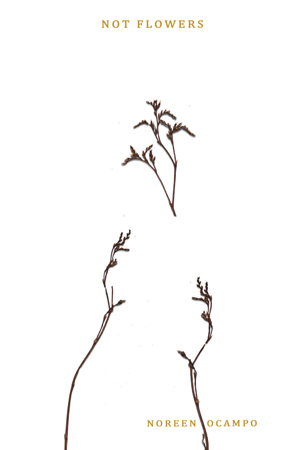
The Wardrobe’s Best Dressed: Not Flowers by Noreen Ocampo


This selection, chosen by guest editor Katie Manning, is from 
Not Flowers by Noreen Ocampo, released by Variant Lit in 2022.

Peachtree

                   SUWANEE, GEORGIA

I miss our old backyard & the way everything grew
into everything / my father’s terracotta bricks in careful
arches / seeping into the earth / the trees whispering /
in forbidden corners of the wood / the patch where the
ghost-playground was / if you looked hard enough /
despite our street name / we didn’t grow peaches / no
one ever did / but birds & squirrels / ate off my blueberry
plants / before I could chase them / into the next morning
/ & fill a green-striped bowl that no longer exists / we
grew long / long beans that caught all strangers’ eyes / &
/ I wanted to be something / like that / something other
than soft skin for mosquito bites / I grew up to want
something / other than my mother spraying sunscreen
on my back / my father plucking weeds until the grass
burned blue / my brother recoiling from a dragonfly /
bumblebee / fairy & darting back inside / but I didn’t yet
understand / how silent / sudden / goodbyes often are

Noreen Ocampo is a Filipino American writer and poet from metro Atlanta. Her collection Not Flowers won the 2021 Variant Lit Microchap Contest, and her work can also be found in Palette PoetrySundog Lit, and Depth Cues, among others. She holds a BA in English from Emory University and currently studies poetry in the MFA program at The University of Mississippi, where she is working to document and elevate stories of Filipino Americans in the Deep South.

Katie Manning is the author of Hereverent (Agape Editions), Tasty Other (winner of the Main Street Rag Poetry Book Award), and six chapbook collections, including How to Play (Louisiana Literature Press) and 28,065 Nights (River Glass Books). Her poem “What to Expect” was featured on the Poetry Unbound podcast, and her poems have appeared in HAD, Poet Lore, SWWIM, Stirring, Thimble, Verse Daily, and many other venues. Katie is the founder and editor-in-chief of Whale Road Review and a professor of writing at Point Loma Nazarene University.

The Wardrobe’s Best Dressed: Bath by Jen Silverman


This selection, chosen by guest editor Katie Manning, is from Bath by Jen Silverman, released by Driftwood Press in 2022.

Bath 11

On New Year’s Eve my ex’s wife tells us about giving birth
to their daughter - about the salty Hudson Valley midwives

who thronged her - the lady doctor, face carved like a river-
bed, who shouted at her What are you waiting for -

and she repeated it to herself again and again until it was a
much larger question: What am I waiting for? -

about how her one fear was pooping in the bed and she kept
asking her husband, B, Am I pooping? did I poop? -

and each time he’d tell her You aren’t pooping - but even now
she isn’t sure if he lied. They are sober, drinking seltzer,

my partner and I are drinking our last glasses of wine before
a month-long fast; the first of the year is always the moment

to set ourselves towards the people we wish we were,
hit a button, launch. We pull Tarot cards from three different decks;

one of them is blunter than the others; when I fail it gives me
the Eight of Swords; when I am afraid, it tells me: What are you waiting for.

B pulls the Eight of Pentacles, his wife the Five, and my partner
pulls the Sun. Earlier in the night we pulled a card for their daughter,

who is sleeping in our bedroom after we danced her around the
hardwood floors, held her small shocked face to the revelation of

lights stringing the tree. Sometimes I pull back and look down at us
with a god’s eye. Sometimes all times coexist, and his wife is giving birth

at the same time that all of us are meeting, at the same time
that B and I are breaking up, both of us sobbing hysterically,

and his pronouns are still she/ her, and I don’t yet have ink all over
my arms, and my partner is a bright horizon that has yet to arrive.

Jen Silverman is a New York-based writer and playwright. Jen is the author of the debut novel We Play Ourselves and the story collection The Island Dwellers (Random House) which was longlisted for a PEN/Robert W. Bingham Prize. Additional work has appeared in Vogue, The Paris Review, Ploughshares, Prairie Schooner, The Sun, and elsewhere. Jen’s plays have been produced across the United States and internationally. Jen is a three-time MacDowell Colony fellow, a member of New Dramatists, and the recipient of an NEA Fellowship, a New York Foundation for the Arts grant, the Yale Drama Series Award, and a Playwrights of New York Fellowship. Jen also writes for TV and film.

Katie Manning is the author of Hereverent (Agape Editions), Tasty Other (winner of the Main Street Rag Poetry Book Award), and six chapbook collections, including How to Play (Louisiana Literature Press) and 28,065 Nights (River Glass Books). Her poem “What to Expect” was featured on the Poetry Unbound podcast, and her poems have appeared in HAD, Poet Lore, SWWIM, Stirring, Thimble, Verse Daily, and many other venues. Katie is the founder and editor-in-chief of Whale Road Review and a professor of writing at Point Loma Nazarene University.

The Wardrobe’s Best Dressed: Bath by Jen Silverman


This selection, chosen by guest editor Katie Manning, is from Bath by Jen Silverman, released by Driftwood Press in 2022.

Bath 9

(New Mexico)

Mud that will rebuild your bones. Iron
richer than blood. Yellow phosphorous to

give new light to your limbs, your loins.
All signs say: NO NUDITY. There is a limit

to the fountain of youth.
We have driven for miles

past billboards starring Jesus:
a reminder of His imminent return.

You are hungover; I am bruised; the wind
flakes like mica, our skins glitter,

our hair is jeweled with sand. We made
such grand promises. But here

we are, limping toward a new persuasion.
We have so many forgivenesses to beg.

I lower myself into a steam-choked pool.
You ask

do I feel good / do I feel strange / has anything changed.
The sky is a hot blue arc.

The dust is all dust, a living chronicle of
what falls apart, and why, and how quickly.

Feeling each bone separate a little, each muscle unstring
I tell you that it all feels different, this time,

this time,
in time, we will be new.

Jen Silverman is a New York-based writer and playwright. Jen is the author of the debut novel We Play Ourselves and the story collection The Island Dwellers (Random House) which was longlisted for a PEN/Robert W. Bingham Prize. Additional work has appeared in Vogue, The Paris Review, Ploughshares, Prairie Schooner, The Sun, and elsewhere. Jen’s plays have been produced across the United States and internationally. Jen is a three-time MacDowell Colony fellow, a member of New Dramatists, and the recipient of an NEA Fellowship, a New York Foundation for the Arts grant, the Yale Drama Series Award, and a Playwrights of New York Fellowship. Jen also writes for TV and film.

Katie Manning is the author of Hereverent (Agape Editions), Tasty Other (winner of the Main Street Rag Poetry Book Award), and six chapbook collections, including How to Play (Louisiana Literature Press) and 28,065 Nights (River Glass Books). Her poem “What to Expect” was featured on the Poetry Unbound podcast, and her poems have appeared in HAD, Poet Lore, SWWIM, Stirring, Thimble, Verse Daily, and many other venues. Katie is the founder and editor-in-chief of Whale Road Review and a professor of writing at Point Loma Nazarene University.

The Wardrobe’s Best Dressed: Bath by Jen Silverman


This selection, chosen by guest editor Katie Manning, is from Bath by Jen Silverman, released by Driftwood Press in 2022.

Bath 7

(Boston)

That winter, the roof fell in
during one long dinner. All of us

drenched in dust and wine.
When the chaos subsided, we examined the hole.

You thought it was a great improvement.
“Like a skylight,” you said.

You give me half your bed, we sleep like sisters,
orange duvet, animals of solace.

When we cook, the house heats
with lentils and turmeric, crusty bread.

When we dance, your neighbors come over;
the surgeon can salsa, he spins us one by one.

Tea leaves accumulate, abandoned mugs
divine themselves.

It was lonelier, in my other life
but it was a thing I made.

I wear your sweaters as the air tightens.
When I walk alone at night, I become

pure Libra, each hand cupped
on a different set of promises.

The trolley clattering past in the night,
the old windows creaking, a pharmacy of shampoo bottles

lining the bathroom window.
When I shower, you sit on the floor,

only steam between us.

Jen Silverman is a New York-based writer and playwright. Jen is the author of the debut novel We Play Ourselves and the story collection The Island Dwellers (Random House) which was longlisted for a PEN/Robert W. Bingham Prize. Additional work has appeared in Vogue, The Paris Review, Ploughshares, Prairie Schooner, The Sun, and elsewhere. Jen’s plays have been produced across the United States and internationally. Jen is a three-time MacDowell Colony fellow, a member of New Dramatists, and the recipient of an NEA Fellowship, a New York Foundation for the Arts grant, the Yale Drama Series Award, and a Playwrights of New York Fellowship. Jen also writes for TV and film.

Katie Manning is the author of Hereverent (Agape Editions), Tasty Other (winner of the Main Street Rag Poetry Book Award), and six chapbook collections, including How to Play (Louisiana Literature Press) and 28,065 Nights (River Glass Books). Her poem “What to Expect” was featured on the Poetry Unbound podcast, and her poems have appeared in HAD, Poet Lore, SWWIM, Stirring, Thimble, Verse Daily, and many other venues. Katie is the founder and editor-in-chief of Whale Road Review and a professor of writing at Point Loma Nazarene University.

Sundress Reads: Review of Glass Essays

Sundress Reads black-and-white logo with a sheep sitting on a stool next to the words "Sundress Reads." The sheep is wearing glasses and holding a cup filled with a hot drink in one hoof and holding an open book in the other.
Cover of J.A. Bernstein's Glass Essays. Stormy blue, black, and white watercolors with a grown up spinning a child in a dress around by the arms. The title is at the top in clear block letters and the author's name is at the bottom.

J.A. Bernstein’s Glass Essays (Variant Lit, 2023) centers on a man’s experience in the liminal spaces between soldier-hood and parenthood.

This short essay collection opens with a brief two-page vignette recounting a time when the speaker’s wife bough overpriced watercress at a farmer’s market. The speaker then recalls the Oxford English Dictionary page for watercress, writing, “what a study in contrasts: water and cress; soothing and pain, as it were” (Bernstein 1). Thus begins a meandering thirty pages. Flashing between sweet moments of fatherhood and uncomfortable memories of life or death conflicts, the collection is its own study of moments of soothing and moments of pain.

In the essay “In the Lake, Before Dark,” a Jewish-American foreign volunteer in the Israeli Army describes the world around him in which he is deeply uncomfortable, in which fellow soldiers share explicit videos of women performing sex acts and brag about how many “Arabs” they’ve “gotten” (read: shot or killed) over McDonald’s burgers. In the same essay, fifteen years later, the speaker sits at his kitchen table while his toddler daughter eats breakfast. When her spoon hits the floor, the “discordant clanging” reminds him of the very American-aid-supplied .50-caliber rifles he himself used to fire (Bernstein 4). The reader is transported to the world of armed conflict with the speaker. Just two lines later, separated by a roman numeral, we are with the speaker and his toddler wading naked into a lake somewhere in Wisconsin, his wife looking upon them lovingly. These echoes of war contrasted with what would otherwise be normal, happy parenting moments resound throughout the entire collection.

As the speaker continues meditating on mortality, a new collective trauma unfolds on the page: the COVID-19 pandemic. In the essay “Bug,” which takes place early in the pandemic, he reflects on the fleetingness of childhood memories with his oldest daughter, now three. “‘I’ll always remember you,’ she says. ‘And I’ll always remember this, too,'” he says back (Bernstein 20). Again, speaker finds that performing fatherhood is a welcome distraction to the tragedies he’s hearing on the news. As a reader, I find this essay extra eerie; I know that the pandemic in Italy he only hears of on the news will soon become a reality in his own family’s life too. Thinking of the news, he says, “I remember how desolate the world is, and uncertain and afraid, and I fixate now on [my daughter’s] eyes: the way they almost glow there, so quiet and amused, so contented with the world, and alive” (Bernstein 20). Here, the speaker juxtaposes parenthood, the impending pandemic, and the passing of time so fluidly that it reads with ease. There are no lead pens here, rather a light airiness to the writing in stark contrast to the heavy subjects dissected and examined.

Meditations on the passage of time recur throughout these essays, in part thanks to their structure and placement. Time goes back and forth, ranging from 1984 to 2021. Not every essay is denoted with time, though. In this way, Bernstein potentially lets readers get lost, or perhaps, makes them work harder while reading.

The collection opens with an epigraph from its namesake, Anne Carson’s The Glass Essay:

            It is dawn.
            They are leaving Dover for France.
            My father on the far left is the tallest airman,

            with his collar up,
            one eyebrow at an angle.
            The shadowless light makes him look immortal,

            for all the world like someone who will not weep again.

Here, Carson describes her father as only an airman who is immortal, someone who will never cry. But the speaker in these essays is not immortal, noting that time and time again. He is certainly not someone who holds in his feelings; he pours his emotions onto the pages in this collection. Bernstein’s vulnerability on the page pushes back against Carson’s idea of a hardened soldier, as he shows us that there are other kinds of soldiers too: softer ones who feel conflicted about their violent actions, love for their families, and anxieties about the past, present, and future.

Glass Essays is available for purchase at Variant Literature.


Heather Domenicis (she/her) is an Upper Manhattan based writer and editor moonlighting at a tech startup. She holds an MFA in Creative Non-Fiction from The New School and her words appear in HobartJAKE, and [sub]liminal. Born in a jail, she is writing a memoir about all that comes with that. You can follow her on Instagram @13heatherlynn1.

Sundress Reading Series Seeks Readers for Spring 2024

From February through May of 2024, the Sundress Reading Series will be back in person at Pretentious Beer Co. in the Knoxville Old City. This year’s iteration of the reading series will feature two headlining poets with an open mic to follow.

The Sundress Reading Series is an award-winning literary reading series previously hosted on-ground in Knoxville, TN, just miles from the Great Smoky Mountains. An extension of Sundress Publications and the Sundress Academy for the Arts, the Sundress Reading Series features nationally recognized writers and performers from around the US while also supporting local and regional nonprofits. 

Our events will take place on Thursdays from 7-9PM EST. The Spring 2024 series run during the following dates: February 22, March 21, April 18, and May 16. 

Performers will receive publicity across Sundress Publications’ social media channels in the lead up to their event, an opportunity to sell books, and a $100 honorarium thanks to generous grants from the Witter Bynner Foundation for Poetry and the Tennessee Arts Commission. We are currently seeking readers for our series with an emphasis on marginalized voices; you may note in your cover letter if you identify as a writer of color, a trans and/or nonbinary writer, a queer writer, and/or a disabled writer. 

To apply to perform for the spring, send 6-12 pages of poetry, a 50-100 word bio, CV (optional), a brief video of you reading one of your poems, and a ranking of preferred reading dates to sundresspublications@gmail.com. Please make sure the subject line reads “Reading Series Application – Your Name.” 

Applications to participate as a performer are open and the deadline to apply is November 15, 2023. Those selected will be notified by early December. 

Find our more or to view some of our past performers and schedules, visit our website.

Sundress Academy for the Arts Presents “Writing the Grotesque: A Generative Poetry Event” with Hannah V. Warren

Knoxville, TN—Sundress Academy for the Arts is honored to present, “Writing the Grotesque: A Generative Poetry Event,”’ a workshop led by Hannah V. Warren on October 11, 2023, from 6:00-7:30pm. This workshop will take place over Zoom. Participants can access the workshop at tiny.utk.edu/sundress (case-sensitive password: safta).

This generative writing event and short included lecture aim to encourage writers to explore the joys of incorporating traditionally displeasing aesthetics into their poetry. How can we beautify the non-beautiful? When should we let it remain hideous? Famously, aesthetician Wolfgang Kayser defines the grotesque as the “monstrous fusion of human and nonhuman elements.” With poets such as M. NourbeSe Philip, Danielle Pafunda, Selah Saterstrom, and Frank Stanford as models, this workshop offers composing methods to poets who seek to develop their use of bodily imagery.

Rather than viewing poetry as a genre with one lineage, participants will consider a variety of grotesque, abject, and sublime texts—including monster theory, art-horror, and fairy tales—as tools in poetry-writing. We’ll determine how a body can find power and reclamation in grotesquery. Participants will leave with written drafts and an expanded knowledge about what it means to embody and embrace the grotesque.

Photo of Hannah V. Warren

Hannah V. Warren is the author of Slaughterhouse for Old Wives Tales (Sundress, Winter 2023) and two chapbooks. Her works appear in Gulf Coast, Passages North, Crazyhorse, THRUSH, and Fairy Tale Review, among others. Currently a PhD candidate at the University of Georgia and a Fulbright scholar, Hannah’s writing and research interests center monstrous aesthetics, post/apocalypse literature, and representations of alterity.

While there is no fee to participate in this workshop, those who are able and appreciative may make donations directly to the workshop leader, Hannah V. Warren—Venmo: @hannahvwarren; PayPal: hannahvwarren@gmail.com.

This event is brought to you in part by grants provided by the Witter Bynner Foundation for Poetry and the Tennessee Arts Commission.