Ahead of the release of the speculative poetry collection NOMBONO: Speculative Poetry by BIPOC Poets, Akua Lezli Hope spoke with Sundress Publications editorial intern Stephi Cham about how the meaning of “nombono,” the number 10, and the roots of speculative poetry influenced her editorial approach to the collection.
Stephi Cham: What was your primary thought process as you put this collection together? Is there a larger narrative you hoped to achieve?
Akua Lezli Hope: I envisioned a collection of BIPOC speculative poetry last fall, when I entered the competition to create an anthology. I was privileged to be included in a number of speculative poetry readings and panels at SF/F conventions last year. I was inspired by both the presence and absence of BIPOC creators. I committed myself to remedy the twin absences of speculative poetry and of BIPOC creators of speculative poetry. I created Speculative Sundays Poetry Reading Series and conceived my idea for this anthology.
SC: How did you choose the title? How did the word “nombono” speak to you?
ALH: I went in search of a title. One of my favorites was already taken, so then I went in search of non-English words. “Nombono” means vision. It is lovely in the mouth and it’s a “false friend” as it resembles “name good” (“bono” is used in English pro bono—for the public good and “nom” means name in French). So the Zulu has all these western evocations as well as the wonderful meaning. Vision speaks to the ability to invent, imagine, intuit. NOMBONO.
SC: You write that speculative poetry started as “humanity’s first literature.” How do its roots influence the writings in NOMBONO?
ALH: I can’t speak for or to each writer’s influences, having only read a few poems by each. That would be most presumptuous of me. There is myth making and myth telling and retellings among the poems in the collection. Encoding myth/beliefs and folkways was the role of humanity’s first literature—which was in verse. These poets are performing the role of humanity’s first poets, creating art that encodes and reports their experiences, ideas and vision.
SC: Can you talk about your process in dividing this collection into 10 sections? What is its significance?
ALH: There were more sections. I sought to have poems be in conversation with each other, to create a flow, to have a beginning, a middle, and an end. 10 means a return to unity, the fusion of being and non-being, it is a divine number.
SC: What role does the recurring theme of societal denial play in these works?
ALH: There are many roles that societal denial plays — it is propulsive, introspective, motivating, meditative, informing, deconstructive, instructive, inspiring, underpinning, undergirding, catalytic. It spawns the affirmation, avowal, achievement. It is the sad stage setting that is shred, overturned, overcome, repudiated. It is that which is overcome.
SC: In “Mmádu Si Àlà Putá,” Ogbuji writes, “It’s time to push away the teat and forage / the void, to answer scarcity with courage—” How can we answer scarcity with courage in our lives?
ALH: We answer scarcity with courage by being undaunted and undeterred in our creating, by making good and peace manifest, by loving fully both ourselves and the world we inhabit. There is no scarcity, there is only the lack of will and imagination.
Download your free e-copy of NOMBONOhere or order a print copy from the Sundress store.
Akua Lezli Hope is a creator and wisdom seeker who uses sound, words, fiber, glass, metal, and wire to create poems, patterns, stories, music, sculpture, adornments, and peace. Her honors include the NEA, two NYFAs, an Elgin and SFPA Award, and Rhysling and Pushcart Prize nominations. Her first collection, EMBOUCHURE, Poems on Jazz and Other Musics, won the Writer’s Digest Book Award. She is the editor of Eye To The Telescope #42 on The Sea.
Stephi Cham holds a BM in Music Therapy with a Minor in Psychology from Southern Methodist University. She is currently working toward her MA in Publishing at Rosemont College, and she is the Fiction Editor at Rathalla review. She is a freelance editor and the author of the Great Asian-Americans series published by Capstone Press, and her work has appeared in Strange Horizons.
Sundress Publications is pleased to announce the release of NOMBONO: Speculative Poetry by BIPOC Poets, edited by Akua Lezli Hope. This is a collection that asks us earthers, terrans, the identified sentients of this planet to reconceive how we perceive ourselves in this world.
In the stunning and imaginative NOMBONO: Speculative Poetry by BIPOC Poets, we are presented with visions, invocations, foretellings, and bold harbingers. NOMBONO, drawing from the Zulu word for “visionary,” brings together mystical dreams and possibilities that are at times both striking and devastating. This anthology asks: are we on a bright threshold or at the edge of a dark precipice? Are we about to take flight and evolve or plumet into cataclysm? Around each corner in this book there may be a hyena man, salmon women, Mananggal, prayers, or curses. There is steady, unbroken eye contact, and there is fierce joy and fury. Here we have the limitless, boundless exploration of resplendent worlds.
Linda D. Addison, award-winning author, HWA Lifetime Achievement Award recipient, and SFPA Grand Master, said of the collection: “The masterful Akua Lezli Hope is the quiet conductor of this transformative poetry collection, with work from around the world, each solo piece glows against the infinite dark/light background of galactic imaginations. Here, we are reminded that the blood of ancestors, whispering in our DNA, still sings of the stars to all souls, now and forever.”
Akua Lezli Hope is a creator and wisdom seeker who uses sound, words, fiber, glass, metal, and wire to create poems, patterns, stories, music, sculpture, adornments, and peace. Her honors include the NEA, two NYFAs, an Elgin and SFPA Award, and Rhysling and Pushcart Prize nominations. Her collections include EMBOUCHURE, Poems on Jazz and OtherMusics, which won the Writer’s Digest Book Award, and THEM GONE. She is the editor of Eye To The Telescope #42 on The Sea. Her scifaiku micro chapbook, Stratospherics, is in the Quarantine Public Library. Her 2021 Elgin Award–winning chapbook, Otherwheres, is available now.
One thing to know about me is I am an extremely tidy individual. I always seem to be organizing my desk, sweeping the floor, or unscrewing my standing fan in order to properly dust it. It’s annoying, but there are worse habits to have. I remember once being told “if you want to keep a clean house, don’t own any books.” Despite the accumulation of dust the books gather, they have stayed (and grown) over the last few years.
While I am slowly flirting with the idea of audio books, I still have a decent amount of hard copies that get read with tea, shared with friends, or reread to spark inspiration. My favorite thing about physical copies are the notes scribbled in the margins either from myself, a previous owner, or from friends who have borrowed them. I have a strict rule that if someone borrows a book of mine, they have to underline favorite passages or interact with my notes in some way (long live my annotated copy of Titus Andronicus that has pages of detailed notes).
My bookshelf is essentially a junk drawer of the things that represent my interests. It consists of a lot of poetry, including my favorites: Amy Gerstler’s Nerve Storm (I loved this one so much, I named my pet dumbo rat after it) and Diana Khoi Nguyen’s Ghost Of. I have books spanning topics like palm reading, fairy tales, Fleetwood Mac, and the history and evolution of human monogamy. I have a plethora of literary magazines, some of which include my favorite subscriptions, like 32 Poems, Fairy Tale Review, and Ecotone. With the next year being dedicated to my thesis, I will be diving back into reading poetry. However, I have taken a decent break this summer to read books outside of my typical genre. Hanya Yanagihara’s A Little Life read like butter and also had me openly weeping on the patio of a coffee shop. Carmen Maria Machado’s In the Dream House is next up on the docket once the heartbreak from finishing A Little Life passes.
We all have a list of books we return to if we are feeling lost or uninspired. Maggie Nelson’s Bluets is one of mine. Bluets is the book I read when I want to feel held yet also relish in my heartache. I am reminded of a younger self when rereading this one. I see poetry lines in the margins from when I read it in college for the first time and was working through fresh wounds from a breakup. Next to these are more recent notes, having reread it for a hybrid workshop last year, a workshop that inspired a list essay on the color red. Everything Matters! by Ron Currie Jr. is another favorite. This science fiction book was first introduced to me some years ago in high school. I read it again in college and again during the pandemic, and it’s a powerful reminder that every aspect and detail in life is important in a way that doesn’t seem to be a cliché. I’m looking forward to finding the next book that makes it on this list.
I’m always looking for new books to add to my collection and will continue to dust them weekly. My goal within the next year is to buy a bigger shelf.
Ryleigh Wann (she/her/hers) is an MFA poetry candidate at UNC Wilmington. Her past experiences include reading poetry for Ecotone, editing with Lookout Books, teaching creative writing, and working for the Parks and Recreation Department in Michigan. Her writing can be found in Rejection Letters, Flypaper Lit, and Kissing Dynamite Poetry, amongothers.
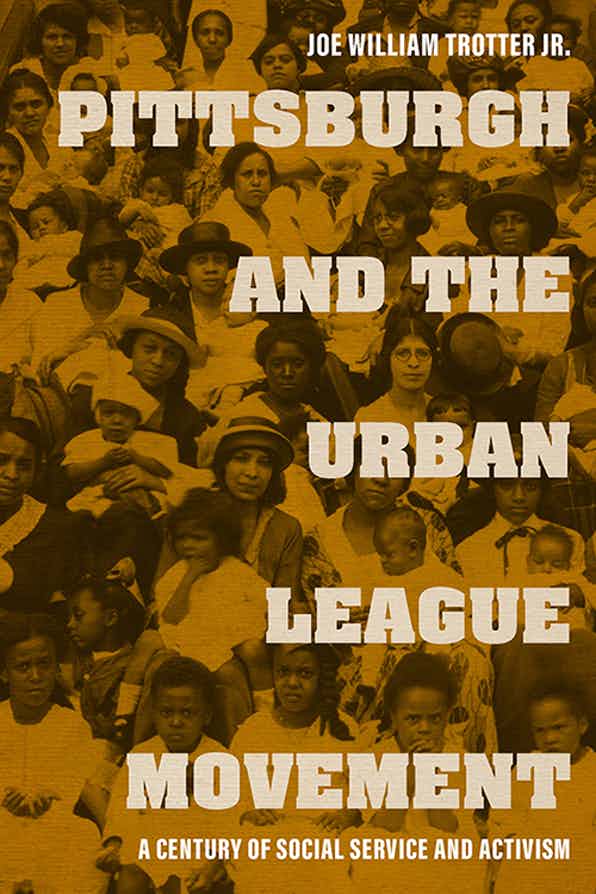
Pittsburgh and the Urban League Movement: A Century of Social Service and Activism by Joe William Trotter, Jr. (The University Press of Kentucky, 2020) details the history of the Urban League of Pittsburgh, an organization with over a century of social service and activism in the Greater Pittsburgh Metropolitan Area. The Urban League of Pittsburgh is a branch of the National Urban League, and this book breaks down 100 years of its goals, actions, how they were perceived, and the sometimes controversial approach they took to alleviate racial and class inequality. It also contextualizes and provides insight into the various events, biases, and ongoing, concurrent social struggles that factored into and influenced the Urban League Movement, giving readers an in-depth look at the often untold side of the history of Pittsburgh—and of the United States.
The book is divided into a prologue, three sections, and an epilogue. The three sections move in chronological order, from the Pittsburgh Urban League’s establishment, to changes brought about by the New Deal and the Black Freedom Movement. The epilogue concludes with the author’s thoughts on the Urban League Movement’s overall positive effects in connecting its social justice movements with social science research and social services. The book draws deeply from both primary and secondary sources, working across the Urban League’s files, newspapers, and oral histories, and is supplemented by relevant charts, clippings, and images from sources that include the census and the 1923 Pittsburgh Courier, though the book is almost entirely text.
The prologue provides both a helpful introduction to and a succinct summary of the book’s contents. Together with Part I—which details the beginnings of the ULP—we learn many of the themes and overall advocacy focuses that will be expanded on throughout the book, such as the push against racism in employment and housing and the ULP’s collaboration with other organizations, including those of the state government. By detailing the Urban League of Pittsburgh’s early practices and changing focuses, the author expands on the factors that led to these decisions: the workforce was volatile, influenced not just by wartime practices, but also rampant racism and sexism from employers and non-Black employees, who fought for lower wages and decreased opportunities for Black people. The percentage of Black people in the area also changed significantly, impacted by anti-enticement laws, labor shortages, discriminatory housing and employment practices, and living conditions.
The narrative delves into the interrelated nature of housing, employment, and community, and how they influence one another. For instance, better housing conditions led to better job performances and increased job stability. The ULP’s extensive research helped its staff pinpoint need areas and make crucial decisions on where to divert its resources, and Trotter concisely describes the results of these studies and consequences of its initiatives. Of the ULP’s research on the steel industry’s labor process, Trotter writes, “According to one branch research report, the so-called unskilled worker displayed considerable technical knowledge in the ‘conserving of his health and strength, personally avoiding burns or other accidents and protecting his fellow workman from same.’” These early chapters, which, on the surface, give a detailed history of the Urban League of Pittsburgh in its early years, describe the intersection of capital, labor, racial, gender, and class relations that continues throughout the history detailed in the book and persists today.
As the ULP evolved in the early 20s, it developed more of a focus on disparities in medical treatment of Black people and education. The first part of the book deals with post–World War I upheaval and its lingering effects, while the second describes the struggle of Pittsburgh’s Black community during the Great Depression and the continued turbulence brought about by World War II. Here, the pace picks up, with several years of struggle often condensed into single sentences and paragraphs. However, the narrative remains firmly dedicated to highlighting the most significant or representative events within the timeframe. The third section moves into post-WWII struggles and victories, including the Cold War’s influence on Black employment opportunities, the ULP’s role in the expansion of the African American middle class and the fall of Jim Crow, and the branch’s involvement in the Civil Rights Movement. Crucially, as the ULP shifted its philosophy from using social services exclusively to using the principles of social services, the book shifts into a broader overview of the ULP’s actions, following its larger-scale efforts and activity. However, Trotter’s attention to details brings the narrative to more personal levels, pinpointing actions and policy decisions to specific people. The final chapter moves through the postindustrial era and late twentieth century into the present. As policies enacted in the earlier decades fell apart, the fight for equality continued to shift, with many struggles still ongoing. The epilogue reflects on the changes and steps made toward justice and the ULP’s impact on and connection with racial relations and social service work while pointing out the unequal treatment that remains.
Though the author’s descriptions of the Urban League of Pittsburgh’s actions and responses reveal his overall positive view of the branch, they highlight some of its potential controversies, such as the end of John T. Clark’s ULP tenure and mishandled or misguided policies. The book does not shy away from describing the biases that plagued the ULP itself, such as its classism, sexism, and even racism toward the very people it claimed to support. The effects of the ULP’s actions, both positive and negative, are made clear—the upticks in employment as a result of direct recommendations and advocacy, and the periods of stagnancy when even the ULP’s strongest advocates could not sway the racism of employers.
One of the points that makes this book stand out is its specificity: whenever possible, names, dates, direct quotes, and detailed summaries are provided, even with the source going as far back as 100 years. The details are balanced, though, with small time jumps and concise summaries—never too loaded or distracting. While reading this book, it was easy to imagine some of the events unfolding before me, especially the exchanges between Urban League staff and the people to whom they made recommendations (and arguments).
Overall, the book was a fascinating, insightful case study into the history of not just the Urban League in Pittsburgh, but the area’s changing Black communities, landscape, and society. I found the summaries at the beginning of each chapter helpful in understanding key takeaways and priming myself for the upcoming sections. These sections are divided by common themes while the chronological order of events is mostly preserved, leading to easy organization and fluency.
After reading this, I now feel it is impossible to truly learn about Pittsburgh’s history and governmental and societal treatment of Black people without an understanding of the role of the Urban League Movement in the area. Like the book’s inability to speak of one without the other, racial relations and general community disparity and controversy are deeply entangled with the organization’s actions, connections, and advocacy. This book is a crucial read for understanding not only history, but also the present.
Stephi Cham holds a BM in Music Therapy with a Minor in Psychology from Southern Methodist University. She is currently working toward her MA in Publishing at Rosemont College, where she manages the publishing program’s communications as a graduate assistant. She is a freelance editor and the author of the Great Asian-Americans series published by Capstone Press, and her work has appeared in Strange Horizons.
Former SAFTA Staff Director and current farmhouse Writer-in-Residence, JoAnna Brooker, spoke with SAFTA intern, Kathryn Davis, about her writing, her residency, and the value in trusting the process.
Kathryn Davis: What keeps you, personally, committed to writing in times like these? Why does art matter for you right now?
JoAnna Brooker: I think my commitment to my writing ebbs & flows—some seasons I’m more concerned with living my life, gabbing to everyone around me, eating croissants, & exploring sights, tastes, & smells. Others, I’m predisposed to solitude—cancelling plans, reading sad poetry, sipping earl grey tea & looking forlornly out a window. I think I’m committed in knowing I can always come back to it—& so I’m using my time here to do just that. I keep coming back to it for the same reasons I always have; it’s one of the main ways I make meaning out of the random smorgasbord life likes to throw at me. I really enjoy contemporary art for this reason; it feels timely & raw in what is true to experience. I think in this period of great isolation, art is our way of checking in with each other, or putting into words what’s happening, like saying “Yes, I am also feeling this VERY MUCH right now,” or “here’s how I’m making meaning of what life is like right now.” I think there’s a sense of urgency around right now, that I’ve felt since 2016, which gives me more of a commitment to my art, writing, & to the truth of what that means to me. I don’t know if any of us will still be here in 15 years—but I’d like to write to make sure that we are.
KD: Has the pandemic impacted your work as a writer? How?
JB: Absolutely. When the pandemic began last March, I stopped performing standup comedy completely—so my writing narrowed to frantic journaling, poetry, & long meandering essays. I spent many days unemployed, taking sun soaked naps, playing Zelda & Animal Crossing, & reading poetry about technology, female sexuality, & the American mythos. Because of this “independent study,” I discovered even more what work resonated & duplicated what I’d like to create, & I know my work is stronger for it. I think I generated more content, but at the same time, I was more unsure of this content— without my workshop & community, any work I edited or sent out felt like shooting in the dark. A double-edged sword, in that way.
Further, I think the pandemic made me realize how true it is that we are not alone. In any of this. We are all different parts of consciousness experiencing life together. There’s something really beautiful and heartbreaking about that. We can feel each other’s joy, but also each other’s pain. Right now, there’s a lot of pain in the world.
When everything shut down & I was locked in my room, alone, I turned to poetry. Poetry can be sad, funny, resonant, or dumb as hell, but it puts your finite experience into certain words & that’s so damn rewarding to me.
KD: What advice would you give to other writers who are struggling to create right now (OR if you’re struggling yourself!) in order to help them push through and keep writing?
JB: Allow yourself to create garbage. Lol. I mean it though—I think there’s a lot of pressure put on, whether that be by the establishment, the man, the internet, or otherwise, to always be churning out something new, cutting edge, & good. In reality, most artists have the same themes they wrestle with for seasons, or even their entire lives. Their art is like a sandwich—their childhood trauma is like arugula tossed in Louisiana hot sauce, complicated feelings about religion are two crispy slices of bacon, codependency issues are melted gouda…. They might make twenty or thirty different sandwiches with these ingredients, yet, each sandwich is going to taste slightly different each time. Their goal is to make a satisfactory bite— that this flavor and texture combination is precisely what it felt like to be twenty-three, graduate college, and lose their first calico cat. And it’s okay to make terrible sandwiches. Mistakes & failure are the best teachers of what it means to succeed & know exactly what you want or feel. Trust the process. You’ll graduate to broccoli cheddar soup, or sourdough bread pizza when you’re ready.
KD: Your poems seem to do so much work in terms of grappling with the vivid, tangible bits of life—and the absolutely tumultuous interiority and inner dialogue/anxiety/ahhhh of it all. Is that balance something you work for, or does it just happen? Either way, it works so well, and it’s such a compelling blend of narrative and interior speaker. I’m really interested in how that comes about for you as a writer.
JB: Lol, first of all, thank you.
The only balance I strive for is meaning in absurdity. I’ve always had a rich interior life, which, in my youth, was a place to escape to. But as I’ve grown older, I work to find meaning in the random events of my life, the joyous & terrifying. Right now, between capitalism, climate change, & Covid, I see my anxieties & fears reflecting back to me in the simulation. Which can go to a dark place, or a very funny place, depending on how you look at it. No feeling or emotion is off limits; & I think I carry this curiosity & desire to smash apart the simulacrum to my writing.
KD: Because your work and identity as a writer seems to live across and between several genres—journalism, comedy, poetry—I’m really interested in how the different forms in your writing life inform other areas of it. Does being a journalist make you a better poet? What is the tension like for you when it comes to composing in one genre versus another?
JB: Mostly, it means I wish I could always write multigenre. Sometimes, I’m laughing about something that has shattered my heart to smithereens, & I don’t know if it’s because it’s a bit or it’s a poem. It probably just means that I use humor as a defense mechanism. Lol. I think I was a bad journalist, because I don’t think I’ve ever been truly objective in my life; truthfully, none of us can be. But I was very passionate about being an op-ed columnist, which makes comedy & poetry easier for me. I know I have a viewpoint somewhere. Somewhere between exactly how many times they texted me on Labor Day, and the way I felt when they smiled at me after eating a hot dog is how I figure out what that is. Sometimes I go back & forth between a feeling for years.
KD: What do you love most about SAFTA?
JB: Erin Elizabeth Smith has mentored me, given me opportunities for growth, friendship, & community through this wonderful nonprofit, & made some incredible grub that has warmed my belly & my heart. To her, I am eternally grateful. Zoë & Inara, the farm sheepdogs, are a close second; I could feed them crispy salmon skins until sunrise. Getting to hike, soak up the sunshine, & meet incredible artists from around the country doesn’t hurt either. #haftasafta
JoAnna Brooker is a graduate from the University of Tennessee, where she studied Journalism & English. Her work has been featured in Figure 1, Jet Fuel Review, HASH Journal, Menacing Hedge, & on stage as a comic. In her spare time she enjoys petting cats & making cheese based meals for her loved ones. She can be found on all social media platforms @cupofjoanna.
Kathryn Davis is a writer and editorial intern with Sundress Academy for the Arts. She earned her bachelor’s degree in Creative Writing from Grand Valley State University, and served as editor-in-chief of the university’s literary journal, fishladder. She writes and produces films from the southwest corner of Michigan.
In celebration of the release of his chapbook of elegiac poems, Ugochukwu Damian Okpara sat down with Editorial Intern Katy DeCoste to discuss blank space as language, living for hope in the face of trauma, and the journey towards tenderness.
Katy DeCoste: Can you speak to the many meanings of “tremor” throughout the book?
Ugochukwu Damian Okpara: The word “tremor” has stayed with me for a while now. And all through the moments, I journeyed toward visualizing it. Zora Neale Hurston writes, “If you are silent about your pain, they’ll kill you and say you enjoyed it.” So, I worked toward seeing it beyond its facade. I had initially wanted to interrogate the word using the nonfiction form, but failed at it, and the poems in this collection were a success at a different attempt. In a way, they allowed me to step outside the self, and explore fear and anxiety through an outward expression such as the quaking of the hands. But really, the many meanings of tremor in the book trail towards fear—a mother weary of losing her son, a lover unsafe even in the comfort of their partner or a safe environment, or in the poem, “Leaving Sad Things Behind,” where even your solitude haunts you, probably because you’ve been hyperaware of yourself and your environment.
In my neuro class, I came to know of the critical period during brain development, and how life experiences during this period could forever impact the nervous system, after which nothing can be done. For one, I believe the past is constantly being intertwined in the present, and through the various experiences of the speaker, trails toward their tremor and, in shaping them, becomes a critique of their life. Even in the poem, “I Know the Origin of My Tremor,” the speaker acknowledges the tremor and goes further to poke it—what would you save if you found him in the hands of a mob because of his mannerism and/or who they chose to love? Will you save the stick? Or the stone? Or even him?
KD: In “In the History of Belonging,” you write, “rejection is the language furrowed in my mother’s tongue.” How do mothering and motherhood figure in this collection?
UDO: Motherhood is central to life—in being the medium through which life springs forth. I think the maternal leaning found in some of the poems was a result of my personal experiences with my mother, and the tendency to run to her when my world becomes enveloped with chaos. Thinking of this line now, rejection being furrowed in a mother’s tongue, I wanted the opposite for the speaker, to deprive him of a place to run to. Even this rejection isn’t alien to us. There are myriads of stories where a mother abandons a child or treats them a certain way because of their sexuality or perceived sexuality. And often we do not make of what this does to the child. In the collection, the arrangement of the poems with respect to motherhood sort of journey through brokenness, depression, and tenderness. Rejection being furrowed in a mother’s tongue, to the speaker saying “dear momma, see me before this elegy fills me up,” and finally to a mother willing a son to come to her embrace. Really, it’s all a journey, one that is both unnecessary and sad.
KD: Can you speak to the use of white space in this collection, especially in poems like “A Ruined Candle Wax Still Breathes Itself Into Shape” and “Self Portrait as White Spaces”?
UDO: For me, silence is language, and so is the white space used in the collection. It bears its weight. I wanted the white space in the poems to signify pauses. In that fleeting moment when nothing is said, what becomes of the reader? To an extent, it’s a whole system of what lies before, after, and even the summary effect it has on the reader. Often it could be a small moment to ponder or a preparation for wonder. To speak of the use of white space in the two poems you mentioned, I’ll begin with “Self Portrait as White Spaces” because it appears first in the collection. While making the poem, I wanted the structure to mirror the speaker. What does it mean to have that many pauses in the poem? In a way the speaker is broken—even exile doesn’t bring the joy he yearns for—and so the many pauses in the poem reflect his internal state. The brokenness. The need to mend.
I’ve been listening to Birdy lately, often in moments when I question the purpose of this world. In Birdy’s voice, my pain becomes more intimate with me. It is as though pain is something tangible, something I can hold and examine its features. To paraphrase Ellen Bass, to sit with what weighs me down. It is in this intimacy that I often find hope when I look beyond the moment. Hope makes the uncertainty of the future bearable. Birdy and RHODES sing, “If we’re strong enough to let it in / we’re strong enough to let it go.” To an extent, this is what the poem “Self Portrait as White Spaces” does for the speaker. He embarks on a journey to make sense of it all. In the epigraph of the section where “A Ruined Candle Wax Still Breathes Itself Into Shape” appears, Pamilerin Jacob says, “Life is one long journey into tenderness, into rekindling.” The poem ferries through “Self-Portrait as White Spaces,” through the visualization of chaos to finding and living for hope. In the poem, the white spaces evident at the beginning become eclipsed at the end, and then the poem falls into shape. It also alludes to the title that a ruined candle wax still breathes itself into shape.
KD: Tell me about the portrayal of desire and sexuality in this book?
UDO: So much of living outside the spectrum of what society knows is filled with desire. For instance, either as a queer person or an effeminate man, you walk down the street and you’re taunted, made fun of and mimicked. You think you’re writing much about it, only to log into Twitter to see another effeminate boy beaten because of his mannerism and perceived sexuality. For one, it could be you. In “Prayer,” I write “I know what desire looks like for I’ve stood at its door for too long.” And I think this may reflect everyone who lives outside the spectrum of what a hostile society knows. There may be this desire to fit in, to find home, a safe space, to truly live, and so on. The speaker journeys through it all. No one sees fire and deliberately runs into it.
KD: Each section in this collection, and several individual poems, are introduced with epigraphs. Can you tell me a bit about the epigraphs you’ve chosen?
UDO: In January 2020, I left home to a new environment. The thought of leaving my parent’s house was exciting. I thought it was an opportunity to begin again, to find joy and live in its tenderness. Then I moved and it wasn’t quite what I envisioned. The silent comfort of my room filled me with paranoia, and made me question life and its purpose. What found me were the epigraphs beginning each section. To an extent, I saw reasons to live in them. Ellen Bass’s poem “The Thing Is,” found me first. It is a beautiful poem about loving life despite it having its back to you. “How can a body withstand this?” Truly, it made me sit with what weighed me down and often, when overwhelmed, I’d find myself mouthing “to love life, to love it even when you have no stomach for it.” Ruth B’s “Lost Boy” resonated with me the same way Bass’s poem did. Listening to the song, I imagined it as a friend, broken like me. We’re holding each other’s hands, looking at the moon and stars, and finally running away from all of it, all of reality. It is in this kinship that I was able to survive the bouts of sadness that enveloped me. Finally, Pamilerin Jacob’s poem made me realize that in the end, we’re journeying towards tenderness, where what has happened before won’t matter. It will fade away, sure! And you’ll be glad that you’re here.
After I arranged the poems in the chapbook, I found that they were journeying towards tenderness. And that group of poems resonated with the different stages of my life during my search for home. I wanted something to prop each section. Something that would also mirror my journey. And the epigraphs were just ideal and beautiful.
The works of Chibuihe Obi and Romeo Oriogun were some of the first queer poetry I read. They were relatable and influenced so much of my early writing. Having their works begin some of the poems in the chapbook is my way of paying gratitude to them.
KD: In “I Practice to Get Hold of Myself,” you write “sometimes a poem is a truth” and “in my next world, / i promise, i will come as a happy poem.” What role does poetry play in the joyful possibilities of queer futures?
UDO: In a way, I do not necessarily think poetry plays a role in that. I think what lies behind the future mostly precedes what role poetry should play. If the world was fair—especially here, where very inhumane laws are enacted against queer people—then I wouldn’t have written that line about coming back as a happy poem. I think now of Noor Hindi’s poem, “Fuck Your Lecture on Craft, My People Are Dying”. In the poem, she wishes to write about the moon and flowers but can’t get herself to do that because outside, her people are dying. How can she even bring herself to write about the flowers and moon at that time? If the world was tender to queer people, then the poems that would spring forth would mirror that. On the other hand, the ability to relate to a poem, when it stays with you, it sort of offers you a hand, hug, or anything, saying, “I see you, let’s walk down this path together.” And who knows? Just by being seen, you can find joy on this journey.
KD: Many of these poems deal with violence and trauma, yet this collection is underscored by hope and joy. What role does queer desire play in imagining this kind of radical tenderness?
UDO: In that state of trauma or violence, one could get overwhelmed by all of it. In fact, people do. It is also the same way grief overshadows one, and its lexicon: until we meet to part no more, is underscored by hope and joy. Hope and desire are constantly being intertwined. It is even interchangeable. In a way, aren’t we all living for hope? That a wound wouldn’t fester? That a hand would pull you close and call you kin? That the ache in your heart would elude you? That if the world is tender, then we would love to return? And if it isn’t? Please bring me back as a happy poem or even a pineapple. It is with these thoughts that the collection approached me, and I approach life this way too. I think in living for hope, we become tender, knowing that whatever ache tugs our hearts, will eventually fade away.
KD: You frequently return to prose poetry in this collection, like in the opening piece, “Exile Leaves You at the Foot of Desire.” How does this form shape the articulation of themes such as desire and loneliness?
UDO: I think it is what each poem wants. In making my poems, form is critical. Sometimes I mess up a poem because I’m trying to fit it into another form. I could even lose out on a poem because I’m not paying attention to its form. Sometimes I know what I want to make but struggle with it because I’m putting it in the wrong vessel. Some of the poems in the prose form were failed attempts at being in the traditional poem format or even a couplet. It was only when put into the right vessel were these poems able to live.
KD: These poems speak of survival, both individually and across generations. What kinds of relationships and communities can help us survive?
UDO: Create a safe space. I think queer people or any other marginalized groups, for that matter, should create their safe spaces. You try to control who and what has access to you, that way you relieve yourself of the responsibility of living on the edge, of being overly on guard about certain aspects of your life. I know it is exhausting and emotionally draining to achieve this, especially in a hostile community where you can’t control much. But you can try. And hopefully, it gets better.
Ugochukwu Damian Okpara, Nigerian writer & poet, is an alumnus of the SprinNG Fellowship, and Purple Hibiscus Trust Creative Writing Workshop held annually by Chimamanda Ngozi Adichie. His works appear in African Writer, Barren Magazine, The Penn Review, 20.35 Africa, The Masters Review, and elsewhere. In 2019, he was the 1st Runner Up in the Nigerian Students Poetry Prize. He was also a contributing interviewer for Poetry at Africa in Dialogue.
Katherine (Katy) DeCoste is a queer, white settler currently living on the unceded territory of the Lekwungen-speaking peoples and the WSANEC peoples, where they are pursuing their MA in English at the University of Victoria. In 2020, they received their BA Honours in English and History from the University of Alberta, as the Rutherford Memorial Medalist in English and Dr. John Macdonald Medalist in Arts. You can find their poetry in Barren Magazine, Grain Magazine, The Antigonish Review, and other outlets. In 2020, their play “many hollow mercies” won the Alberta Playwriting Competition Novitiate Prize. When not writing, reading, or answering emails, Katherine can be found playing Dungeons and Dragons, volunteering with food support initiatives, and forcing their friends to eat their baking.
The Sundress Academy for the Arts (SAFTA) is pleased to announce Ching-In Chen, recipient of the Kristi Larkin Havens Memorial Fellowship; T. Chester, recipient of the Black and/or Indigenous Identifying Writers Fellowship; as well as Caoimhe A. Harlock and Dena Igusti, winners of the Spring 2022 LGBTQIA fellowships. These residencies are designed to give artists time and space to explore their creative projects in a quiet and productive environment.
Ching-In Chenis a genderqueer Chinese American hybrid writer, community organizer and teacher. They are author of The Heart’s Traffic and recombinant (winner of the 2018 Lambda Literary Award for Transgender Poetry) as well as the chapbooks to make black paper sing and Kundiman for Kin :: Information Retrieval for Monsters (Finalist for the Leslie Scalapino Award). Chen is also co-editor of The Revolution Starts at Home: Confronting Intimate Violence Within Activist Communities and Here Is a Pen: an Anthology of West Coast Kundiman Poets. They have received fellowships from Kundiman, Lambda, Watering Hole, Can Serrat and Imagining America and are a part of Macondo and Voices of Our Nations Arts Foundation writing communities. They are currently an Assistant Professor in the School of Interdisciplinary Arts and Sciences and the MFA in Creative Writing and Poetics at the University of Washington Bothell.
T. Chester (they/them) is a scholar, artist, and organizer from South Florida. Over the last 10 years, T has taught in Black Studies, Women and Gender Studies, and Theatre departments at the university level. As an artist, scholar, and organizer, T centers storytelling as a way to understand difference, promote empathy, and create change. Please visit www.tabithachester.com for more information and follow them on Twitter @TJ_Da_Face.
Dena Igusti is a queer non binary Indonesian Muslim writer and multimedia artist born and raised in Queens, New York. They are the author of CUT WOMAN (Game Over Books, 2020) and I NEED THIS TO NOT SWALLOW ME ALIVE (Gingerbug Press, 2021). They have received play commissions at The Tank (First Sight, 2021) Players Theatre (SHARUM, 2019) and Center At West Park (CON DOUGH: Stories of 1-in-5 Gentrified, 2021). They are a Culture Push Associated Artist. They are currently a 2021 Playwright-in-Residence for Rogue Theater Festival. They are a 2021 Baldwin For The Arts Resident, 2021 Hook Arts Media Digital Connections Fellow, 2021 City Artist Corps, 2021 Stories Award Finalist, 2021 LMCC Governor’s Island Resident, 2021 Broadway For Racial Justice Inaugural Casting Directive Fellow, 2020 Seventh Wave Editorial Resident, 2020 Ars Nova Emerging Leaders Fellow, 2020 Spotify Sound Up cohort member, 2019 Player’s Theatre Resident Playwright, and 2018 NYC Youth Poet Laureate Ambassador. They are a Converse All Stars Artist and UN #TOGETHERBAND Global Ambassador. Their work has been featured in BOAAT Press, Peregrine Journal, and several other publications. Their work has been produced and performed at The Brooklyn Museum, The Apollo Theater, the 2018 Teen Vogue Summit, Prelude Festival (Cut Woman 2020), The Tank (First Sight 2021 at LimeFest), and several other venues internationally.
Caoimhe Harlock is a southern trans woman writer and artist. Her fiction has been published in The Evergreen Review, Gathering of the Tribes, and Superfroot Magazine, and she has comix with Honey Literaryand Diskette Press (forthcoming). She’s finishing up a Ph.D. about gender and the supernatural in American literature and lives in Durham, NC with her partner, two pups, a cat, and an altar to the goddess Hecate.
Finalists for this year’s fellowships included Julia Mata, Keana Aguila Labra, Coyote Shook, Michelle Moncayo, and Annette Covrigaru.
Sundress Publications announces a virtual book launch and reading to celebrate the release of NOMBONO: An Anthology of Speculative Poetry by BIPOC Creators From Around the World.
The virtual launch will take place via Zoom on October 27th from 7:00-8:30PM EST.
In the stunning and imaginative NOMBONO: An Anthology of Speculative Poetry by BIPOC Creators From Around the World, we are presented with visions, invocations, foretellings, and bold harbingers. NOMBONO, drawing from the Zulu word for “visionary,” brings together mystical dreams and possibilities that are at times both striking and devastating. This anthology, edited by Akua Lezli Hope, asks: are we on a bright threshold or at the edge of a dark precipice? Are we about to take flight and evolve or plummet into cataclysm? Around each corner in this book there may be a hyena man, salmon women, Mananggal, prayers, or curses. There is steady, unbroken eye contact, and there is fierce joy and fury. Here we have the limitless, boundless exploration of resplendent worlds.
Readers for this event will include: Jenna Le, Elsa Valmidiano, Jennifer Perrine, Ching-In Chen, féi hernandez, Andrew Geoffrey Kwabena Moss, Minoti Vaishnav, Gustavo Barahona-Lopez, Shanta Gander, Amelia Díaz Ettinger, Ellen Huang, Zeenat Khan, Owolabi Aboyade, Shagufta Mulla, Grisel Y. Acosta, Quincy Scott Jones, Uche Ogbuji, Ansley Moon, and KL Lyons.
In dark, dense forests and well-kept domestic houses, Roseanna Alice Boswell’s collection Hiding in a Thimble (Haverthorn Press, 2020) weaves the fairytale of adolescent girlhood with a grimness reminiscent of the Brothers’ Grimm or Hans Christian Andersen. As she asserts in the book’s opening poem, “Forest: Feat. Thicket:” “If / everything is in its place, a forest should / look almost domestic.” It is in these myths—of Snow White, a recurring anthropomorphized “Bunny,” and personified does—that the speaker identifies facets of herself, and the horrors of a girlhood defined by the male gaze and male desire.
In this collection, the speaker’s rapidly changing body becomes a site of profound alienation and disassociation. “Snip/Slide” recounts the painfully vivid tale of the speaker’s violent alteration of a bathing suit to fit in with other preteen girls: “I / am a watermelon—blocky and green,” she laments, before “I cut the / middle out and it is ragged and rolls down / but I don’t care.” In this poem, exposure stops a childish, innocent girlhood in its tracks; “I / will never slide down another slide as long / as I live,” insists the speaker, defiantly racing towards the womanhood that she sees symbolized in the other girls’ “lemon print bikinis and tanned middles.”
Throughout the book, the speaker grapples with her own burgeoning desire, which both empowers and disenfranchises her. Recounting a first crush in “You Make Me Feel Things I Can’t Tell My Mother,” sexuality straddles childhood, where “who knows what could happen / on Hello Kitty sheets.” However, the same conflict follows the speaker into adulthood. “I make an excellent wife with my recipes / from Aesop,” she brags, recounting how she must contort herself to please her husband and other men: “I almost imagine myself a pomegranate / with all that hidden flesh for plucking.” The possibility is both titillating and heartbreaking, as the speaker conflates desire with being desired, adopting male wants as her own. Even as she reflects that “I’ve developed a lot of empathy for colanders / &/or condoms recently. Really anything / that has to filter potential catastrophe / for a living,” she boasts that “If any girl is home with a broken heart / it’s not me.”
The disconnect between the speaker and her own body is frightening enough, but as the rest of the collection reveals, it is adulthood—and the male attention it brings—which intensifies this disconnect, making it still more harmful. In several poems about “Bunny,” the speaker places herself in the shoes of this small, helpless prey animal, analogizing the creature’s timidness to her own obedience, demureness, and submission to men: “Mable Bushytale stores everything / away for her husband / never takes a stray / acorn for herself,” reads the opening stanza to “Lessons in Deportment,” both lauding this self-sacrificial behavior and mourning its impact on Mable, who “is always looking for ways / to take up less.” Such internalized violence is coupled, more explicitly, by comparisons between predator animals and the rape culture that characterizes so much of female adolescence. In “Bunny Fables,” Boswell adopts the victim-blaming language of media, explaining “she should know better / than to stray / off the path alone.” In the face of a world where “her bones / will be delicious / cautionary tales,” the bunny may find that Mable’s desolate, empty nest is the more appealing option.
A profound sense of irony cuts through Hiding in a Thimble as Boswell recontextualizes the patriarchy’s language in a sharp critique of its impact on young women. In “Funny Girl Talks,” contemporary media unravels the fairy-tale image of the bunny: “hey just look up my Twitter @ / swellbunny you’ll see how fucking funny / I can be.” This poem, and a few others, offer a jarring, vocal anger that contrasts the quiet bitterness of most of the collection’s pieces. Boswell surgically deconstructs the same myths that she’s spent much of the collection exploring, recasting her speaker as “shrew-mouthed and screaming” and insisting that “Girl-hearts always become cannibal.” Here, the violence that the bunny-girl experiences is refocused on those who have hurt her. Ultimately, the speaker attempts to reject the genealogy of ideal femininity that she inherited from her own mother, claiming that “We are not going to grow / old conventionally if I have any say.” Even for a woman scarred by patriarchal violence and self-hatred, healthy versions of domestic bliss are possible, where “My lover’s arms are warmer / than our furnace ever gets.” But doubt lingers, and “everyone becomes somebody’s mother.” Hiding in a Thimble maps the quiet traumas of girlhood onto familiar fairy-tale imagery, stitching a myth that, like most fairy-tales, is less idyllic and more violent than it first appears. Its “cautionary tale” is not the bunny who strays from the path, but rather this account of the dispossession, silencing, and alienation that young women face in their intimate relationships as they become objects to be desired and animals to be hunted down.
Katherine (Katy) DeCoste is a queer, white settler currently living on the unceded territory of the Lekwungen-speaking peoples and the WSÁNEĆ peoples, where they are pursuing their MA in English at the University of Victoria. In 2020, they received their BA Honours in English and History from the University of Alberta. You can find their poetry in Barren Magazine,Grain Magazine, The Antigonish Review, and other outlets. When not writing, reading, or answering emails, Katherine can be found playing Dungeons and Dragons, volunteering with food support initiatives, and forcing their friends to eat their baking.
Poets in Pajamas (PiP), a Sundress Publications reading series, is putting together its slate of readers for 2022 and would like to invite you to apply to read.
Poets in Pajamas is a live-feed online reading series, hosted by Sundress Publications, which prides itself on producing high-quality poetry readings for an online audience. Readers read from their own work for fifteen minutes and then answer questions from listeners for an additional ten or fifteen.
We are interested in hearing from ALL writers (we accept both poetry and prose readers) but we also particularly want to welcome writers who identify as part of disenfranchised communities such as, but not limited to, people of color, immigrant populations, native and Indigenous people, LGBTQ+, d/Deaf and Disabled, non-binary people, members of non-dominant religious groups, all women, Dreamers, formerly incarcerated, and more. We want to host you and promote your work.
To apply, send three poems or up to five pages of prose and a short video clip of you reading, NOT a recorded reading in front of a crowd. Please send a new video of you reading at home or in your garden, in front of your computer, or in your living room. This is NOT a call for produced sessions. Read for no more than 1 to 3 minutes (less is more), and please attach a bio and author photo in one email to poetsinpajamas@gmail.com. Submissions close November 1st, 2021.
Note: We’re NOT concerned with audio/video quality here, nor your appearance. We are looking for that magical combination where the poet writes wonderful words we want to hear and knows how to give a good reading in a virtual setting. Really, one to three minutes, read as you would at any reading, one poem, or one paragraph, don’t overthink. Please apply!
Now more than ever, people miss getting out to readings. Plus, many folks don’t have access to readings because they don’t live near a literary city/don’t have time/can’t get to them. These are the people who wouldn’t regularly be at your reading but want to see you read, and want to know and love your work. PiP would like to help you and them find one another.