Meet Our New Intern: Saoirse

A brown femme person with shoulder length black har sitting at a table. They have a drink in their hand and a butterfly tattoo in pride colors is visible on their wrist.

I grew up in a family of six people and four languages. We also moved around quite a lot. Between code switching at home and learning a new dialect with every move to a different city, I learned the power of language pretty quickly. So it was no surprise when I started poking my nose in my parents’ book collection as a child. Always being the new kid in school and being bullied constantly only made me retreat into my books even more.

Not the best idea—according to my teachers, at least. Books can plant the darnedest ideas in your head. They can suggest your school textbooks are sexist and problematic. They can tell you it’s okay—gasp—even healthy, to be your full queer self. They can instill in you a revolutionary zeal. My books got me in quite a lot of trouble—trouble I took as a sign that I was doing something right.

Though I had a habit of juggling languages based on my mood in both my reading and writing, English held a mysterious allure for me. It was the language where I found my identity as a queer nonbinary woman and it was also a legacy of the colonial violence that separated by grandparents from their ancestral lands. I was proud to be articulate in a language that could never articulate its own violence upon my lived reality. It was to understand this fraught relationship that I found myself majoring in English at Washington College on the eastern shore of Maryland.

Washington College, particularly the pedagogical brilliance of Drs. Kimberly Andrews and Alisha Knight, allowed me to come into my own as a writer and a thinker. It was also where I discovered my passion for editing. Over the years, I’ve harnessed that passion into working with emerging writers who don’t necessarily have access to a creative writing workshop. To that end, I founded Palimpsest—a writers collective focused on honing our craft in community with each other. I also serve as a Guest Editor at Oyster River Pages, where I inaugurated the Emerging Voices in Poetry program as well as ORP Schools— our creative writing workshops. These are all an attempt to create spaces that center the creativity of historically excluded folks.

Language is power harnessed through story. There is no ecstasy greater than finding a story that disrupts, enhances, and challenges the trends at any given time and place. And no honor greater than working with the writer to help them achieve precise muscularity of language as they tell their story. That is why I am so very honored to join Sundress Publications in the curation of a diverse and vibrant literary landscape.


Saoirse’s name and passion are the same: freedom. As an exophonic writer, their academic interests revolve around linguistic power dynamics, especially in connection to the land. They are always trying to write, and find, poetry that breaks the English language into articulating its own colonial violence. They are a freelance editor and serve as the Guest Editor for Emerging Voices in Poetry at Oyster River Pages. They are a 2021 Brooklyn Poets Fellow and a finalist for the Sophie Kerr Prize. They find excitement in travel, comfort in a good cup of coffee, and love in their newly adopted puppy, Malaika. Find them at saoirseedits.com or on Twitter @saoirseedits.

Lyric Essentials: Maya Williams Reads Anis Mojgani

Welcome back to Lyric Essentials! This week writer, slam poet, and organizer Maya Williams has joined us to discuss the work of Anis Mojgani and poetry as conversation. We hope you enjoy as much as we did, and, as always, thank you for tuning in. 


Ashley Hajimirsadeghi: How did you discover Anis Mojgani? 

Maya Williams: I discovered Anis Mojgani upon watching his performance of “Shake the Dust” uploaded to Button Poetry on my birthday in college (it was only uploaded two days before!). I have been obsessed ever since.

Maya Williams reads “They Raised Violins” by Anis Mojgani

AH: In an interview published at Literary Arts, Mojgani stated the following: “That’s what poetry comes down to––the opportunity to make sense of who we are, that we might grow and learn and foster ourselves, and in turn perhaps aid in the growth and learning and fostering of others.” Through interacting with Mojgani’s work and poetry as a whole, what has poetry become for you? 

MW: Through interacting with Mojgani’s work and poetry as a whole, poetry becomes for me an expansive conversation. One with myself as I’m reading, one with the writer of the poem (even if the writer cannot respond to me as I’m reading), and with others who may resonate with his work or another writer’s work. It continues to inspire me to make sure my poems in my work can be their own conversations for people.

Maya Williams reads “Sock Hop” by Anis Mojgani

AH: Why did you choose these poems specifically? 

MW: I choose these poems specifically because I wanted to showcase different phases of Mojgani’s work. It’s incredible to see what remains the same in his work and how he has grown overtime not only in his work, but how talks about it and tries to make his work a pulse for social change in any way he can.

AH: What’s next for you? Got any plans you’d like to share (about life, writing, creativity—anything!)? 

MW: Ooh! Next for me is finishing up my third semester at Randolph College, working on a thesis right now about the ramifications of the metaphors of mental illness that correlate with the prison industrial complex. I’m excited to start poetry programming with the Portland Public Library in 2022. I was selected as Portland, Maine’s poet laureate in July of this year, which involves community poetry programming I get co-facilitate with fellow poets I admire!


Anis Mojgani is a visual artist and spoken word artist originally from New Orleans. He received his education in Sequential Art then Performing Arts, which led him to joining poetry slam teams. Mojgani currently is the Poet Laureate of the state of Oregon, where he currently resides. His poems have appeared in The New York Times, Rattle, as the Poem-of-the-Day at Poets.org, and have been performed all around the world.

Find his website with his art and writing here.

Watch Mojgani perform “To Where the Trees Grow Tall.”

Discover his book The Feather Room here.

Maya Williams (ey/they/she) is a Black Mixed Race poet and sucide survivor residing in Portland, ME. They have received residencies and fellowships from the Sundress Academy for the Arts (SAFTA), Voices of our Nation Arts (VONA) Foundation, The For Us by Us Fund’s Words of Fire Retreat, and Hewnoaks Artist Colony. You can find em as one of the three selected artists of color to represent Maine in The Kennedy Center’s Arts Across America series. You can also find her on her website at mayawilliamspoet.com

Watch Maya read their poem “Definitions of Home.”

Read their poem “The Words We Wear” here.

Read their essay “I’m a Black Suicide Survivor and Joy is My Act of Resistance” here.

Ashley Hajimirsadeghi is a multimedia artist and writer. She has had work appear, or forthcoming, in Barren Magazine, DIALOGIST, Rust + Moth, and The Shore, among others. She is the Co-Editor in Chief at both Mud Season Review and Juven Press, and reads for EX/POST Magazine. More of her work can be found at ashleyhajimirsadeghi.com

Stirring Open Call for Submissions

Stirring is open for submissions of creative work from all writing genres and a variety of visual art media. We are continually striving to publish underserved voices, BIPOC, LGBTQIA+, and other marginalized beings. We do not consider translations or previously published pieces. We are currently not accepting books for review but would still love to read reviews you have written.

We enjoy short poems, long poems, flash fiction, memoirs, form, prose, narrative, lyrical, etc. Stirring is a journal with several editors who all contribute their individual input for each issue. The joy of Stirring is the confluence of our diverse opinions. Of course, keeping up with Stirring, as well as reading a few of our previous issues, will give you the best idea of what we are looking for in written work. Visual art submissions may range from images of your 2-D work or 3-D pieces. We are open to select 4-D or video art submissions if they suit our needs.

We welcome simultaneous submissions. However, you must inform us immediately if your work has been accepted elsewhere. We do not consider previously published work. Please refrain from sending multiple submission to us as they will not be considered for publication.

We request that all written work be submitted in the body of your email. No attachments, please. Additionally, please include a brief third-person bio in your submission.

Submissions Guidelines:

Book Reviews: Up to 700 words sent to Katie Culligan at stirring.reviews@gmail.com

Poetry: Up to 5 poems sent to Luci Brown at stirring.poetry@gmail.com

Fiction: Up to 5,000 words sent to Shaun Turner at stirring.fiction@gmail.com

Nonfiction: Up to 5,000 words sent to Ada Wofford at stirring.nonfiction@gmail.com

Art: Between 5 and 10 individual files attached and/or a link to your portfolio sent to Stephanie Phillips at stirring.artphoto@gmail.com

If you get published with Stirring, we obtain First Serial Rights of your work during the time it appears on our website’s current issue. When the new quarterly issue goes up, the rights revert back to you. We also hold the right to re-print your piece in any further issues of Stirring or any print anthologies back by Sundress.

If you have any questions, feel free to contact us here.

Meet Our New Intern: Kathryn Davis

I’ve never been big on football, but I’ve always loved books. Between my third-grade and seventh-grade years, the oldest of my two brothers played college football nine hours away from home, and my parents resolved to attend every. Single. Game. We’d wake up at four or five each Saturday morning, load into my dad’s Ford Explorer without a word to one another, and we’d drive. 

During the first couple hours of those drives, it’d be too dark to read—but around seven or eight, I’d start in. The librarians in town had known me for a while by then (my general book habit was nothing new), but they began to learn the football season drill as well. They’d ask where Joe was playing that week. How many hours away? Twelve? How many of these (gesturing vaguely at the pile of books I’d pulled off the shelves to take with me) do you think you’ll finish by next weekend? All of them? See you next week. 

I’d read from that first light until we parked and headed into the game. We’d settle into the bleachers. Then I’d start again. About halfway through Joe’s college football career, a teammate of his said to him, “Joe—I didn’t realize you had a sister. What does she look like?” Another teammate interjected, “A book cover.” 

I went to college years later in hopes of making books, because there will always be more long drives, more library trips, more football games. In college, I led my university’s literary journal, fishladder, while pursuing a degree in Creative Writing—while writing bad stories and worse poems and working with great writers. I had just about the greatest and luckiest college experience a young writer can have. 

The bad thing about this fact, though, is that the writing life beyond college does not necessarily feature regular three-hour discussions of short stories, debates about line breaks, or exhausting and wonderful workshops. There are long and difficult work days that mean the writing never gets done. There are lots and lots of Submittable rejections and bills to pay. On roadtrips, I’m now expected to put down my books and help drive. All that said, I’m so, so excited to have arrived at this internship with the Sundress Academy for the Arts. I feel like I’m sneaking more time in the backseat of my dad’s Explorer, lucking into more time to draft a story that’s almost-there. I’m so honored to be trusted to help uplift Sundress’s incredible writers’ voices, to play a small role in fostering a community of folks who’d rather hang out behind a book cover than watch the game.

Sundress Academy for the Arts Presents “Magical Realism & Cultural Context”: A Writers Workshop

The Sundress Academy for the Arts is excited to present “Magical Realism & Cultural Context,” a workshop led by Jessica Reidy on August 11, 2021 from 6-7:30PM. This event will be held over Zoom. Participants can access the event at tiny.utk.edu/sundress (password: safta).

This workshop will challenge the idea of magical realism as something imagined within reality with Marquez’s assertion that “surrealism runs through the streets,” and invite students to consider various cultural perspectives on what is real, which include magic or spiritual phenomena as inseparable from reality. The format of this workshop will be part lecture, and part generative. In the lecture, we will examine works by Rajko Đjuríc, Edwidge Danticat, and Joy Harjo as examples of the magic and the mundane coexisting, and we will examine the cultural elements of the story that inform these specific realities.

The second part of the workshop will be focused on generating material through writing prompts that guide students to writing their own magical realism, incorporating their sense of heritage, place, and cosmology into their work. The goal of this workshop is to free up ideas around what is real and what is magical, allowing students to access all forms of their and their characters’ lived experiences, and create a holistic narrative.

While there is no fee for this workshop, those who are able and appreciative can make direct donations to Jessica via Venmo @jezminavonthiele or PayPal at jessica.s.reidy@gmail.com .

Jessica Reidy (she/they) is a writer and educator with works in Narrative Magazine as Story of the Week, Prairie Schooner, The Kenyon Review online, RomArchive, and other publications. She is the winner of the Nancy Thorp Poetry Prize, the Penelope Nivens Award for Creative Nonfiction, and the Glenna Luschei Prize, and her work has been nominated for a Pushcart and Best of the Net. She is a co-host of Romanistan podcast alongside Paulina Verminski, a celebration of Roma, rebels, and roots. Under the name Jezmina Von Thiele, she is a dancer, healer, artist, art model, and fortune teller, dealing in tarot, palmistry, and tea leaves. She tells fortunes in her mixed Roma/Sinti family’s tradition. She is a queer witch, and can be found at jessicareidy.com and jezminavonthiele.com

Doubleback Review is Seeking Short-Form Previously Published Works

Doubleback Review is currently seeking submissions for issue 3:2! We are a part of Doubleback Press, a small press specializing in republishing creative works that were originally published by now-defunct journals and presses. Doubleback Review has also had a special edition for conscientiously withdrawn pieces—works that were withdrawn from journals because of harmful behavior from an editor. We are a home for your retired darlings, and we are also committed to uplifting the voices of marginalized creators.

We are open for submissions year-round and accept poetry, short stories, artwork, and more short-form work. Poets should send up to five poems and prose writers should send up to 4,000 words total—one story or essay, or up to three shorter flash pieces—in one document (Word preferred). Please begin each piece on a separate page. Include your name and email address at the top of each page. Below each piece, specify where it was previously published.

Artists may send one high-resolution image in .JPG, .JPEG, .PNG, or .PDF format, up to 25 MB in size. Please include an artist statement and specify where the piece was previously published in the cover letter field.

Our full submission guidelines can be found here.

Lyric Essentials: John Sibley Williams Reads Marcelo Hernandez Castillo

Welcome back to Lyric Essentials! This week poet and educator John Sibley Williams has joined us to discuss the work of poet Marcelo Hernandez Castillo, what courage may look like, and the cutting details and musicality of a poem. As always, thank you for tuning in!


Ashley Hajimirsadeghi: We all have specific memories of the first time we picked up a specific book or read a favorite poet—when was the first time you discovered Marcelo Hernandez Castillo’s work?

John Sibley Williams: I was lucky to have discovered Castillo’s work purely by accident while shopping at my local independent bookstore. I was there looking for a specific book, but this stark, brilliant cover caught my eye. I opened to the first page and was immediately hooked by the simple complexity of its first lines:


Because the bird flew before
there was a word
for flight

This linguistic and philosophical conundrum was followed by:

years from now
there will be a name
for what you and I are doing.

This unexpected shift to the intensely personal while remaining elusively abstract truly caught me off guard. I ended up reading almost a quarter of the book right there, standing in a narrow aisle in a crowded bookstore. And I think I finished it later that night.

John Sibley Williams Reads “Cezontle” by Marcelo Hernandez Castillo

AH: I love the rich details and topics the poems delved into! What drew you to these poems specifically?

JSW: It’s so difficult to dismantle poetry that really speaks to you in order to pinpoint what exactly about it fills and breaks and then refills your heart with its music. But the musicality in Castillo’s work is definitely a part of its allure. Each line, phrase, syllable just seems to inspire and converse with the next, and the varied structures in every instance perfectly compliment its themes. But, beyond the evocative language and surprising shifts and richly universal themes, Castillo consistently strikes this astonishing balance between the concrete and abstract, the heartbreakingly intimate and highly conceptual. Everything just leaps off the page, demanding attention and careful consideration, while also asking us to throw all that out and simply sink unquestioningly into his world. There’s just this overarching sense that these poems were written specifically for me and at the same time specifically for everyone else. These poems are bridges across cultures and times, philosophies and deeply felt personal experiences.

John Sibley Williams Reads “Drown” by Marcelo Hernandez Castillo

AH: In the Los Angeles Times, a reviewer described Castillo’s work as “courageous.” For you, as a poet, what has courage looked like on the page?

JSW: “Courage” can take so many (often overlapping) forms in a poem. It can be striking out to attempt something wholly new, breaking with one’s usual conventions and stretching one’s creativity just shy of the breaking point. It can be making bold linguistic decisions that may or may not work, that could be monumentally moving or utterly ridiculous, but still choosing to walk that tightrope whether or not the poem “fails”. I know it’s a cliché, but isn’t it a beautiful thing to master failure? To take huge risks and just pray readers follow your leaps and twists and experimentations? But “courage” can also be deeply personal. Most of the poems I love know exactly when and how to break and then to heal me. There’s a sense of genuineness, an authentic vulnerability, an unspoken agreement that poetry is meant to be one half of a conversation, trusting readers to be that necessary other half. Trusting others with your own deeply felt truth is true courage.

AH: What have you been up to lately? Got any exciting plans (anything!) that’d you like to share?

JSW: Although I haven’t been writing new work as much as I’d like to due to my shifting focus on being the best father I can be to my twin toddlers, I’m honored and thrilled to have two new books forthcoming. “The Drowning House” (winner of the Elixir Press Poetry Award) and “Scale Model of a Country at Dawn” (winner of the Cider Press Review Book Award) are both due out this coming winter. Professionally, last fall I founded Caesura Poetry Workshop, an affordable online workshop series focusing on both poetry and publishing. Each month I’ve been offering new classes, and I’ve been incredibly busy fostering and learning from the community we’ve built together. Beyond the creative, though, I am spending most of my time and energy on my children. It’s a tough world to be brought up into, and there’s nothing more important to me than ensuring they’re prepared to meet it with open hearts, open minds, and a strong sense of themselves.


Marcelo Hernandez Castillo is a poet, essayist, and translator. His collection Cezontle was selected for the 2017 A. Poulin Jr. Prize, and he is the author of the award-winning memoir Children of the Land. The first undocumented graduate from the Helen Zell Writers Program, he aided the establishment of Undocupoet Fellowship. His work has appeared in The New York Times, New England Review, and The Paris Review.

Discover more about Marcelo on his website.

Read his poem “Essay on Synonyms for Tender and a Confession.”

Purchase his collection Cezontle.

John Sibley Williams is the author of seven poetry collections, including Scale Model of a Country at Dawn (Cider Press Review Poetry Award), The Drowning House (Elixir Press Poetry Award), As One Fire Consumes Another (Orison Poetry Prize), Skin Memory (Backwaters Prize, University of Nebraska Press), and Summon (JuxtaProse Chapbook Prize). A twenty-six-time Pushcart nominee, John is the winner of numerous awards, including the Wabash Prize for Poetry, Philip Booth Award, Phyllis Smart-Young Prize, and Laux/Millar Prize. He serves as editor of The Inflectionist Review and founder of the Caesura Poetry Workshop series. Previous publishing credits include Best American Poetry, Yale Review, Verse Daily, North American Review, Prairie Schooner, and TriQuarterly.

Find his website here.

Read two of John’s poems in North Dakota Quarterly.

Purchase his poetry collection Skin Memory.

Ashley Hajimirsadeghi is a multimedia artist and writer. She has had work appear, or forthcoming, in Barren Magazine, DIALOGIST, Rust + Moth, and The Shore, among others. She is the Co-Editor in Chief at both Mud Season Review and Juven Press, and reads for EX/POST Magazine. More of her work can be found at ashleyhajimirsadeghi.com

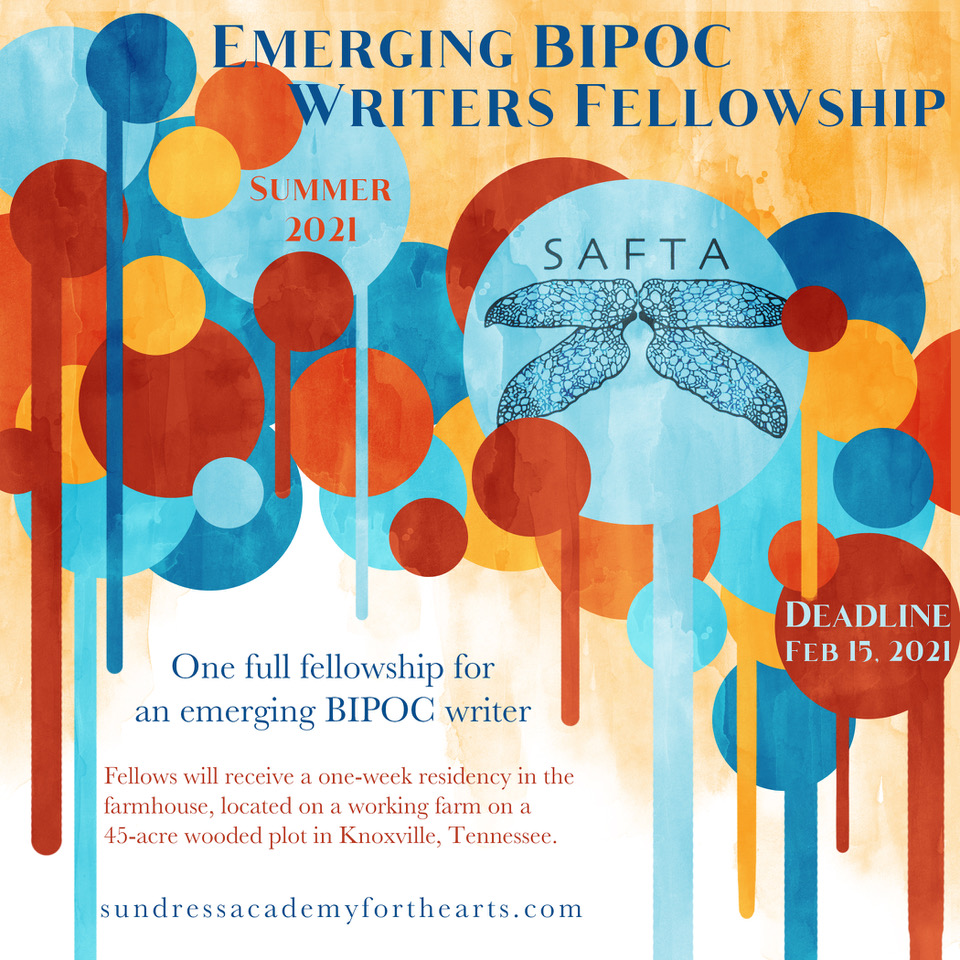
Sundress Academy for the Arts Now Accepting Residency Applications for Summer 2021

The Sundress Academy for the Arts (SAFTA) is now accepting applications for short-term writing residencies in all genres—poetry, fiction, nonfiction, playwriting, screenwriting, journalism, academic writing, and more—for their summer residency period which runs from May 17 to August 22, 2021. These residencies are designed to give artists time and space to complete their creative projects in a quiet and productive environment.

Each farmhouse residency costs $300/week, which includes a room of one’s own, as well as access to our communal kitchen, bathroom, office, and living space, plus wireless internet.

Residencies in the Writers Coop are $150/week and include your own private dry cabin as well as access to the farmhouse amenities. Because of the low cost, we are rarely able to offer scholarships for Writers Coop residents.

Residents will stay at the SAFTA farmhouse, located on a working farm on a 45-acre wooded plot in a Tennessee “holler” perfect for hiking, camping, and nature walks. The farmhouse is also just a half-hour from downtown Knoxville, an exciting and creative city that is home to a thriving artistic community. SAFTA is ideal for writers looking for a rural retreat with urban amenities.

SAFTA’s residencies, which also include free access to workshops, readings, and events, offer a unique and engaging experience. Residents can participate in local writing workshops, lead their own workshops, and even have the opportunity to learn life skills like gardening and animal care.

For the 2021 summer residency period, SAFTA will be offering the following fellowships only:

  • Black & Indigenous Writers Fellowships: one full and one partial fellowship for Black and/or Indigenous identifying writers
  • Emerging BIPOC Writers Fellowship: one full fellowship for an emerging BIPOC identifying writer

Please note in your application if you are applying for one of these fellowships.

As part of our commitment to anti-racist work, we are now also using a reparations payment model for our farmhouse residencies which consists of the following:

  1. 3 reparations weeks of equally divided payments for Black and/or Indigenous identifying writers at $150/week
  2. 3 discounted weeks of equally divided payments for BIPOC writers at $250/week
  3. 6 equitable weeks of equally divided payments at $300/week

Black and/or Indigenous identifying writers are also invited to apply for a $350 support grant to help cover the costs of food, travel, childcare, and/or any other needs while they are at the residency. We are currently able to offer two of these grants per residency period (spring/summer/fall). If you would like to donate to expand this funding, you may do so here.

The application deadline for the summer residency period is February 15, 2021. Find out more about the application process at www.sundressacademyforthearts.com.

The application fee is waived for all BIPOC identifying writers. For all fellowship applications, the application fee will also be waived for those who demonstrate financial need; please state this in your application under the financial need section. Limited partial scholarships are also available to any applicant with financial need.

Apply today!

Meet our New Intern: Mary B. Sellers

My sweet-tooth for stories and books is entirely my mother’s doing. From the beginning, she ingrained in me the importance of make-believe; the easy, seductive escapism that goes along with a good book. My childhood library was a vast, impressive thing, which my mother also had a hand in making. On my last visit home, I climbed the winding staircase with the odd bend in its middle up to my old bedroom, where I remembered seeing these childhood books last.

I found them neatly stacked—tall and glossy with the hardcover’s requisite fierce laminate shine—on the old twin-sized trundle bed, their pages stuck shut by time and that species-specific dust bunny native only to suburbia.

I tried to be gentle as I sifted through them, rereading some entirely like Audrey Wood’s King Bidgood’s in the Bathtub, which I remember being one of my particular favorites as it was about a king who did just that—held court in his bathtub. Bubbles pop and soak marble floors while jesters make silly grimace-grins: I imagine it must have inspired from my then-toddler-self, a deep awe for the interdimensional aspects of the average-looking bathtub. Others, too, like Grandfather Twilight, about a kind old man who puts the moon in the sky after his evening walk each night; The Rainbabies, too—a classically structured folktale dealing in magic rain, the moon, and wishes coming true—depicted in careful sketching and pastel watercolors, soft and cool-toned.

The first time I “seriously” wrote anything was the summer my mother had her first manic episode (bipolar psychosis), and her first stint at the psych ward. It was the summer before eighth grade. It was also the last summer that my mother ever wrote anything seriously again. Specifically, I mean the book she’d started writing a few weeks after quitting her job as a speechwriter. I’d been beyond excited at the prospect of having a real-life author for a mother. I fantasized about this scenario, made sure to brag to my friends at school about it. My mother, the writer.

Because it was true, how it’d always been: my mother was the writer in the family; the reader, the dreamy girl who spent her teenage weekends with bent, seventies’ paperbacks. Looking back on photos of my mother as a teenager and young twenty-something, I see a pretty girl with olive skin and dark fly-away hair who seems to always be laughing with a book in hand. It’s the true sort of happiness that’s hard to fake. Bliss, joy, a silliness I’ve never seen on her. There’s light in those black eyes of hers, and the skin around her happy mouth is stretched tight and young with delight. I wish I’d known her then, could talk to that version of her now that I’m grown.

Originally from Jackson, MS, I now live and work in Seattle, WA, with my Cavalier King Charles Spaniel who I (nerdily) christened Daisy Buchanan after the leading lady in The Great Gatsby. (I’ve always loved her ‘beautiful little fool’ quote towards the beginning of the novel.) I currently am a part time children’s creative writing instructor for Pacifica Writers’ Workshop, a Split Lip Press nonfiction reader, and a freelance writer. Side hustles include: web development, selling on Poshmark, dog sitting, and trying to write a novel.

I graduated with a BA in English Literature from the University of Mississippi in 2013 and an MFA in Creative Writing with a Fiction emphasis from Louisiana State University in 2018, where I served as graduate prose editorial assistant for The Southern Review, social media editor for New Delta Review, and cohost for the Underpass Readers & Writers series. In 2018, my graduate thesis—a hybrid novel, Rapunzel Has Insomnia—was a finalist for the University of New Orleans Publishing Laboratory Prize.

My fiction, essays, articles, and reviews appear in Psychopomp Magazine, Flash Fiction Magazine, Grimoire, Third Point Press, Sidereal Magazine, Crab Fat Magazine, Literary Orphans, Queen Mob’s Teahouse, Dream Pop Press, The New Southern Fugitives, Click Magazine, Mississippi Magazine, Young Professionals of Seattle, and New Delta Review, among others.

For the past decade, I’ve attempted to keep at least one toe in the book publishing and literary worlds, which is why I have such eclectic work experiences: summer editorial assistantships for lifestyle magazines, an NYC-based literary agent, and a couple of online magazines, and Thacker Mountain Radio, a weekly radio show. Fresh out of college I even worked for Fat Possum Records, a record label located in my college town of Oxford, MS, while studying for the GRE and applying to 12 MFA programs. After being rejected from all 12 schools and subsequent identity crisis, I spent the next year working remotely as associate publisher for the small indie press Blooming Twig Books and freelance writing. They would later go on to be kind enough to publish my first collection of short stories, Shoulder Bones, in 2014.

During my time in graduate school, I had the opportunity to live and workshop my writing abroad for one month in Prague, thanks to the 2016 Prague Summer Writers Program. Also, in 2017, I participated in the Sewanee Summer Writers Residency. Recently, my short story “The Other Mother” was second runner up in Psychopomp Magazine’s 2019 Short Fiction Contest. My personal essay “Inheritance: A Timeline” was nominated for a 2019 Best of the Net award, and my short story “Alice and the Moon” was nominated for a Pushcart Prize.


Mary B. Sellers lives and works in Seattle, WA, and is at work on her second book, a novel of autofiction. She holds a B.A. in English Literature from the University of Mississippi and an M.F.A. in Creative Writing from Louisiana State University. Most recently her writing has appeared in Psychopomp Magazine, Flash Fiction Magazine, Grimoire, Third Point Press, Sidereal Magazine, and Young Professionals of Seattle.

Sundress Releases Blood Stripes by Aaron Dylan Graham

sundress logo

Sundress Releases Blood Stripes by Aaron Dylan Graham

Blood Stripes CoverSundress Publications announces the release of Blood Stripes, the debut full-length poetry collection from Aaron Graham. Blood Stripes is a haunting, unprecedented example of contemporary trench poetry.

Set in Iraq during the mid-2000’s, Blood Stripes delves into the complexity and trauma of modern conflict. Through the eyes of a marine, these poems illustrate the intimacy of violence with candid brutality. Beyond the innate bonds formed between comrades, a strange communion develops across enemy lines as those charged with destroying each other do so with a kind of tenderness. Through inflicting atrocities, the speaker forges human connection—connections that cannot be replicated outside the battle.

In these poems, violence is a new creature, one that is concurrently loathsome yet addictive and sensual. Amid the shrapnel and the sand wet with bits of lung, this violence is perhaps born of a love of the struggle. While the marine unwittingly volunteers to be a harbinger of death, it is a role of eternal confinement. These poems reveal the moral ambiguity of the causal sequence of war, as at home the marine is haunted by trauma while still craving it. The side effects of conflict cannot be outlived—despite quickclot being applied to a ruptured artery—some bleeding cannot be stopped.

“In Aaron Graham’s searing debut, poetry emerges as a full-blooded form of counterintelligence. WWI novelist Henri Barbusse called soldiers ‘forgetting machines,’ built to suppress and deny the trauma they experience in themselves and produce in others. Marine veteran of wars in Iraq and Afghanistan, Graham trains every fiber of his uncompromising attention on the sacred and obscene task of remembering what, strictly speaking, cannot be known. PTSD tendrils between every line—’all my nows murder all my / vowels – // all my nows justify / the violence’—as the poet reaches through and beyond realism. Deploying his formidable intelligence as linguist, translator, and philosopher, Graham isolates ‘the moment before an explosion / breaks, the word shrapnel becomes / the beginning of the reality shrapnel.’ Under the poet’s targeted pressure, ‘the whole structure of propriety delaminates,’ including the fiction of the reader’s innocence. The poems in this collection sear me, stain me, push me to the point of slamming the book shut until I’m ready to pry the pages open again, to see in Graham’s language what I cannot see.”
-Cassandra Cleghorn

Aaron Graham hails from Glenrock, Wyoming, population 1159, which boasts seven Aaron Grahambars, six churches, a single 4-way stop sign, and no stoplights. He served as the editor-in-chief for the Squaw Valley Review, is an alumnus of Squaw Valley Writers Workshop and The Ashbury Home School, and the Cambridge Writer’s Workshop. Aaron is currently attending UCNG’s MFA program in poetry and finishing his Ph.D. at Emory University. He currently resides in Greensboro, NC with this wife, Alana, and their three daughters, Alexi, Nora, and Naomi.

Pre-order Blood Stripes here.