21 Great Gifts for the Writer in Your Life

When gadgets and gizmos abound, it can be a bit tricky to find a good gift for someone who is always writing (or trying to). This year, get them something that’ll really let them make their mark at any price!

1.Cosmos Waterproof/All Weather Notebook– $9

Picture1

These notebooks are awesome for someone always on-the-go use because of their size, and they are waterproof! No coffee or tea spills to destroy precious ideas. Pack of 5 available here.

2. Magnetic Poetry Kit–$12

2

Even if they already have these sprawled all over their refrigerator, magnetic poetry kits are fun for brainstorming (and holding up tiny pieces of paper). This pack and others from magneticpoetry.com are available in a variety of different sets like Cat Lovers, Charles Dickens, and Cocktail Hour. Or, take a look at this shop on Etsy for other faves like Game of Thrones, Monty Python and the Holy Grail, and Gilmore Girls.

3. Pilot Varsity Disposable Fountain Pens– $15

3

Rather than spending an entire paycheck on a fountain pen and some ink, get them a pack of disposable pens. This pack from Pilot comes with 7 bright colors. Available here.

4. Dammit Doll– $16

4

These fun dolls come in different designs and make a great gift for someone to toss around while trying to get stuff onto the page. Each doll is handmade and has a poem stitched onto the belly to inspire some thoughts (or swear words). Get one here.

5. DIY Bookmaking Kit- $15

5

This bookmaking kit is perfect for showcasing short stories, poems, business cards, photographs and more. Each kit comes with instructions, materials to make the book, and some nifty suggestions for how to showcase their work. Find it here on Etsy.

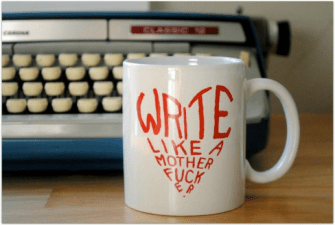
6. Write Like a Motherfucker Coffee Mug–$15

6

Because sometimes they need a reminder that they’re a badass. Available here.

7. Punk Rock Author Coasters Set–$18

7

Jam out to some Sex Pistols while Dickinson, Thoreau, Austen, and Kafka keep side tables safe in style. For each set sold, Out of Print donates a book to a community in need. Grab them here.

8. The 2016 Sundress/SAFTA Calendar–$20

Screen Shot 2015-12-14 at 4.22.16 PM

Get them the 2016 Sundress/SAFTA calendar, this year featuring portraits of gender-swapped work that want to destroy the gender binary! Featuring Chris Petruccelli, Jennie Frost, Rhonda Lott, Grant Howard, Vania Smrkovski, Ben McClendon, Rose Meyers, Katie Hall, Shastina Parahoo, Emily Capettini, Adam Crandall, Emma Walcott, Jeb Herrin, and Luci Brown! Snag one here. 

9. Adagio Tales and Tea Leaves Sampler Set–$19

8

Adagio has plenty of tea samplers for fandoms like Harry Potter, Chronicles of Narnia, even fan fiction. This particular set is for fans of Lord of the Rings. Find it here or browse the entire collection here

10. Paddywax Library Candle Collection–$15/$21

9

No, they don’t smell like the writers themselves, but these soy candles from Paddywax have original mixes like cardamom, absinthe, and sandalwood to give writers a whiff of something inspirational. Available online here.

11. Their Own 2×2 Square in SAFTA’s Poetry Barn–$25

original

Get a 2’x2′ space to have a poem/quote/prose selection of your choice (by yourself or by someone else) printed directly on the barn!

Simply supply us with the piece you’d like to appear, and we will handwrite it for all SAFTA visitors and residents to read and enjoy during our readings, events, and more! Find it here. 

12. Literary Quotes Poster–$24

10

These gorgeous prints by Etsy artist ObviousState are great for the writer who wants something more minimalistic for their home.  Buy them here.

13. “From the Library of” Stamp– $29

11

Help them stake their claim on their library with a custom-made stamp. Find it here.

14. iPad/Tablet Portfolio–$38

12

This portfolio comes with a cute typewriter print, and doubles as both sneaky storage for their tablet or iPad and a notepad to jot down ideas while reading their favorite E-book. Available on Etsy.

15. Secura Automatic Electric Milk Frother and Warmer–$37

13

On a tight writing schedule, they might not be able to pop out to get their favorite latte. Give them the ability to make their favorite drinks at home or in their office.  Get it here.

16. Secura 1.8 Quart Stainless Steel Cordless Electric Water Kettle– $45

14

Alternatively, if they prefer tea, a cordless water kettle is an option. No messy cords, and this kettle has a cool-touch exterior to held avoid burns. Find it here.

17. Library Stamp Sweatshirt–$42

L-1108_Library-Stamp-gray_Womens_LS_1_1024x1024

Remember when, not-so-long-ago, library books were stamped? This fleece sweatshirt from Out of Print will keep any writer cozy and warm while they write. Purchase of this sweatshirt also sends a book to a community in need! Snag one for them (and maybe yourself, too) here.

18. The Poet Tarot and Guidebook from Two Sylvias Press–$48

15

Two Sylvias Press has this awesome set of tarot cards and guidebook with beloved poets on it “to help writers explore nuances of the creative process.” Need we say more? Buy this online here.

19. Subscription to Journal of the Month– $40-$199

JournalStack-00f0e11a47aa6c136696b34ce482b2ad

A subscription to their favorite journal, or even one to Journal-of-the-Month is an amazing gift for anyone. Journal-of-the-Month includes publications like The Missouri Review, Tin House, and more to give them a nice sample from a range of journals. Aside from skipping a trip to the post office, you can also choose a subscription type that suits their needs and your budget. Check out the options available for Journal of the Month subscriptions here.

20. Audible.com Subscription–$15-$250

screen-shot-2015-04-16-at-9-30-29-am

Not everyone has as much time as they would like to sit down and read. For someone always on-the-go, an audible.com subscription is a perfect choice. For $15/month (depending on the type of subscription) they’ll get to choose from hundreds of audio books and stream their book directly onto their phone, tablet, or computer. That way, they can listen during the commute to work, while cooking dinner, or on a business trip! Find out more about audible and its subscription services here.


21. Do something with them not writing-related

Take them to the movies, treat them to a nice dinner or a massage. For most writers, the gift of relaxation is necessary yet hard to find. Knowing that they are getting time to unwind and enjoy other things in life can be one of the greatest gifts to receive.

__

Hunter Parsons is a recent graduate from Kalamazoo College. When she’s not writing, being a plant mom, or advocating for young women’s self esteem, Hunter is baking and glued to Turner Classic Movies. 

“Quaker Meeting: Cambridge/Rangeley, Maine” from Gathered

gathered


Quaker Meeting: Cambridge/Rangeley, Maine

There you are, purchasing
the Sunday paper. Ibuprofen.
Ajax. Pampers. Peanut butter.
Margarine. Clorox. There
you are, baby squalling, holy
voices in the IGA,
in Sarah’s kitchen tasting oatmeal-
raisin bread, yearning
for pies and chocolate frosting. You
will not forget the Wednesday corn
line. You must choose: How
many? and are the kernels
small and sweet?

“Almost died,” he
said, “fever of 106, down to
the hospital.” “Going to rain, trees
need the water, I guess.” “Thanks be
to God, my son got out, the night my store
burned down.” “Geologist dug up this
here rock, said it was from the time
of the Grand Canyon. Used to be this land
was all under water, back then.”
“Learned me the Internet at
the library—looked up my condition
on the Medline, they call it. Ain’t
no reason, just old age, they say, doctors
don’t know, but I’d have gone blind, it said,
if they hadn’t of given me the Cortisone
in time.” “I’ll think on it awhile, let
you know if I can fix it for you.” “The locksmith
out Rt. 4, he was a Baptist preacher,
died last June, you know. The schoolbus driver
he’s out 16 across from where the diner was,
the widow sold him all the molds. Lock
stock and barrel, you could say.” “Those wasps
you got, just spray ‘em with Raid and run
like hell.”

-Marian Kaplan Shapiro

You can purchase a copy of Gathered: Contemporary Quaker Poets, edited by Nick McRae, from the Sundress store for only $16!

Cleared for Lift-Off: The Flight Patterns of Pretty Owl Poetry

pop image

Since the Spring of 2014, the online literary journal known as Pretty Owl Poetry has brought potent and poignant writing to its growing readership. This is all due to its dedicated, tri-force-powered team: poetry editors Kelly Andrews and Gordon Buchan, as well as B. Rose Huber, the journal’s flash fiction editor.

In its ongoing quest to honor all things on the rise within the literary landscape, the Wardrobe sought out the story behind Pretty Owl’s evolution from none other than the POP editors themselves.

Jacob Cross: How did Pretty Owl come together in the months leading up to the launch issue in the spring of 2014? What was the initial meeting of the minds like for each of you?

Kelly Andrews: Prior to inception, I was working on B.E. Quarterly, a Pittsburgh-based literary zine, with a few other people in the community and loved the editorial process. I was also just starting to read poetry for Hot Metal Bridge, University of Pittsburgh’s MFA online lit mag. I really wanted to learn as much as I could about publishing and so the next logical step was to start a journal from the ground up. I reached out to Gordon and Rose—I had participated in workshops and online critiques with both of them and truly admired their abilities as both writers and editors. Very quickly we decided to make Pretty Owl a collaborative effort—with no designated Editor in Chief or Managing Editor. Our first meeting was a Google Hangout, and we were overflowing with ideas for the journal. At one point, we started working on collaborative writing that we were planning to share on the website, but eventually we shifted our focus to design, aesthetic, and outreach so that we could publish the best poetry and flash on a beautiful platform. The launch of the first issue was an incredible feeling—to have so many people trust us with their work was inspiring, and I still feel that way when we publish a new issue.

B. Rose Huber: During a late winter evening, I received a text from Kelly. It said, “I think we should start a literary journal. We should call it Pretty Owl Poetry.” At the time, I wasn’t sure how difficult this would be to do, but I knew well enough to say, “Yes.” I’d long admired Kelly’s work as a writer and editor and knew Gordon was a cool, artistic guy. The collaboration seemed like a good fit. As Kelly wrote, our first meeting was a Google Hangout with plenty of ideas to get us started. Gordon made me laugh; Kelly kept us on task. Our cats mewed in the background. It was pretty much perfect.

Gordon Buchan: Around that time, Kelly and I had been, not really editing, more like co-mentoring each other’s poetry through email, most notably her chapbook, Mule Skinner. I had been wanting to work on something that wasn’t a poem, was more like artwork, so when Kelly told me about Pretty Owl, I started sketching up blueprints right away. Rose, someone I had met one foggy minded night at a college party — talking, if I remember correctly, about poems folded up inside of cereal boxes — was something of a 5’1” tall tale; I wasn’t really sure if she existed, but everyone I knew knew her, and I had this nascent idea that maybe I knew her, too?

JC: Who designed the logo? It almost resembles a Rorschach test blot. Also, what was the basis for the look of the online journal’s website?

GB: Rorschach test blot? Awesome. The owl logo is based off of one dollar bill clippings. I had cut up a couple dollar bills and repasted them back together in a vaguely strigine shape. On the other hand, for the website design, I tried to work with negative afterimages or “ghosts.” If I’m not paraphrasing too much. According to J.H. Brown’s 19th century pamphlet, Spectropia (or Surprising Spectral Illusions Showing Ghosts Everywhere and of any Colour) if you look at a picture too long, it will cause an afterimage to linger in your vision (especially if you look at a blank page afterwards). I don’t know if I successfully created an afterimage-inducing-website design, but I thought it complimented Rose’s homepage banner well.

JC: Has the aesthetic selection of the journal’s poems and flash fiction evolved in any surprising ways? I love the poetic and concrete metaphors Pretty Owl uses in its submissions section, making the call for “lockets filled with tiny twig hairs.”

KA: Our call for submissions was a collaborative writing effort, and while it does offer a glimpse of what we are looking to publish, it isn’t all-inclusive to what we have actually published so far. What I find most surprising is how open Gordon and I are to different voices and styles of poetry. While there tends to be a bit of overlap in what we want to publish, each of us has had to convince the other to include pieces that fall outside of our intended aesthetic. But this is one of the most exciting parts of publishing for me—finding beauty in voices that are completely unlike my own and sharing that with the world. I don’t think the journal would be quite the eclectic mix of poetry it has become if it wasn’t for that openness that exists in our discussions.

BRH: Our flash fiction has evolved in sort of a backward direction. When you think of the term “flash fiction,” you probably imagine a traditional story told in few sentences like microfiction. But that wasn’t the type of flash fiction we were publishing in the beginning. Instead, I was drawn to the poetic, the lyrical. As a writer, I myself have teetered between prose and poetry, not really identifying with either concretely. And that’s the type of prose we’ve published. But in recent months, I’ve been trying to look more carefully at traditional flash fiction. Telling a short story in a small space is an art, and it’s something Pretty Owl Poetry wants to publish going forward.

Cover of the inaugural Spring 2014 Issue of Pretty Owl Poetry.

JC: How do you keep each issue fresh and distinctive? You receive new submissions and new names, but are there prerequisite, subtle themes that each of you attempt to apply to every new installment? In other words, how do you make each issue stand on its own two feet?

KA: One thing we are striving for in each issue is inclusiveness in terms of different voices. While we want to connect and relate to the pieces we publish, we also want to see the world fresh with each poem or piece of flash we showcase. I’m thinking about Cameron Barnett’s poem “Crepe Sole Shoes” in Issue 2 that recalls the death of Emmit Till in 1955 and the lines, “Today you could//be my grandfather.” That poem gives me chills every time I read it—how much has the world changed since that lynching and murder? How much is the same? The narrative and self-reflection in Barnett’s poem is incredibly relevant given the current headlines of police brutality and discrimination against people of color. The next lines in that poem are “I want to put you//back together, but//how can I rebuild you?” I read these as not just speaking to Emmitt Till, but to all of America. For me, each issue is idiosyncratic because we include phenomenal poems like that one. In general, I think we are less concerned about themes (though they usually manifest once we have accepted a handful of pieces) and more concerned with sharing contemporary poetry and flash that moves us.

BRH: The theme seems to emerge after we’ve chosen what to publish.  I choose the fiction exclusively with no input from Kelly and Gordon. I don’t see the poetry they’re choosing, either. When I’m designing the issue and reading all of the pieces together, that’s when the theme begins to emerge. Sometimes it’s uncanny how this happens given our independent selection process. But it’s not terribly surprising because I think, as writers and editors, we are all drawn to similar styles. Since we’ve started including art in the journal, I’ve found the imagery really ties it all together nicely.

GB: If an issue has a theme, it’s probably accidental. Kelly is very interested in diversity, and I am also interested in diversity, but Kelly is really, really interested in diversity. What I’m really, really interested in is keepings things chaotic and destabilizing my comfort zone. Luckily, these characteristics go hand-in-hand.

JC: What are some of your favorite literary journals, publications that each of you draw inspiration from as staff members of Pretty Owl?

KA: I think Gulf Coast, Caketrain, and PANK have beautiful print designs and the work they publish always blows me away. TENDE RLOIN showcases one poet and includes video or sound along with written interviews, and I love getting that big picture of the writer behind the words. Pretty Owl has adopted similar platforms with our online reading series that includes a short interview with the writer and also with our Spotlight Series in Pittsburgh.

I also adore the online journals Big Lucks, Hobart, Octopus, Birdfeast, Phantom Limb, Ghost Proposal, Jellyfish, and 12th House, among others. Each website has its own unique design, and they include such tremendously talented writers. If I could afford unlimited subscriptions to print journals, then I’d be buying copies of The Atlas Review and Gigantic Sequins as well; but for now, I’m just reading the poems that are available online and swooning.

BRH: In the early stages of Pretty Owl Poetry, I leaned a lot on Andrew Keating, editor at Cobalt Review. We went to graduate school together, and I’ve always admired his know-how with regards to online lit mags. We talked on the phone for quite a while about how Pretty Owl should look and feel. Those conversations really shaped our own journal, and now I have a much deeper appreciation for Cobalt Review and what Andrew is trying to do.

I also love, in no particular order: Hobart, Oblong, Aperion Review, Booth Journal, Metazen, decomP magazine and Tupelo Quarterly. I love staring at the beauty that is Ninth Letter. And when I need a good traditional short story, I get my hands on a copy of Glimmer Train.

GB: I think the first journal I ever read was Jellyfish, and that really opened my eyes to a world beyond the New Yorker. Today, I read a good amount of A capella Zoo, Sugar House Review, INK BRICK, and McSweeney’s. I think that Gregor Holtz, the guy who designs Octopus, is a huge inspiration, mostly because the innovative and beautiful things he creates compel me not to be a lazy asshole about my art.

JC: Have you ever considered doing a flash anthology or a sole flash edition? Was there any question when the journal was first formed as to whether or not flash would be included, or was it an instantaneous, unanimous “must-have?”

BRH: Although our name reflects poetry, we felt that flash fiction was a must-have for the journal. But, like I said, if you read through our issues, you’ll see that the work we publish is much more poetic than conventional flash fiction. We are drawn to lyric and sound in both poetry and prose. At the same time, we welcome more traditional flash fiction and often publish these forms in the journal. It’s important for us to include both.

KA: To add to Rose’s response, the poetry we publish is sometimes prose poetry that could easily be nestled under the “flash” title. We published a narrative poem by Jennifer MacBain-Stephens in Issue 5 titled “Growths” that chronicles outbreaks of “birdhouse development syndrome”—people afflicted with birdhouses inexplicably growing from their heads. The poem isn’t necessarily lyrical, but the imagery is so surprising with lines like: “Some of the burliest men I knew had a small raspberry colored birdhouse situated above one of their ears” or “Susan stared at the therapist’s frontal lobe olive birdhouse and felt biasness creep in.” I felt immersed in this strange world that MacBain-Stephens had created. Whether it’s technically prose poetry or flash fiction wasn’t a concern for us, and I think we’re actually more interested in pieces that embody a fluidity of different forms.

As for doing a flash anthology or an entirely flash edition, we’ve never considered this, but it’s a truly great idea! It definitely gives us something to discuss for our next meeting.

Cover of the Summer 2015 issue of Pretty Owl Poetry.

JC: I love the way Pretty Owl has formed an interactive alumni of contributors so-to-speak in so little time. With the featured artist interviews, video interviews, and the Spotlight Series, the journal doesn’t just pair bios and names with their poems. Pretty Owl really delves into personality and process by establishing such a community, both online and in person. So thank you for maintaining this commitment to bringing writers together.

Here’s the question: how do you plan to continue to build and interact with this community in the future?

KA: Thank you for those kind words! We’re currently tossing around ideas of how we can improve the online interviews and readings. One thing we might do moving forward is feature two writers at the same time with the hopes of getting a discussion going between all of us. We want the online interviews to be a little informal and fun for everyone involved. I don’t think we’ve done one yet that didn’t have some sort of technology hiccup, and we just try to go with the flow when that happens.

As for our Spotlight Series, I’ve started to bring in one “wildcard reader” from the community who isn’t (yet!) published in the journal. Pittsburgh has an incredibly vibrant poetry community and there’s so many talented writers that I would love to see in our issues and reading for us. We’ve also hosted out-of-town readers like Zachary Schomburg, Joshua Marie Wilkinson (twice!), John Beer, Mathias Svalina, and Noah Eli Gordon. With those readings, we had a great turnout, and I hope to put on more readings with people who are traveling through the area.

BRH: You may have noticed that our journal doesn’t really have a “home base,” and I think that’s a strength. Kelly’s in Pittsburgh; Gordon’s in Philadelphia, and I’m in Princeton, N.J. In our early discussions, we decided to not really label our journal with a place. That makes sense, given that our journal is on the internet, accessible to everyone.

That said, in the future, I hope to expand our Spotlight Series to the East. Kelly has done a fantastic job of rallying writers in Pittsburgh, and I’m certain we could do that here, too. Princeton is sandwiched between two major cities — New York and Philly — and I want to start taking advantage of that. Plus it means I would get to hang out with Gordon more, an opportunity I wouldn’t turn down.

GB: In the future, we want to feature two readings in the same interview, open a conversation between the members of this community. My goal is to be less of an editor or an interviewer and more like a fosterer of chaos. One day, I want that written on a plack: Gordon, Fosterer of Chaos.

JC: What is your journal’s greatest strength? What makes each of you beam with pride?

BRH: Our ability to work as collaborators. We don’t have a set editor-in-chief, making all decisions as a unit. This results in a better final product. At times, it can feel frustrating. That blood, sweat and tears thing? Totally happens almost every issue. But I find — and I think Kelly and Gordon would agree – that it’s during those passionate debates that our vision really shines. Some of our best decisions have been realized after hours of talking and arguing and sending a thousand emails to each other. In many ways, this is the way we established our mission. And I think, for the betterment of the journal, it’s made us all better editors and thinkers. I’m grateful to work with two writers with very different viewpoints; it’s forced me to be more thoughtful, engaged and passionate.

I also think we’re doing something different with our multimedia approach. We’ve really tried to embrace the electronic part of our literary journal. That’s why we’ve introduced Google Hangouts and other online mediums. Since the journal was born, we’ve wanted those voices to extend beyond the poem or story. There is a person behind those words worth showcasing, too.

KA: I’m always amazed by how each of us has certain abilities that have contributed to making Pretty Owl what it is today. Rose designed our layout and physically puts each issue together, along with maintaining our social media outlets. Gordon handles all of our artistic endeavors—from the design of the logos and our website to the cover art. I proofread each issue multiple times before it goes live and handle a lot of the outreach and networking along with the Spotlight Series. I couldn’t imagine what Pretty Owl would look like without our fierce talents combined, and I don’t want to! And we’re all incredibly busy people with multiple projects happening in our lives so the fact that we can work together to make each issue something we can be proud of and filled with writers we admire brings me tremendous joy.

GB: Kelly, Rose, and I are all, for better or worse, very passionate people. We are passionate about our tastes in art, and we are passionate about our passions. Most of Pretty Owl’s issues begin with a healthy dose of dissonance between the editors, and, progressively, the three of us shape it into something more unified.

1Kelly Andrews is an assistant managing editor at an economic journal and working on her MFA in poetry at the University of Pittsburgh. Her chapbook Mule Skinner is available from Dancing Girl Press (2014). Her poetry has appeared or is forthcoming in PANK, Up the Staircase Quarterly, Weave Magazine, and elsewhere. You can read more about her past and future publications and literary endeavors at her website.

Gordon-profile-pic1-sundressGordon Buchan resides in Philadelphia where he navigates books of etymology and writes about his findings. Recently, he was published in BE Literary and Sugar House Review. Check out his blog, Invisible Woods.

huberB. Rose Huber spends her days writing about research at Princeton University. She received her M.F.A. in Creative Writing and Publishing Arts from the University of Baltimore. Her work has appeared or is forthcoming in Cobalt, Pear Noir!, The New Yinzer, the Light Ekphrastic, BE Literary, and Weave, among others. She also binds books for those who ask. Read more here.


__
Jacob L. Cross lives in the southwest suburbs of Chicago. He studied creative writing and publishing at the University of Illinois Springfield, where he served as editor of The Popcorn Farm Literary Journal. His work has been featured in Still: The Journal, Stirring, and elsewhere. More recently, his poems were featured in Clash by Night, a poetry anthology inspired by the punk staple, London Calling. He enjoys hiking with his wife, traversing Zelda dungeons, spoiling his dogs, and consuming copious amounts of half-priced sushi.

Summer Flash Showdown: Get Your Jersey On!

Donkey Basketball. Photo by Lauren Leone-Cross.
Photo by Lauren Leone-Cross.

Welcome to the second round of the Summer Flash Showdown, a series by none other than Sundress Publications! While our audience is likely chomping at the bit to hear our two winners from last week’s challenge, the running is too close. We’ll need some more time to make the many difficult decisions to come. For the remainder of this ongoing saga of flash fiction, tune in to The Wardrobe every Wednesday to find out who came out on top.

As you may know, all finalists will have the opportunity to write for the Grand Prize Round, in which the supreme victor could walk away with endless boasting privileges, publication of their story on The Wardrobe, and FIVE FREE SUNDRESS TITLES OF YOUR CHOOSING!!!

Also, round two’s winner will receive an Outspoken Tank (as well as publication on the blog.) The runner-up will also receive publication right here on The Wardrobe.

Without further adieu, this week’s honored judge is…

APRIL MICHELLE BRATTEN!!! 

April Michelle Bratten

April Michelle Bratten was born in Marrero, Louisiana. The daughter of an USAF active duty father, April grew up traveling and living across the United States and abroad. Her travels have greatly influenced her writing over the years, particularly her three year residency at Incirlik Air Force Base, Turkey. She currently lives in Minot, North Dakota, where she received her BA in English from Minot State University. You can find her poetry in decomP, Southeast Review, THRUSH Poetry Journal, and others. April has been the editor of Up the Staircase Quarterly since 2008 and she is also a contributing editor at Words Dance Publishing, where she writes the article Three to Read. Three to Read highlights recent poetry and poets in online journals around the web. Aside from reading, editing, and writing, April loves beer, art, libraries, sports, camping, and bunny rabbits. You can find her on twitter: @aprilmbratten

THE CHALLENGE: Get Your Jersey On!

11096431_10155395570870444_4812894696832677135_n

All submitted stories in this round must take place at a sporting event, whether it’s a grizzly tee ball match or a Stanley Cup Playoff. The conflict can hover in the stands or be slugged out on the field, but the setting must be at and during the game.

It must also be told from a second person p.o.v. We want your use of this perspective to immerse readers in the action with a unique abruptness. Command your readers to feel the sand on their soles mid-volley ball match or harness the crack of a bat in their palms.

For example, you might write as your first line, “Rise to pass 100 people for more $9 nachos for your gurgling belly. You trip and spill beer into the perm of the woman in front of you who has been on her smartphone for half the game.”

And no Mighty Ducks, tearful sentiments on the “love of the game.” Be a good sport and serve us lit that taps into deeper realities than a team winning a preconceived stand-off. Make the odds higher than the scoreboard.

Word limit is 450 for this round. Send all stories to sundressflashsummer@gmail.com. RTF or DOCX file format preferred.  Stories must be submitted by Friday, July 24th at midnight EST! [EDIT: DEADLINE EXTENDED TO MONDAY, JULY 27TH AT MIDNIGHT]

We hope you knock this one out of…we’ll spare you any more sports puns. Go get em!

The Confluence of Rhythms Begins: Mapping the Sounds of Your Poems

11078207_486665424813960_3616362013540484854_o

Saturday, June 27 1:00pm – 4:00pm
Sundress Academy for the Arts
195 Tobby Hollow Ln,
Knoxville, Tennessee 37931

“Soon, soon the flesh / The grave cave ate will be / At home on me.”

Sylvia Plath’s images in “Lady Lazarus” are haunting, but they are propelled into nightmare through her expert sense of sound and rhythm. Think about the last poem that pulled you beneath its rhythmic tide. Did it chime with beauty like Elizabeth Bishop’s lines in “At the Fishhouses”:

“It is like what we imagine knowledge to be: / dark, salt, clear, moving, utterly free”?

If you are wondering how to further develop the natural tempos and patterns in your poems to enhance your poems’ images and narrative, this innovative music-poetics workshop is for you.

To combat the old struggles of writing and counting metrical lines, you will learn fresh methods like sound mapping, beat-tuning, and creating nonce forms to follow the sound of your poems to their crescendos. These methods will boost sound play in both free verse and metrical poems.

If you have always wanted to incorporate slant rhyme or alliteration but it seems wooden, this workshop is for you. In this 3 hour course, we will explore contemporary poets’ rhythmic techniques and you will learn to create evolving and enlivening music within your poems. Bring a couple of drafts-in-progress (at any stage) to revise. We will also write at least one new sound-driven piece in workshop. In addition to personalized feedback from the instructor and a helpful list of further readings, there will be a discussion of where and how to place sensual, sound-driven poetry for publication.

Purchase your tickets here!

10959347_832705225537_8697748533403976874_nSandy Marchetti is the author of Confluence, a debut full-length poetry collection forthcoming from Sundress Publications, and holds an MFA in Creative Writing-Poetry from George Mason University. Eating Dog Press also published an illustrated edition of her essays and poetry, A Detail in the Landscape, and her first volume, The Canopy, won Midwest Writing Center’s Mississippi Valley Chapbook Contest. Her work appears in The Journal, Subtropics, The Hollins Critic, Sugar House Review, Mid-American Review, Thrush Poetry Journal, Green Mountains Review, South Dakota Review, Phoebe, and elsewhere. She currently works as a writing teacher and freelance creative manuscript editor in her hometown of Chicago.

Join the Event on Facebook: https://www.facebook.com/events/1424376254548595/
Follow Sundress on Twitter: https://twitter.com/SundressPub
Subscribe to the Sundress blog: https://sundressblog.com/

SAFTA Reading Series Presents Darren Jackson and Andra Watkins

June-Reading-Series-FB-Cover (1)

June 21, 2015 at 3:00PM

Birdhouse Knoxville

800 N 4th Ave, Knoxville, Tennessee 37917

Knoxville, TN– Sundress Academy for the Arts is proud to present the June edition of the award-winning SAFTA Reading Series featuring visiting writers Darren Jackson and Andra Watkins!

darren jackson_edited (1)

Darren Jackson’s recent poems have appeared in The Pinch, The Laurel Review, The Offending Adam, Bluestem, and other journals. He has also translated Life in the Folds by Henri Michaux (Wakefield P, forthcoming Fall 2016); “The White Globe,” an essay by Bertrand Westphal, included in the The Planetary Turn: Art, Dialogue, and Geoaesthetics in the 21st-Century (Northwestern UP, 2015); and, with Marilyn Kallet and J. Bradford Anderson, Chantal Bizzini’s Disenchanted City (Black Widow Press, 2015). He was nominated for a Pushcart for fiction in 2015 and holds a Ph.D. in English from the University of Tennessee.

alw-headshot (1)

Andra Watkins is the author of the memoir Not Without My Father: One Woman’s 444-Mile Walk of the Natchez Trace, nominated for the 2015 National Book Award for Nonfiction. Her other works include her debut novel To Live Forever: An Afterlife Journey of Meriwether Lewis and the photography collection Natchez Trace: Tracks in Time.

The SAFTA Reading Series is free and open to the public! We look forward to seeing you there!

Growing Organically: An Interview with Scott Fynboe, Creator of SAFTAcast

fynboe

In honor of the one year anniversary of SAFTAcast, I had the pleasure of chatting with Scott Fynboe, creator of the series.

Jane Huffman: Can you tell me the creation story of SAFTAcast? What was your role in it?

Scott Fynboe: Okay, so, December 2013: Sundress VP and SAFTA Literary Arts director T.A. Noonan and I were discussing a then recent episode of The Nerdist podcast. At the time, Sundress was looking to expand into new, creative areas, and I was looking to get more involved with the organization, so T.A. tossed out the idea of doing a podcast of some sort.

We talked it over, drew up a proposal, pitched it to Erin Elizabeth Smith over the phone, and within minutes, Erin greenlit the project.

The show was pitched as something like “a podcast that goes back to the original ‘talk show’ style, like Jack Parr or Dick Cavett, with people just talking about things.” In other words, a writing & literature podcast that would feel like a getting-coffee-at-a-diner conversation.

Erin loved the idea and gave me complete creative control over the show – title, logo, theme song, guest choice, etc. I mention that because one thing I really enjoy about working with SAFTA is that they let creators do what they do, and act more as advisors than architects. That freedom, then, allows a project – a show like this – to grow organically. It’s an amazing level of trust that they put into creators and I don’t take that trust lightly; it means a lot.

JH: How have the goals and incentives of the program changed over the past year?

SF: Some things have changed, certainly. But most of them have been within the show – redoing the way I open each episode, the addition of “The Burning Question that is on Everyone’s Mind,” that sort of thing.

But as for overall goals and incentives, I can’t say that much has changed. When the show was greenlit, T.A. and I wrote up a four-point “mission statement” for it:

  1. To be unique in the creative writing podcast market by producing a show that is not only informative, but entertaining.
  2. To give authors, editors and artists an outlet to not simply read and/or discuss their work, but to explore the topics that fascinate them and which display their personality.
  3. To foster Sundress Publications’ relationships with other presses, authors and artists.
  4. To continue Sundress Publications’ tradition of exploring diverse creative outlets.

I still adhere to those aims by keeping them in mind each time I record something. (Though, now that I think about it, the fourth one feels a little “out of date.” I think that was written because the show was going to be Sundress’ first audio-only project. It might need a little rewording.)

gmmqh2j6
JH: What is your favorite part of interviewing authors about their lives outside of their writing.

SF: Everyone – author and not – has stories about their individual histories and experiences. Yet there are also common threads that connect people. There’s an amazing balance of the unique and the universal experience in a conversation, and I love hearing someone’s stories while uncovering those connections.

For example, when Leslie LaChance was on the show, we got to talking about E.T. the Extra-Terrestrial. We both know the film and we both have a dislike of it – but for different reasons.

As I recall, Leslie said she was working in retail when it came out, and customers were obsessed with the merchandise. Meanwhile, at that same moment in time, just a couple hours drive away, I was a little kid, having the merchandise forced on me.

And neither of us knew the other person existed until decades later.

I don’t know about you, but that’s so cool to me. Consider just how many separate moves, maneuvers, interactions, networks, relationships, jobs, hobbies, technologies, etc. had to be in place – just for one episode of The SAFTAcast to take place; for two people to connect over a mutual disdain for a Spielberg film.

Okay, I risk going on a tangent into quantum physics type territory here. So I’ll say that, ultimately, what I really dig about doing the show is just that I get to chat with awesome people; learn about their stories. Then let audiences discover how awesome the guests are, independent of their art. It’s a pretty sweet gig.

JH: Maybe this is an impossible question, but do you have a favorite episode or episodes?

SF: I “plead the fifth” on this question. However, I will say that I have a couple of favorite promos.

For technical reasons, I love the “Sundress Academy 2015 Holiday Message.” That was recorded and cut in less than two hours, and came out amazing.

Overall, though, the one that still gets me is for Mary Stone’s episode, “SAFTAcast en SAP!” Intentionally bad Spanish, goofy, non-sequitur sound effects, inaccurate music cues – I still giggle every time I listen to it.


JH: What is a question you often ask writers that you’ve never had the chance to answer yourself?

SF: “What was it like growing up in ________________?”

I could have a field day with that question.

JH: Do you have any other current projects you’re working on? What’s next for you?

SF: After being out of the scene for a few years, this April I got the itch to start writing and publishing again. So I aim to do a bit of that over the summer.

I’m also developing a second, Sundress-related podcast. But I won’t say anything about that right now.

JH: What’s next for SAFTAcast?

SF: Keep going and get bigger.

Okay, that was a little pithy. We [Sundress and me] are gonna keep doing the show, obviously. But we’ve got a few special things in the works.

We’re toying with making some merchandise of the show available to the public this summer, and we’d really like to do one or two listener/fan “contests” before the year is out (once we figure out the logistics of them). Speaking of the end of the year, based on the response from last December, we’re looking to do more than one “Holiday music mini-sode” this winter.

And who knows what’ll happen beyond that. Best thing to do is keep a watch on The SAFTAcast website, Facebook page, and Twitter feed.

*  *  *  *  *  *  *

Check out SAFTAcast here.

More information on Scott Fynboe here.

More information on the Sundress Academy for the Arts here.

*  *  *  *  *  *  *

Jane Huffman writes from a variety of rooms in the Midwest. Recent poetry is featured or forthcoming in Radar Poetry, Word Riot, RHINO Poetry, The Boiler, Arroyo Literary Review, Moon City Review, and elsewhere in print and online. She is an Editorial Assistant for Sundress Publications. She was a recipient of a 2015 fellowship from the Stadler Center for Poetry. She has a BA from Kalamazoo College and is an MFA candidate at the University of Iowa Writers’ Workshop.

Sundress Publications Now Open for Full-Length Poetry Manuscripts

sundress

Deadline: July 19, 2015

KNOXVILLE, TN — Sundress Publications is opening for the first time for submissions of full-length manuscripts. All authors are welcome to submit qualifying manuscripts during our reading period, which will close on July 19, 2015.

We are looking for manuscripts of forty-eight to eighty (48-80) single-spaced pages of poetry. Individual pieces or selections may have been previously published in anthologies, chapbooks, print journals, online journals, etc., but cannot have appeared in any full-length collection, including self-published collections. Single-author and collaborative author manuscripts will be considered. Manuscripts translated from another language will not be accepted.

The reading fee is $12 per manuscript, though the fee will be waived for entrants who purchase or pre-order any Sundress title. You can place book orders or pay submission fees at our store.

To encourage submissions from writers of color, we are offering a 50% discount during this reading period to all writers of color. Those who wish to pay their entry fee by purchasing or pre-ordering one of our titles will be given the option to submit two separate manuscripts or gift their second entry to another writer of color.

All manuscripts will be read by members of our editorial board, and we will select at least two manuscripts for publication. Selected manuscripts will be offered a standard publication contract, which includes 25 copies of the published book.

To submit, email your manuscript to sundresspublications@gmail.com along with your Sundress store receipt for submission fee or book purchase. Be sure to note both your name and the title of the manuscript in your email header. You may enter more than one manuscript, however each manuscript must come with a separate submission fee or book purchase.

A 501(c)3 non-profit literary press collective founded in 2000, Sundress Publications is entirely volunteer-run, publishes chapbooks and full-length works in both print and digital formats, and hosts a variety of online journals. Although we are conscious of the lack of representation by women writers in literary publishing, we are a non-discriminatory publishing group focused on the creativity of all artists, regardless of race, class, gender identity, sexual orientation, religion, education, etc. We are firm believers in fostering artists whose work is worthy of recognition.

To learn more about Sundress, visit our website at www.sundresspublications.com.

SAFTA Reading Series Presents Meagan Cass & Shannon Hardwick

SAFTA logo

KNOXVILLE, TN – Sundress Academy for the Arts is pleased to announce a fantastic summer reading by Meagan Cass and Shannon Elizabeth Hardwick! This installment of the award-winning SAFTA Reading Series will be held at the Birdhouse (800 North 4th Avenue, Knoxville, TN 37917) on Thursday, May 28th at 7:00 PM. Join Sundress Academy for the Arts in welcoming these wonderful writers to the stage for a night of reading and entertainment.

Meagan CassMeagan Cass is the author of Range of Motion (Magic Helicopter Press), and her fiction has appeared in Hayden’s Ferry Review, The Pinch, DIAGRAM, Washington Square, and Puerto del Sol. Meagan Cass is an assistant Professor of English at the University of Illinois at Springfield, where she teaches courses in creative writing, publishing, literature, and composition. She founded the Shelterbelt Reading Series at UIS and serves as an assistant editor at Sundress Publications, coordinating fiction for the Best of the Net anthology. Over the last ten years, she has done editorial work for a range of national literary journals, including Stirring, Harpur Palate, and Rougarou, of which she is a founding editor.

Shannon Elizabeth HardwickShannon Elizabeth Hardwick received her MFA from Sarah Lawrence College. Her manuscript was a finalist for the Levis Prize in poetry and her chapbook was recently released by Thrush Press. She is an associate poetry editor for The Boiler Journal. Her work has appeared in collections such as 3:AM Magazine, Night Train, Versal, Sugar House Review, Four Way Review, among others.

All interested parties are encouraged to attend this latest installment of the engaging, award-winning SAFTA Reading Series. This will not be an event to miss! SAFTA welcomes everyone to the Birdhouse for this fantastic early summer reading!

***

The Sundress Academy for the Arts (SAFTA) is an artists’ residency program on a 45-acre farm in Knoxville, Tennessee, that hosts workshops, retreats, and residencies for writers, actors, filmmakers, and visual artists. All events are guided by professional instructors from a variety of creative disciplines who are dedicated to cultivating the arts in Eastern Tennessee.

Web: http://www.sundresspublications.com                      Twitter: SundressPub

Email: safta@sundresspublications.com                            Facebook: SundressPublications

Crazy Forms: Sandra Marchetti’s Creating Symmetry

10959347_832705225537_8697748533403976874_n

I find starting a poem within a traditional form constricting at times. How about you? This is why I love creating nonce forms. I often craft my own forms after I’ve written free verse drafts. Each poem contains the school that teaches me how to write it, and here are a couple of forms my revisions have taught me. They both effort to create symmetry and a structure throughout the poem, something I am preoccupied with in my work.

Dickinson’s Sashay, or Put on Your Syntax Hat!

This first one is a shout out to my lady, Emily Dickinson—it’s all about the dash. The stanzas alternate between tercets and couplets and each tercet contains a sentence with a non-essential clause demarcated by dashes. The non-essential clause begins after the first word of second line in each tercet, and the non-essential clauses end rhyming with each other. (Slant rhymes work great for this, too.) The dash is the end stop for that same line.

The two couplets contain one end rhyme each for the non-essential clauses as well, which creates an outward reverberation—the first couplet’s first line ends in a rhyme for the non-essential clauses, and the second couplet’s second line rhymes with those same clauses. The ending couplet also rhymes on the same scheme, thus lines 2, 4, 7, 10, 12, 13 should be slant or traditionally rhymed. If you want to create a mood of misgiving, sidestepping, or interjection in your poem, this is an excellent form. Here’s my example:

Of Late

The bluest feathers lie in my husband’s
eyes—bespeckled gold and green—
furrowing back young yet astigmatic.

His lashes flick as I preen
the gray at his temples.

What wisdom he has to grow old
now—for his aging to be seen—
like my grandfather who combed snow

at thirty, skipped dinners
to hum the microchip into being.

My husband opens each
lid—these, carrots now steamed—
aware of each meal and its meaning.


The Haunted Metronome, or It Won’t Go Away!

This second symmetrical form requires a poem drafted in two movements, with words that can be “borrowed” from one movement for the next. Sonnets or fractured sonnet forms work very well. Like a sonnet, this form works best if the poem takes on two different moods/voices in the two movements, which will ensure the repetition does not become overplayed. (A combination that works well is the speaker first observing and then acting, etc.)

When crafting your first movement, you will want to create many options for words that can be repeated later. The first movement of my sample poem below contains a bunch of rhyming words (though yours need not rhyme): “wind,” “behind,” “mine,” “brine,” “vine,” “time,” and “line.” Then, the second movement repeats only three of these: “time,” “vine,” “behind.” This also functions as a sort of inverse palindrome in that “behind” is mentioned in stanzas 1 and 6, “vine” in stanzas 2 and 5, and “time” in stanzas 3 and 4. You could also repeat this strategy to create a much longer poem, or even a sonnet-like crown. Here is my example:

Ebb Tide

Spiders wind behind limestone
at heights twice mine.

A black beach brines
the vine-choked wall,

times my dizzied pull
at the horizon line.

~

I tell you this time I am not afraid.
I click the teeth of seven gods,

catch vines in my throat
and spit them to the sea.

I tell you I spark into fire
the grass behind my strides.

__

Sandra Marchetti is the author of Confluence, a debut full-length poetry collection forthcoming from Sundress Publications, and holds an MFA in Creative Writing-Poetry from George Mason University. Eating Dog Press also published an illustrated edition of her essays and poetry, A Detail in the Landscape, and her first volume, The Canopy, won Midwest Writing Center’s Mississippi Valley Chapbook Contest. Her work appears in The Journal, Subtropics, The Hollins Critic, Sugar House Review, Mid-American Review, Thrush Poetry Journal, Green Mountains Review, South Dakota Review, Phoebe, and elsewhere. She currently works as a writing teacher and freelance creative manuscript editor in her hometown of Chicago.