Interview with Donna Vorreyer

Screen Shot 2016-01-05 at 2.24.24 PM


Donna Vorreyer is the author of Every Love Story is an Apocalypse Story (Sundress Publications, 2016) and A House of Many Windows (Sundress Publications, 2013) as well as seven chapbooks, most recently Encantado, a collaboration with artist Matt Kish from Redbird Chapbooks. She is the reviews editor for Stirring: A Literary Collection, and she works as a middle school teacher in the Chicago suburbs.

Sundress: Tell me about your process: Do you plan what you want each poem to accomplish, or does your writing evolve as you are working on it?

Donna Vorreyer: I rarely go into a poem knowing what I want it to accomplish. Each poem starts with some trigger –a piece of language, an idea, an image, a prompt, even –but then takes on a life of its own. I can start free-writing about tomatoes and end up with a long poem about a persona unearthing childhood trauma. I think that, once the poem lives on the page for a while, I can perhaps shape it to my will, but in a draft, the ideas and images of a poem have to be allowed to spread like ripples in a puddle. I believe that intellectualizing the poems too much at the beginning of the process can lead to stilted work. That’s why, during dry spells in my drafting, I don’t force ideas on to the page. The minute I say, “I’m going to write a poem about…” is the minute that I will draft a lousy poem. My initial drafts tend to be pretty rambling and somewhat prose-y in nature. In revision, I tend to hone image with particular attention to sound. And, as you have seen, most of my completed poems end up fairly short. So one could say I am more of a whittler than an architect.

Sundress: What’s on your bookshelf? Who are the main writers who inspire you and inform your work?

Donna Vorreyer: My bookshelves (there are many, all over the house) have a lot of poetry, of course, but also everything from biographies to novels to strange non-fiction topics like deadly plants and museum artifacts. In terms of main writers who inspire me, there are many, but I have a shortlist. Classic favorites, I would say, are Shakespeare, Whitman, Dickens and Melville. The richness of their language and syntax teaches me something new each time I read and re-read. In terms of informing my work, anything that I am reading is an influence. When I was reading the journals of Lewis and Clark, the language of nature was an inspiration. Reading Melville, the long sentences make my brain move differently. Reading Katie Ford or Traci Brimhall makes me consider image, emotional urgency, and surprise. Reading Amorak Huey and Diana Goetsch teaches me about humor and movement from idea to idea. So, I can’t honestly say that one particular writer influences me more than others.

Sundress: You often reference an unnamed “you” in your poems. Do you consider it the same “you” throughout, or does the title imply that these poems are many different “apocalypse stories”?

Donna Vorreyer: It could be read either way. I’d like to leave it to the reader to decide.

Sundress: You use water imagery throughout the book: “of the sea pulling into itself, the science of tides,” “Useless life, wharf/ with no docks” “When we wake, we walk to the river,” etc. Did you intentionally use water as a theme, or is it an image you are drawn to as a writer?

Donna Vorreyer: I do not intentionally return to water as an image, but I am drawn to water in a personal way, so I think it creeps into many poems (hopefully not in a clichéd way). I love the sound of waves and rushing falls, the fact that water can be both transparent and opaque, its colors, its moods…As someone who grew up near enough to Lake Michigan to know water but far enough away to yearn for it, water holds a sense of mystery and grandeur for me. Of course, there is also the human dependence on water –we are, after all, made of those atoms of hydrogen and oxygen, and anytime one is writing about the human condition or relationships, the body looms large. And the body contains oceans.

Sundress: Tell us a little about the title of the book and its significance.

Donna Vorreyer: The book was conceived as a way to explore how society tends to escalate any problem or obstacle to the level of apocalypse. I work with teenagers, and their tendency to inflate the size of a problem is normal. But I’ve also noticed serious issues with scale in all aspects of life today, especially on social media. Everything is either great or a crisis, and that idea needed a story to frame it.

A love story is the most universal of all stories, and love is rife with problems, so in that sense, every love story is an apocalypse story.

Sundress: How were the subheadings chosen, and how do they affect the progression of the book?

Donna Vorreyer: The subheadings are lines from different poems in the book and are meant to guide the reader through the stages of the relationship: a sweet beginning, typical ups and downs, a betrayal, a descent into crazed almost feral mourning for what was lost, and then a reconciliation of sorts. The sections were originally numbered, and my editor Sara Henning suggested section titles, something that had also worked well for me in my first book.

Sundress: What is one thing you wish people knew about you?

Donna Vorreyer: I started writing poems by writing song lyrics when I was in junior high school. I play the piano (pretty well) and the guitar (badly) as well as sing, and I had teenage angsty heartbreak enough to fill an Olympic-sized swimming pool. (Damn you, Mike Dalton!) I stopped writing in college and didn’t start again until I was in my early 30s. It’s never too late to start over when it comes to something you love.

You can purchase Every Love Story is an Apocalypse Story at the Sundress store!

2015 Best of the Net Anthology Released

BOTNCover2015.jpg

Sundress Publications is pleased to announce the release of the 10th anniversary edition of the Best of the Net Anthology! This year’s anthology includes poetry, fiction, and nonfiction published in 27 different journals and features work by Claudia Emerson, Chen Chen, Jennifer Givhan, Rachel Eliza Griffiths, Sandra Meek, Eric Tran, Harmony Neal, Jesse Goolsby, Kimi Traube, and many more!

This year’s judges included Bruce Bond, Brian Oliu, and Kate Schmitt.

Bruce Bond is the author of fourteen books including five forthcoming: Immanent Distance: Poetry and the Metaphysics of the Near at Hand (University of Michigan Press), For the Lost Cathedral (LSU Press), Black Anthem (Tampa Review Prize, University of Tampa Press), Sacrum (Four Way Books), and The Other Sky (Etruscan Press). Presently he is Regents Professor at University of North Texas.

Brian Oliu is originally from New Jersey and currently teaches at the University of Alabama. He is the author of three full-length collections, So You Know It’s Me (Tiny Hardcore Press, 2011), a series of Craigslist Missed Connections, Leave Luck to Heaven (Uncanny Valley Press, 2014), an ode to 8-bit video games, & Enter Your Initials For Record Keeping (Cobalt Press, 2015). essays on NBA Jam. i/o (Civil Coping Mechanisms), a memoir in the form of a computer virus, is forthcoming in 2015. His works in progress deal with professional wrestling and long distance running (not at once).

Kate Schmitt‘s Singing Bones won the 2013 Zone 3 Press Creative Nonfiction Book Award. A writer and visual artist, Kate Schmitt has an M.F.A. and a Ph.D. from the University of Houston’s Creative Writing Program. Her work has been published in a number of anthologies, including Earth Shattering Poems (Holt, 1998), Light Gathering Poems (Holt, 2000), I Just Hope It’s Lethal (Houghton Mifflin, 2005), and The Weight of Addition (Mutabilis Press, 2007), as well as the literary journals Paradigm, Birmingham Poetry Review, Southern Poetry Review, and Louisiana Literature. She was a nonfiction editor of Gulf Coast and served on the journal’s Board of Directors in 2008-2009. She has also edited and written for the companion website to a pilot television series created by Shelley Duvall, a wind energy company, and most recently for the Museum of Fine Arts, Houston. Her courses include nonfiction and poetry workshops, 20th-century literature, young adult literature, and Chinese literature in translation.

You can read the newest edition of the anthology online.

The Desiring Object OR Voyager Two Explains to the Gathering Stars How She Came to Glow Among Them by Jessica Rae Bergamino Released

Sundress Publications is pleased to announce the release of The Desiring Object OR Voyager Two Explains to the Gathering Stars How She Came to Glow Among Them by Jessica Rae Bergamino, which was the runner-up for the 2015 Sundress Chapbook Contest.

“In Jessica Rae Bergamino’s The Desiring Object OR Voyager Two Explains to the Gathering Stars How She Came to Glow Among Them, each word carries a heavy weight. This chapbook forced me feel every vibration in order to fully experience the hybrid collage of science and sound. From the epigraph that contextualizes the ambitious theme, and through the immediacy of every line down to the last, I traversed the stars.”
-J. Nicole Oquendo, 2015 Sundress Chapbook Contest Judge

“We rarely ask about the instruments behind scientific discoveries, but perhaps we should. Or, better yet, perhaps we should ask them how they feel about themselves and their work. Jessica Rae Bergamino’s The Desiring Object imagines the inner workings of a Voyager Two who—like Star Trek‘s V’ger and Welcome to Night Vale’s Fey—has become sentient and pursues desires of her own. As she wonders ‘what body knows what’s left of herself / when she’s drifting from her shadow,’ we can’t help but turn skyward, dream of probes barreling through interstellar space and how, if they spoke as beautifully as Bergamino, they’d answer our questions.”
-T.A. Noonan, author of The Bone Folders


bergamino

Jessica Rae Bergamino is the author of two previous chapbooks: The Mermaid Singing and Blue in All Things: a Ghost Story (dancing girl press 2015). Individual poems have most recently appeared or are forthcoming in Crab Orchard Review, Slice, So to Speak, West Branch, and elsewhere. She splits her time between Seattle and Salt Lake City, where she is a PhD student in Literature and Creative Writing at the University of Utah.


The Desiring Object OR Voyager Two Explains to the Gathering Stars How She Came to Glow Among Them
is available free download from the Sundress Publications website!


Sundress Publications Presents a Night of Three Celebratory Off-Site Readings

12646800_1027405523984062_5530833608033989019_o


Sundress Publications is pleased to present three readings celebrating the launch of our Political Punch anthology, the tenth anniversary of Best of the Net, and Sundress’s Sweet Sixteen.

This event will take place on Thursday, March 31, at 7pm and will be held at The Lexington Bar located at 129 E 3rd St, Los Angeles, California 90013.

From 7PM-8PM, we will launch our new poetry anthology, Political Punch: The Politics of Identity, with readings by Timothy Liu, Cam Awkward-Rich, Xochitl-Julisa Bermejo, Hanif Willis-Abdurraqib, Lee Ann Roripaugh, and Chen Chen.

At 8PM, we will celebrate the 10-year anniversary of the Best of the Net Anthology with readings by previous contributors and judges, including Traci Brimhall, Matt Hart, Nicole Walker, Alix Olin, Emily Jungmin Yoon, Sarah Einstein, and more!

In our final hour, we will honor Sundress’s Sweet 16 with readings by our authors, including Fox Frazier-Foley, Amorak Huey, Letitia Trent, Jill Khoury, Saba Syed Razvi, Jessica Rae Bergamino, and M. Mack.

Sundress Publications is a (mostly) woman-run, woman-friendly non-profit publication group founded in 2000 that hosts a variety of online journals and publishes chapbooks and full-length collections in both print and digital formats. We also publish the annual Best of the Net Anthology, celebrating the best work published online.

RSVP today!


Lyric Essentials: Blas Falconer on “Infidelity” by Stanley Plumly

bf1

Welcome to Lyric Essentials, where writers and poets share with us a passage or poem which is “essential” to their bookshelf and who they are as a writer. Today Blas Falconer reads “Infidelity” by Stanley Plumly.

Chris: Blas, this poem strikes me as “confessional.” Am I wrong in thinking that? What can you tell us about Stanley Plumly’s writing? Is he the type of person to be offended by the confessional mode?

Blas Falconer: You know, Stanley was my professor back in the day at the University of Maryland, and if he had not helped me to break out of a terrible rut, I would have stopped writing twenty years ago. So I committed to memory as much of what he said as possible and often hear his voice when I am working through a poetry problem.

When I read your question this morning, I remembered him say, “Every poem I’ve ever written is somehow about my father.” I can’t remember the context, but it was probably an offhanded comment in workshop in response to someone else’s poem, something about poetic obsessions. This wasn’t terribly surprising, I suppose, but it left an impression because of what he said soon after: “Every poet eventually has to learn how to not write about himself.” I think that these comments come to mind because, after all of these years, I’ve never thought of this poem, any of his poems, come to think of it, as confessional, though it’s easy to see why someone would. When I imagine the speaker of the poem, I don’t think of Stan.  Nonetheless, I don’t think that he’d be offended.

Chris: So much depends upon that single letter, “I.” It must be a tiresome role. It’s interesting that he doesn’t come to mind as the narrator. Do you think the poem suffers in anyway if it is read with Plumly as the speaker? What does the poem gain if it isn’t him?

Blas Falconer: No, I don’t think that the poem suffers or gains anything either way.

Chris: I really like the idea of “poetic obsessions.” Are there other obsessions that inhabit Plumly’s poetry? Do you have any poetic obsessions yourself?

Blas Falconer:  As for Stanley, I don’t know, maybe birds.

As for me, I often return to the landscape of Puerto Rico, my mother’s homeland, and to my mother, and to exile. I return to these subjects even when I’m not writing about them explicitly, which was Stanley Plumly’s point, I think.
Chris: I also enjoy this idea that poets have to learn how not to write about themselves. To me, that sounds like a thing easier said than done. Was not writing about yourself something you were already practicing when you were at Maryland? Or did that come with experience?

Blas Falconer: I think that Stanley meant to suggest that eventually we had to move beyond our own stories to address our obsessions. We needed to find alternative approaches, other devices. I don’t think that he wanted us to do away with narrative altogether.

For some of us, it was a thing much easier said than done. At the time, I was, for the most part, writing poems inspired by personal experience, and I still often have to challenge myself to move beyond some version of my own story.

Chris: Do you think Plumly was attempting to get students to write universality into their poetry? For instance, in order to write about our obsession accurately we have to consider and understand them both subjectively and objectively?

Blas Falconer: I’m sure that he was, Chris, and I think that he was also encouraging us to find multiple methods of approaching a recurring theme so that we didn’t write the same poem (or same kind of poem) over and over again.

Chris: This may be a bit of an odd question, and it’s definitely the wannabe critical geographer in me talking, but given how you return to the landscape and your mother in your writing, I’m curious, what does “place” mean to you? How do you perceive and understand the landscape?

Blas Falconer: The Puerto Rico of my childhood was somewhat Edenic, and so in my mind, rendering the landscape became a way of infusing my poems with a sense of wonder and loss. I guess that I often use landscape as a means of conveying a sense exile. For example, my first book, A Question of Gravity and Light, often juxtaposed imagery of the island with the imagery of Tennessee to express this sentiment.

Chris: Blas, sorry for the strange detour from Plumly’s poem. We’ll get back to it now. What characteristics of “Infidelity” make it essential to your bookshelf?

Blas Falconer: It’s been fun, Chris, and this question is perfect because it helps me to better articulate my first point. When I read “Infidelity,” I’m drawn into it the way that I’m drawn into a compelling film. Watching a good movie, I don’t think about the actors or the screenwriter or the director. I’m not wondering if the trees in the background are real. (They probably aren’t.) I just give myself over to the experience. Only after the magic is over will I wonder how the movie was made.

Similarly, after reading “Infidelity,” I begin to see how hard everything is working to create the experience: the title, how it speaks to both to the parent and the child in the open-ended final lines, the narrative with all its pauses, the descriptions, the lines, the line breaks, the turns, the repetition, even the comma in the middle of the thirteenth line, for crying out loud. Everything works together to draw me into the world of the poem, not the world of the poet, and it happens every time. For me, this is why it’s essential for my bookshelf, because it’s a model for the kind of poems that I like to read and the poems that I aim to write.
_________________________________________________________________

Blas Falconer is the author of two poetry collections, The Foundling Wheel and A Question of Gravity and Light, and a coeditor of two essay collections, The Other Latino: Writing Against a Singular Identity and Mentor and Muse: Essays from Poets to Poets. The recipient of an NEA Fellowship, the Maureen Egen Writers Exchange, and a Tennessee Individual Artist Grant, his poems have appeared in various literary journals, including Poetry, Poetry Northwest, and Puerto del Sol. He is the Poetry Editor for The Los Angeles Review and teaches in the low-residency MFA at Murray State University. His third poetry collection, Forgive the Body This Failure, is forthcoming through Four Way Books in 2018.

Christopher Petruccelli is an associate poetry editor at Stirring: A Literary Collection and is currently trying to survive his first winter in Fairbanks, Alaska. His poetry has appeared in Connotation Press, Still: The Journal, Rappahannock Review, and elsewhere. His chapbook, Action at a Distance, is available from UIndy’s Etchings Press. In his free time, Chris enjoys smoking cigarettes and drinking whiskey with older women.

Lyric Essentials: Natalie Easton Reads “Sex Without Love” by Sharon Olds

NEbiopic

Sundress: Welcome to Lyric Essentials, where writers and poets share with us a passage or poem which is “essential” to their bookshelf and who they are as a writer. Today Natalie Easton reads “Sex Without Love” by Sharon Olds.

I’m such a Sharon Olds fan, I’m excited you picked her. Before we get into the great poem you recorded for us, can you tell us a little about your first Olds experience?

Natalie Easton: Picking her was almost unavoidable, for me. She’s always the first to spring to mind when I think about whose work I’ve enjoyed wholeheartedly. I knew of her, of course, but my first real introduction to her came after you visited my house in May 2014 and left Satan Says behind. (I still have it–sorry, you’ll get it back, promise.) I loved her accessibility, her lack of frivolity, her poetic narrative full of truth and completely lacking in pretense. I loved the way her poetry made me cringe; her descriptions of our bodies, of her sense of family, of conflicting emotions so tightly entwined that betrayal and love become almost indistinguishable. She makes it easy to believe that this dynamic is the norm. She implies–more than explains–how these feelings came to mesh in her mind, but manages to completely avoid sentimentality.

My love cemented further in June of that same year when I devoured Strike Sparks on a camping trip, her book in one hand and a drink in the other.

Sundress: I think what strikes me most about “Sex Without Love” is how she first compares two people having sex without love as “beautiful as dancers” and “gliding over each other like ice skaters,” then as pros, “the great runners, alone with the road surface” and how these ideas feel so contradictory, and yet, both are imbued with a sense of wonderment and admiration by Olds. What strikes you most?

Natalie Easton: What strikes me most about the acts you mentioned is obvious, of course: the physicality involved. These are sports she’s talking about, where there are goals achieved and medals given. Of course, those things can just be done for pleasure, but nonetheless there is a competitive nature there.

 What grabs me in general about the poem is her desperation to separate herself emotionally from the act, and how she even subtly hints at the pain involved when one cannot do that: “wet as the / children at birth whose mothers are going to / give them away.” She envies these lovers, but never has to state it; we come to conclusions about her emotional state of mind through what she doesn’t say.

Sundress: I agree, it is a lot about “What she doesn’t say.” Okay, for a minute, let’s say “Sex Without Love” is a lesson—what does it teach?

Natalie Easton: In terms of interpretation, I think perhaps it could teach us to look closer at how even the supposedly pleasurable is something to be worked toward. (Her work always teaches us about the failings of our humanity.) Common, everyday occurrences get parsed endlessly by people with high emotional intelligence, which I think certainly describes Olds. One person may experience something and walk away feeling strangely discontent, but an artist like Olds brings those muddled feelings to light and identifies them.

In terms of formatting, when I read this poem aloud I tried my best to capture the breathlessness of it–the running, the gasping for air: the passion in those line breaks. I’m not sure how well I got that across, but that was one thing that, for me, reading the poem aloud revealed. The other thing I notice in this poem is the imagery: first we have ice skaters, but then red steak and wine and wet babies and runners. Mixing images like this is something I’m wary of doing in my own poetry because it can easily become distracting and inefficient, but she makes it flow; there is a logic in her associations.

Also: no stanza breaks. She shows us with these poems that they aren’t always necessary, but again, this poem is all about breath; in this instance, the reader should feel close to running out.

Sundress: Having read the entirety of Strike Sparks, how would you say “Sex Without Love,” from her second book, compares to her newer work? What is essential Olds?

Natalie Easton: What the poems of Strike Sparks, her collected works, have in common is the gut punch. This is something she has always been capable of, but I feel that her more recent work has seen her style become more polished, her descriptions more keen. There’s that constant kernel of truth that makes you want to barrel on ahead recklessly, sucking in your breath the whole time. Of course, there is no questioning that she’s always been pretty fantastic.

Essential Olds is, I would say, about getting to the uncomfortable, and then living there so comfortably that we all squirm to read it but are unable to look away; who would want to, when what she has to say is so human and interesting? I marvel at her ability to discuss intimacy in the way she does, and how her own fractured relationships have led her to long for things in a way that never seems requited. Sadly. Maybe that’s partly the temperament of artists in general–a driving factor.

Sundress: How has Olds influenced your own writing?

Natalie Easton: I don’t know that my answer to this question will be anything but banal. I think what every artist does, in the face of work they admire, is try to learn by osmosis. There’s a certain helplessness there, as well: the idea that I will never do this. But we try to take elements of what we love so much, and then put our own spin on it. For me it’s the way Olds describes things…I feel the same way when reading Ted Hughes’ work: “How did she/he get to this description, to this thing I feel all the time, and put it into words?” Everything is so clear; even what we haven’t experienced feels like truth in their experienced hands. They make it all look so easy. It’s anything but. That’s the level I’d love to reach one day.

Sundress: Who else “makes it all look so easy?” Other than Olds, who would you recommend?

Natalie Easton: I love Mark Doty, always, though I can’t say he always makes it look easy; at times he gets quite cerebral. I enjoy it, but can’t emulate that. Ellen Bryant Voigt is fantastic; I particularly enjoyed her book Shadow of Heaven. I frequently recommend C.D. Wright’s “Deepstep Come Shining,” which was suggested to me by the poet Russel Swensen, who reminds me of a poetic Bret Easton Ellis. He’s a Black Lawrence Press poet, and they always put out good stuff, so give him a go. Michael Bazzett is another one; You Must Remember This is worth a read. I also have a slew of books I acquired while at Bread Loaf that I haven’t managed to get through yet, so when I’m done with those I’ll have a lot more to recommend, no doubt.

_____________
Natalie Easton’s
 poems have appeared in such publications as Jet Fuel Review, Superstition Review, and Sweet. She was nominated for a Pushcart in 2014, and was a contributor at Bread Loaf in 2015. Later that year she went to Firefly Farms in Knoxville, Tennessee, for a week-long SAFTA residency.

Rhiannon Thorne‘s poetry has been published or is forthcoming in Black Warrior Review, Midwest Quarterly, and The Doctor T. J. Eckleburg Review, among others. She is the Managing Editor of cahoodaloodaling and an associate interviewer and a book reviewer at Up the Staircase Quarterly.

Sundress Publications Opens Submissions for 2016 E-Chapbook Competition

sundresslogogaramond_vectorized2

Sundress Publications is pleased to announce its fourth annual chapbook contest. Authors of all genres are invited to submit qualifying manuscripts during our reading period of February 1st to March 31st, 2016.

We are looking for poetry, fiction, nonfiction, or any combination thereof. Manuscripts must be between twelve to twenty-six (12-26) pages in length, with one piece per page. Individual pieces may have been previously published in anthologies, print journals, online journals, etc., but cannot have appeared in any full-length collection, including self-published collections. Only single-author and collaborative dual-author manuscripts will be considered. A unifying element is encouraged but not required. Manuscripts must be primarily in English; translations are not eligible.

The entry fee is $10 per manuscript, though the fee will be waived for entrants who purchase or pre-order any Sundress title from our store.

The winner will receive a $200 prize, plus publication as a beautiful full-color PDF available exclusively online. Runners-up will also be considered for publication.

This year’s judge will be Staci R. Schoenfeld. Schoenfeld is a recipient of an NEA Fellowship, grants from the Barbara Deming Memorial Fund and the Kentucky Foundation for Women, and residencies from the Ragdale Foundation and Albee Foundation. She is a PhD student at University of South Dakota, assistant editor for poetry at South Dakota Review, and an assistant editor at Sundress Publications. Her poems appear in Mid-American Review, Washington Square, and Muzzle.

All manuscripts should include a cover page (with only the title of the manuscript), table of contents, dedication (if applicable), and acknowledgments for previous publications. These pages will not be included in the total page count. Identifying information should not appear in any part of the manuscript. Authors with a significant relationship to the judge (friends, relatives, colleagues, past or present students, etc.) are discouraged from entering. We are dedicated to a fair judging process that emphasizes the quality of the writing, not the résumé of authors.

Simultaneous submissions to other presses are acceptable, but please notify Sundress immediately if the manuscript has been accepted elsewhere. Multiple submissions are allowed, but a separate entry fee must accompany each entry. No revisions will be allowed during the contest judging period. Winners will be announced in Summer 2016.

Submit your manuscript to contest@sundresspublications.com. Be certain to include “CHAPBOOK CONTEST ENTRY” in the title. Please also include either a screenshot of the payment or the order number with your submission.

Submit today at sundresspublications.com!

Meet Our Newest Intern, Graham Bonnington!


20150717_190534

Hey everyone!

I’m Graham Bonnington, and it’s great to be here.

I re-discovered my love of writing prose near the end of my Communications Bachelor degree days. My days are spent feeding my coffee addiction and writing ideas down on paper before sitting down in front of a screen to get the prose out. I tend to write cosmic horror, which is in the realm of HP Lovecraft stuff, but minus the racism. Right now I’m trying to finish a book about a pansexual black girl realizing she’s part of an alien race trying to liberate itself from the planet. I also enjoy being “woke” and enjoy electronic music. Look me up on Soundcloud or my band I do vocals for, Landslide of Signal.

I’m looking forward in being part of Sundress.

Thanks!


Graham Bonnington is a Chattanooga Tennessee native. He graduated from the University of Tennessee at Chattanooga with a master’s degree in creative writing. A reader and writer of cosmic horror, Graham also prides himself as an amateur early middle ages historian (don’t get him started on the Lombard King Grimoald I), a non-believer, an electronica musician, a fan of Mystery Science Theater 3000, and all things astronomical.

Meet Devyn Fussman, Editorial Intern

Photo
Hello! My name is Devyn, and I’m an editorial intern for Sundress and an English student at Florida State University. The only thing I love more than creating words is helping to make them better, which makes editing a dream job for me.

I began my literary journey with creative writing classes and a staff position at my high school literary magazine and have been hooked ever since. Throughout my college years I’ve written and edited for newspapers, literary magazines, and online blogs and am thrilled to now be working with the Sundress team. I love stories and language in all forms and fashions, but poetry, diversity, and book publishing have always been close to my heart.

Besides reading and writing (which is how I spend most of my time), some of my other passions are fanfiction and fandom, anime, movies, photography, and video games.

—

Devyn Fussman is a senior English major at Florida State University and a born bookworm. She has written and edited for several publications, including The Southeast Review, TIPS, and Nole Reservations. She is currently an information assistant at FSU Student Publications and pursuing her English degree and a certificate in Editing and Publishing. When she’s not writing, Devyn enjoys fanfiction, books, photography, and video games.

21 Great Gifts for the Writer in Your Life

When gadgets and gizmos abound, it can be a bit tricky to find a good gift for someone who is always writing (or trying to). This year, get them something that’ll really let them make their mark at any price!

1.Cosmos Waterproof/All Weather Notebook– $9

Picture1

These notebooks are awesome for someone always on-the-go use because of their size, and they are waterproof! No coffee or tea spills to destroy precious ideas. Pack of 5 available here.

2. Magnetic Poetry Kit–$12

2

Even if they already have these sprawled all over their refrigerator, magnetic poetry kits are fun for brainstorming (and holding up tiny pieces of paper). This pack and others from magneticpoetry.com are available in a variety of different sets like Cat Lovers, Charles Dickens, and Cocktail Hour. Or, take a look at this shop on Etsy for other faves like Game of Thrones, Monty Python and the Holy Grail, and Gilmore Girls.

3. Pilot Varsity Disposable Fountain Pens– $15

3

Rather than spending an entire paycheck on a fountain pen and some ink, get them a pack of disposable pens. This pack from Pilot comes with 7 bright colors. Available here.

4. Dammit Doll– $16

4

These fun dolls come in different designs and make a great gift for someone to toss around while trying to get stuff onto the page. Each doll is handmade and has a poem stitched onto the belly to inspire some thoughts (or swear words). Get one here.

5. DIY Bookmaking Kit- $15

5

This bookmaking kit is perfect for showcasing short stories, poems, business cards, photographs and more. Each kit comes with instructions, materials to make the book, and some nifty suggestions for how to showcase their work. Find it here on Etsy.

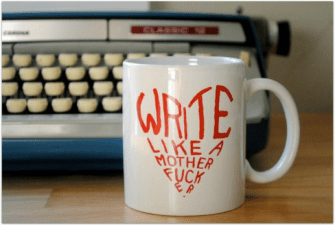
6. Write Like a Motherfucker Coffee Mug–$15

6

Because sometimes they need a reminder that they’re a badass. Available here.

7. Punk Rock Author Coasters Set–$18

7

Jam out to some Sex Pistols while Dickinson, Thoreau, Austen, and Kafka keep side tables safe in style. For each set sold, Out of Print donates a book to a community in need. Grab them here.

8. The 2016 Sundress/SAFTA Calendar–$20

Screen Shot 2015-12-14 at 4.22.16 PM

Get them the 2016 Sundress/SAFTA calendar, this year featuring portraits of gender-swapped work that want to destroy the gender binary! Featuring Chris Petruccelli, Jennie Frost, Rhonda Lott, Grant Howard, Vania Smrkovski, Ben McClendon, Rose Meyers, Katie Hall, Shastina Parahoo, Emily Capettini, Adam Crandall, Emma Walcott, Jeb Herrin, and Luci Brown! Snag one here. 

9. Adagio Tales and Tea Leaves Sampler Set–$19

8

Adagio has plenty of tea samplers for fandoms like Harry Potter, Chronicles of Narnia, even fan fiction. This particular set is for fans of Lord of the Rings. Find it here or browse the entire collection here

10. Paddywax Library Candle Collection–$15/$21

9

No, they don’t smell like the writers themselves, but these soy candles from Paddywax have original mixes like cardamom, absinthe, and sandalwood to give writers a whiff of something inspirational. Available online here.

11. Their Own 2×2 Square in SAFTA’s Poetry Barn–$25

original

Get a 2’x2′ space to have a poem/quote/prose selection of your choice (by yourself or by someone else) printed directly on the barn!

Simply supply us with the piece you’d like to appear, and we will handwrite it for all SAFTA visitors and residents to read and enjoy during our readings, events, and more! Find it here. 

12. Literary Quotes Poster–$24

10

These gorgeous prints by Etsy artist ObviousState are great for the writer who wants something more minimalistic for their home.  Buy them here.

13. “From the Library of” Stamp– $29

11

Help them stake their claim on their library with a custom-made stamp. Find it here.

14. iPad/Tablet Portfolio–$38

12

This portfolio comes with a cute typewriter print, and doubles as both sneaky storage for their tablet or iPad and a notepad to jot down ideas while reading their favorite E-book. Available on Etsy.

15. Secura Automatic Electric Milk Frother and Warmer–$37

13

On a tight writing schedule, they might not be able to pop out to get their favorite latte. Give them the ability to make their favorite drinks at home or in their office.  Get it here.

16. Secura 1.8 Quart Stainless Steel Cordless Electric Water Kettle– $45

14

Alternatively, if they prefer tea, a cordless water kettle is an option. No messy cords, and this kettle has a cool-touch exterior to held avoid burns. Find it here.

17. Library Stamp Sweatshirt–$42

L-1108_Library-Stamp-gray_Womens_LS_1_1024x1024

Remember when, not-so-long-ago, library books were stamped? This fleece sweatshirt from Out of Print will keep any writer cozy and warm while they write. Purchase of this sweatshirt also sends a book to a community in need! Snag one for them (and maybe yourself, too) here.

18. The Poet Tarot and Guidebook from Two Sylvias Press–$48

15

Two Sylvias Press has this awesome set of tarot cards and guidebook with beloved poets on it “to help writers explore nuances of the creative process.” Need we say more? Buy this online here.

19. Subscription to Journal of the Month– $40-$199

JournalStack-00f0e11a47aa6c136696b34ce482b2ad

A subscription to their favorite journal, or even one to Journal-of-the-Month is an amazing gift for anyone. Journal-of-the-Month includes publications like The Missouri Review, Tin House, and more to give them a nice sample from a range of journals. Aside from skipping a trip to the post office, you can also choose a subscription type that suits their needs and your budget. Check out the options available for Journal of the Month subscriptions here.

20. Audible.com Subscription–$15-$250

screen-shot-2015-04-16-at-9-30-29-am

Not everyone has as much time as they would like to sit down and read. For someone always on-the-go, an audible.com subscription is a perfect choice. For $15/month (depending on the type of subscription) they’ll get to choose from hundreds of audio books and stream their book directly onto their phone, tablet, or computer. That way, they can listen during the commute to work, while cooking dinner, or on a business trip! Find out more about audible and its subscription services here.


21. Do something with them not writing-related

Take them to the movies, treat them to a nice dinner or a massage. For most writers, the gift of relaxation is necessary yet hard to find. Knowing that they are getting time to unwind and enjoy other things in life can be one of the greatest gifts to receive.

__

Hunter Parsons is a recent graduate from Kalamazoo College. When she’s not writing, being a plant mom, or advocating for young women’s self esteem, Hunter is baking and glued to Turner Classic Movies.