The Wardrobe’s Best Dressed: Jennifer S. Cheng’s “Invocation: An Essay”

Image

This selection is from Jennifer S. Cheng’s chapbook, “Invocation: An Essay,” pp. 12-13

Image

The Breadth of an Utterance:

  1. In a house crowded with other people, the night ends with her sitting on the floor in the shadow of a chair, eating slowly with a fork. It has to do with not knowing a way of being, of using language, a rhythm of body, which is to say it begins with uncertainty and ends with something darker.
  2. When you are a child you are instructed to speak with a six-inch voice. This is to control the projection of words—a barrier that encloses your sound.
  3. Eve, who was left with nothing to name and so wandered off alone into the moonless forest: wisps of lead-colored moss.
  4. In a pool that is five feet deep, the water covers my head and I tiptoe-drift in the lukewarm encircling me, sun refracting shapes. I open my mouth, exhaling, vibrating, watching my muted sounds float tensely to the surface in little off spring bubbles.

This selection is from Jennifer S. Cheng’s chapbook Invocation: An Essay, available from New Michigan Press. Purchase your copy here!

Jennifer Cheng received her MFA in Nonfiction from the University of Iowa and her BA from Brown University. She is the recipient of a U.S. Fulbright Fellowship, a Kundiman Fellowship, the Academy of American Poets Harold Taylor Award, and most recently the Mid-American Review Fineline Prize. Her writing appears or is forthcoming in Web Conjunctions, the Collagist, Mid-American Review, Ninth Letter, Quarterly West, Seneca Review, and Fifty-Fifty (an anthology of Hong Kong writing). She lives in San Francisco and can be found at jenniferscheng.com.

Meagan Cass is an Assistant Professor of English at the University of Illinois Springfield, where she teaches courses in creative writing, independent publishing, and composition, curates the Shelterbelt reading series, and advises the campus literary journal, the Alchemist Review. Her fiction has appeared in Hayden’s Ferry Review, The Pinch, Hobart Web, PANK, and Puerto del Sol, among other journals. Magic Helicopter Press will publish her first fiction chapbook, Range of Motion, in January 2014. She holds a Ph.D. in English from the University of Louisiana Lafayette and an MFA in fiction from Sarah Lawrence College.

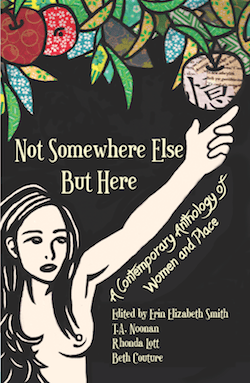
Press Release: Not Somewhere Else But Here

notsomewhereelse

Knoxville, TN — Sundress Publications is pleased to announce the release of Not Somewhere Else But Here: A Contemporary Anthology of Women and Place, edited by Erin Elizabeth Smith, T.A. Noonan, Rhonda Lott and Beth Couture. This book is Sundress’s first anthology and contains poetry, fiction, and non-fiction pieces exclusively featuring contemporary women writers. In this 300+ page eclectic and engaging multi-genre anthology, the reader will find literature that transports them across the entire globe, written by women who have boldly traversed it.

Writers include Marjoie Maddox, Wendy Call, Barbara Crooker, Marthe Reed, Karyna McGlynn, Rosebud Ben-Oni, Dianne Seuss, Sarah Sloat, and many,many more!

“Miniature celebrations of place, the writings in Not Somewhere Else But Here deftly maneuver through imagined spaces and bustling Manhattan streets, the impossible page and the architecture of Japanese homes. Here, place is questioned and subdued: it is the hot gloss of sun on concrete.”

-Lily Hoang, author of The Evolutionary Revolution and Changing

“The writing in Not Somewhere Else But Here is at turns haunting and infused with a deep magic. The work carries the reader from Beirut to Vermont, from Japan into dream worlds, bodies as maps. Landscapes are often treacherous, populated with, “mouths of razor-wild men,” enchanted with, “fists opened to explosions of diatomic stars,” and each woman in this collection navigates those spaces with a deft grace. Step into the worlds they have summoned.

-Margaret Bashaar, Editor of Hyacinth Girl Press

To find out more or to order a copy for sale or review, visit the Sundress Publications website at www.sundresspublications.com.

The Wardrobe’s Best Dressed: Excerpt from Adriana Páramo’s My Mother’s Funeral

EXCERPT FROM ADRIANA PARAMO’S MY MOTHER’S FUNERAL

Cows’ brains. That’s what Mom cooked the day my brother left. Whenever she was in a foul mood, we all paid. She cooked angry food, which is to say, we ate angry food in tense silence. The brains kept slipping off Mom’s fingers as she tried to wash them in the sink. They looked like a conglomerate of cauliflower heads covered by a thin membrane that made them appear wet. Red blood vessels traversed the yellowish matter.

After the veins and the membrane were removed, Mom dropped the brains into boiling water. She added bouillon cubes if she was splurging or plain salt if she wasn’t. The day my brother left, she used salt. As the brains cooked and their surface became tender and malleable, their smell also changed. It went from gamey to homey; it morphed from alien and backwards to something familiar, something that made our bellies twitch.

On the kitchen counter Mom chopped garlic, onions, and tomatoes, although it looked as if she were doing much more than just chopping. She was murdering the white bulbs of the onions and, with them, she was killing something else. She swung the hollow green ends into the garbage like she was trying to fling them out of the kitchen. What a wild chef Mom was that day.

“My biology teacher says that the green end is the most flavorful part of the onion,” my oldest sister Dalila said, looking at the scallions in the can.

Mom shot her a narrow-eyed, watch-it look. “Who’s cooking, me or the biology teacher?”

We knew better than to take the issue any further and watched in silence as Mom sautéed the onions and the tomatoes in reheated pork lard. When the mixture was ready, she jumbled it up with the garlic bits, the cows’ brains, and three eggs. She beat the concoction with fury. The fork’s prongs rose and fell, breaking the gelatinous texture of the brains, the viscosity of the eggs, and in a moment she had created something very similar to scrambled eggs, filled with protein and maybe unsuspected diseases.

“I have a project for my biology class,” my oldest sister said. She was the only one talking. My other three sisters and I knew that Mom was not in a talking mood. We didn’t scrape or clatter our cutlery against the plates. It was a quiet meal.

“I could get an A+ and extra points if I complete the whole thing,” Dalila said. I looked at her and couldn’t help noticing how perfectly shaped her nose was, how much lighter her skin was than mine, how, when she smiled, her teeth shone even and white like marble sculptures.

“About time you bring home good grades,” Mom said. “What is it you have to do?”

“An anatomy project,” my sister said. “We need to assemble a skeleton.”

My mother, who had never been known as squeamish, had no qualms about this. If her daughter needed a skeleton to do well in her class, a skeleton she would get. Or two, as it turned out.

Back then, graves in Colombia were not final resting places. They were a liminal phase of the disposal of human remains. The bodies were buried in graves leased for five years. At the end of the term the remains were disinterred and the surviving relatives given two options: to increase the term of the lease or to rebury the body in perpetuity. In either case the caskets—if still in good form—were reused and the graves leased again. Disturbing the dead used to be a good business. When the bodies went unclaimed, they were placed in plastic bags and thrown into common graves, which were later incinerated or buried for good, depending on the resources of the cemetery—the final touch of social stratification. Yet accidental disinterment sometimes happened. Twenty years later, my grandfather’s grave would be mistaken for somebody else’s whose lease had expired, and his remains would be disinterred. Mom would go to the cemetery in Mariquita to leave flowers on his grave and find the place desecrated. She would spot his remains in a burlap bag among the undertaker’s tools, other burlap bags containing unclaimed bones, and an army of worms creeping out of a skull. She would cry, humiliated and indignant, lamenting that this would not have happened had her family been upper class.

This excerpt appeared in Adriana Páramo’s memoir, My Mother’s Funeral, available from CavanKerry Press!  Purchase yours today!

Adriana Páramo is a Colombian anthropologist winner of the Social Justice and Equality Award in creative nonfiction with her book Looking for Esperanza. Her writing has appeared in Alaska Quarterly Review, The Los Angeles Review, Consequence Magazine, Fourteen Hills, Carolina Quarterly Review, Magnolia Journal, So To Speak, Compass Rose, and Phati’tude, among others. Páramo has volunteered her time as a transcriber forVoice of Witness, a book series which empowers those affected by social injustice.

This week’s Wardrobe Best Dressed was selected Nicole Oquendo. Nicole Oquendo is an Assistant Editor for Sundress Publications, and the Nonfiction Editor of Best of the Net. Her most recently published essays and poetry can be found in DIAGRAM, fillingStation, Storm Cellar, and Truck.

Creative Camping : A Workshop and Retreat in East TN

561306_511868935537941_357416975_n

Join us for our first workshop at our new home, Firefly Farms! At this multi-genre overnight workshop you will get the opportunity not only work with top-tier local writers, including poet Erin Elizabeth Smith, you will also get to explore the new 29-acre location of the weekend workshops!

This workshop will focus on writing nature and will feature instruction on incorporating local flora, fauna, etc. into your work. With instructional workshops on tree identification, foraging, and campfire cookery, you will have the opportunity to learn a number of new woodsy traits to examine in your writing.

All food and drink (including alcohol) is included in the workshop fee, which also includes workshop instruction, camp sites, and printing. Camping gear will also be available for rent for a minimal extra cost.

The overnight workshop fee is $100. Current students receive 20% off with ID. Please RSVP by April 18th to reserve your space. 

2012 Best of the Net Anthology Released

Sundress Publications is pleased to announce the release of the 2012 edition of the Best of the Net anthology! This year’s anthology includes poetry, fiction, and nonfiction published in twenty-four different journals and features work by Eduardo C. Corral, Matt Hart, Saeed Jones, Alix Ohlin, Ocean Vuong, Marcus Wicker, Wendy Xu, and many more!

This year’s judges included poet Marilyn Kallet, fiction-writer John McManus, and memoirist & novelist, Lee Martin.

Marilyn Kallet is the author of 15 books, including Packing Light: New and Selected Poems (Black Widow Press, 2009). Her next book of poems, The Love That Moves Me, was published early in 2013. She has translated Paul Eluard’s Last Love Poems and Surrealist Benjamin PŽret’s The Big Game. In 2005, Kallet was inducted into the East Tennessee Literary Hall of Fame in Poetry. She has won the Tennessee Arts Commission Literary Fellowship in Poetry, and has served as a literary arts advisor to the TAC. Dr. Kallet is Director of the Creative Writing Program at the University of Tennessee, where she is also Professor of English. She also teaches poetry workshops for the Virginia Center for the Creative Arts, in Auvillar, France.

John McManus is the author of the novel Bitter Milk (2005) and the short story collections Born on a Train (2003) and Stop Breakin Down (2000), all published by Picador USA. In 2000 he became the youngest-ever winner of the Whiting Writers’ Award following the publication of Stop Breakin Down. His fiction and non-fiction have also appeared in Ploughshares, Tin House, American Short Fiction, The Oxford American, The Harvard Review, StorySouth, Columbia, Paraphilia, and Night Train, as well as the fiction anthologies Surreal South ’09, Surreal South ’11, and Degrees of Elevation. His writing fellowships and awards include the New Writing Award from the Fellowship of Southern Writers and the James A. Michener fellowship at the University of Texas, where he earned his MFA in 2004. McManus is a professor of creative writing at Old Dominion University in Norfolk, Virginia, and he also teaches in the low-residency MFA program at Goddard College in Vermont. He is contributing editor for Fiddleblack, a literary journal dedicated to creative writing with a strong sense of place.

Lee Martin is the author of the novels, The Bright Forever, a finalist for the 2006 Pulitzer Prize in Fiction; River of Heaven; Quakertown; and Break the Skin. He has also published three memoirs, From Our House, Turning Bones and Such a Life. His first book was the short story collection, The Least You Need To Know. He is the co-editor of Passing the Word: Writers on Their Mentors. His fiction and nonfiction have appeared in such places as Harper’s, Ms., Creative Nonfiction, The Georgia Review, The Kenyon Review, Fourth Genre, River Teeth, The Southern Review, Prairie Schooner, and Glimmer Train. He is the winner of the Mary McCarthy Prize in Short Fiction and fellowships from the National Endowment for the Arts and the Ohio Arts Council. He teaches in the MFA Program at The Ohio State University, where he was the winner of the 2006 Alumni Award for Distinguished Teaching.

You can read the newest edition of the anthology online at http://www.sundresspublications.com/bestof.

Sundress Publications Announces E-Chapbook Competition

Sundress Publications is pleased to announce its second annual chapbook contest for emerging writers. Authors with no more than two full-length books are invited to submit qualifying manuscripts during our reading period from Febuary 15th to April 30th, 2013.

We are looking for poetry, fiction, nonfiction, or any combination thereof. Manuscripts must be between twelve to twenty (12-20) pages in length, with one piece per page. Individual pieces may have been previously published in anthologies, print journals, online journals, etc., but cannot have appeared in any full-length collection, including self-published collections. Only single-author and collaborative dual-author manuscripts will be considered. A unifying element is encouraged but not required. Manuscripts must be primarily in English; translations are not eligible.

The entry fee is $7 per manuscript, though the fee will be waived for entrants who purchase or pre-order any Sundress title. The winner will receive a $200 prize, plus publication as a beautiful full-color PDF available exclusively online. Runners-up will also be considered for publication.

This year’s judge will be Nick McRae. He is the author of The Name Museum (C&R Press), for which he received the De Novo Poetry Prize, and the chapbooks Mountain Redemption (Black Lawrence Press) and Moravia (Folded Word Press). He is also the editor of the anthology Gathered: Contemporary Quaker Poets (Sundress Publications). All are forthcoming in 2013. His work has appeared or will soon appear in Birmingham Poetry Review, Cincinnati Review, Hayden’s Ferry Review, Linebreak, The Southern Review, and elsewhere. In addition to serving as an assistant editor of Sundress Publications, Nick is associate editor for 32 Poems, poetry coordinator for the Best of the Net anthology, and poetry review editor for The Journal. This summer, Nick will join the staff of the Sewanee Writers’ Conference. He lives in Columbus, Ohio.

All manuscripts should include a cover page (with only the title of the manuscript), table of contents, dedication (if applicable), and acknowledgments for previous publications. These pages will not be included in the total page count. Identifying information should not appear in any part of the manuscript. We are dedicated to a fair judging process that emphasizes the quality of the writing, not the résumé of its authors. Authors with a significant relationship to the judge (close friends, relatives, colleagues, past or present students, etc.) are discouraged from entering.

Simultaneous submissions to other presses are acceptable, but please notify Sundress immediately if the manuscript has been accepted elsewhere. Multiple submissions are allowed, but a separate entry fee must accompany each entry. No revisions will be allowed during the contest judging period. Winners will be announced in late spring/early summer 2013.

Visit our website for more information!